
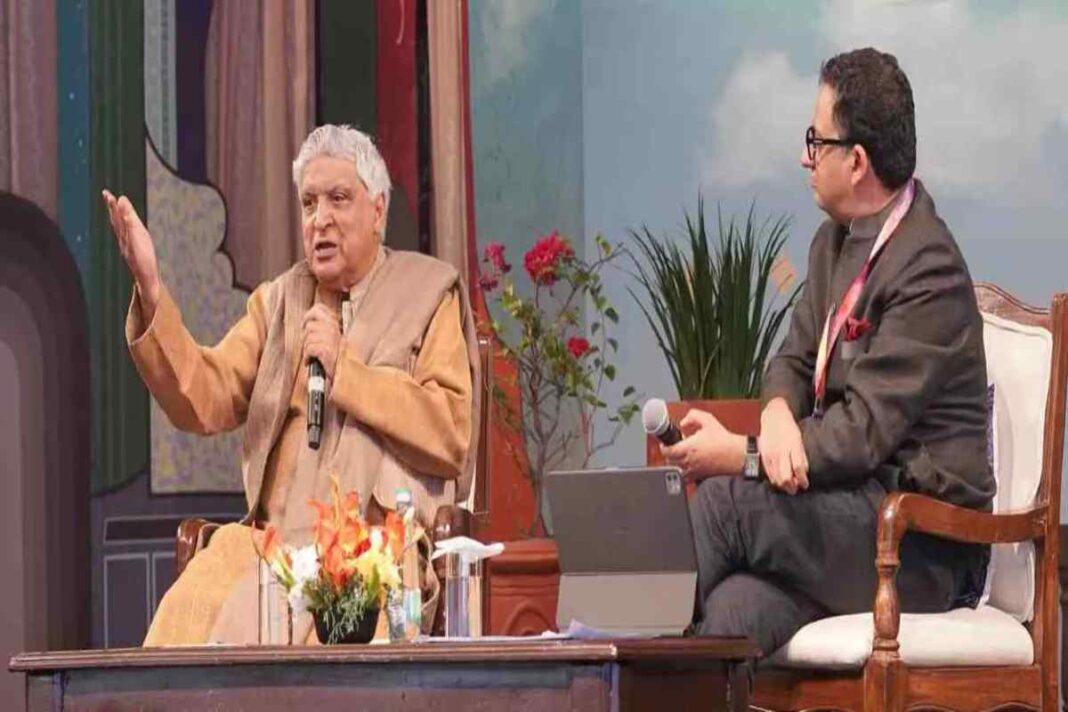

Renowned Urdu litterateur Javed Akhtar addressed a captivated audience during a session on ‘Secularism and Urdu Poetry’ at the Jashn-e-Rekhta festival. Akhtar questioned the persistent inclination of some towards religion despite its widespread misuse, emphasizing the need for secularism.
Secularism in Language:
In his discourse, Akhtar stressed that language should not be tethered to religion. He argued that languages are inherently regional, citing the global spread of English as an example. Drawing parallels between Hindi and Urdu, he highlighted the significant linguistic overlap, with 70 to 80 percent of words being common.
Religion’s Misuse and Persistence:
Akhtar, known for his contributions to Bollywood as a lyricist and scriptwriter, contended that religion remains one of the most misused phenomena globally. Despite this, he observed that people continue to adhere to it. Reflecting on the influence of religion on poetry, he asserted that Urdu poetry commenced with atheism, challenging the conventional narrative.
Urdu as a Secular Language:
Engaging in a conversation, Akhtar described Urdu as the language of secular people, emphasizing its secular genesis. He debunked the misconception that Urdu is associated with religion, stating that it has been unfairly adorned with symbols like a beard and a cap.
The Essence of Urdu:
Akhtar unveiled the essence of Urdu, revealing that its real name is ‘Hindvi,’ signifying the language of India. He explained that ‘Rekhta,’ meaning a hybrid formed by the combination of multiple languages, accurately captures the essence of Urdu.
Philosophical Insight and Linguistic Identity:
Referencing Greek philosopher Plato, Akhtar highlighted the importance of understanding the meanings of words before speaking. Making a critical distinction between language and script, he challenged the notion that languages using the same script should share the same identity, using English, French, and German as examples of languages with distinct identities despite using the Latin script.
Conclusion:
Javed Akhtar’s enlightening discourse at Jashn-e-Rekhta underscored the secular nature of Urdu and the imperative to detach language from religious affiliations. His insights into the historical roots and linguistic essence of Urdu left the audience with a profound understanding of the language’s secular identity.
For a detailed story, please visit: Awaz the voice
Also Read: NTCA and Sankala Foundation’s Artistic Celebration of Tribal-Wildlife Harmony
You can connect with DNN24 on Facebook, Twitter, and Instagram and subscribe to our YouTube channel.