
Thursday, January 15, 2026
10.1 C
Delhi

The Sacred Pause: Lord Jagannath’s Rath Yatra and the Mazar of Salabega 

Every year, during the Ashadha month (June-July), the world-famous Rath Yatra of Lord Jagannath takes place in Puri, Odisha. This grand festival, attracting millions of devotees from across the globe, celebrates the journey of Lord Jagannath, his elder brother Balabhadra, and sister Subhadra to their aunt’s house. However, what makes this journey uniquely fascinating is a brief halt at a mazar (mausoleum) along the Grand Road, honoring a devout Muslim poet named Salabega. This story beautifully encapsulates the essence of faith transcending religious boundaries. 

The Grand Rath Yatra: A Journey of the Divine Trio 

The Rath Yatra begins on the second day of the bright fortnight of Ashadha. Three grand chariots are prepared, one each for Lord Jagannath, Balabhadra, and Subhadra. These chariots are pulled by thousands of devotees, creating a vibrant spectacle of devotion and excitement. 

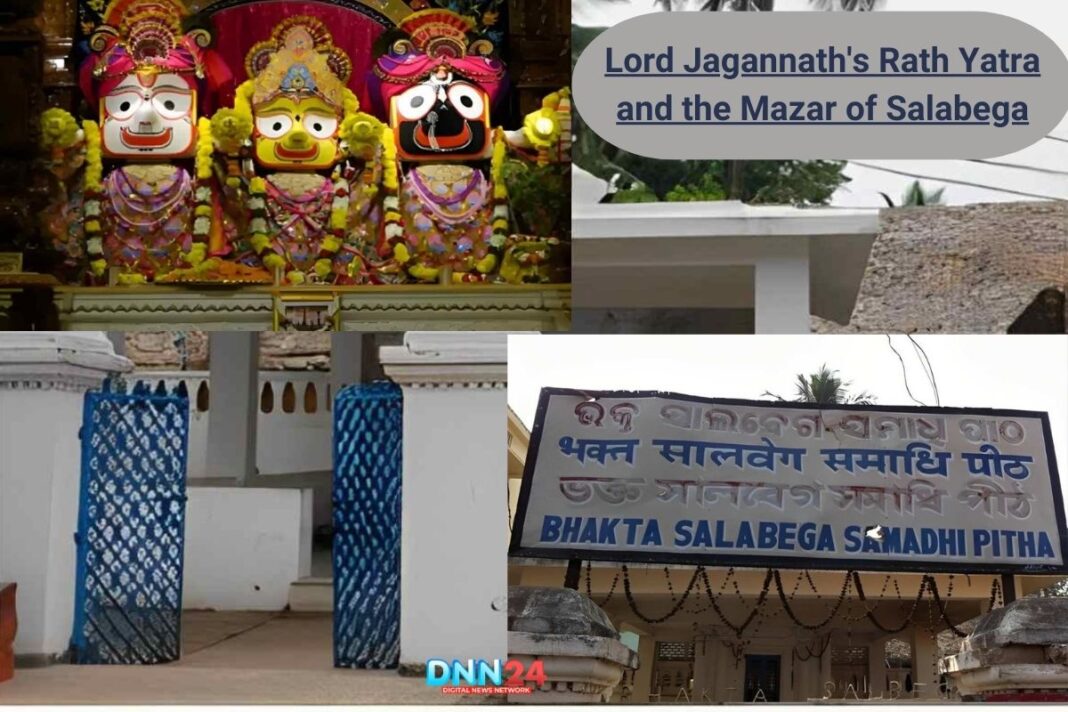
The Grand Rath Yatra (Photos- internet)

According to Hindu scriptures, the Rath Yatra represents Lord Jagannath’s visit to his aunt’s house, accompanied by his siblings. The chariots are named Nandighosa (Jagannath’s chariot), Taladhwaja (Balabhadra’s chariot), and Darpadalan (Subhadra’s chariot), each adorned with distinct colors and motifs. As the chariots proceed through the streets of Puri, they symbolize the gods’ journey to the Gundicha Temple, where they stay for seven days before returning to the Jagannath Temple. 

The Pause at the Mazar: A Divine Intervention 

A unique and touching tradition during the Rath Yatra is the brief pause at the mazar of Salabega, located about 200 meters along the Grand Road. This pause is not just a ritual but a testament to the deep bond between Lord Jagannath and his devotee, Salabega. 

Mazar of Salabega (Photos- Internet)

Salabega was the son of a Mughal subedar and a Hindu woman. Despite his mixed heritage, Salabega grew up with an unwavering devotion to Lord Jagannath. Due to his Muslim background, he was not allowed to enter the Jagannath Temple. However, his devotion found expression through numerous bhajans and poems dedicated to the Lord. These devotional songs still resonate in the prayers and rituals of Jagannath’s worship. 

The Legend of Salabega: A Devotee’s Unyielding Faith 

The legend goes that once, while returning to Puri to witness the Rath Yatra, Salabega fell gravely ill. Unable to move, he prayed fervently to Lord Jagannath for a glimpse of the divine. When the Rath Yatra commenced, something miraculous happened. Lord Jagannath’s chariot stopped in front of Salabega’s hut and refused to move further. 

Devotees and priests tried everything to move the chariot, but it stood still. It was only after Salabega had completed his prayers and paid his respects that the chariot resumed its journey. This divine act was seen as Lord Jagannath’s acknowledgment of Salabega’s unwavering faith and devotion. 

Continuing the Tradition: Honoring Salabega’s Mazar 

To this day, the tradition of halting the Rath Yatra at Salabega’s mazar continues. The chariot stops, and prayers are offered, honoring the memory and devotion of Salabega. This act is a profound reminder of the inclusive nature of faith and devotion, transcending all religious and cultural barriers. 

Mazar of Salabega (Photos- Internet)

This tradition also highlights the harmonious coexistence of different faiths in India. It is a beautiful example of how spirituality and devotion can unite people, regardless of their backgrounds. The story of Salabega and Lord Jagannath’s bond is celebrated through songs, stories, and the continued reverence at the mazar, making it an integral part of the Rath Yatra. 

Also Read: Azizan Bai: The Courtesan-Turned-Warrior Who Fought for India’s Freedom

You can connect with DNN24 on FacebookTwitter, and Instagram and subscribe to our YouTube channel.

LEAVE A REPLY

Please enter your comment!
Please enter your name here

Hot this week

Pranshu Chatur Lal: The Home Where Music Breathes, Today’s Custodian of Pandit Chatur Lal’s Legacy

Pranshu Chatur Lal has performed in front of Prime Minister Narendra Modi and the President of Sri Lanka. He has also performed with renowned South Indian flutist Vijayagopal, Anup Jalota, Rajan-Sajan, and Hari Prasad Chaurasia.

Usman Parvaiz: The Story of a Specially-Abled Player Who Won Silver at the 18th Floorball Championship

Nine-year-old Usman Parvaiz from Pulwama, who cannot hear or speak, is rewriting the meaning of determination. Winning a silver medal at the National Floorball Championship, he proves that courage, focus, and passion can turn silence into strength.

Walls that speak: Preserving Uttarakhand’s Folk Art Through Murals

Colorful murals across Almora are turning public walls into living galleries, celebrating Uttarakhand’s rich folk art, traditions, and hill life. This creative initiative blends culture with tourism, offering locals and visitors a vibrant glimpse into the region’s heritage.

No land, Only Courage: Jammu & Kashmir’s Aasiya Turned Her Rooftop Into A Farming Field

Despite many challenges, social remarks, and an atmosphere of...

Countless Tablas, One Bond– The Journey Of Zakir Hussain & His Tabla Maker Haridas Ramchandra Vhatkar

From a Miraj workshop to the world’s grand stages, Haridas Ramchandra Vhatkar shaped rhythm with patience and devotion. A third-generation tabla maker, his hands crafted the sound trusted by legends- especially Ustad Zakir Hussain- proving that true legacy is built quietly.

Topics

Pranshu Chatur Lal: The Home Where Music Breathes, Today’s Custodian of Pandit Chatur Lal’s Legacy

Pranshu Chatur Lal has performed in front of Prime Minister Narendra Modi and the President of Sri Lanka. He has also performed with renowned South Indian flutist Vijayagopal, Anup Jalota, Rajan-Sajan, and Hari Prasad Chaurasia.

Usman Parvaiz: The Story of a Specially-Abled Player Who Won Silver at the 18th Floorball Championship

Nine-year-old Usman Parvaiz from Pulwama, who cannot hear or speak, is rewriting the meaning of determination. Winning a silver medal at the National Floorball Championship, he proves that courage, focus, and passion can turn silence into strength.

Walls that speak: Preserving Uttarakhand’s Folk Art Through Murals

Colorful murals across Almora are turning public walls into living galleries, celebrating Uttarakhand’s rich folk art, traditions, and hill life. This creative initiative blends culture with tourism, offering locals and visitors a vibrant glimpse into the region’s heritage.

No land, Only Courage: Jammu & Kashmir’s Aasiya Turned Her Rooftop Into A Farming Field

Despite many challenges, social remarks, and an atmosphere of...

Countless Tablas, One Bond– The Journey Of Zakir Hussain & His Tabla Maker Haridas Ramchandra Vhatkar

From a Miraj workshop to the world’s grand stages, Haridas Ramchandra Vhatkar shaped rhythm with patience and devotion. A third-generation tabla maker, his hands crafted the sound trusted by legends- especially Ustad Zakir Hussain- proving that true legacy is built quietly.

Kashmir’s Floral Spectacle: The 2026 Tulip Show To Bloom With 1.8 Million Vibrant Flowers

As winter arrives, Kashmir’s Tulip Garden comes alive with preparations for the grand 2026 Tulip Show. A record 1.8 million bulbs, including fresh imports from Holland, are being planted, promising a breathtaking display of vibrant colors and boosting spring tourism in the Valley.

How Pobitora Women Are Redefining Assam’s Handloom With Wildlife-Inspired Designs?

Near Assam’s Pobitora Wildlife Sanctuary, women from Auguri village are turning threads into stories of nature. Their eco-friendly handwoven gamosas and stoles, inspired by the one-horned rhino, are winning tourists’ hearts while weaving livelihoods and conservation together.

Udaygiri Caves: Where Ancient Kings Carved Gods Into Mountains

Stand before a hill that holds secrets from 1,600...

Related Articles