

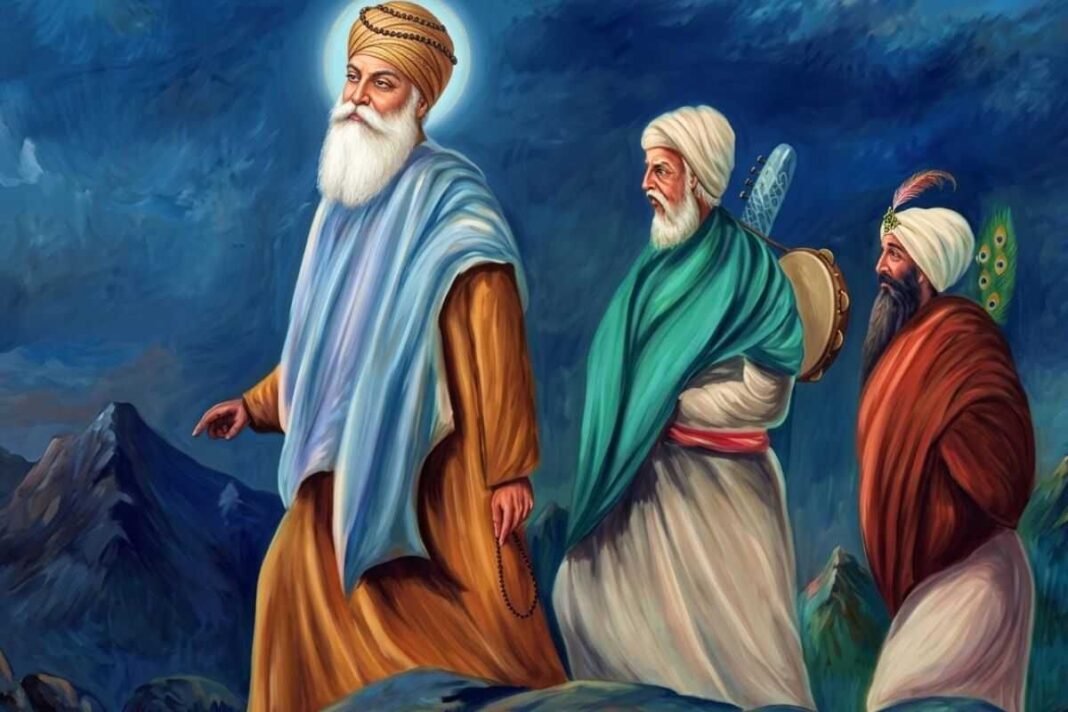

During one of his journeys, Guru Nanak reached Pakpattan Sharif, an ancient town in Punjab known as an important spiritual centre of the Chishti Sufi tradition. The shrine of the 13th-century saint Baba Fariduddin Ganjshakar still stands there.
Constantly searching for knowledge, Guru Nanak met a learned saint named Sheikh Farid. Sheikh Farid believed that salvation required severe austerity and withdrawal from worldly life. Guru Nanak engaged him in dialogue and expressed a very different idea: everything one seeks exists within; wandering outside in search of it only creates illusion.
The episode captures a fascinating paradox in Guru Nanak’s life. He travelled thousands of kilometres across vast regions, yet taught that one did not need to abandon home to discover God.
Accounts of Guru Nanak’s life and teachings survive largely through the Janamsakhis. One of these, the Miharban Janamsakhi, interprets his teaching to mean that when the mind is pure and focused, God can be realised even while living at home.
A World in Political Transition
Guru Nanak was born in 1469 at Talwandi, today’s Nankana Sahib in Pakistan. The Indian subcontinent of his time was politically fragmented. The Delhi Sultanate did not exercise uniform control everywhere, while regional kingdoms, local chiefs and sultanates held considerable authority.
Bahlul Lodi ruled Delhi when Nanak was born. Guru Nanak subsequently witnessed the reigns of Sikandar Lodi and Ibrahim Lodi. In 1526, Babur defeated Ibrahim Lodi at Panipat and established Mughal power. Guru Nanak therefore lived through a remarkable transition from Afghan Lodi rule to the beginning of Mughal authority.
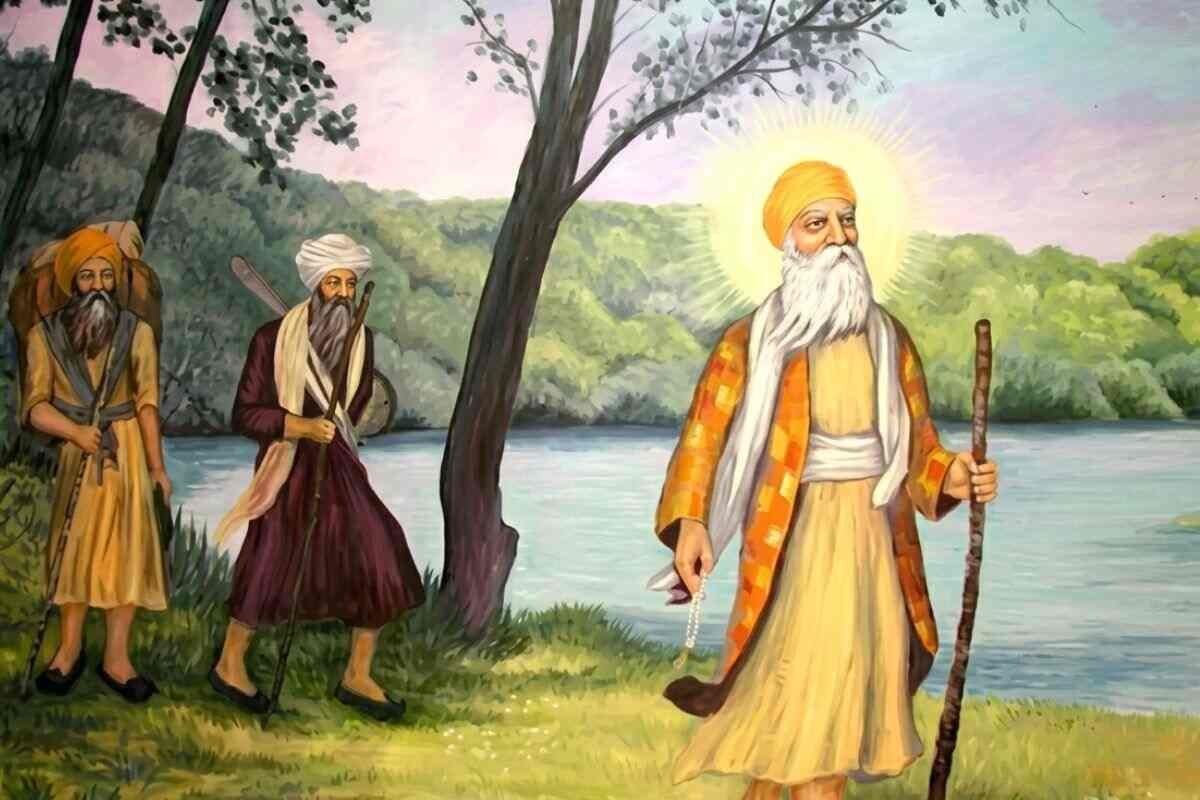
But political change was only one part of the world that shaped him. From childhood, Nanak was introspective. He could remain silent for days and often wandered through forests, closely observing nature: the arrival of spring, buzzing bees and butterflies, the scorching summer sun and the rains that brought dry earth back to life.
These observations gradually produced deeper questions. Who created this enormous universe? Who sustains it? And could ritual alone, whether Hindu or Muslim, really lead a person to the Creator?
Sultanpur Lodhi and Mardana
Around sixteen, Nanak moved to Sultanpur Lodhi, where he worked for about fourteen or fifteen years at the grain store associated with Daulat Khan, a local representative of the Lodi administration. During these years, he married and had two sons.
With him was Mardana, a Muslim companion who would eventually become his closest fellow traveller. The Janamsakhis describe Mardana as belonging to the Mirasi musician community. He played the rabab while accompanying Guru Nanak’s hymns. Nanak developed a reputation for remarkable honesty. He refused bribes and avoided the corrupt practices associated with his predecessors.
Yet his ordinary working life increasingly troubled him. One story in the Miharban Janamsakhi describes Nanak working late into the night over account books. Suddenly, he questioned why calculations were consuming his life while he neglected the larger purpose of understanding his Creator.
If he was going to remain awake beside a lamp at night, he felt, it should be for something truly meaningful. His spiritual concerns gradually expanded into questions about society. He recognised caste discrimination as a profound injustice, but he was equally disturbed by hostility and division created in religion’s name.
Sometime between 1499 and 1501, according to accounts cited in the source text, Guru Nanak decided to travel widely to understand the world, religious practices and the contradictions surrounding them. Mardana accompanied him. Thus began the extraordinary journeys remembered in Sikh tradition as the Udasis.
Journeys Not to Conquer, But to Understand
The Udasis took Guru Nanak among pilgrims, ordinary villagers, scholars, pandits, Sufis, ascetics and religious institutions.
A beautiful story associated with his first Udasi describes Guru Nanak and Mardana seeing a flock of swans flying overhead. Nanak was so fascinated that he ran towards them. When the birds descended into a field, he carefully observed their long necks, bright eyes and silver-white feathers.
He wondered why such beautiful creatures travelled enormous distances between Khurasan and Hindustan and whether they ever looked towards their Creator. He blessed the birds and continued walking. The story captures something essential about the Udasis: Guru Nanak had not set out to conquer the world. He had set out to observe and understand it.
Scholars differ over the precise chronology and number of these journeys. According to the account cited in the article, four principal Udasis are generally recognised: eastward from 1500–1506, southward from 1506–1513, northward from 1514–1518 and westward from 1519–1521. Some scholars additionally describe journeys within Punjab around 1523–24 as a fifth Udasi.
Because Guru Nanak left no personal travelogue, later documentation may have accumulated additional stories and characters. The first and longest eastward journey is associated with places including Delhi, Kurukshetra, Haridwar, Mathura-Vrindavan, Ayodhya, Kashi, Gaya, Patna, Bengal, Kamrup and Jagannath Puri.
The Famous Lesson at Haridwar
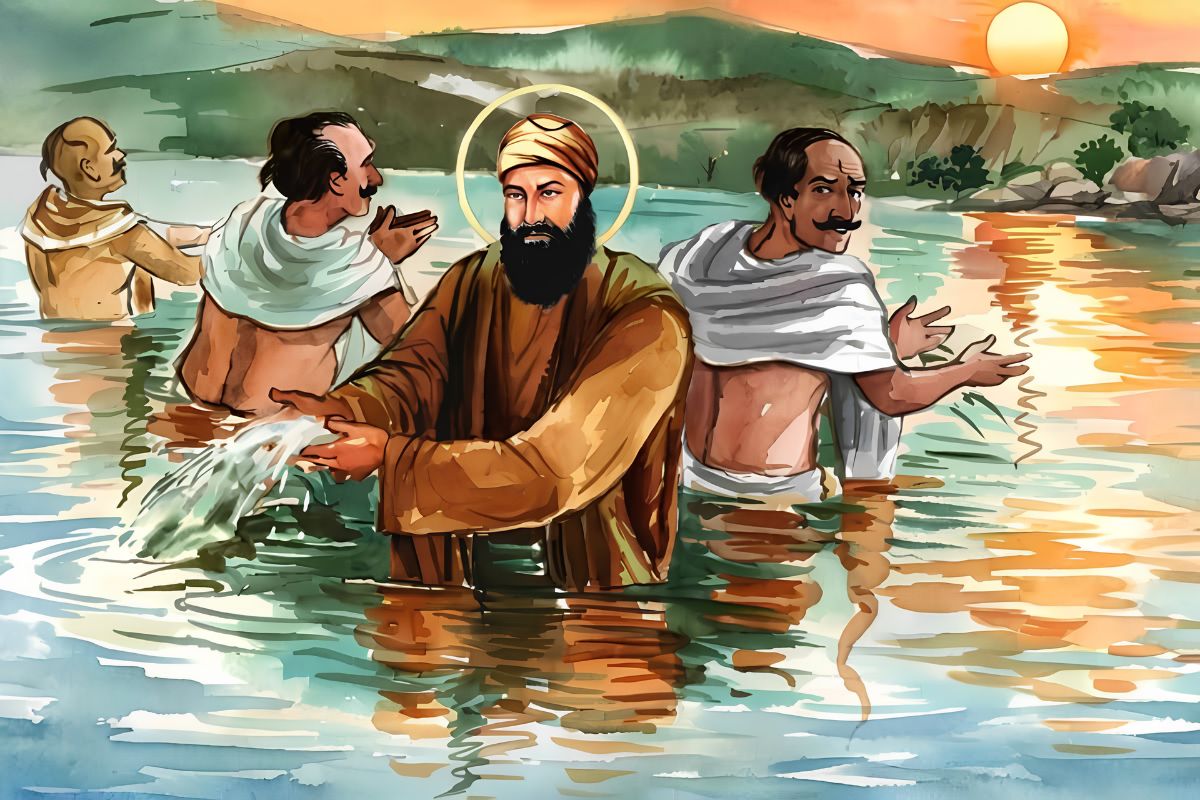
One of the most memorable episodes took place at Haridwar. During a Baisakhi gathering, Guru Nanak saw pilgrims standing in the Ganga, facing east and throwing water towards the sun. He entered the river but began throwing water westward.
Confused pilgrims asked why. They explained that their water was being offered to deceased ancestors living unimaginably far away in heaven. Guru Nanak replied that his own fields were near Lahore and needed water, so he was sending water towards them.
The pilgrims laughed. How could water thrown from Haridwar possibly reach fields hundreds of kilometres away?
Guru Nanak turned their reasoning back on them: if their water could reach ancestors millions of miles away, why couldn’t his reach Lahore?
The story was more than a witty challenge to ritual.
It illustrated a principle that ran throughout Guru Nanak’s spiritual journey: tradition must withstand reason and have meaning.
From Haridwar, Guru Nanak and Mardana travelled towards Prayag and then Banaras, one of the great centres of Hindu learning. Accounts describe encounters with pandits who challenged his unconventional beliefs and tested his knowledge of sacred texts.
Whether every detail of these stories can be historically established is less important to the article’s central argument than the philosophy they represent. Guru Nanak was not rejecting tradition simply because it was old. He was questioning blind tradition.
For him, religion could not be measured merely by how often someone repeated a mantra, performed a ritual or followed an inherited custom. Its real value lay in what those practices changed within a human being.
That idea became one of the defining threads running through his Udasis. Guru Nanak travelled immense distances searching, observing, questioning and conversing with people of different faiths and traditions. Yet the destination of these journeys was never simply geographical.
Before asking humanity to search for God somewhere far away, his journey asked people to examine themselves and to rediscover the meaning of being human.
Read: IFFJK 2026 Brings the best of World Cinema to Kashmir
You can connect with DNN24 on Facebook, Twitter, and Instagram and subscribe to our YouTube channel.