

Kashmir did not develop its artistic identity in isolation. For centuries, Persian ideas travelled into the Valley through Central Asia and the wider Persianate world. Traders, poets, scholars, architects, and craftspeople brought new skills, decorative forms, and ways of seeing beauty. They met a society already shaped by the Himalayas, Buddhist and Hindu traditions, and a long history of craftsmanship.
What followed was neither an import nor a weak copy of Persian art. It became something Kashmiri. It appeared in decorated papier-mâché boxes, woven carpets, embroidered shawls, terraced gardens, painted manuscripts, calligraphy, and Srinagar’s wooden architecture. Persian art did not replace Kashmir’s older culture. It settled into it, changed with it, and became part of the Valley’s sense of itself.
An Ancient Encounter
Persian influence in Kashmir began long before the region became famous for its Islamic-era crafts. Early Iranian artistic currents reached Kashmir indirectly through Hellenistic and Kushan culture. A second-century statue fragment of a Kushan ruler, carved in the Parthian style and found at Huvishkapura near modern Ushkar, is preserved in Srinagar’s Sri Pratap Singh Museum.
After the Parthian empire declined in 227 CE, artisans and stonemasons appear to have moved from its eastern frontiers towards Kashmir and northwest India. Their presence can be traced at Buddhist sites such as Harwan, where figures in Parthian dress and style survive beside Indian motifs. By the fourth century, Indian cultural forms had again become dominant in much of Kashmiri art.
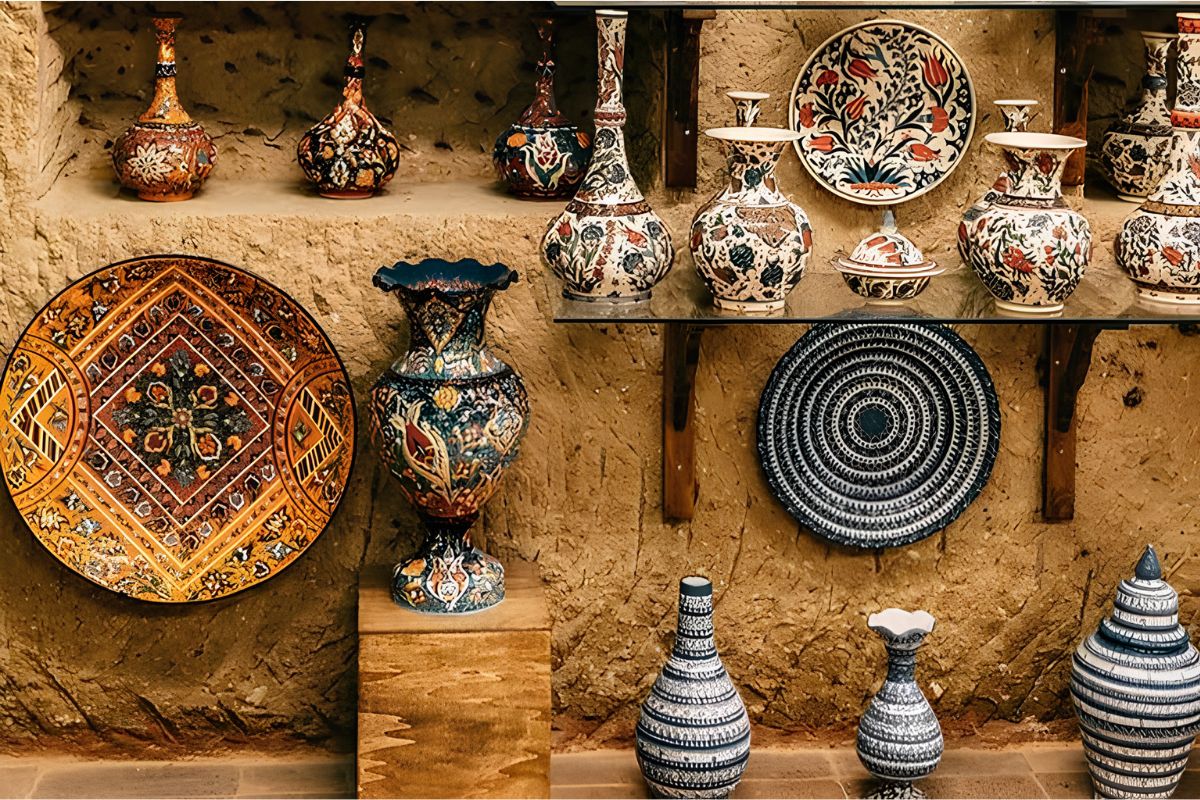
This early contact matters because it shows that Kashmir was never completely cut off by its mountains. The Valley lay along routes connecting the Indian subcontinent with Central Asia, Persia and the Silk Road. It received goods, artistic styles, religious ideas, technologies, and craftsmanship.
The mountains shaped Kashmir, yet they did not isolate it. They made it a meeting place.
A New Cultural Age
The most decisive Persian influence began in the fourteenth century. Muslim rule gradually took root in the Valley, bringing Sufi teachers, scholars, administrators, and artisans. Persian became the language of the court, government, scholarship and poetry. Kashmir welcomed Persianate artistic forms.
Sultan Zain ul Abidin, who ruled from 1420 to 1470, became one of the greatest supporters of the arts in Kashmiri history. He is remembered as Budshah, the Great King. Tradition associates him with bringing skills from Samarkand, including papermaking and papier-mâché. He also encouraged crafts that local people could learn, practise and pass from one generation to the next.
This was important. Persian art did not remain locked inside royal courts. It entered workshops, homes, shrines and markets. Kashmiri artisans adapted imported techniques to local materials, tastes, and needs. The Valley had a cool climate, plentiful water, timber architecture and communities of skilled makers. These conditions gave Persian forms a new life.
Papier Mache Becomes Kashmiri
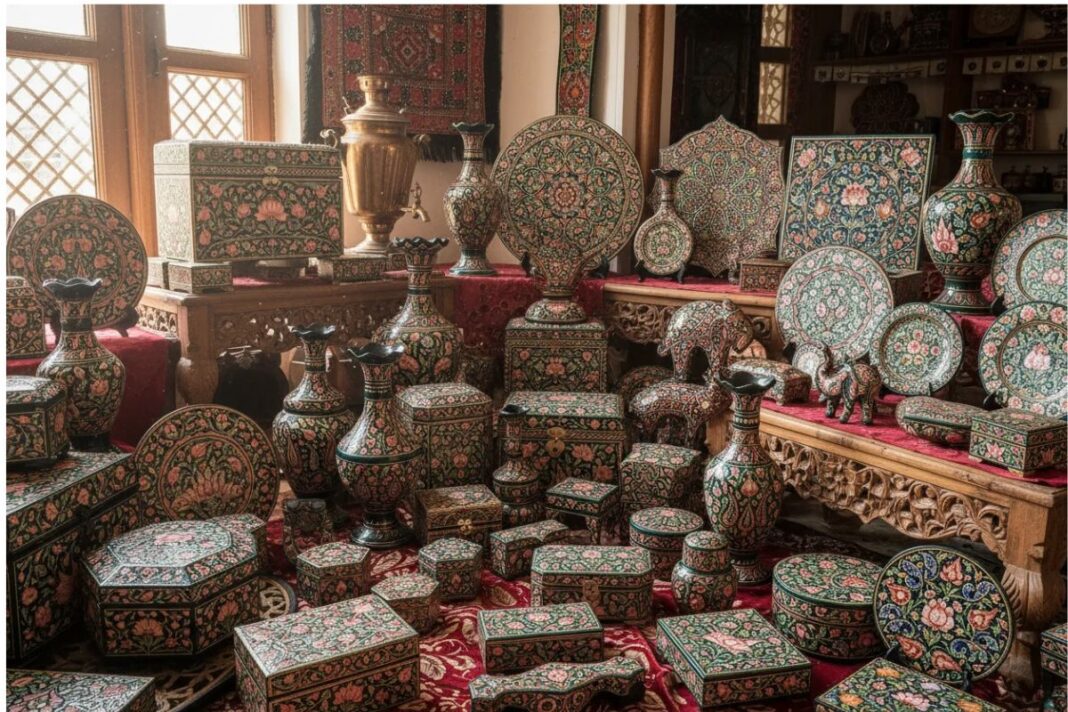
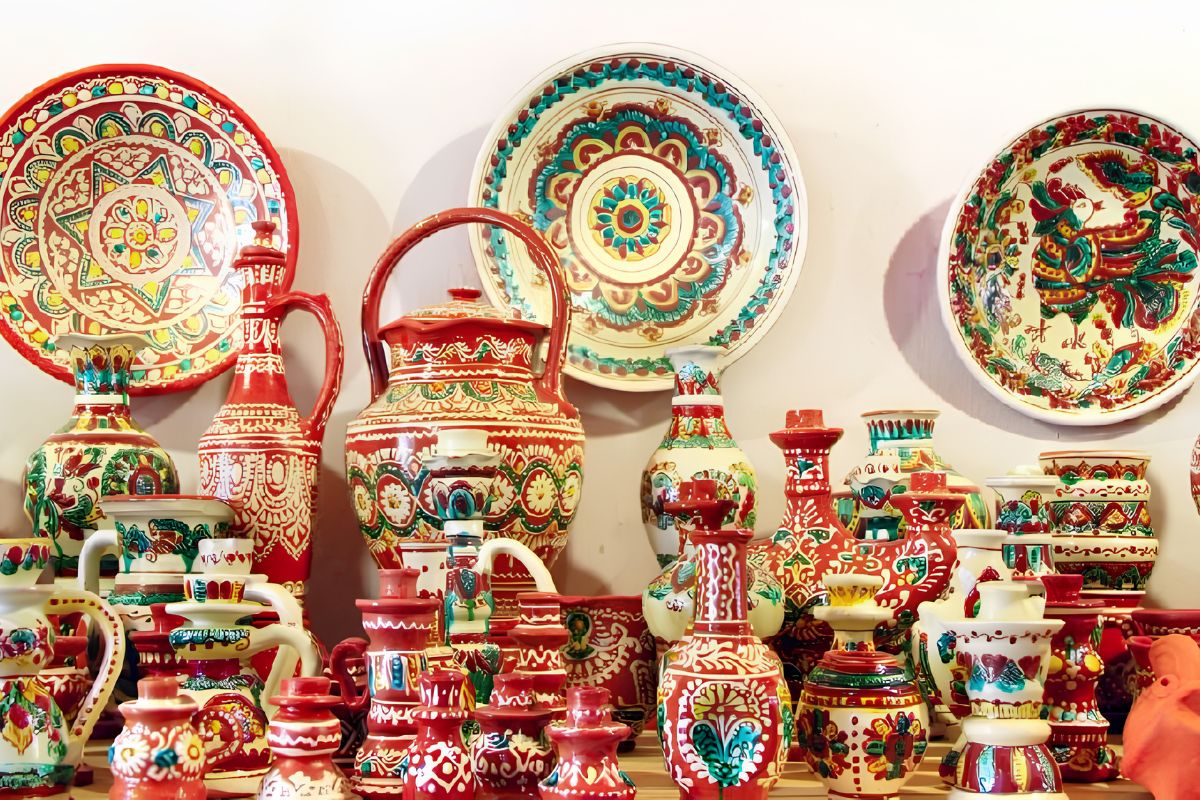
Few crafts show this transformation more clearly than Kashmiri papier-mâché. Traditionally known as kar i qalamdani, or pen case work, it began with decorated boxes for pens and inkpots. Such objects naturally belonged to Persian courtly and literary culture, where writing, poetry, and calligraphy held high status.
Historical accounts give two related explanations for its arrival. One tradition links the craft’s spread to Mir Sayyid Ali Hamadani, the Persian Sufi saint known in Kashmir as Shah i Hamadan. He is said to have arrived with a large following, including skilled craftspeople. Another account credits Sultan Zain ul Abidin, who encountered Central Asian techniques during his connection with Samarkand.
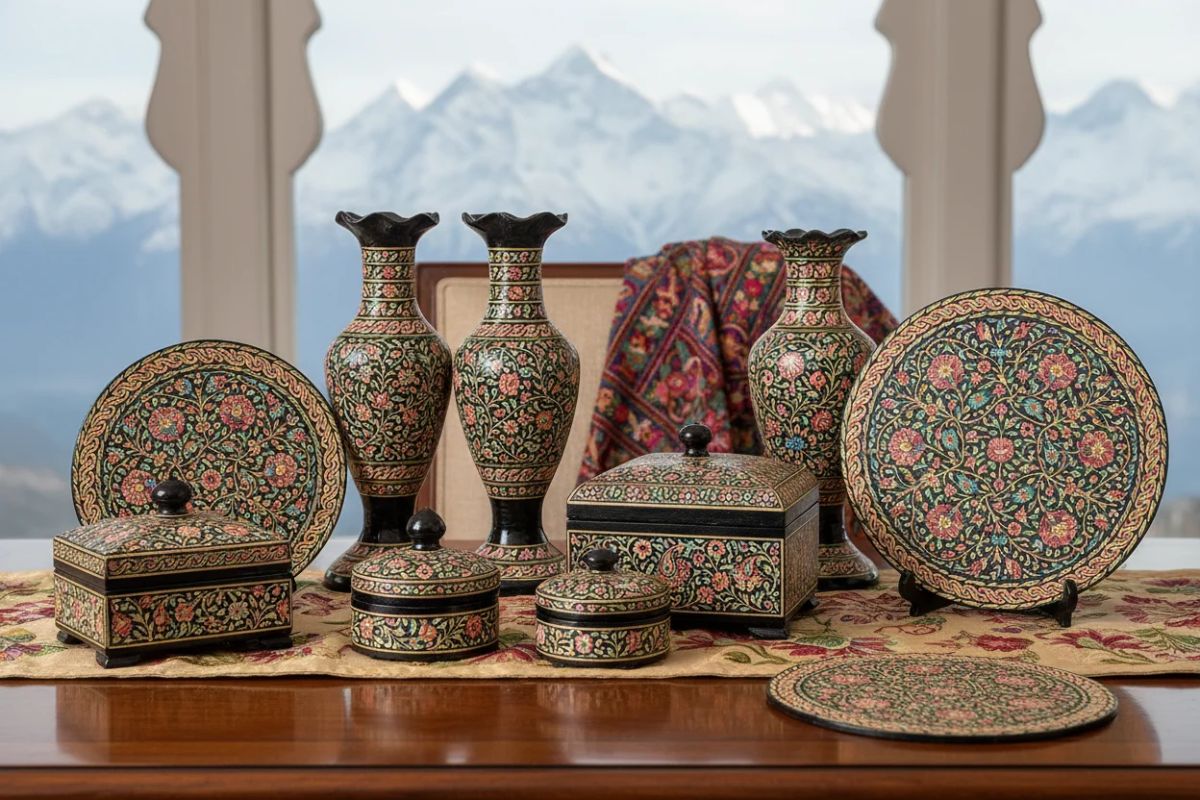
Scholars have not settled every detail of these competing stories. Yet both point to the same larger truth. Kashmir received Persian and Central Asian craft knowledge, then made it its own.
Kashmiri artisans changed the technique in remarkable ways. They moulded paper pulp into boxes, vases, trays and ornaments. They painted these objects with flowers, vines, birds and geometric borders. Many pieces carried Arabic calligraphy or Persian verse. Their colours and designs often recalled Kashmiri shawls and Mughal floral patterns.
A craft that began elsewhere became a source of livelihood, family inheritance and cultural pride. Even today, many artisans regard papier-mâché as more than decoration. It is a living reminder of Kashmir’s long connection with the Persian world.
Carpets, Shawls and Woven Gardens
Persian influence also reshaped Kashmir’s textile arts. The Mughals introduced carpet weaving with Persian knots and patterns. Kashmir became one of India’s leading centres of carpet production. Persianate designs appeared in Kashmiri carpets: medallions, scrolling vines, cypress trees and layouts inspired by formal gardens.
Yet the carpets were not simply Persian carpets made in Kashmir. Local weavers gave them a distinctive density, colour and richness. They adapted Persian designs to suit Kashmiri homes, materials, and taste.
The Kashmir shawl tells an equally striking story. Its wool came from a special Himalayan goat, but many of its Mughal-era patterns resembled traditional Islamic and Iranian designs. By the nineteenth century, Europeans admired Kashmiri shawls. In Iran, they carried deep social meaning. They appeared in elite clothing, ceremonial settings and robes of honour.
These textiles show that cultural exchange moved in more than one direction. Kashmir received Persian design traditions. In return, its shawls became objects of admiration and status far beyond the Valley, including in Iran itself.
Gardens, Mosques and the Persian Eye
Persian influence may be most visible in Kashmir’s gardens and sacred architecture. Mughal emperors brought the charbagh, the Persian four-part garden, to the Valley. Akbar established gardens in Srinagar. Jahangir created Shalimar Bagh beside Dal Lake in 1619 and 1620. He also developed the garden at Verinag, near the Jhelum’s source.
These gardens used water channels, terraces, pavilions and plane trees to create ordered visions of paradise in a mountain setting. The Persian idea of the garden was formal and symbolic. Kashmir gave it lakes, snow peaks, flowing streams and a landscape of extraordinary natural beauty.
Kashmiri architecture adapted Persian and Central Asian forms rather than copying them without change. Srinagar’s Jamia Masjid reflects an Iranian and Central Asian four-ayvan plan, with grand arched entrances. At the same time, its timber columns and pitched roof belong firmly to Kashmir’s Himalayan building tradition.
The result is a building that feels both Persianate and deeply Kashmiri. Stone, brick and arches carried Persian ideas. Deodar wood, sloping roofs, and local craftsmanship helped those ideas survive the Valley’s climate. This architectural blend is one of Kashmir’s great achievements.
A Language of Poetry and Memory
Persian was more than an artistic influence. For centuries, it was Kashmir’s language of learning and power. It served as the court language from the fourteenth century and shaped Kashmiri vocabulary, literature and religious thought.
Poets such as Gani Kashmiri wrote in Persian and earned recognition far beyond the Valley. Srinagar’s Mazar e Shouara, the cemetery of poets, preserves the memory of Persian-speaking scholars and poets who made Kashmir their home. Their graves remind visitors that the Valley was once part of a much larger world of Persian learning.
Persian’s formal dominance ended in 1889, when the Dogra administration replaced it with Urdu as the official language. Its cultural presence did not disappear. It remained in poetry, religious practice, craft motifs, place names and the rhythms of Kashmiri speech.
A Living Heritage
The story of Persian art in Kashmir is a story of creative absorption. Persian artisans brought techniques. Kashmiri makers gave them local meaning. Persian gardens inspired Mughal landscapes. Kashmir’s mountains and lakes gave those landscapes a new setting. Persian calligraphy and ornament decorated objects Kashmiri hands made for Kashmiri homes.
That is why Persian art feels less like something that merely came to Kashmir and more like something that took root there. In a painted papier-mâché box, a woven carpet, a shawl border, or the wooden arches of Srinagar’s Jamia Masjid, one sees a conversation between civilisations.
That conversation continues. It lives in workshops, family skills, old buildings, and the Valley’s everyday beauty. Persian art found a home in Kashmir, and Kashmir gave it a character that could belong nowhere else.
Also Read: India Built Underground Palaces of Water Long Before Modern Water Management
You can connect with DNN24 on Facebook, Twitter, and Instagram and subscribe to our YouTube channel.