
Every September, in the misty valleys of Arunachal Pradesh, a village stops being just a village. Houses fill with the smell of fermenting rice, bamboo altars go up in front of doorways, and a single older man stands in the middle of a circle of women, shaking a rattle made of iron discs. For five days the Adi people put their whole way of life on display, though they would never describe it that way. This is Solung, and it may be the most honest festival in the eastern Himalayas.
A Festival That Follows the Fields
The Adi are among the largest indigenous communities in Arunachal Pradesh. They live along the Siang River basin, across the East Siang, West Siang, Upper Siang and Lower Siang districts. Solung is their most important festival. The name itself points to farming. “So” or “E” refers to the mithun, the semi-domesticated bovine that sits at the centre of Adi wealth and ritual, and “lung” means a herd or group. Put together, the word speaks of healthy animals and fertile land.
The festival is held in early September, when sowing and transplanting of paddy are finished. The moon fixes many festivals in India. The fields fix Solung. When the work is done, the village stops, gives thanks, and asks for a good harvest. In 2026, it ran from September 1 to 5, and villages across the Siang belt reported strong turnout.
Five Days, Five Kinds of Work
Each day has its own task, and together they read like a plan for how a community should look after itself.
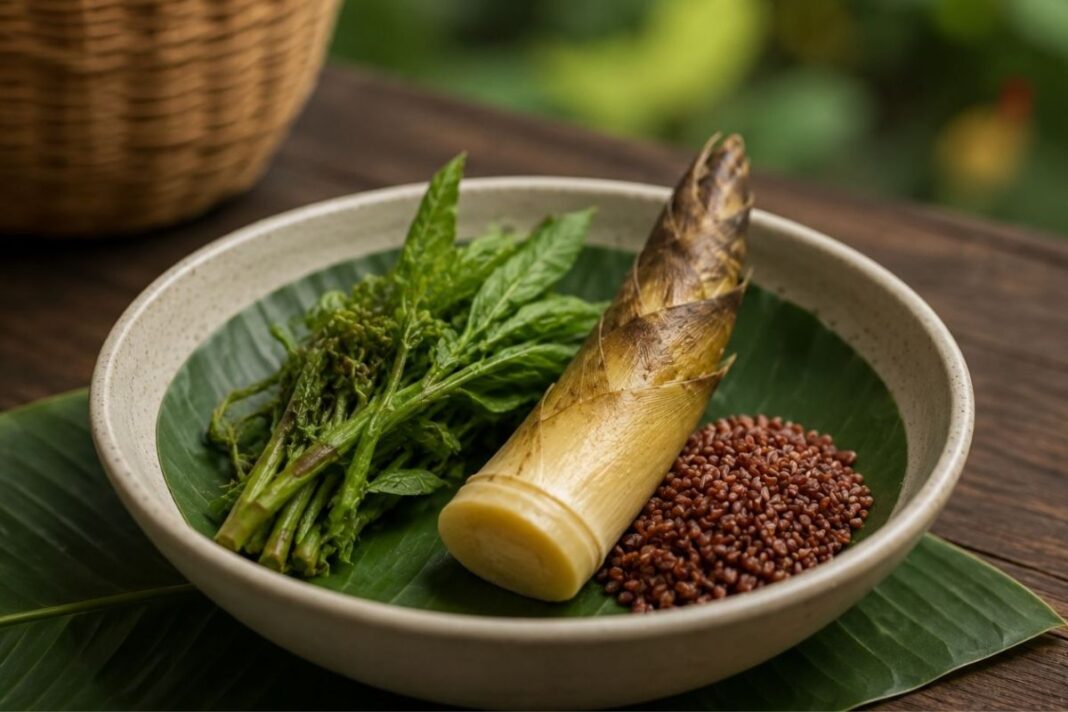
The first day is Solung Gidi Dogin. Families clean their homes, weave fresh bamboo altars called Yekar Pale for the harvest deities, and prepare apong, the local rice beer, along with other food. No household stays outside the effort. Everyone has a job before the first prayer.
The second day, Doreph Long, is the day of sacrifice. Mithuns and pigs are offered to Dadi Bote, the god of domestic animals, and to other deities, so that livestock stay healthy and free of disease. The Adi hold that human prosperity rises and falls with the wellbeing of animals and land, and the offering is a way of saying so out loud.
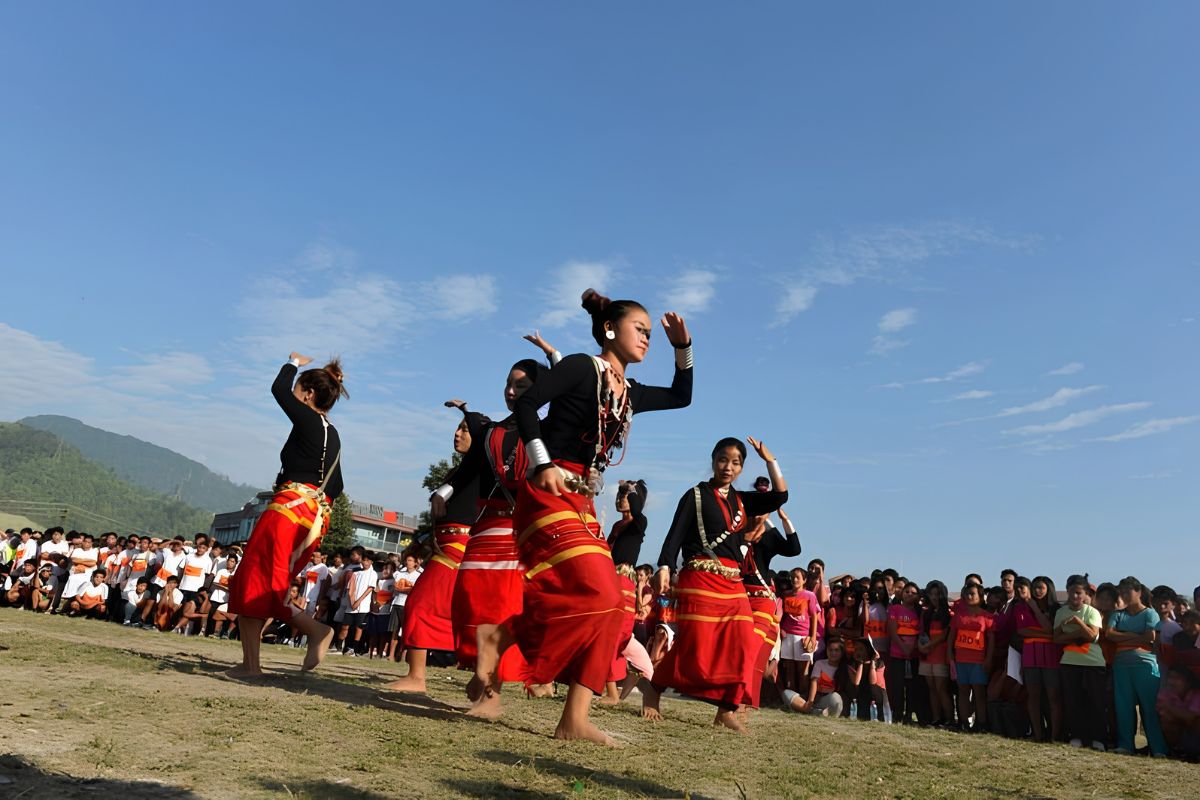
The third day, Binnyat, is the festival’s spiritual centre. Prayers go to Kine Nane, the goddess of crops; Doying Bote, the god of wisdom and heaven; and Gumin Soyin, who guards the household. Elders recite the Solung Etor, an oral epic that tells of the Adi’s origin, their long migration, and the gift of agriculture. They chant it through the night, and by morning the village has retold its own history from memory.
The last days belong to the Ponung dance and to exchange. Families trade gifts of meat and apong, which renews old ties between relatives and neighbours.
Ponung, Step by Step
If Solung has a face, it is the Ponung. Yet few visitors know how it is actually built, so it is worth slowing down.
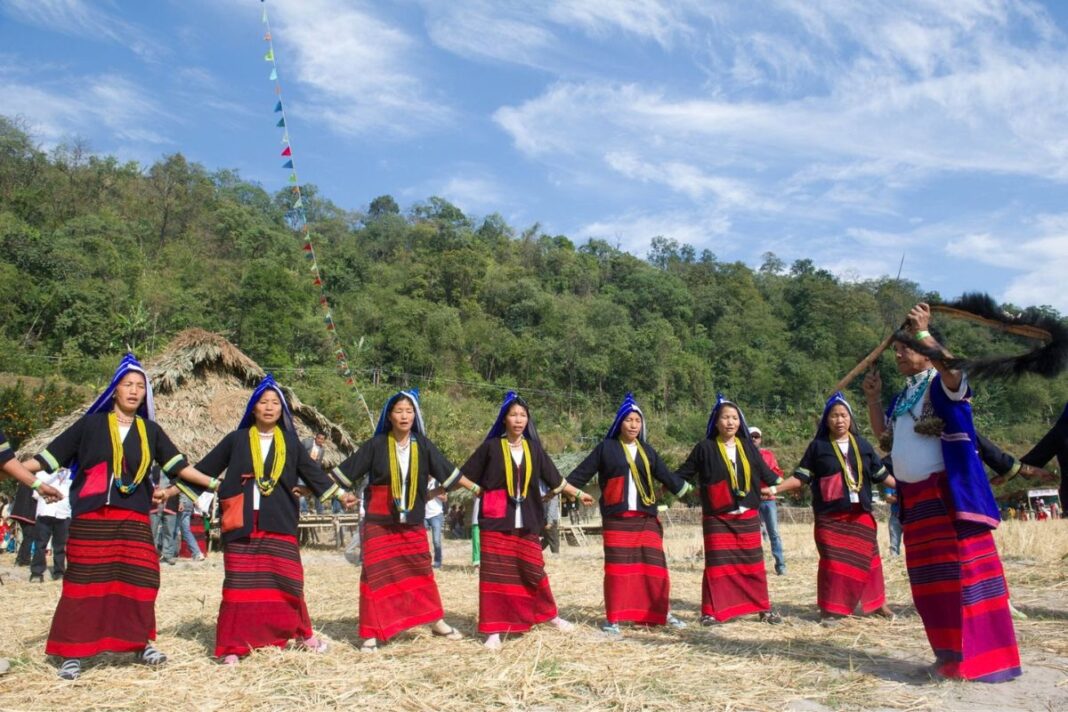
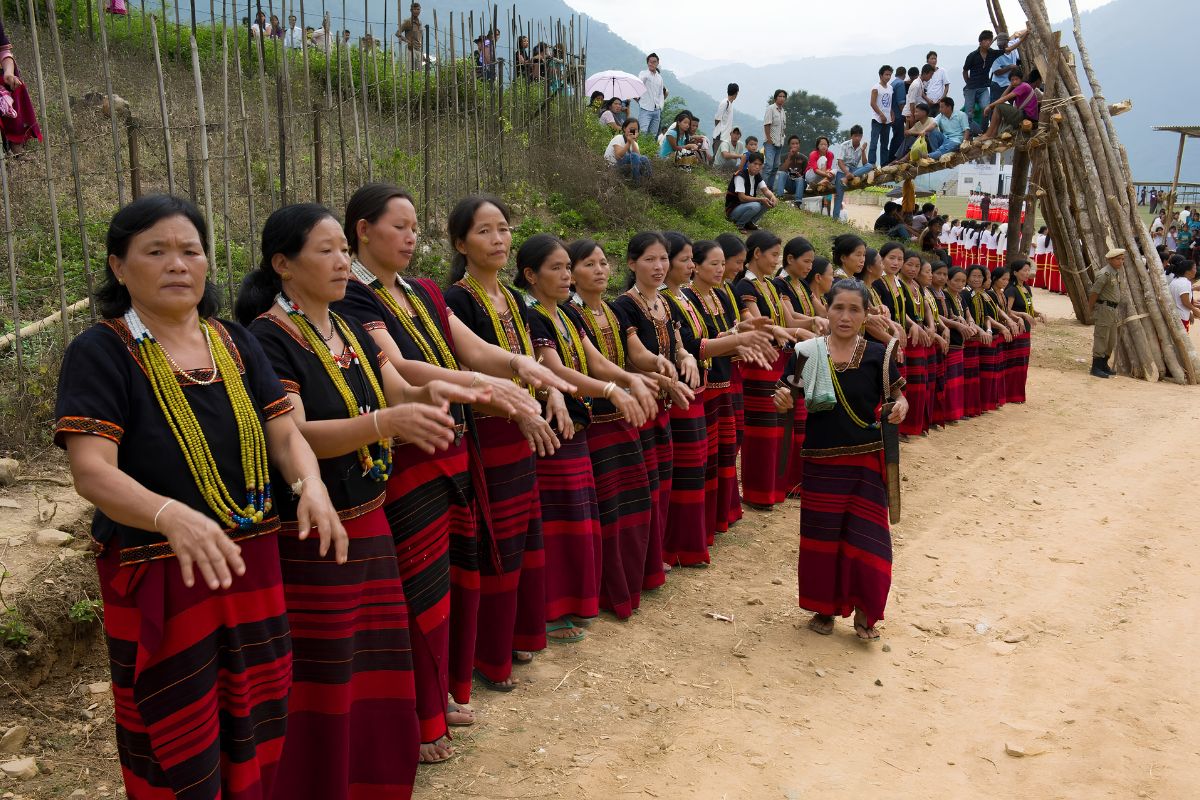
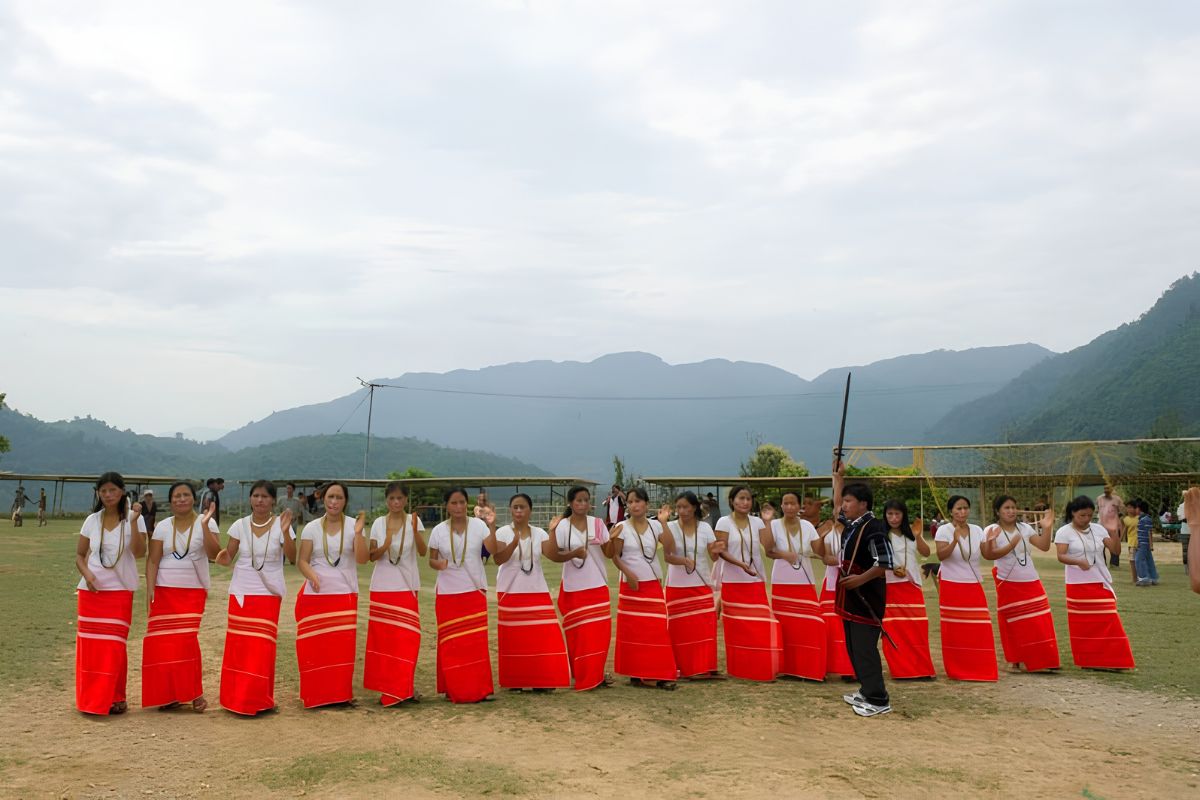
The dance begins with young women and girls, traditionally between fourteen and eighteen years of age, forming a large closed circle. They place their hands on one another’s shoulders, and in some villages they hold hands directly. The ring has no gap. It stands for the community’s unity, the passing of one generation to the next, and the shared labour of sowing and reaping.
The circle moves slowly, with a gentle sway. It moves at a steady, meditative pace and can go on for hours, often through the night. The slowness is deliberate, since it follows the rhythm of farming life, where good results come from patience.
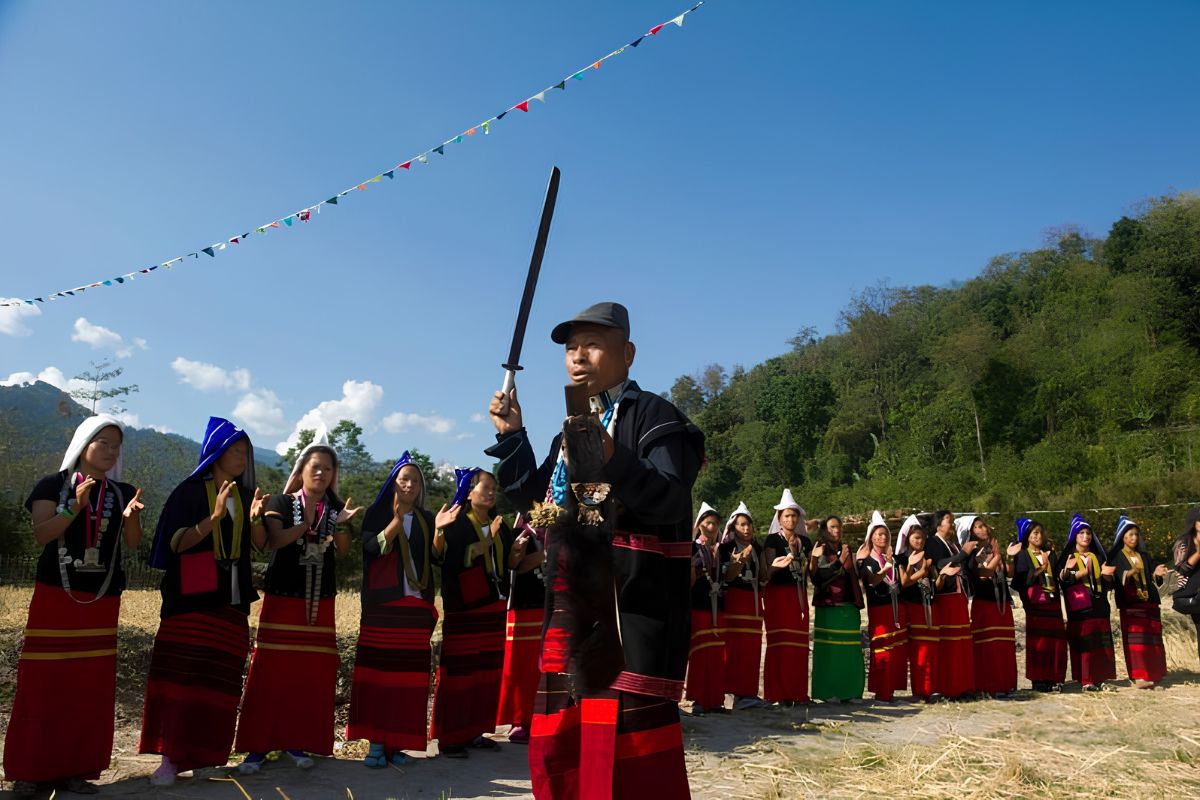
At the centre stands the Miri, a priest and singer, and the dance’s only man. He is usually an elder respected for his knowledge of Adi oral tradition. He wears ceremonial dress, including a sash called the beyop and sometimes a cane helmet. In his hand, he carries the yoksha, an instrument shaped like a sword, with iron discs fixed loosely to a handle. When he shakes it, it rattles.
The Miri sings one line at a time, in a rising tune, about where crops came from, how the Adi people migrated, and what lessons their history holds. The women answer by repeating each line together. This exchange turns the dance into a shared act of storytelling. In the core Ponung, no drums or hired musicians are used. The rattle of the yoksha is the only instrument, and the voices do the rest.
What the Dancers Wear
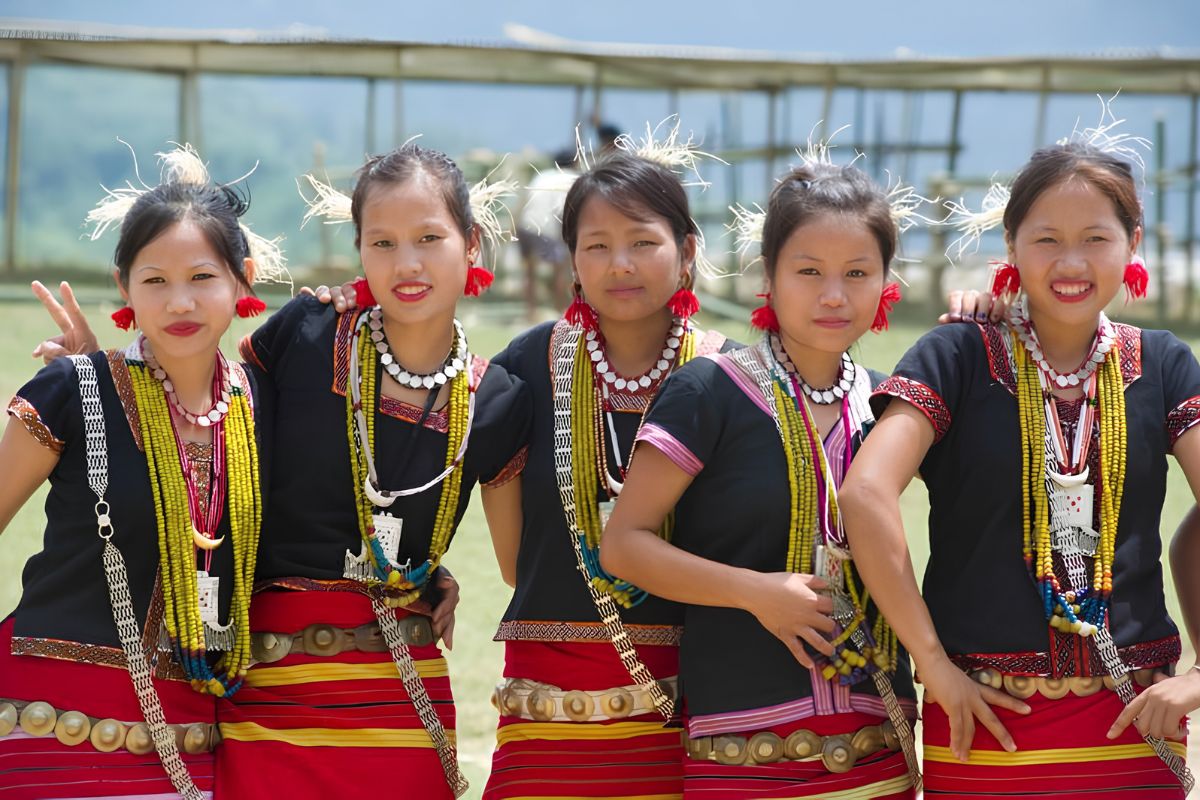
The dancers dress in traditional Adi clothing. They wear handwoven shawls with geometric patterns, beaded necklaces, cane ornaments, and, at times, brass or silver jewellery handed down through families. None of it is there for show. The colours recall earth and sky, and the beads stand for prosperity and protection.
The dance itself is a prayer. It honours Kine Nane, the goddess of grains, and asks for a successful crop. For the Adi, it also serves as a classroom, a temple, and a village meeting all at once. Children learn from it what they owe to the land and to each other.
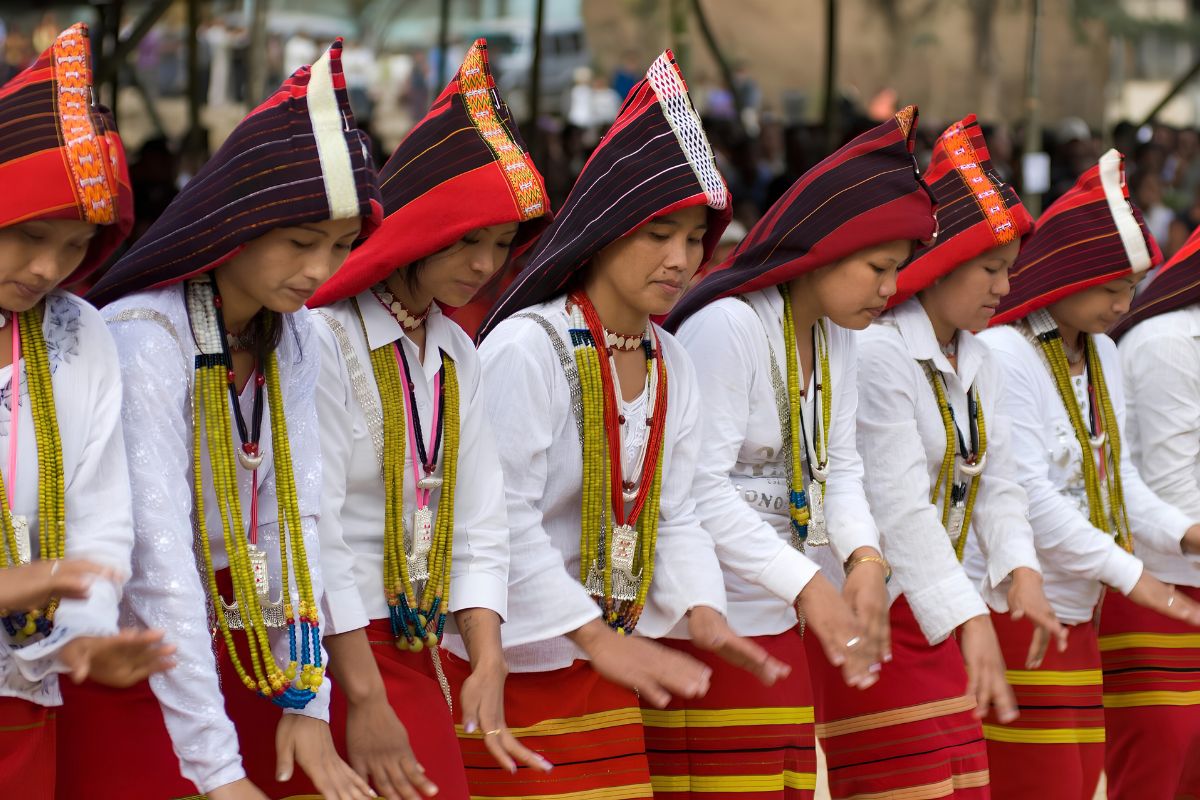
In smaller villages such as Gete, in the Yingkiong district, the dance keeps a close family feeling. Grandmothers teach the steps to granddaughters as part of the preparation, and the learning happens in kitchens and courtyards long before anyone reaches the circle. Women of every age take part in the wider festival, from teenagers to grandmothers, and that mix is a large part of why the dance feels so complete.
The Living Archive
The chants of the Ponung are the Solung Etor, and they carry centuries of Adi history, belief and moral teaching. Writing was never the main way this knowledge travelled. It travelled by voice, from mouth to ear, year after year. When the women repeat the Miri’s lines, they are keeping that record alive. The next generation inherits land, and it also inherits the memory of how the land came to them.
Why Visitors Feel Like Participants
At Solung, the line between performer and onlooker gets thin. Researchers, tourists and people from neighbouring tribes are welcomed as guests. They are offered meals, invited into dances, and given a place near the elders to listen. Nobody hands out a programme, because nothing is staged for them.
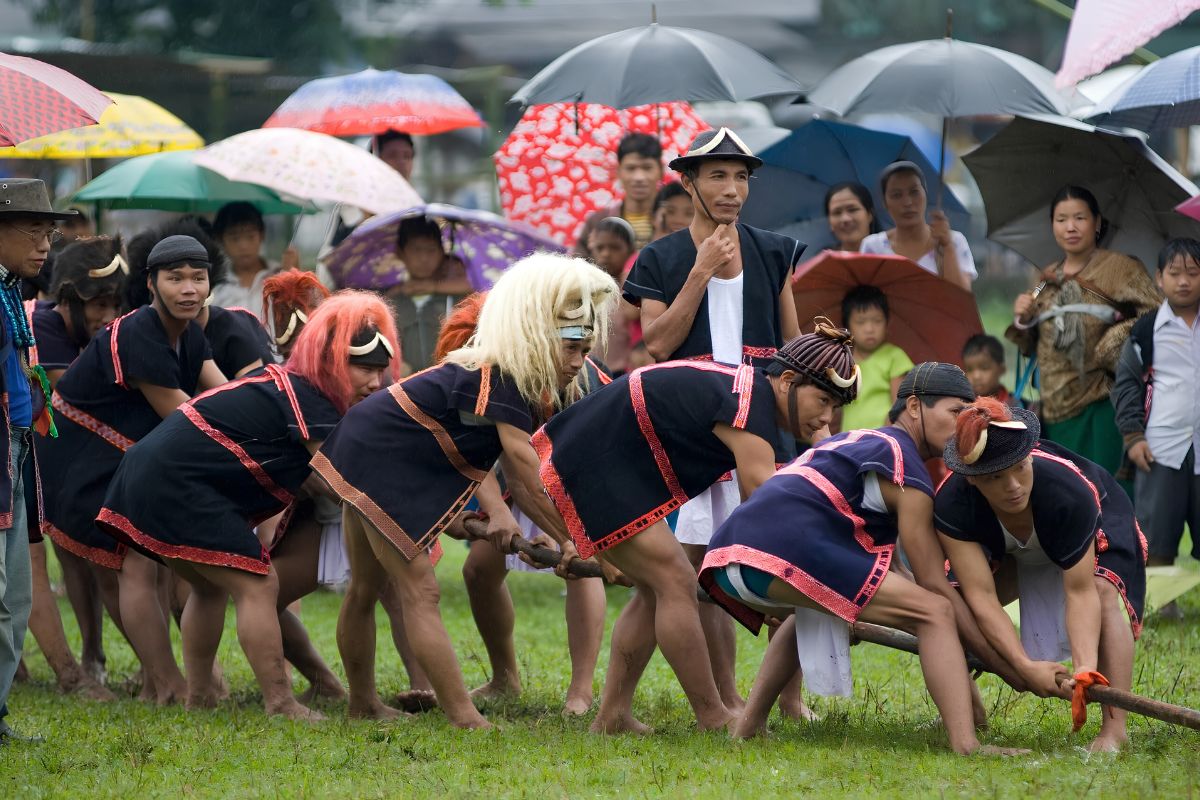
In Pasighat, often called the unofficial capital of the Adi, the festival is celebrated on a larger scale, and people arrive from across the Siang valley and beyond. In remote villages like Gete, it stays small and close. Both versions are real. The difference is only in size.
This is how a village becomes a museum: no glass cases, no labels. The rituals, the food, the weaving, the bamboo houses, the spoken histories and the bond with the land are all on view because they are all in use. A museum keeps old things behind a rope. Here, the people who own it still handle everything old.
A Tradition Under Strain
Solung faces the same pressures that press on most indigenous festivals. Young people leave for cities to study and find work, and some see the rituals as distant from their daily lives. Climate change is altering the farming calendar the festival depends on. Migration thins out the villages.
Still, the Adi have held on to the festival’s core with real determination. Local organisations and cultural trusts have started recording the rituals. Oral history projects are gathering the chants. The Arunachal Pradesh government has also taken an interest, including the festival in its promotion of cultural tourism. The community hopes such support builds pride and keeps the practice going, without turning Solung into a product to be sold.
What the Rest of India Can Learn
Solung offers something to people far from Arunachal. It shows a community timing its work, its worship and its celebration to the needs of the land. It shows knowledge passing between generations without a single textbook. In a period of climate worry and growing sameness in local cultures, that is worth a serious look.
It also challenges an old assumption: that progress requires giving up tradition. The Adi are farmers, teachers, business owners and artists. They live in the present, use its tools, and still gather each September to sing the story of where they came from. Their message is plain. A people can move forward and keep their memory at the same time.
Coming as a Witness
For anyone who travels to Arunachal Pradesh during Solung, the invitation is to take part with respect. Sit with the elders while they chant the Etor. Taste apong made from rice grown in the village. Watch a young girl learn the Ponung steps from her grandmother, correcting her feet one small movement at a time. It takes humility, because the guest is stepping into something that has been running for centuries without them.
In an age when so many festivals end up as photographs and hashtags, Solung still belongs to the people who hold it. For five days, the land is thanked, the community leans on itself, and the old stories are told again so that none of them is lost.
Also Read: Before the alphabet, A lesson in Hygiene, Dignity and Hope
You can connect with DNN24 on Facebook, Twitter, and Instagram and subscribe to our YouTube channel.