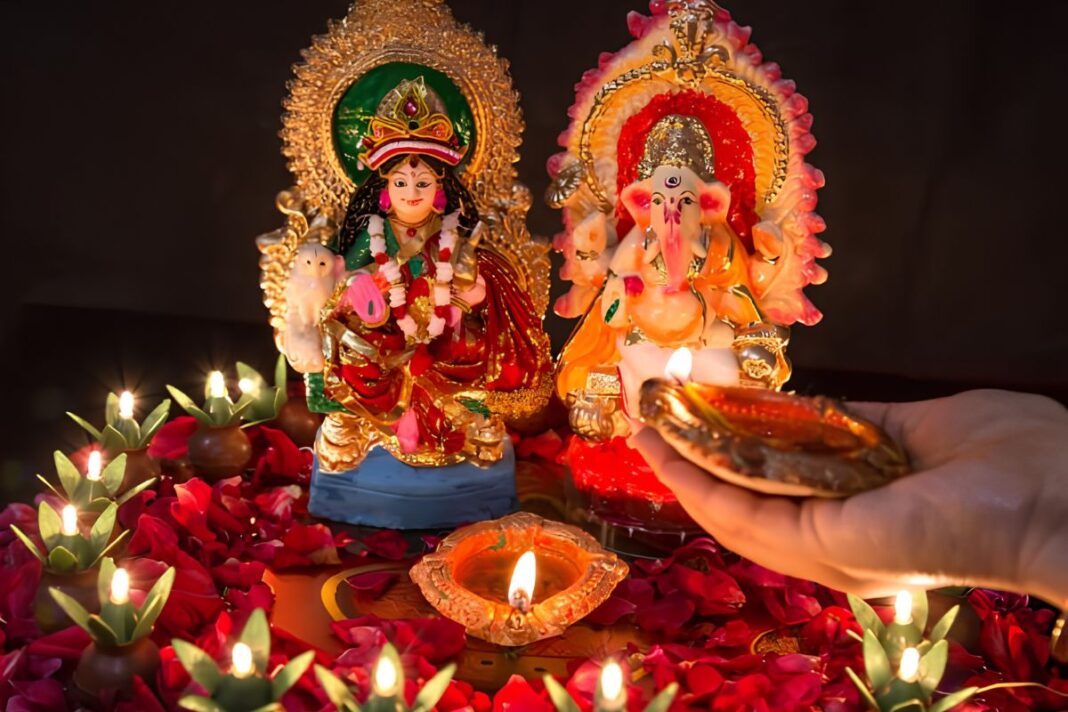

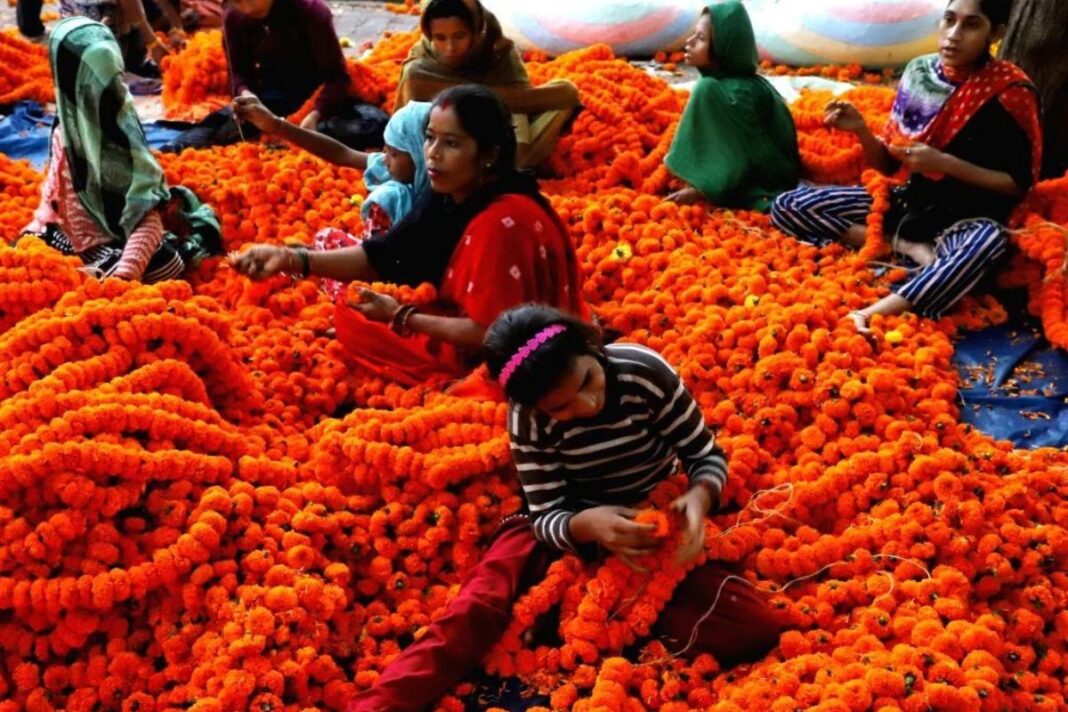

Walk down almost any Indian street during Diwali, and you will see the same small thing above nearly every door. A string of green leaves, often threaded with orange flowers, hangs from the frame. It looks simple, and it takes only an afternoon to make. Yet it carries one of the oldest ideas in Indian building, and it has a name: the toran.
The Door Is Never Just a Door
In Indian life, the doorway has always meant more than a gap in a wall. It is where the street ends and the family begins. Guests become hosts’ responsibility there, and the ordinary day meets the sacred one. Families have long chosen to mark this spot with leaves, flowers, cloth, mirrors, and colour. The message is plain enough. Whoever walks in is welcome, and the house is ready for good fortune.
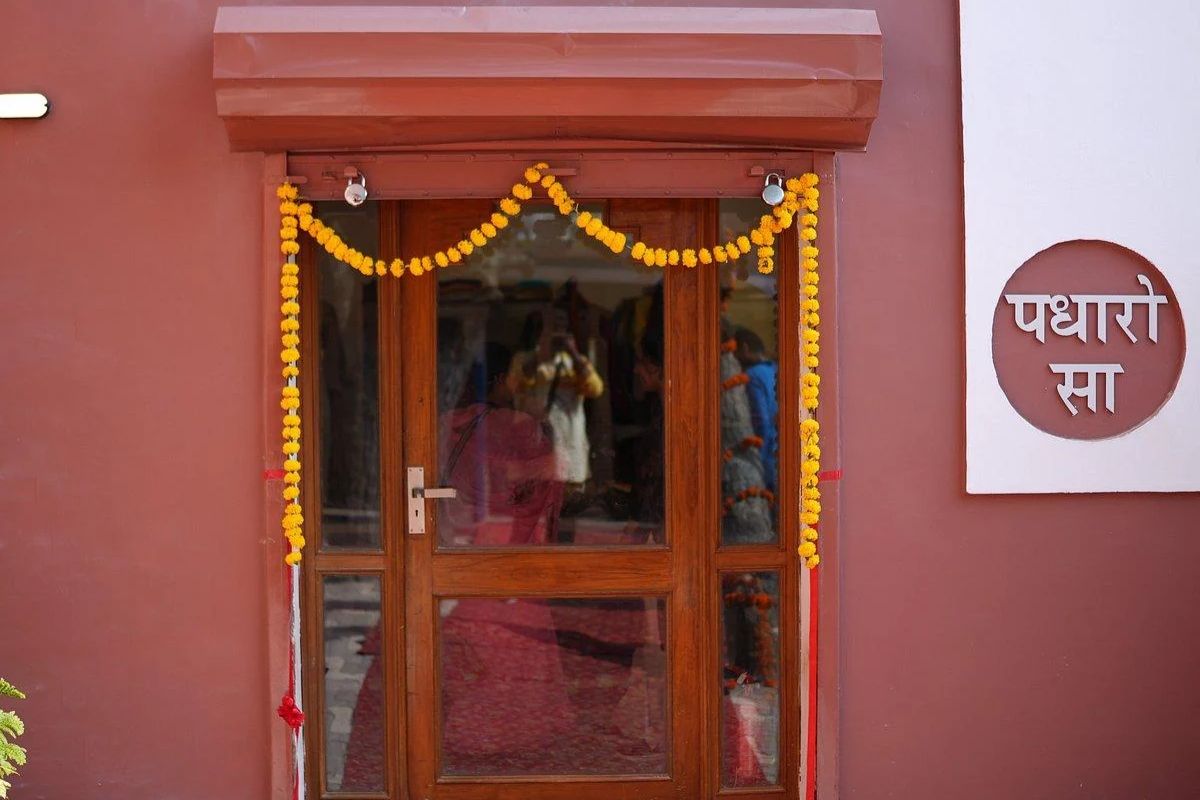
The word comes from the Sanskrit torana, which refers to an arch, a gateway, or a decorated passage. In Hindu, Jain, and Buddhist traditions, it first described a ceremonial gateway, a grand structure of wood or stone. Only later did the word settle on the garland or embroidered strip that hangs over a household door. So the leaves on your neighbour’s doorframe are a distant cousin of a monument.
Stone Gateways That Still Stand
Some of the earliest surviving examples of the form are the four carved gateways around the Great Stupa at Sanchi in Madhya Pradesh. They are generally dated to around the first century BCE. Each one has two square posts that carry three curved beams, and every surface is crowded with carved stories, animals, and figures. The stone is cut to look like timber joinery. That detail suggests that wooden gateways of the same kind stood even earlier and have simply not survived.
At Sanchi and at Bharhut, the toranas formed part of the protective railings around the stupas. Their carvings show scenes from the life of the Buddha and tales from the Jataka stories. Jain tradition uses the word too. There, a torana is the ornamental triangular arch above an image of a Tirthankara, often held up by pillars and topped with a kalasha, the ceremonial pinnacle.
A pilgrim walking through one of these gateways was doing what a modern family does when it steps under a garland. Both are crossing a marked line, and both are meant to feel the difference.
An Old Text That Sorted Torans by Material
Ancient Indian writers treated the toran as a subject worth classifying. The Manasara, a treatise on architecture, describes several kinds according to how they are decorated. A patra toran is made of leaves, a pushpa toran of flowers, a ratna toran of gems, and a chitra toran of pictures or painted figures.
This list tells us something useful. Nobody thought of the toran as a random scrap of decoration. It had a grammar, a set of materials and symbols that builders and householders chose with care. The leaf garland in your doorway sits in the first category of an ancient catalogue.
Why Mango Leaves and Marigolds
The most familiar toran is also the humblest. It is a string of fresh mango leaves, often broken up by marigold flowers, tied across the top of a door. Mango leaves are linked with love, fertility, and blessing. In Gujarat and other parts of western India, the little hanging pennants on a cloth toran are often a stylised version of mango leaves. The shape stayed even when the material changed.
Marigolds add yellow and orange, colours people connect with sunlight, celebration, and good luck. Together, the two make a doorway that smells fresh and looks alive. Families have also used neem, peepal, banyan, and ashoka leaves, depending on the region and on what grew nearby. The toran was always made from whatever the local land offered.
You will see them most during Diwali, Navratri, Ugadi, and Pongal, and at weddings and housewarmings. Many households put up a fresh one for each festival. Replacing the leaves is a small way of tidying the entrance and telling the neighbourhood that something worth celebrating has arrived.
Welcome, Wealth, and a Little Protection
At its centre, the toran is about hospitality. It tells visitors that the household is ready to receive them, to honour its gods, and to mark an important day. In Hindu homes, it is often tied to the welcome of Lakshmi, the goddess of wealth and prosperity, who is invited into a house that has been cleaned and dressed for her.
Many families also see the toran as a guard. A common belief holds that it draws in good energy and keeps out bad luck, though the exact meaning changes from one community and region to the next. What stays the same is the feeling behind it. The door becomes a blessing instead of a barrier.
People hang torans at the start of things: a marriage, a festival, a new house, a new year. The decoration lasts a few days, but the hope behind it is much older than that.
Gujarat: Cloth That Tells a Family’s Story
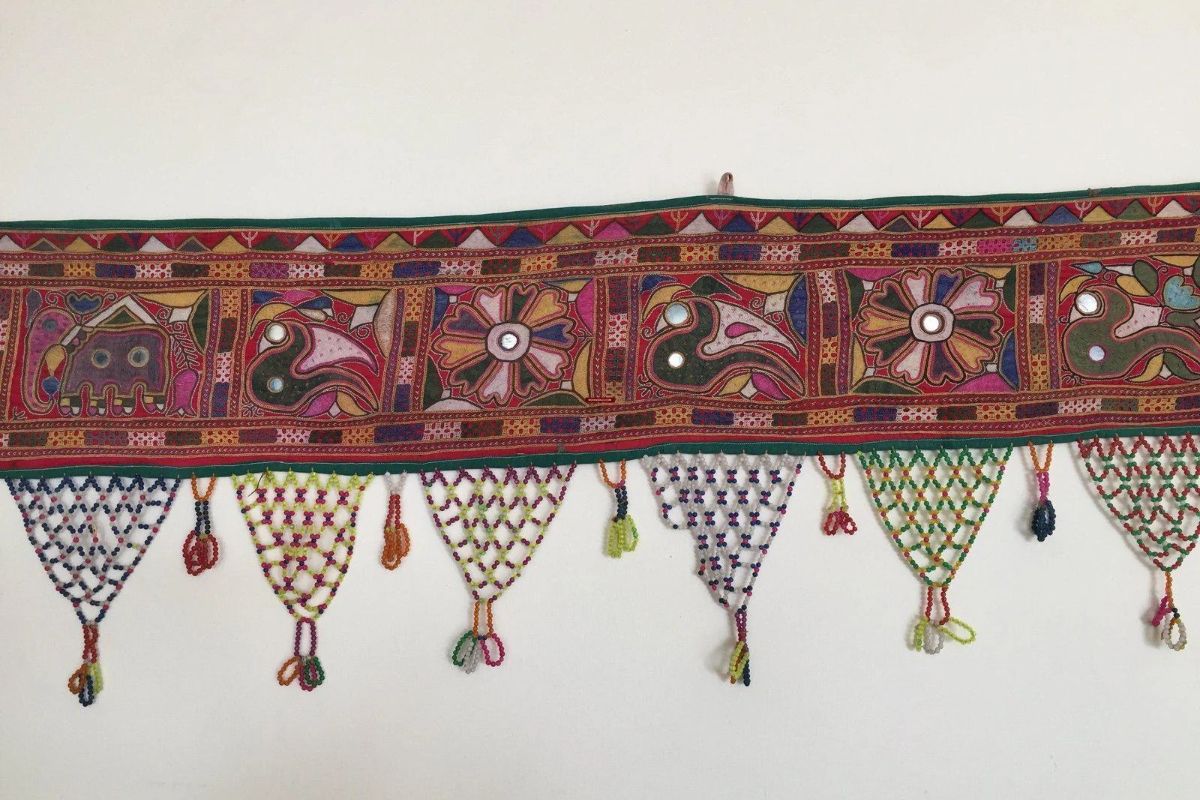
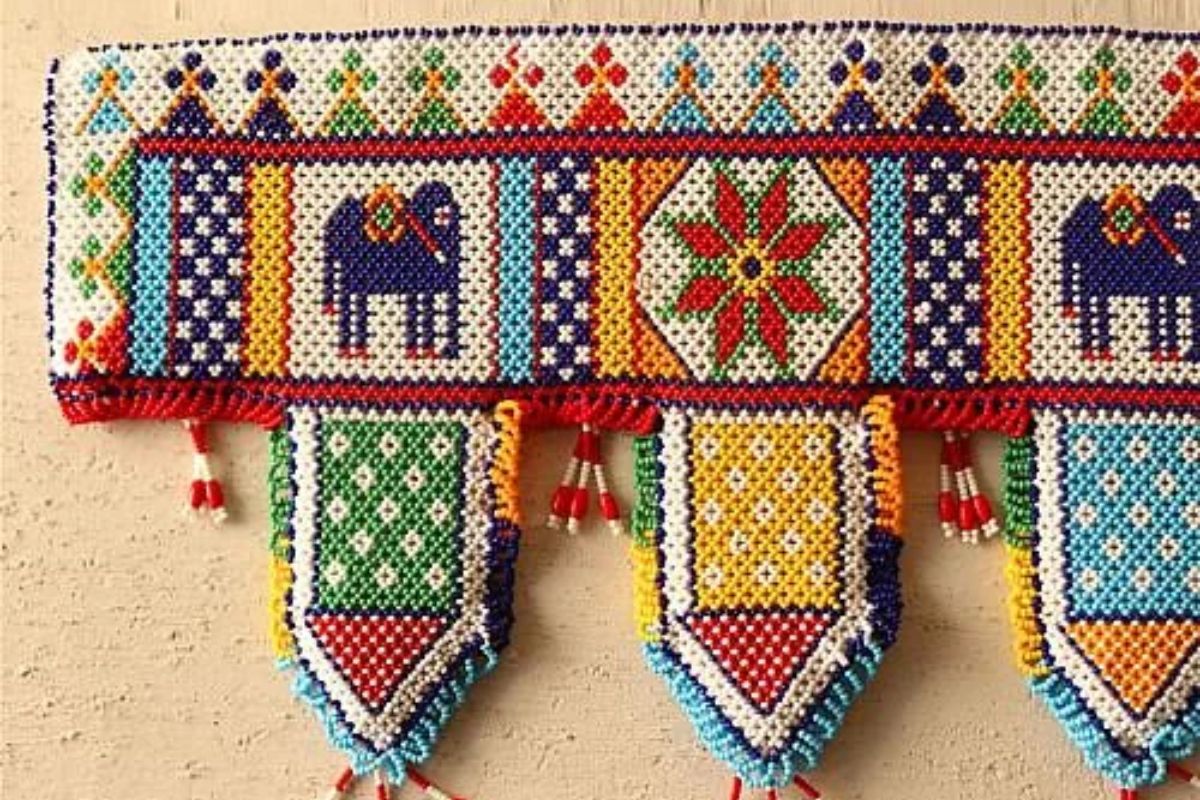
India’s torans vary enormously because each region built them from its own materials and skills. In Gujarat and Saurashtra, they can be remarkable works of textile art. A traditional Kathipa style toran may be silk embroidered on cotton, with diamonds, triangles, mirrorwork, and rows of hanging pennants. Women often stitched these pieces as part of a dowry and carried them to their new homes after the wedding. Many such torans were therefore made by the very person who would live beneath them.
These embroideries also work as records. As communities changed, their motifs changed with them. An elephant might give way to a bicycle, which tells you something about new machines and new ways of moving through rural life. A cloth toran can show, thread by thread, how a pastoral or farming community adapted to markets, migration, and fresh materials.
Maharashtra: Paper, Bamboo, and a Century of Practice
In Ichalkaranji in Maharashtra, artisans have long made torans from bamboo sticks, coloured paper, gelatine sheets, and printed images of deities. One family there described its craft as more than a hundred years old. Their designs come from trained judgement and steady hands, with no geometric tools to guide them. Cases like this remind us that the toran is more than a wreath of leaves. It supports whole families of specialist makers who have passed their skills down over generations.
Today’s torans use cotton, felt, satin ribbon, beads, kundan stones, wood, metal, shells, small bells, hand-painted pieces, and artificial flowers. The materials keep changing. The purpose stays easy to recognise, which is to make an entrance festive and welcoming.
What the Colours and Motifs Say
Traditional toran colours were chosen for good reasons. Green stands for nature, growth, and renewal. Red suggests energy, married love, and strength. Yellow and saffron are tied to purity, knowledge, and celebration. A doorway dressed in these colours looks bright, and it also carries wishes for the household.
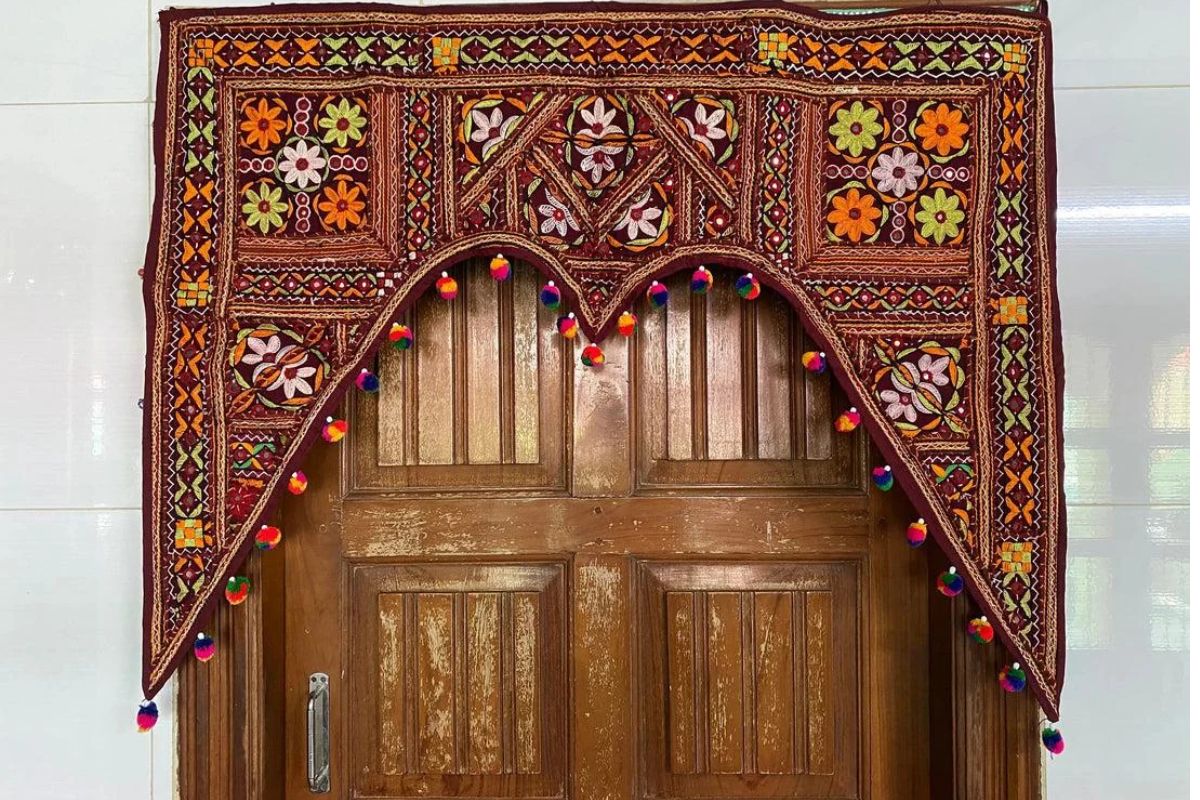
Motifs add their own meanings. Flowers can suggest fertility, medallions can stand for creation, peacocks for happiness, and images of Lakshmi for prosperity. Even a toran made only of geometric shapes gives a sense of order and plenty through its repeated patterns and balanced colour. It dresses the house, marks the occasion, offers a welcome, keeps a regional craft alive, and holds a wish for harmony, all at the same moment.
Why It Has Lasted
The toran has survived because it bends to circumstances. It can be a few mango leaves tied with thread, or it can be a piece of mirrored embroidery that took many hours of stitching. A family can renew it every festival or keep it for decades as an heirloom. It hangs in village doorways, city flats, temples, and wedding pandals with equal ease.
Shops today are full of factory-made décor, and much of it is forgotten within a season. The toran keeps its place because someone usually made it with a particular door and a particular day in mind. A handful of leaves, a thread of marigolds, or a length of embroidered cloth can hold a great deal of meaning.
So the next time you pass under one, notice how it hangs. An Indian family that puts up a toran is decorating a door, and it is also repeating a very old act of welcome, thanks, and hope.
Also Read: How Clay Diyas Became an Enduring Symbol of Diwali
You can connect with DNN24 on Facebook, Twitter, and Instagram and subscribe to our YouTube channel.