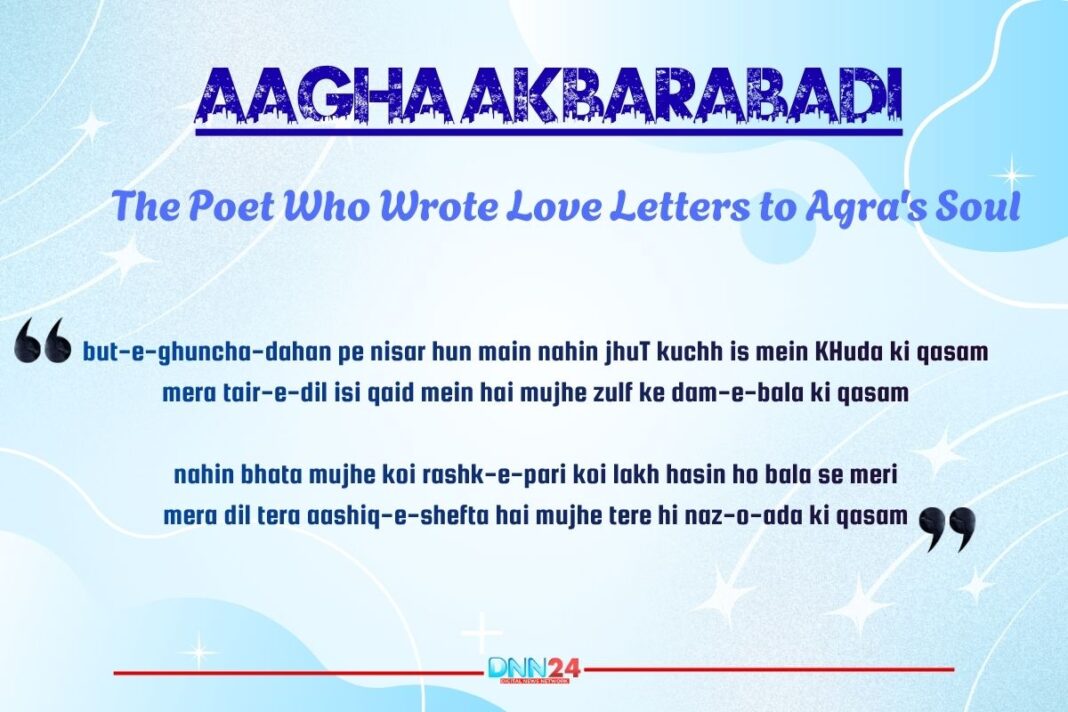

What if I told you that the most honest love poems in Urdu came from a man who never chased fame, never bowed to kings, and spent his life wandering Agra’s dusty streets with nothing but words burning in his chest? Aagha Akbarabadi lived in the 1800s when empires were falling apart, and poetry was the only thing that made sense. While others wrote for courts and patrons, he wrote for the shopkeeper nursing a broken heart, the woman stealing glances across the bazaar, the young man drowning in feelings he could never speak out loud.
nigahon mein iqrar sare hue hain
Aagha Akbarabadi
hum un ke hue wo hamare hue hain
His ghazals do not ask you to sit politely and admire them from a distance. They grab you by the shoulders and shake you awake. In today’s world of carefully filtered emotions and three-second attention spans, Aagha’s poetry hits different because it refuses to lie. This is not just another article about a dead poet. This is about why his words still matter when we are all pretending to be fine while scrolling through strangers’ lives at 2 AM.
maddah hun main dil se mohammad ki aal ka
Aagha Akbarabadi
mushtaq hun wasi-e-nabi ke jamal ka
A Boy Born in the Shadow of Crumbling Greatness
Agra in the early 1800s was a city caught between memories and reality. The Taj Mahal still stood white and perfect, but the empire that built it was gasping its last breaths. The British were tightening their grip, turning maharajas into puppets and poets into relics. Into this messy, beautiful chaos, Aagha Akbarabadi was born. We do not know his exact birth year because history tends to forget people who do not wear crowns.
hamare samne kuchh zikr ghairon ka agar hoga
Aagha Akbarabadi
bashar hain hum bhi sahab dekhiye nahaq ka shar hoga
His real name got lost somewhere along the way, too. What survived was his pen name, tied forever to Akbarabad, the old name for Agra that still carried echoes of Akbar’s golden age. Aagha’s family was not rich or powerful. They were ordinary people living ordinary lives in a city that had seen too much glory and too much blood. Young Aagha grew up watching life happen in narrow lanes where everyone knew everyone else’s business.
aankhon pe wo zulf aa rahi hai
Aagha Akbarabadi
kali jadu jaga rahi hai
He saw merchants bargaining over spices, children flying kites from rooftops, lovers meeting in secret when families were not looking. The Yamuna river flowed past the city like it always had, indifferent to empires rising and falling. These were the classrooms where Aagha learned what really mattered. Not Sanskrit verses or Persian grammar, but the way a woman’s dupatta caught the wind, the ache in a man’s voice when he sang about someone who would never be his.
malte hain hath, hath lagenge anar kab
Aagha Akbarabadi
joban ka un ke dekhiye hoga ubhaar kab
Poetry That Tastes Like Real Life
Here is what makes Aagha different from almost every other Urdu poet you have heard of. He wrote in a language that actual people spoke. No ten-dollar words imported from Persian dictionaries. No showing off about how many classical references he could cram into two lines. His ghazals sound like conversations you might overhear in a chai shop, if everyone in that chai shop happened to be dangerously good at expressing what it feels like to be alive and in love.
hazar jaan se sahab nisar hum bhi hain
Aagha Akbarabadi
tumhaari tir-e-nigah ke shikar hum bhi hain
His lines capture everything in just a few words: eyes making promises that lips cannot speak, two people understanding each other without saying anything at all. His descriptions of beauty do not compare women to moons and flowers as every other poet did. Instead, he writes about the specific way someone walks through a marketplace, the dust on their shoes, the realness of them.
muddat ke baad is ne likha mere nam KHat
Aagha Akbarabadi
meri shikayaton se bhara hai tamam KHat
His love poems are not about perfect princesses locked in towers. They are about the girl selling bangles who once smiled at him, the neighbour he has been watching from his window for months, the impossible distance between wanting someone and actually having them.
hazar jaan se sahab nisar hum bhi hain
Aagha Akbarabadi
tumhaari tir-e-nigah ke shikar hum bhi hain
Aagha lived at the same time as Dagh Dehlavi, another famous Urdu poet. But while Dagh moved in elite circles, Aagha stayed close to the ground. His poetry has dirt under its fingernails. It smells like monsoon rain on hot streets. Reading his ghazals now feels like meeting someone who refuses to pretend.
maza hai imtihan ka aazma le jis ka ji chahe
Aagha Akbarabadi
namak zaKHm-e-jigar par aur Dale jis ka ji chahe
When Everything Was Falling Apart
Imagine living through the death of a civilisation. That is what Aagha’s lifetime felt like for many people in Agra. The Mughal Empire, which had ruled for three centuries, was disintegrating in slow motion. The British East India Company had stopped pretending to be just traders and started acting like conquerors. Forts that once housed emperors were being turned into administrative offices.
tere jalal se KHurshid ko zawal hua
Aagha Akbarabadi
tere jamal se mahtab ko kamal hua
Poets who had once received royal stipends were suddenly unemployed. Through all this chaos, Aagha kept writing. He worked odd jobs to survive, taught students when he could find them, maybe served briefly in some minor military capacity, but nothing stuck except the poetry.
namaz kaisi kahan ka roza abhi main shaghl-e-sharab mein hun
Aagha Akbarabadi
KHuda ki yaad aae kis tarah se buton ke qahr-o-itab mein hun
He never had a wealthy patron who would publish his collected works in a fancy volume. He never performed for kings or became famous in his own time. His ghazals spread the old way, person to person, memorised and recited because people found truth in them. Most of his work was not even collected adequately until long after he died. But here is the thing about writing from the heart during terrible times.
jite-ji ke aashna hain phir kisi ka kaun hai
Aagha Akbarabadi
nam ke apne hua karte hain apna kaun hai
It lasts. Aagha’s poetry does not often discuss politics or empires. It talks about things that do not change even when everything else does. Falling in love still feels the same whether the Mughals or the British are in charge. Heartbreak still hurts. By focusing on eternal human experiences, Aagha created something that survived the specific historical moment that gave rise to it.
shiddat-e-zat ne ye haal banaya apna
Aagha Akbarabadi
jism-e-majnun mein hua tang shaloka apna
Why He Still Matters Right Now
So why should anyone in 2025 care about a poet who probably died 150 years ago? Because nothing about human nature has actually changed. We have different technology now, different clothes, different problems on the surface. But underneath, we are still people trying to connect with other people and mostly failing at it. We still want to be seen, understood, and to matter to someone.
ja laDi yar se hamari aankh
Aagha Akbarabadi
dekho kar baiThi faujdari aankh
Social media has made all of this weirder and more complicated. Everyone is performing a version of themselves, carefully editing their feelings to look attractive, calm, or unbothered. But when you read Aagha’s ghazals, it is like someone turned off all the filters and just told the truth. The uncomfortable, embarrassing, beautiful truth about what it actually feels like to want something you cannot have.
daur saghar ka chale saqi dobara ek aur
Aagha Akbarabadi
abr ka’ba se uTha hai man kahna ek aur
Young people discovering his work now are finding language for emotions they thought only they experienced. Turns out feeling like you are drowning in your own feelings while everyone around you seems fine is not a modern problem. Aagha was writing about that in the 1800s. There is also something powerful about how his poetry crosses religious and cultural lines. He was Muslim, writing in Urdu, living in a city sacred to multiple faiths, creating art that anyone could understand, regardless of their background.
nahin mumkin ki tere hukm se bahar main hun
Aagha Akbarabadi
ai sanam tabe-e-farman-e-muqaddar main hun
At a time when identity politics keeps dividing people into smaller groups, Aagha’s work reminds us that emotions are universal. Love does not care what religion you are. His poetry builds bridges just by existing, just by speaking to the parts of human experience that we all share.
wo kahte hain uTTho sahar ho gai
Aagha Akbarabadi
azan ho gai top-sar ho gai
Walking through Agra today, you see tourists taking selfies at the Taj Mahal, vendors selling souvenirs, traffic and noise everywhere. The city Aagha knew is buried under layers of time. But something of his spirit remains. In the way, people still fall in love wholly and impractically. That is what Aagha captured. Not just his time, but all time. Not just Agra, but everywhere. The unbearable, necessary truth of being alive and feeling everything.
Also Read: Tomb of Sher Shah Suri: An Emperor’s Dream Palace Floating On Water
You can connect with DNN24 on Facebook, Twitter, and Instagram and subscribe to our YouTube channel.