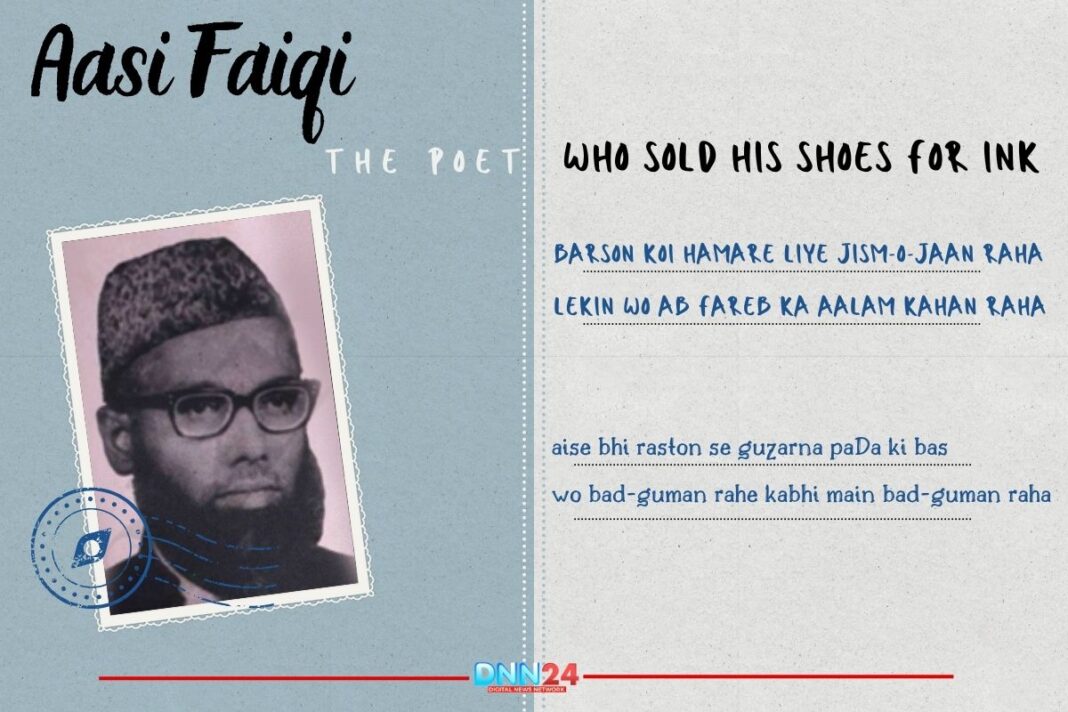

When a boy from Burhanpur chose words over everything else, India gained a voice that still whispers hope to broken hearts. On 8th August 1930, in the quiet lanes of Burhanpur, Madhya Pradesh, a child was born who would one day become the voice of ordinary sorrow and unspoken dreams. Sheikh Abdul Baseer, who the world would later know as Aasi Faiqi, entered a life that offered little but taught much. His home was simple, his circumstances difficult, and his future uncertain. Burhanpur was far removed from the grand cities where poets were celebrated and literature flourished.
purane log nae karobar dete hain
Aasi Faiqi
KHizan KHarid ke fasl-e-bahaar dete hain
Here, survival mattered more than sonnets, and every meal was a small victory.From the very beginning, young Aasi sensed the weight of struggle. His family lived under the constant pressure of poverty, where even necessities felt like distant luxuries. School was not always possible. There were days when family needs pulled him away from books, when responsibilities forced him to grow up faster than childhood should allow.
zarur un ko mohabbat se wasta hoga
Aasi Faiqi
jo ranj-o-gham ke ewaz hum ko pyar dete hain
But in those stolen moments, between errands and duties, he found solace in words. He listened to the old storytellers in the neighbourhood, absorbed the poetry recited at small gatherings, and watched how language could transform pain into something beautiful.
shab-e-visal ki lazzat unhen nasib hui
Aasi Faiqi
jo intizar ki ghaDiyan guzar dete hain
Those early influences planted something precious in his heart: the belief that poetry could be both a refuge and a form of rebellion. He began to scribble verses on whatever paper he could find, his young fingers tracing dreams that refused to die despite everything working against them.
aap ki hasti kya hasti hai
Aasi Faiqi
sarmasti hi sarmasti hai
Aasi Faiqi: Life’s Difficult Turns
The path Aasi Faiqi walked was never meant to be easy. When his father fell ill, the weight of the entire household shifted onto his young shoulders. He took on odd jobs, sometimes earning just a handful of coins for hours of labour. There were mornings when hunger gnawed at him, evenings when exhaustion made his hands tremble as he tried to write. Death visited his family more than once, each loss carving deeper wounds into his already tender heart.
hamare ashk mohabbat mein qimti Thahre
Aasi Faiqi
gham-e-hayat ki qismat sanwar dete hain
Friends and neighbours rarely understood the silent world he inhabited, the constant battle between duty and desire, between making a living and making meaning.Isolation became his companion. While others gathered and laughed, Aasi often walked alone, speaking his verses to the empty streets and the indifferent stars. Financial crises came in waves, threatening to drown his dreams completely.
milan ki rut pe bashar kya daraKHt aur paude
Aasi Faiqi
sab apni apni qabaen utar dete hain
Yet poetry remained his anchor, the one thing poverty could not steal. Every setback became raw material for his art, every disappointment a verse waiting to be born. What few people know is the depth of his sacrifice. There was a time when he sold his only decent pair of shoes to buy ink and paper.
hamari jaan ki qimat chuka rahe hain wo
Aasi Faiqi
mila ke KHak mein musht-e-ghubar dete hain
It was not a dramatic gesture meant for applause but a quiet, desperate act of faith. He chose words over comfort, poetry over possession. These hidden sacrifices, never recorded in grand biographies, form the real foundation of his legacy. They reveal a man who believed in his voice even when the world gave him every reason to stay silent.
hum apne aap mein KHud ba-waqar hain ‘asi’
Aasi Faiqi
jo be-waqar hain apna waqar dete hain
The Tender Heart in His Words: Writings and Life Reflections
Aasi Faiqi did not write poetry to impress literary circles or win prestigious awards. He wrote because his heart demanded it. After all, silence felt like a betrayal of everything he had endured and witnessed. His verses carry the fingerprints of real life, the texture of genuine emotion. They are not polished to perfection but left raw and honest, like conversations with a trusted friend.
jab hum aapas mein milte hain
Aasi Faiqi
duniya aawazen kasti hai
When you read his couplets about waiting another year in loneliness, you feel his actual loneliness. When he writes about unfulfilled dreams, those are his dreams speaking directly to yours.His poetry often carries echoes of his Burhanpur days, of borrowing books from friends who had little themselves, of long walks to distant libraries because knowledge felt worth any distance.
mahngai ke yug mein socho
Aasi Faiqi
man ki mamta kyon sasti hai
But beyond the poetry, there were quieter acts of grace. Aasi helped neighbours with whatever meagre earnings his verses brought him. He mentored young poets who had even fewer resources, sharing not just techniques but the courage to continue. His work “Taak Dinadin Taake Se” speaks of separation and stubborn hope, themes drawn directly from his life’s fabric. These were not abstract literary exercises but lived experiences transformed into art.
basti basana khel hai kya
Aasi Faiqi
baste baste hi basti hai
The untold stories matter most: the nights he went hungry so a fellow poet could eat, the times he gave away his only copy of a cherished book to someone whose need seemed greater. His generosity was not calculated for recognition but flowed naturally from a heart that understood suffering intimately and refused to add to it.
yaadon ke daftar mein ‘asi’
Aasi Faiqi
guzre lamhon ki nasti hai
The Glow Beyond Darkness: Inspiration and Legacy
Despite carrying lifelong burdens, Aasi Faiqi never allowed bitterness to poison his spirit. The poet who once sold his shoes for paper became a symbol of resilience wrapped in gentleness. His legacy is not measured in awards or wealth. Still, in the countless hearts his words have touched, the struggling writers who found courage in his example, the ordinary people who discovered their pain was not invisible after all.
tere gham-KHwar ka mamul KHuda hi jaane
Aasi Faiqi
kis qadar rahta hai mashghul KHuda hi jaane
He transformed personal anguish into universal comfort, proving that even the smallest voice matters when it speaks truth.Lesser-known stories continue to surface about his kindness. He would sit with aspiring poets for hours, explaining not just metre and rhyme but the real purpose of poetry: to bear witness, to heal, to connect. He believed that a few kind words could illuminate darkness where grand gestures failed.
hum ne ulfat ka sabaq sikha hai diwanon se
Aasi Faiqi
us ka ba-qaeda school KHuda hi jaane
Even as age and circumstance continued testing him, he kept writing, kept believing, kept encouraging. His influence did not die with him. It lives in every person who chooses to speak their truth despite fear, in every writer who persists despite poverty, in everyone who believes that beauty can emerge from brokenness.
jubba-sai dar-e-jaanan pe kiya karta hun
Aasi Faiqi
kis liye kyon mera mamul KHuda hi jaane
Aasi Faiqi’s life whispers a powerful message across decades: your circumstances do not define your contribution. Pain can become poetry. Struggle can give birth to meaning. And one person’s quiet faith in words can ripple forward, touching lives they will never know, long after they are gone.
Also Read: Tomb of Sher Shah Suri: An Emperor’s Dream Palace Floating On Water
You can connect with DNN24 on Facebook, Twitter, and Instagram and subscribe to our YouTube channel.