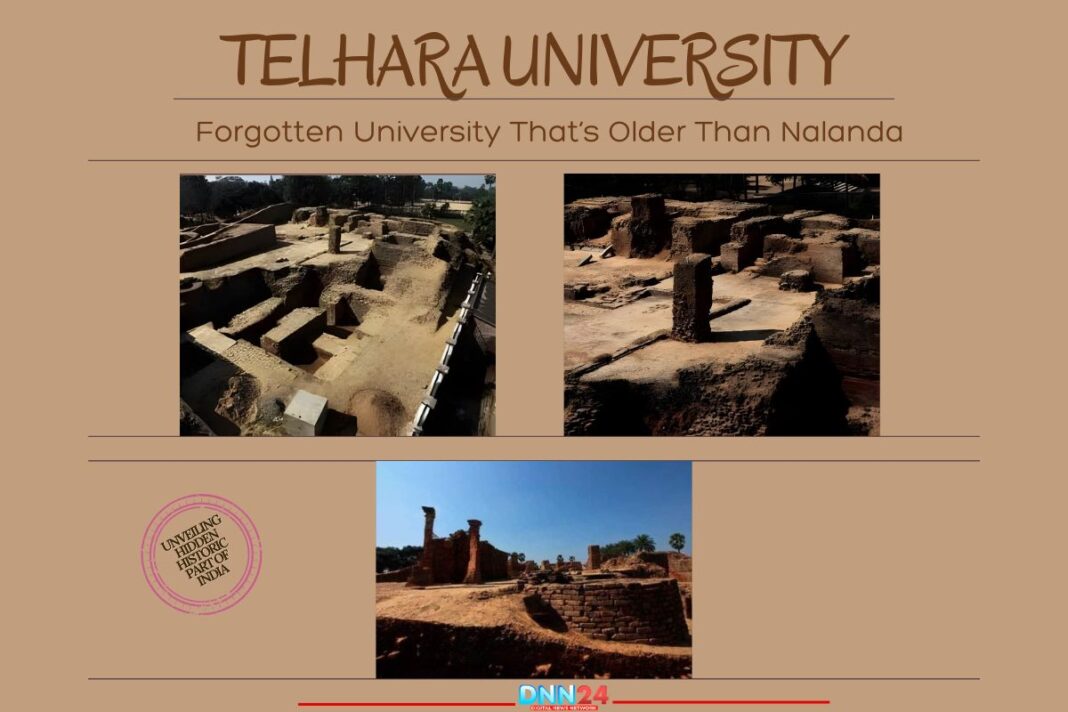

Before Nalanda became famous, there was Telhara. Hidden beneath layers of earth in Bihar’s Nalanda district, this ancient university lay silent for centuries until archaeologists began uncovering its secrets in 2009. What they found shocked historians and scholars alike. Telhara University was not just another Buddhist monastery. It was a thriving educational institution from the 1st century AD, making it older than the celebrated Nalanda and Vikramshila universities. Today, as excavations continue, Telhara emerges as a powerful reminder of India’s unmatched tradition of learning, spirituality, and intellectual exchange, attracting students and monks from across Asia.

Telhara University: The Historical Roots and Cultural Significance
Telhara’s foundation dates back to the Kushana period, around the 1st century AD, as confirmed by brick samples recovered from the site. Archaeological evidence indicates that the university’s active years predate Nalanda’s rise to prominence in the 4th century. The site flourished under royal patronage, particularly from descendants of Magadha’s ancient ruler Bimbisara, who recognised the value of supporting education and Buddhist practice.
This backing allowed Telhara to grow into a major centre of Mahayana Buddhism, where philosophy, logic, meditation, and scriptural studies formed the core of daily academic life. The Chinese traveller Hiuen Tsang visited India in the 7th century and documented Telhara in vivid detail. He described seven monasteries arranged across the complex, featuring three-storied buildings with ornate cupolas, prayer halls, courtyards, and bells that rang throughout the day. His writings paint a picture of architectural splendour and intellectual vitality.

Students and monks lived together, engaged in rigorous debates, studied sacred texts, and pursued spiritual growth in an environment designed specifically for learning. Telhara represented more than religious education. It embodied a holistic approach where knowledge, ethics, and inner development were inseparable. The university’s connection to Buddhist teachings made it a destination for seekers of wisdom from distant lands, contributing to a vibrant exchange of ideas that enriched Indian culture and influenced Buddhist traditions across Asia.
Telhara University: Discoveries and the Archaeological Journey
Excavations at Telhara began in 2009 under the Bihar government’s Archaeological Department. Over the years, archaeologists have unearthed more than 1,000 artefacts that illuminate the university’s past. These findings include terracotta seals with Pali inscriptions, pottery fragments from the Gupta and Pala periods, bronze statues of Buddha, stone sculptures, and extensive red sandstone ruins. The site spans a considerable area, with the remains of multiple viharas, or monasteries, capable of housing approximately a thousand monks and students simultaneously.
This scale indicates that Telhara was not a small learning centre but a major educational institution comparable to the most excellent universities of ancient India. Each artefact tells a story. The seals bear inscriptions and symbols associated with Mahayana Buddhism, confirming the university’s religious identity. The pottery styles help historians date different phases of occupation. The statues reveal artistic traditions and devotional practices. Together, these objects form a mosaic of academic and spiritual life spanning several centuries. One discovery stands out as particularly haunting.

Excavators found a thick layer of ash covering parts of the site, evidence of destruction by fire. Historians believe this destruction occurred during the 12th-century invasions led by Bakhtiyar Khalji, the same military commander who destroyed Nalanda and Vikramshila. This violent end interrupted centuries of scholarship, scattering monks and burning irreplaceable manuscripts. Despite this tragedy, the ruins survived beneath the earth, waiting to share their story. Plans are now underway to preserve Telhara and to develop a nearby museum to display the recovered artefacts, allowing visitors and researchers to connect with this extraordinary heritage.
Relevance of Telhara University in Today’s World
The rediscovery of Telhara carries profound meaning for contemporary society. In an age dominated by specialisation and fragmented knowledge, Telhara reminds us of an educational philosophy that integrated spirituality, ethics, philosophy, and practical learning. Students at Telhara did not merely accumulate information. They cultivated wisdom, moral character, and inner peace alongside intellectual skills. This holistic model contrasts sharply with modern education systems that often separate secular knowledge from spiritual development and ethics from academics.
Telhara’s story also strengthens cultural identity and national pride. It demonstrates that India’s commitment to education, pluralism, and knowledge sharing extends back millennia. Such historical awareness fosters respect for indigenous traditions and encourages contemporary society to draw inspiration from ancient wisdom. Global interest in mindfulness, meditation, and Eastern philosophy continues to grow. Sites like Telhara serve as tangible links between past insights and present needs, offering lessons about balanced living and integrated learning that resonate across cultures.

Telhara’s archaeological revival highlights another critical issue: the preservation of historical monuments. Many ancient sites remain unexplored or inadequately protected, risking loss of invaluable cultural heritage. Investing in archaeological research and heritage conservation not only recovers forgotten history but also educates future generations about their roots. Understanding where we come from shapes who we become. Telhara University, buried and forgotten for centuries, now stands ready to teach new lessons. It invites scholars, students, and curious minds to explore India’s educational legacy and consider how ancient wisdom might inform modern challenges in ethics, education, and spiritual development.
Also Read: Tomb of Sher Shah Suri: An Emperor’s Dream Palace Floating On Water
You can connect with DNN24 on Facebook, Twitter, and Instagram and subscribe to our YouTube channel.