
The FBI and Indian law enforcement work together to dismantle financial fraud networks targeting Americans.
Criminals use phone calls, texts, and trusted branding to impersonate government agencies and businesses, tricking victims, even from thousands of miles away, into giving up money or sensitive information. As these cyber-enabled fraud networks increasingly target Americans, cooperation between the United States and India has become a critical line of defense.
Suhel Daud, the Federal Bureau of Investigation’s Legal Attaché at U.S. Embassy New Delhi, says countering these networks depends on close international coordination. “The FBI works closely with Indian law enforcement through established legal and operational partnerships,” he says. “Our cooperation includes intelligence sharing, joint investigative coordination, capacity building, and technical exchanges.”
A rising threat
The FBI’s Internet Crime Complaint Center (IC3) reports that losses from cyber-enabled crime and fraud reached $16.6 billion in 2024 , up 33 percent from the previous year. As criminals earn more illegal profits, they expand their operations across borders.
Technology fuels this growth. “Criminals adapt quickly,” Daud explains. “They use new technologies, social media platforms, artificial intelligence (AI), and current events to make scams more convincing.” Today, some fraudsters use AI to create fake images, emails, and voices to dupe victims. “This is not a minor nuisance,” Daud emphasizes. “It is organized crime operating in the digital space.”
Busting fraud networks
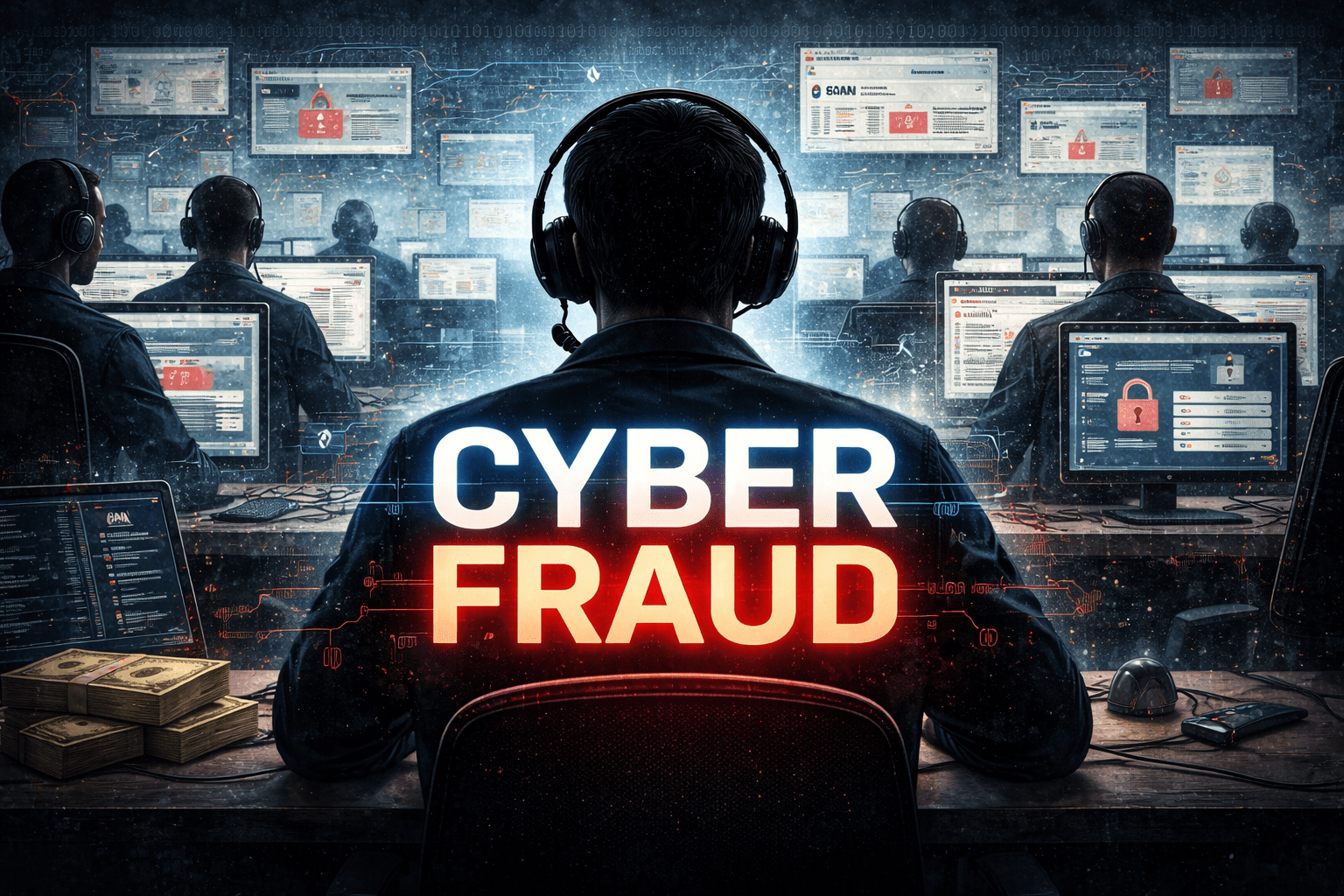
Many cyber fraud schemes operate from organized overseas call centers. Some even “contract” services, such as buying contact lists or hiring companies to create fake websites.
Because victims, evidence, and perpetrators often span multiple countries, investigations demand close coordination. Daud illustrates a typical case: “A call center gets busted in India, but the victims are U.S. citizens, and the financial trail lies in the United States. Indian law enforcement reaches out to the FBI, and the FBI reaches out to the victims and prepares for testifying in Indian courts. The FBI also helps Indian law enforcement finish the financial chain of evidence as the losses are in the United States.”
This cooperation ensures accountability. “This evidence and victim testimony ensure that call center operators in India are held accountable in court. Without this cooperation, the case cannot be prosecuted,” says Daud.
One recent success shows the impact of U.S.–India collaboration. A joint investigation by the FBI Baltimore Field Office, the Montgomery County Police Department, and the Montgomery County State’s Attorney’s Office traced fraud schemes targeting Maryland residents and hundreds of other Americans to organized scam call centers in India. India’s Central Bureau of Investigation (CBI) dismantled the call centers in December 2025, arresting six Indian nationals who led the criminal syndicates responsible for stealing almost $50 million from Americans.
“There have been numerous such examples of success recently. This is all possible due to FBI and Indian law enforcement working hand in hand as partners,” Daud notes. Beyond individual cases, these efforts build long-term disruption by weakening criminal ecosystems—cutting off financial channels, digital infrastructure, and recruitment pipelines that sustain fraud operations.
Why awareness matters
Cyber fraud affects people of all ages and backgrounds. “One common misconception is that cyber fraud only targets people who are not tech-savvy,” Daud explains. “People often believe they would never fall for a scam. These scams exploit human psychology, not technical weakness.” Cyber fraud is not a victimless crime. It affects retirees, families, and small businesses. In many cases, the emotional impact equals the financial loss.
“Awareness is one of our strongest defenses,” Daud emphasizes. Even a brief pause can help people recognize a scam and avoid financial or emotional harm. Reporting scams is also critical. “Even if money has already been lost, reporting helps law enforcement identify patterns and disrupt criminal networks,” he explains.
“Because of the location of bad actors and the ease with which money can be moved globally, cooperation between all law enforcement agencies has never been more important,” Daud says. “Collaboration allows law enforcement to extend across borders, apprehend subjects, and secure justice.”
Technology evolves rapidly, and ongoing engagement ensures that investigators stay ahead of criminal tactics. “This partnership,” he adds, “is about building durable institutional strength, not just solving isolated cases.”
By Charvi Arora
The above article was published in SPAN Magazine and is being reproduced here with their permission.
Also Read: Operationalizing the U.S.-India Defense Partnership
You can connect with DNN24 on Facebook, Twitter, and Instagram and subscribe to our YouTube channel.