
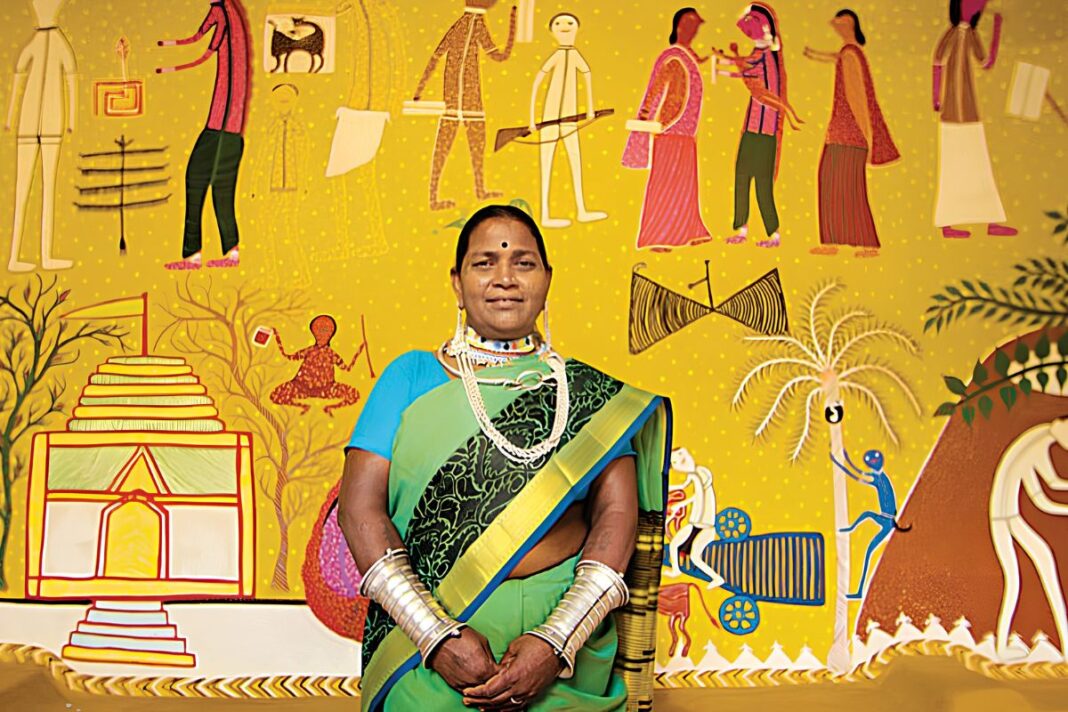

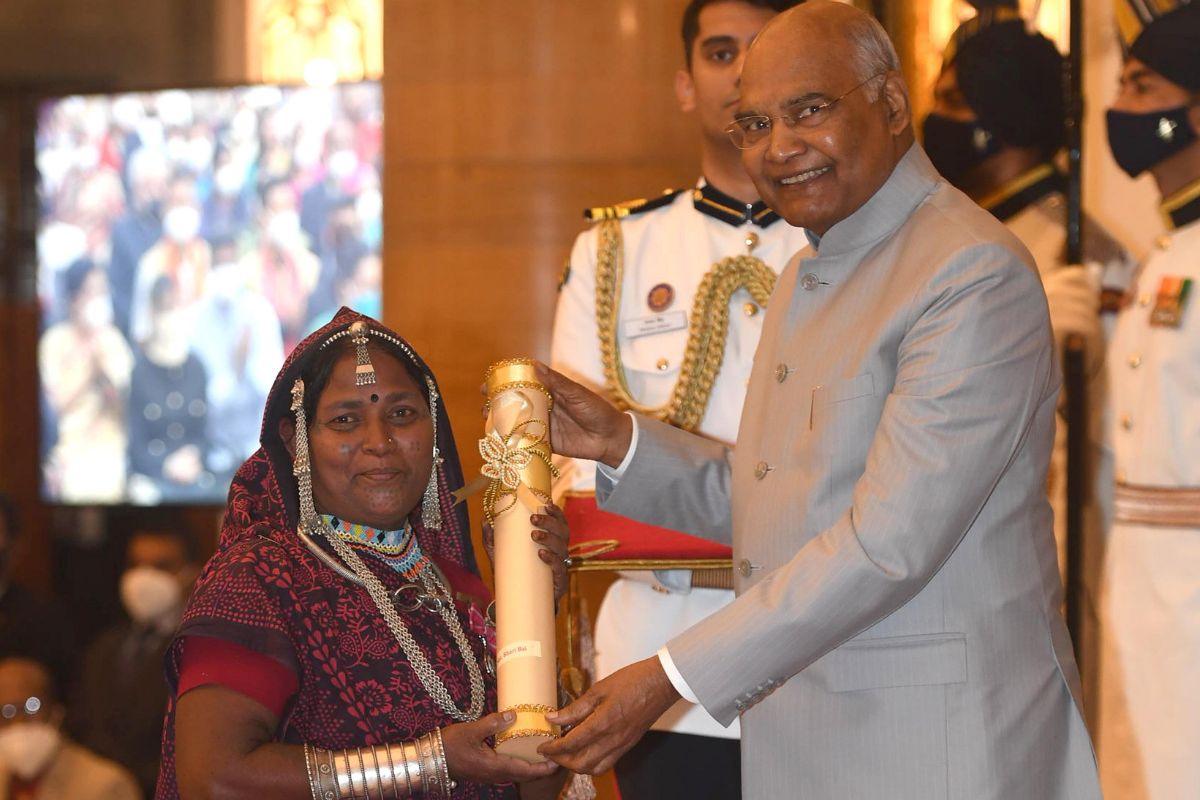
Bhuri Bai once carried bricks at Bharat Bhawan- the Bhopal art centre- for daily wages, unaware that her hands already held a gift the institution had been looking for. Years later, she would become the first artist of the Bhil community to paint on paper and canvas. This shift eventually earned her the Padma Shri, one of India’s highest civilian honours.
Her paintings are full of movement. Forests seem to sway, animals wander freely, festivals unfold in colour, and memory itself takes visible shape. Yet her work is more than personal expression. It stands as a living record of Bhil culture, imagination and daily life. Born in Pitol village in the Jhabua district of Madhya Pradesh, Bhuri Bai rose from a marginalised rural background to become one of the country’s most respected tribal artists.
What makes her story remarkable is that it doesn’t follow a familiar route to success. It quietly changed what people were willing to accept as art, who they considered an artist, and whose stories were finally worth telling.
A Childhood Steeped in Colour
Bhuri Bai belongs to the Bhil community, among the largest tribal groups in India. She grew up near the border of Madhya Pradesh and Gujarat, surrounded by forests, farm animals, village homes, seasonal markets, festivals and oral storytelling. This was the raw material for her imagination long before she ever held a brush in her hands.
In Bhil tradition, art was not something displayed in frames. It lived on the walls and floors of homes, painted with colours drawn from earth, plants and clay. One important form connected to this world is Pithora painting, a ritual practice tied closely to community beliefs and ceremonies.
For young Bhuri Bai, none of this was abstract or distant. It was simply life. The animals, trees, people and rituals she saw each day became the earliest subjects stored in her visual memory, subjects she would later transform into energetic compositions filled with rhythm and colour.
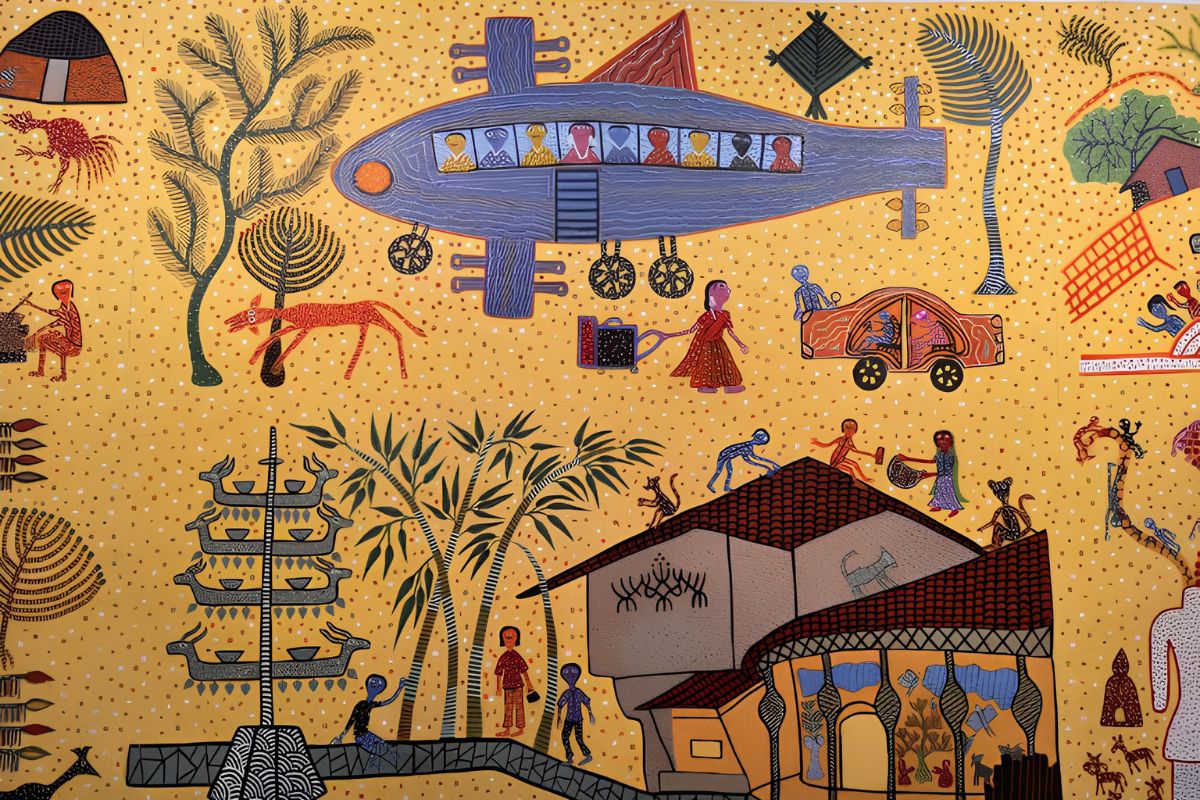
One feature sets her paintings apart immediately. Tiny dots cover her human figures, animals, trees and landscapes, arranged so closely that they create texture and a sense of motion across the canvas. These dots are not decoration alone. They connect her individual style to the wider language of Bhil visual tradition.
The Meeting That Changed Everything
In the 1980s, following her marriage, Bhuri Bai moved to Bhopal and found work as a construction labourer at Bharat Bhavan, an arts centre led by the artist, J Swaminathan. Swaminathan had a deep interest in the artistic traditions of tribal communities across Madhya Pradesh. While speaking with Bhil labourers about their gods and customs, he discovered that one of the women working on the site had painted images on the walls of her own home.
That woman was Bhuri Bai. Swaminathan asked her to try something new – paint on paper. Until that moment, her entire artistic life had unfolded on mud walls during domestic rituals and community occasions. Painting on paper was unfamiliar territory. Swaminathan gave her sheets of paper, poster colours and a prepared brush, materials completely different from the natural pigments she once had to extract slowly from soil and plants.
Her first painting on this new surface depicted her family’s ancestral horse. She later recalled being amazed by the brightness of the ready colours and the simplicity of using a brush that did not need to be made by hand. According to the Indira Gandhi National Centre for the Arts, this made her the first Bhil artist recorded as working on paper and canvas.
Learning to See the Canvas
The change was not easy at first. Bhuri Bai was used to painting while standing before a wall, and sitting down to work on a flat sheet felt strange. She sometimes painted from different sides of the paper, which caused her figures to appear at unusual angles. Swaminathan did not see this as an error to correct. He recognised the originality and encouraged her to keep working in her own way.
He also began buying her early paintings, paying her nearly twice what she earned as a daily wage worker. This was a turning point. Painting shifted from an occasional traditional activity into something that could support her family. She later said she was astonished that she could earn money simply by sitting and painting.
Swaminathan’s support extended beyond materials and payment. Her family doubted her new work at Bharat Bhavan, so he arranged for her husband to take a position as a watchman there, easing their concerns and making the arrangement easier to accept.
His contribution was not instruction. He did not teach Bhuri Bai the stories, symbols or rituals of Bhil culture, since those were already hers. What he offered her was recognition, access to materials, a place to work and the practical support that allowed her talent to survive and grow.
A World Where Old and New Sit Together
Bhuri Bai’s paintings hold memory without freezing it in the past. She paints forests, animals, deities, ornaments, huts, granaries, festivals and dances drawn from Bhil life, alongside gatla, or memory pillars, and stories passed down through oral tradition.
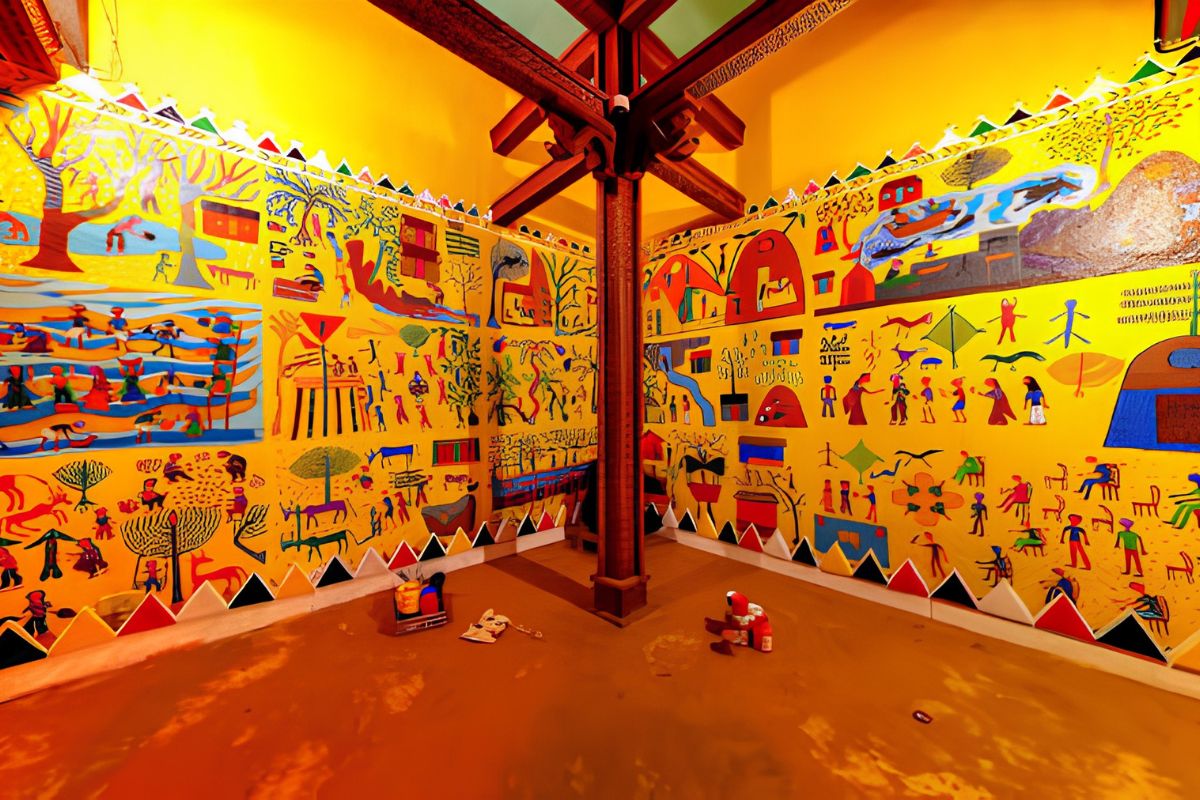
Her compositions rarely follow a single storyline. Instead, several aspects of community life often appear together on one surface. A tree, an animal, a house and a person may sit side by side, joined not by strict sequence but by memory and imagination.
Remarkably, she also paints aeroplanes, television sets, cars and buses next to trees and animals. This is a deliberate choice, not an accident. It shows that tribal life is not frozen in an earlier age. Bhil communities, like any other, experience technology, migration and social change, and Bhuri Bai’s canvases capture that ongoing conversation between inherited memory and present reality.
Recognition Beyond the Village
Bhuri Bai received the Madhya Pradesh government’s Shikhar Samman in 1986 and 1987, described as the state’s highest honour for artists. In 1998, she received the Ahalya Samman, and in 2021, the Padma Shri.
These awards mark artistic achievement, but they also reflect a broader shift in how India views indigenous and folk art. For decades, such work was treated mainly as craft or ritual decoration rather than fine art. Artists like Bhuri Bai proved that these traditions carry their own aesthetic depth, history and relevance to contemporary life.
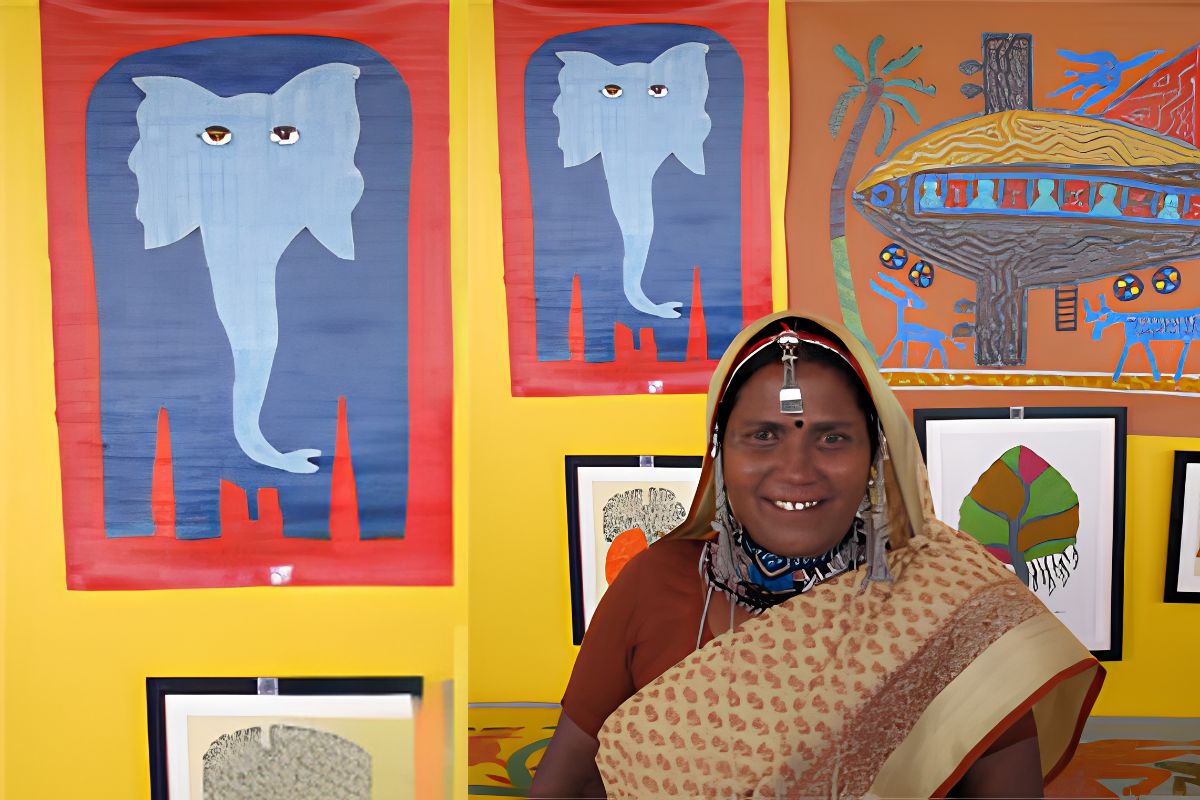
Her shift from wall to canvas mattered in another practical sense too. A wall painting belongs to one place and often disappears when that wall is rebuilt or repainted. A painting on canvas can travel, be preserved, exhibited and studied for generations.
A Legacy Still Unfolding
Bhuri Bai’s story is ultimately about opportunity meeting talent. A woman from Pitol, who began within her community’s tradition and drew on memories of village life, found a way to carry those memories into museums and galleries across the country.
Her journey offers a lesson that reaches far beyond art. Talent exists everywhere, but opportunity does not always find it. Bhuri Bai’s life changed the day someone finally asked her to paint what she already knew, and took her seriously when she did.
Today she stands as a bridge between oral memory and public culture, proof that the smallest village, seen through the right eyes, can hold an entire universe of art.
Also Read: From Guns to Glamour: Surrendered Naxal Women Walk Fashion Ramp
You can connect with DNN24 on Facebook, Twitter, and Instagram and subscribe to our YouTube channel.