
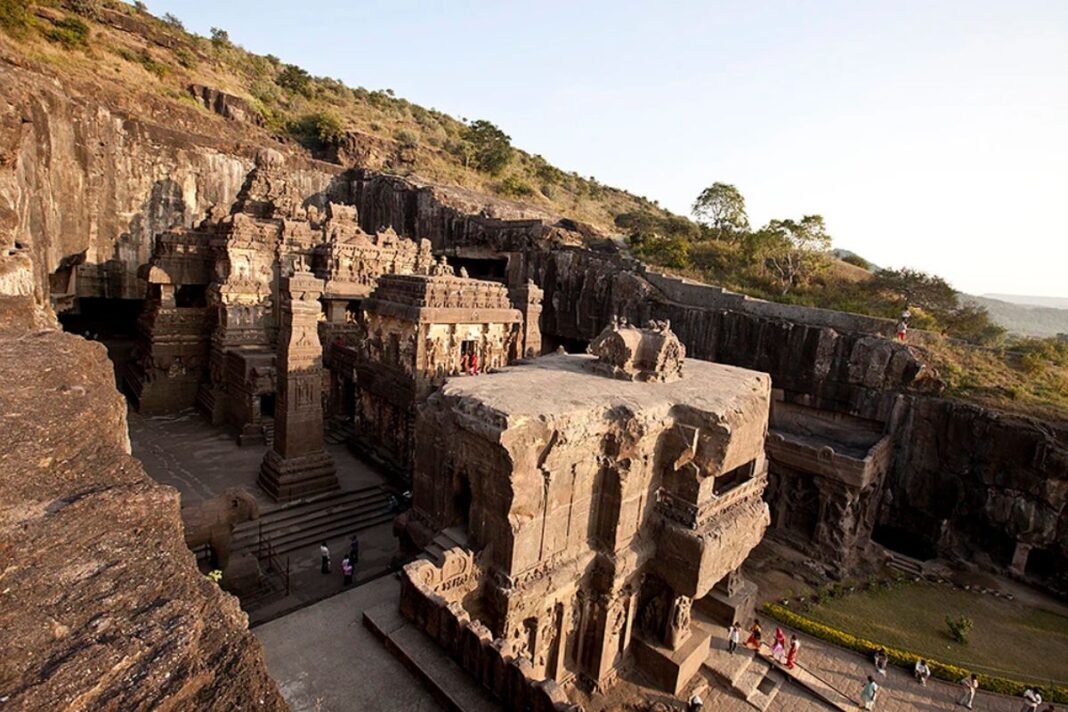

The mountain was carved, cut away piece by piece until a temple stood where solid rock had existed once. On the basalt cliffs of the Charanandri Hills in Maharashtra, generations of workers did something that still puzzles engineers today. They did not stack stone upon stone the way builders normally do. They took a whole hillside and worked at it with their chisels, leaving behind Ellora- 34 caves stretching across more than two kilometres of rock, and a structure so ambitious that historians still wonder exactly how it was done.
Ellora is often introduced as a heritage site, a line on a tourist map. That description barely scratches the surface. Ellora is more a diary written in stone by three different faiths- Buddhist, Hindu and Jain- over roughly six centuries. It wasn’t planned as a single project. It grew slowly, cave by cave, until the cliff itself became a record of how Indian religion, art and engineering evolved side by side.
A civilisation that worked backwards
Most builders start with nothing and add material until a structure appears. The people who created Ellora worked the other way round. They started with a solid mass of volcanic rock and removed what they did not need. Every pillar, doorway, and seated figure of a god or teacher had to be pictured first and then slowly uncovered through careful, irreversible cutting.
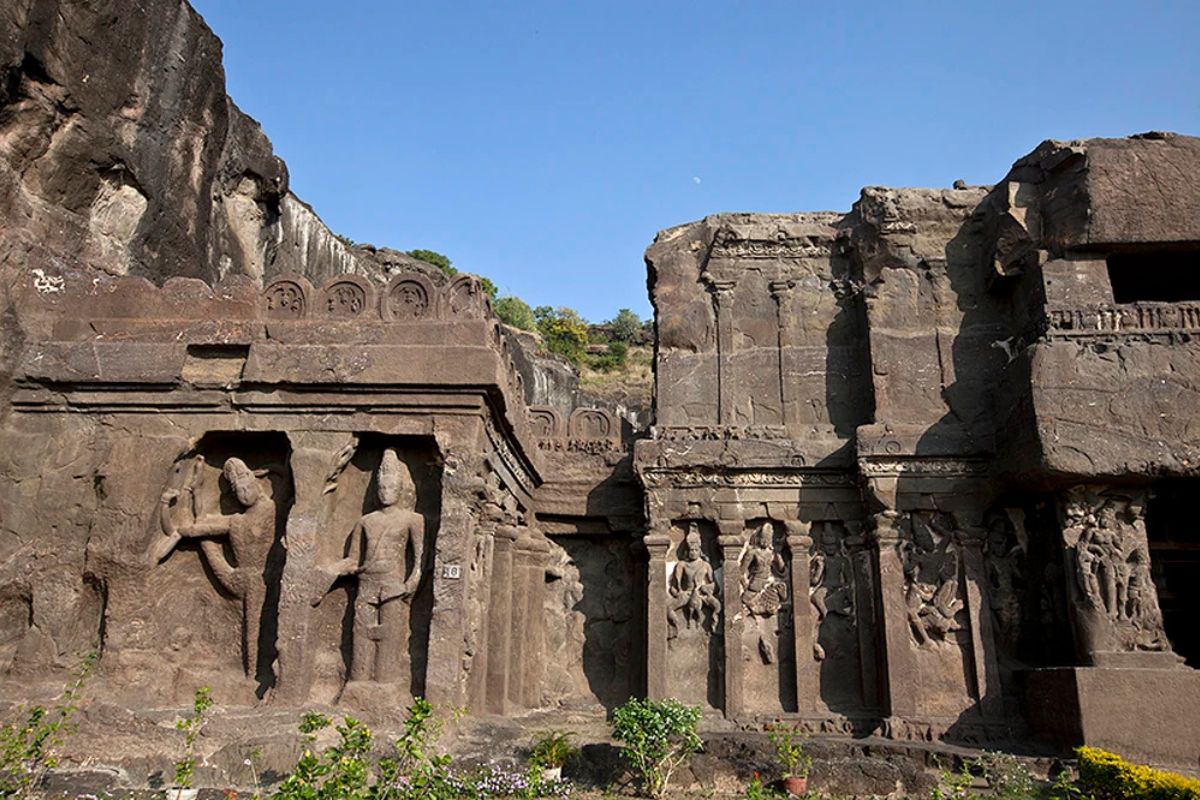
There was no room for a second attempt. Add too much stone by mistake in ordinary construction, and you can build again. Cut away too much rock at Ellora, and the error was permanent. This single fact explains why the site still commands respect among architects and archaeologists today.
The caves were shaped in three broad waves. Caves one through twelve belong to the Buddhist tradition, created mainly between the fifth and eighth centuries, reflecting the Mahayana school that was flourishing across the region. Caves thirteen through twenty-nine are Hindu, cut mostly between the seventh and tenth centuries. The final group, caves thirty to thirty-four, belong to the Jain tradition and were completed between the ninth and twelfth centuries: three religions, one cliff, six hundred years of continuous work.
Among the Buddhist caves, Cave 10, called Visvakarma, or the Carpenter’s Cave, stands out for its prayer hall and its ribbed ceiling, cut to resemble timber beams even though no wood was ever used there. Cave 12, known as Teen Tal, rises across three storeys and shows how far monastic architecture had advanced. These were not simple prayer rooms. They functioned as places where monks lived, studied and organised their daily religious life.
The temple that should not have been possible
Cave 16, the Kailasa Temple, is the monument that draws visitors from every corner of the world to Ellora. Historians often call it the largest single piece of rock-cut architecture on earth, a claim that grows easier to believe once you learn how it was made.
The temple stands for Mount Kailasa, the Himalayan home of Shiva. Instead of carving a chamber into the cliff face like most caves at the site, the builders cut trenches around a huge block of stone, separating it from the surrounding hillside. What remained was a solid island of basalt, and that island became the temple.
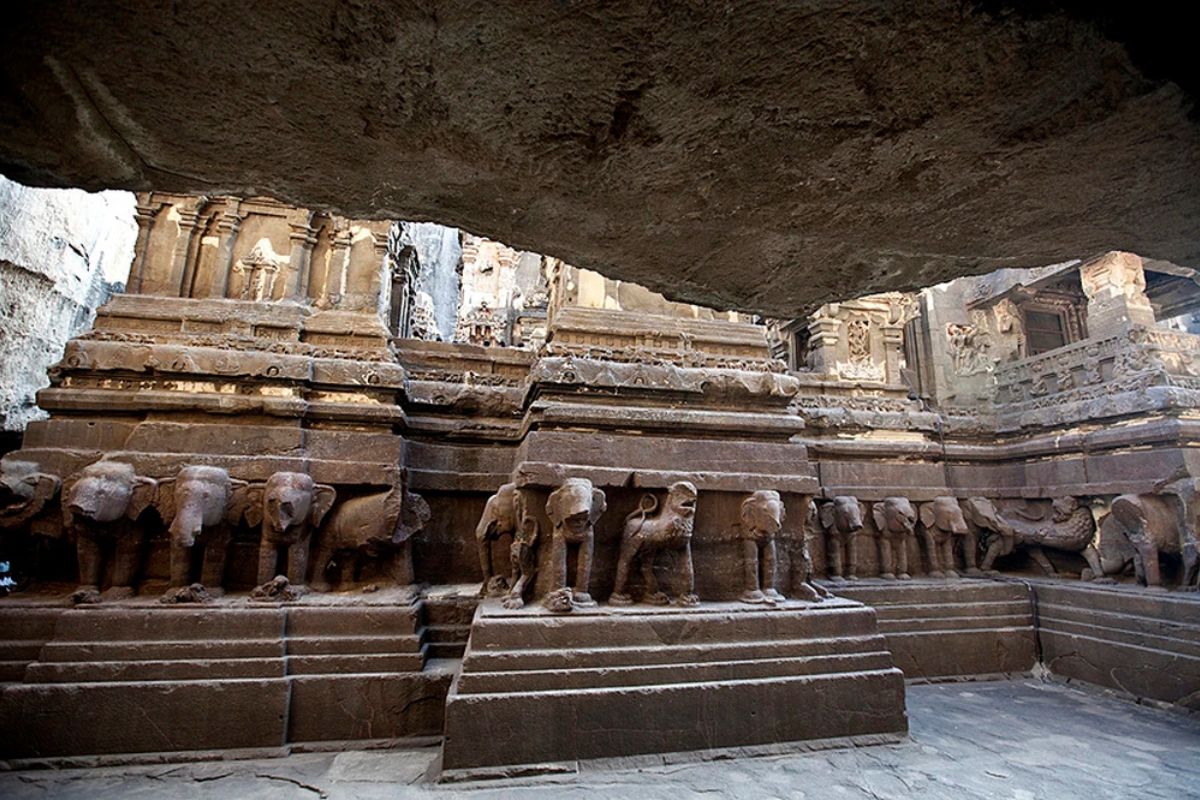
Then came the strangest part. Workers began at the top, shaping the tower and roof first before moving downward, level by level, defining walls, pillars and courtyards as they went. Starting from the bottom would have trapped the upper structure inside rock still joined to the cliff. Working down let them define the outer form before touching the lower levels.
The finished temple holds a grand gateway, a courtyard, a shrine for Nandi, a rock-cut linga, smaller shrines and carvings of elephants and gods across nearly every surface, all uncovered rather than built.
Delicate art at the edge of the cliff
At the northern end of the complex, the Jain caves offer a very different mood. Where the Hindu caves often express drama and power, the Jain carvings tend toward precision and calm. Cave 32, associated with Indra Sabha, is considered the finest of this later group. Its sculptures reflect the Digambara tradition and show that Jain artists adapted the same rock-cut method to their own religious ideas rather than simply repeating older styles.
Why three faiths shared one cliff
Ellora’s deepest significance may not lie in any single cave but in the fact that Buddhist, Hindu and Jain monuments sit together across the same stretch of rock. This does not mean ancient India was free of tension between religious communities. It would be misleading to suggest otherwise. What the site does prove is that three major traditions built lasting sacred spaces in the same location over hundreds of years, leaving behind a shared cultural landscape rather than three separate, isolated ones.
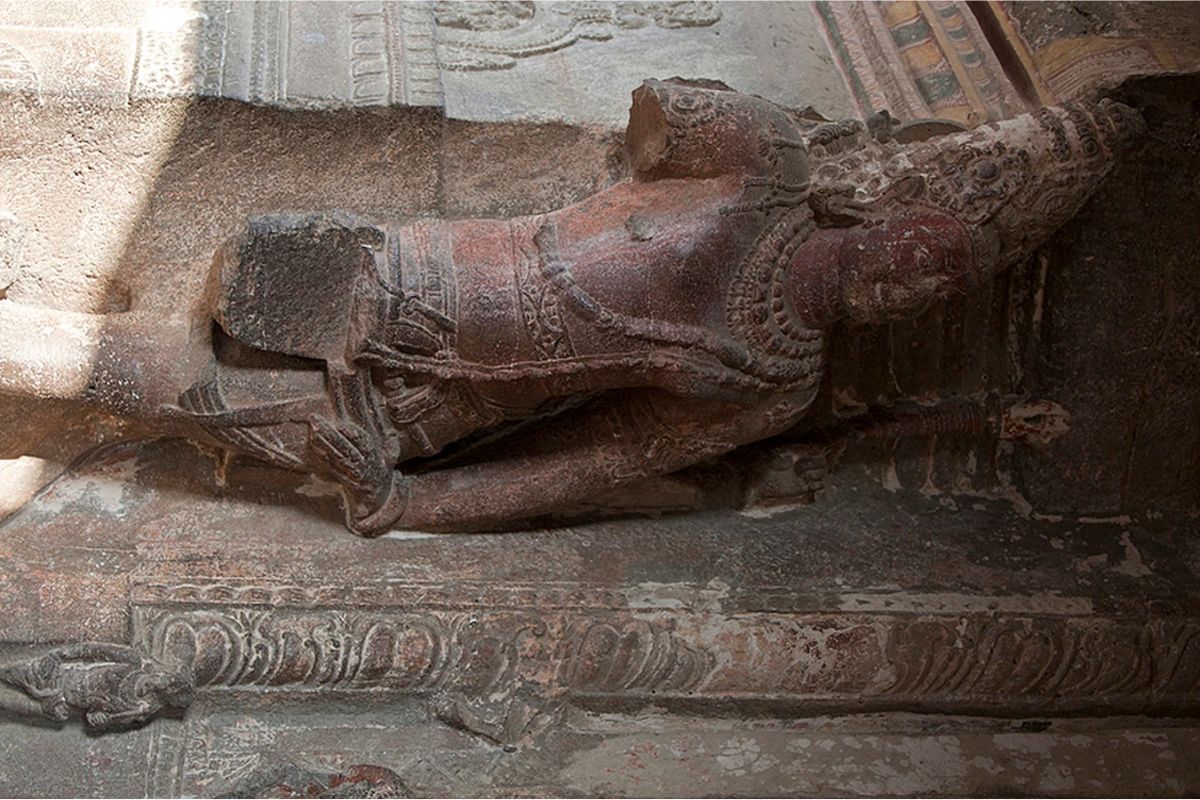
UNESCO recognised this significance when it added Ellora to the World Heritage List in 1983. The Archaeological Survey of India now manages the site, working alongside the Forest Department and the state government of Maharashtra to protect both the caves and the land surrounding them.
Protecting something that cannot be rebuilt
Preservation at Ellora is a delicate task. Water seepage threatens rock surfaces and the faded remains of ancient paintings, while cracks form slowly across centuries of exposure, and visitor traffic adds further strain. UNESCO has flagged environmental monitoring, structural cracking and the need for stronger conservation expertise as ongoing concerns.
Unlike a damaged building, a damaged cave cannot simply be repaired with new material. The rock removed centuries ago is gone. What survives has to be protected exactly as it stands, which makes every visitor’s behaviour part of the conservation effort, whether that means staying off restricted surfaces or following the paths laid out by site managers.
What the cliff still says
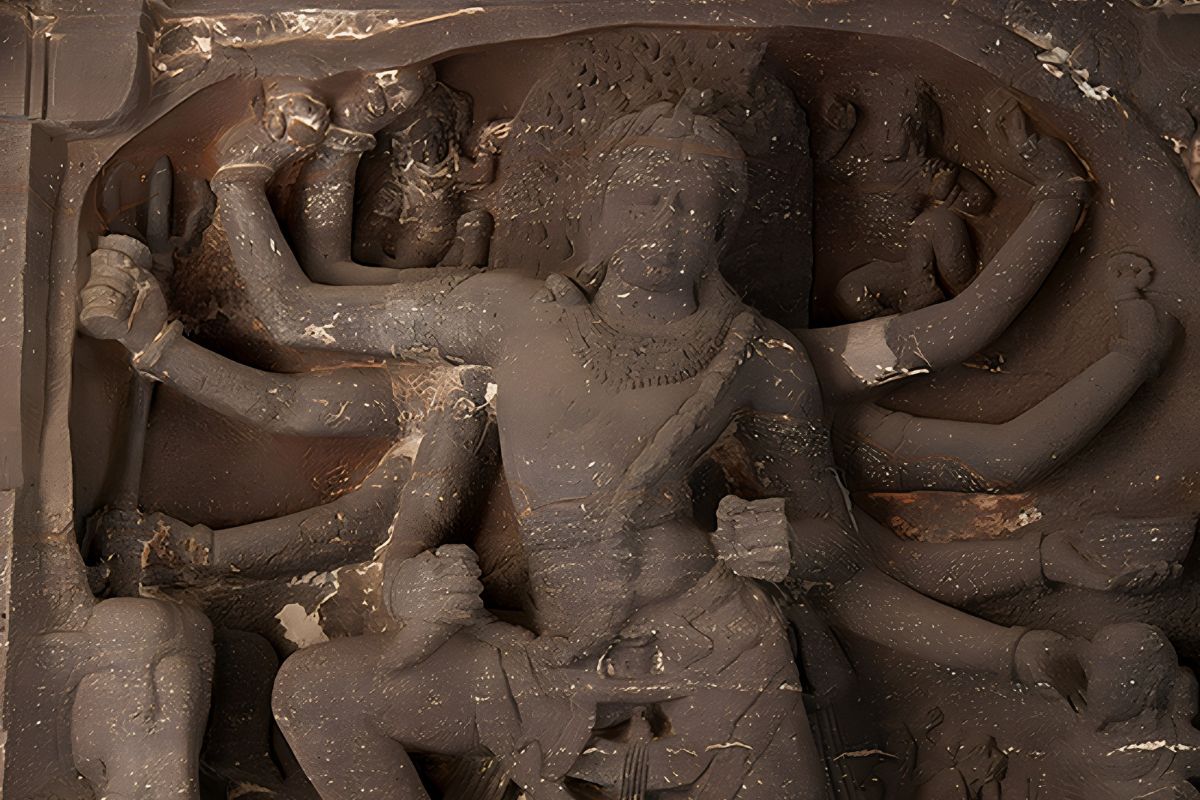
Ellora endures because its builders combined imagination with an almost unbelievable level of discipline. They saw temples and monasteries inside a mountain that, to anyone else, would have looked like nothing more than solid rock. Then they spent generations proving that vision was right, one careful cut at a time.
The site also challenges a modern instinct to separate people by belief. At Ellora, three religions carved their sacred spaces into the very same cliff, choosing proximity rather than distance. The stone did not erase their differences. It simply held them together.
Stand before the Kailasa Temple today, and it is hard not to feel the scale of what was attempted here, not just in size but in confidence. The builders trusted a plan they could not test in advance, cutting downward into rock with no way to undo a mistake. What they left behind is not only a monument to three faiths but proof of what patient, coordinated human effort can achieve when there is no room left for error.
Also Read: From Guns to Glamour: Surrendered Naxal Women Walk Fashion Ramp
You can connect with DNN24 on Facebook, Twitter, and Instagram and subscribe to our YouTube channel.