

In a small village called Sheikhpur, far from any royal court or big city mushaira, a boy named Ibrahim was born in 1834. No one there could have guessed that this child would become a gentle but powerful voice of Sufi love in Urdu poetry. Ibrahim Aajiz grew up in what is now Uttar Pradesh, in an India shaken by the decline of the Mughal world and the rise of British rule.
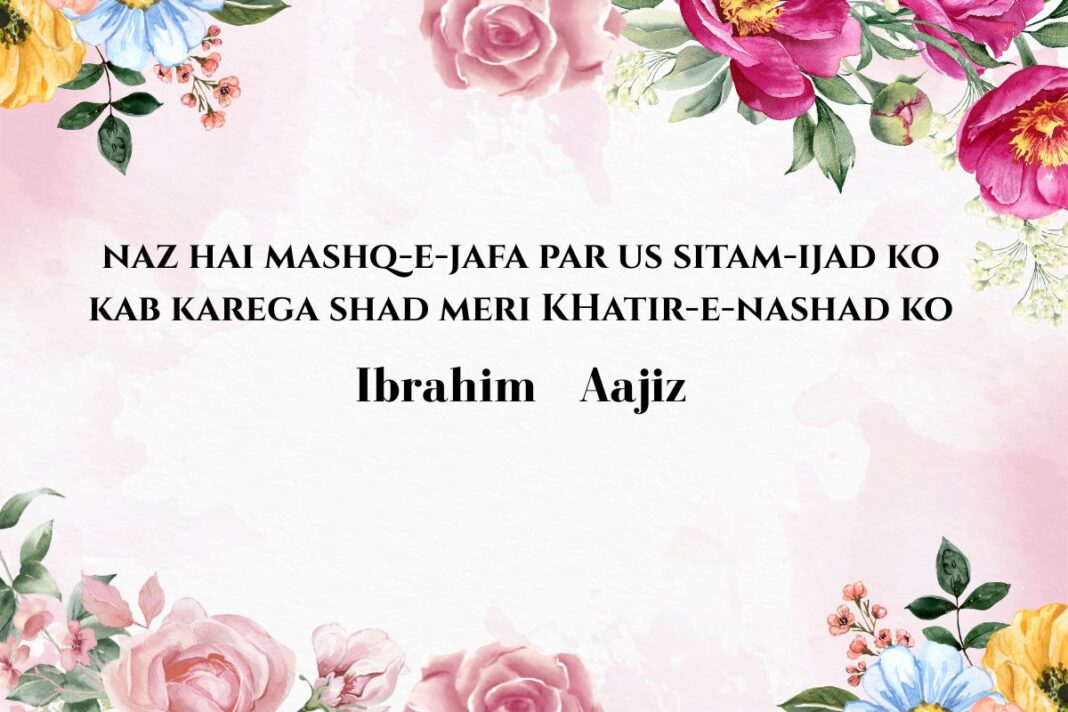
are o be-murawwat tu kahan hai
Ibrahim Aajiz
taDapta hijr mein ye na-tawan hai
Around him, people faced poverty, uncertainty, and fear, yet also sought hope and meaning. In such a restless time, Ibrahim slowly turned towards the world of inner peace, zikr, and ishq-e-haqeeqi, the love of the Divine. He would later be known in Urdu poetry as Ibrahim Aajiz, a name that itself means “the humble one”. The choice of “Aajiz” was not a fashion; it was a mirror of his inner state, a reminder that accurate height is born from sincere humility.
The Romantic Sufi Of Sheikhpur
Aajiz’s life was short: he left the world in 1882, at around forty-eight years of age, and his shrine still stands linked with Sheikhpur. Yet in those few years, he shaped a voice that critics describe as “romantic-sufistic”, full of longing, tenderness and spiritual restlessness. In his ghazals, the beloved is sometimes a human figure, sometimes clearly the Divine, and often both at once, like two reflections in one calm river. His verses talk of fana, the burning away of ego, and wahdat-ul-wujood, the deep sense that all existence is one reality.
mar kar bhi hai talash mujhe ku-e-yar ki
Ibrahim Aajiz
miTTi KHarab kyon na ho mere ghubar ki
Sufis, he suggests, dance in the tavern of the heart, drunk not on wine but on the awareness of God’s nearness. The classic images of Urdu poetry appear again and again in his work: zulf, shama, parwana, mehfil, maykhana. All of them carry a clearer spiritual fragrance in their hands. His ghazals have a lyrical, musical tone; they are meant to be recited slowly, savoured word by word, rather than rushed through like news. Even today, some of his couplets are shared in recitations and online posts that invite listeners to pause and find comfort in the silence between two lines.
History’s Winds Around A Still Heart
To understand Aajiz, we must place him inside the storm of his century. Born in 1834, he was a child when the old order was collapsing and a young man when 1857 shook North India, turning many cities into graveyards of hope. Towns, languages, and loyalties were being remade as the British tightened their rule and old power structures dissolved. In this environment, Sufi shrines, khanqahs, and poetry gatherings became spaces where people carried their grief into something larger than themselves.
na tanha main hi dam bharta hun teri aashnai ka
Ibrahim Aajiz
jahan mein shor hai ai shoKH teri dilrubai ka
Aajiz did not shout political slogans; his resistance was softer but no less real. By celebrating inner freedom, he quietly questioned any outer force that tried to crush the human spirit. While some poets leaned towards courts and patrons, his poetic personality remained rooted in the soil of Sheikhpur, closer to common seekers than to powerful rulers. In this way, his life stands as a minor yet bright footnote in the long story of how ordinary Indians carried faith, culture, and dignity through the most challenging historical turns.
The Ghazals: Love As A Secret Path
Reading Aajiz’s ghazals today is like opening a window into a room filled with old attar: familiar, delicate, yet quietly piercing. Many of his lines circle one central feeling: the ache of distance from the beloved, and the mysterious joy hidden inside that ache. The heart, for him, is both wound and cure, arrow and target, desert and garden. He writes of the crisis of the seeker, drawn to worldly beauty but haunted by a deeper thirst that nothing visible can fully quench.
wo barq-e-jalwa dikhae jamal agar apna
Ibrahim Aajiz
to ai kalim karen hum nisar sar apna
His verses echo classic Sufi ideas: that the ego must burn, that love must strip away pride, that what we lose on this path is actually what was stopping us from seeing clearly. At the same time, the tenderness in his romantic tone makes his poetry accessible even to readers who may not be familiar with technical Sufi terms. This balance of softness and depth, romance and transcendence, explains why modern reciters and listeners still turn to his lines when they need language for their own hidden restlessness. His legacy lives less in grand monuments and more in the quiet way a single sher can sit with a person on a lonely night.
Why Ibrahim Aajiz Matters Today
In our world of constant noise, scrolling, and speed, Aajiz’s gentle insistence on inner stillness feels unexpectedly modern. His call to burn ego, to listen to the heart, and to see all beings as reflections of one reality speaks directly to our age of division, loneliness and spiritual exhaustion. When people across platforms share his couplets with captions about slowing down and finding comfort, they are unknowingly extending his khanqah into the digital space.
wah kya KHub mah-laqa dekha
Ibrahim Aajiz
jalwa us ka har ek ja dekha
For young Indians searching for identity between religion and modern life, his poetry offers a bridge: deeply rooted in Islamic Sufi tradition, yet expressed in a language of universal longing. He also matters for literary history, reminding us that not every significant voice came from Delhi, Lucknow, or big institutions. Some shayars like Aajiz bloomed in small villages and still shaped the fragrance of Urdu. To revisit Ibrahim Aajiz today is to learn that humility can be a form of strength, that love can be quiet and still revolutionary, and that even a brief life in a forgotten corner can leave a trail of light in the long corridor of time.
Also Read:Gauhar Hoshiyarpuri: A Name Born From Dust and Dreams
You can connect with DNN24 on Facebook, Twitter, and Instagram and subscribe to our YouTube channel.