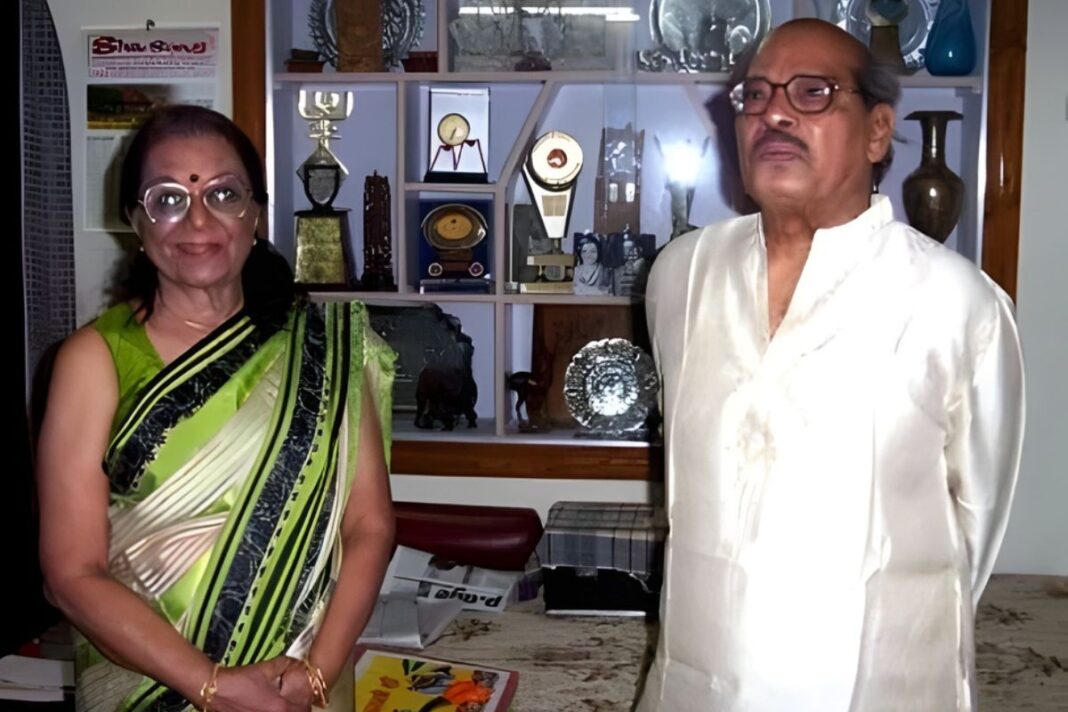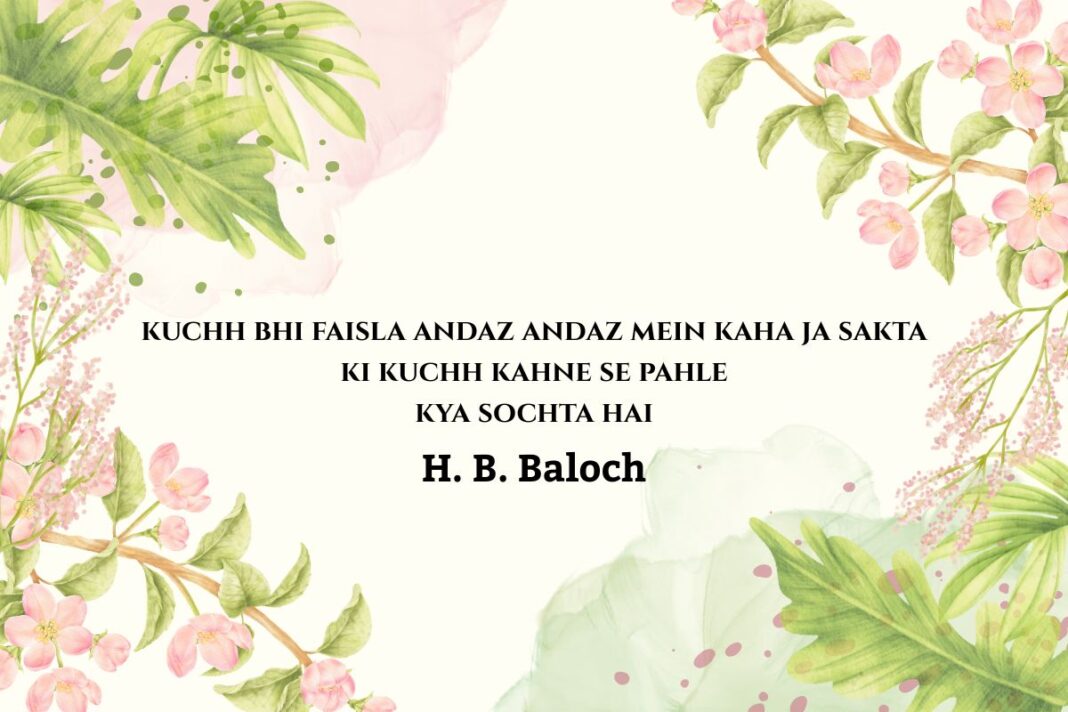

If you want to understand H. B. Baloch, you must first consider Sindh, with its long, flat fields, slow evenings, and quiet winds that seem to carry half-said sentences. He was born there on 15 January 1978, with the name Hazbullah Leghari, in a world that did not know that this child would grow into a voice for inner struggle, fragile hope, and social pain.
mere itminan ke liye
H. B. Baloch
nile samundar
hasin jhil
ya kisi ghas se lipTe hue talab ka zikr zaruri nahin
He did not come from the big, shining cities of fame; he came from a province that has consistently produced stubborn dreamers who mix love and resistance in one breath. Urdu was not the only language around him, but it slowly became the language in which his inner weather began to speak. When he chose the name ‘H. B. Baloch, for his literary journey, carried two things together: his personal identity and the shared history of the Baloch people, known for their pride, patience, and long memory.
mera yaqin samundar jhil aur ek talab se ziyaada sada hai
H. B. Baloch
ye aankhon pe hi e’tibar kar leta hai
Slowly, his relationship with words became serious. He did not just write to pass the time; he wrote as if each line were a small boat trying to cross a dark river. Later, his nazms and ghazals began to appear on platforms that honour Urdu poetry, and his name quietly entered the long list of contemporary poets from Sindh.
aankhen chahe sukhi hon
H. B. Baloch
ya pur-ashob
un ki gahrai ka muqabla pani se nahin kiya ja sakta
His creative life grew in the late twentieth and early twenty-first centuries, in a Pakistan marked by dictatorship, democracy, social inequalities, and the rapid, confusing impact of the media. This history is essential because you can feel it under the surface of his lines: a mix of tiredness and courage, disappointment and yet a thin, shining thread of belief that refuses to break.
From printed page to glowing screen today
If you search for H. B. Baloch today, you do not find a heavy, official biography; you find living traces. Ebooks of his collections, scattered poems on websites, and his presence as an educator and writer on social platforms. His verses appear on poetry archives where people go to read ‘Udas Lahr Ka Akhri Zeena’ and ‘Sitara So Raha Hai’, book titles that already sound like stories of the last step of sadness and a star trying to rest after a long night.
On UrduPoint and similar sites, you see nazms like ‘Mujhe Dhundna Bada Aasan Hai’, ‘Yaqin Ki Koi Had Nahin Hoti’, and ‘Hawa Ek Qalam Hai’, which show his favourite themes: identity, faith, search, dreams, and the invisible forces that shape a person’s life.
aankhen KHush hon
H. B. Baloch
ya udas
lekin ye sirf tumhaari apni honi chahiyen
kisi aur ki aankhon se dekhte hue
yaqin ki koi had nahin hoti
At the same time, there is another side of him: a present-day educator, writer, and ‘struggling for change’, as he describes himself on his public profile. This simple line tells you a lot. It means his writing is not only for aesthetic pleasure; it is tied to teaching, guiding, and gently pushing society towards greater awareness.
jab use patthar se banaya gaya ho
H. B. Baloch
yaqin ke liye kisi KHas din ka hona zaruri nahin
jab use KHwabon se buna gaya ho
His online activity, including short videos and reflections, shows a person who wants to talk to ordinary young people in a direct, friendly voice, not from a pedestal. In this way, H. B. Baloch stands with one foot in the classical tradition of Urdu nazm and ghazal, and the other in the restless, glowing world of TikTok, websites, and quick digital reading. His archive is not a closed cupboard; it is a moving stream that keeps meeting new readers every day.
The inner map of his poetry and prose
When you look carefully at the available pieces of H. B. Baloch’s work, one pattern becomes clear: he writes as if he is walking inside human doubt and human hope at the same time. Titles like ‘Khwab Se Nikli Hui Nazm’ (a poem born from a dream) and ‘Khwab Aur Konplen’ (dreams and buds) show a firm trust in the inner life, in the power of dreams, and in the possibility that something new can still grow, even after many seasons of failure.
main jalta rahta hun
H. B. Baloch
do hisson mein
main jine ki koshish nahin karta
log mujhe jina chahte hain
In another famous line, he writes that there is no limit to certainty, which hints at a mind that keeps testing the borders of belief and disbelief, trying to find where absolute conviction begins. His nazm ‘Mujhe Dhundna Bada Aasan Hai’ talks about the act of being found, of being seen, which can also be read as a deep desire in every sensitive person: to be recognised beyond masks and social labels.
yunhi bikhre wajudon mein
H. B. Baloch
wo mujhe chun chun kar oDh lete hain
He does not belong to just one mood, like pure romance or pure politics. His work moves between love, sadness, social concerns, friendship, and quiet spiritual searching. You can also sense a meta-awareness when a line reflects on how difficult it is to analyse a poet’s life, almost warning the reader not to trap any poet, including him, in a simple formula. Stylistically, he is comfortable in nazm, where he can follow one idea step by step.
bhuke peTon be-hayat poron mein
H. B. Baloch
koi lafz nahin hota
jaane kyon main un ki zaban ki gali ban jata hun
main nang-e-nafas mein uThta hun
Still, he also writes in a way that feels modern, accessible, and clean, without unnecessary decoration. The result is that a young reader who may not be familiar with the heavy classical tradition can still enter his work and feel at home. His poems become like a mirror in a small rented room: modest in size, but deep enough to show you a face you did not fully recognise before.
Why H. B. Baloch matters in our broken time
Today, when many young people in South Asia feel pulled between fast entertainment and deep anxiety, H. B. Baloch offers a different model of the writer: an educator-poet who uses both the page and the screen to keep asking gentle yet profound questions. His self-description as someone ‘struggling for change’ is essential in a time when cynicism feels fashionable, because it tells young writers and readers that you can still choose effort over numbness.
baiThta hun
H. B. Baloch
koi ghair-mari quwwat
mujhe apne tabqe se chipkae rakhti hai
jab kabhi main KHud ko
His poems about dreams, search, and the difficulty of understanding a poet’s life speak directly to a generation tired of easy labels and seeking more honest language about pain, failure, and small courage. For students and emerging writers in India and Pakistan, his journey from a Sindhi background into the broader world of Urdu literature and digital platforms quietly says: your location is not your limit; it is your starting point.
un se
H. B. Baloch
alag karna chahta hun
hamesha ki tarah darwaze ke bahar rah jata hun
mujhe DhunDhna baDa aasan hai
mujhe DhunDne ke liye
har hukmran apni lughat rakhta hai
In a region where identities are often reduced to headlines, his choice of the name ‘H. B. Baloch’s also becomes a soft political act, keeping the Baloch and Sindhi experience visible inside the broader Urdu space. His mix of love poetry, social feeling, and reflective lines about the poet’s role helps us see that writing is not only decoration; it is also a form of inner and outer work.
ek shair ki zindagi ka tajziya karna
H. B. Baloch
intihai mushkil hai
ki wo KHush hai ya na-KHush
hansta hai ya rota hai
ya rote mein hansta hai
Reading him now can remind us that even in a noisy, polarised age, a clear, sincere voice still has value, even if it speaks from the margins. His poems do not promise significant revolutions; they offer steady companionship, like a lamp on a desk that refuses to go out while you finish one more page. In this way, H. B. Baloch becomes not only a name in an online poetry list but a quiet partner in our own struggle to stay human, attentive, and awake.
Also Read:Gauhar Hoshiyarpuri: A Name Born From Dust and Dreams
You can connect with DNN24 on Facebook, Twitter, and Instagram and subscribe to our YouTube channel.