
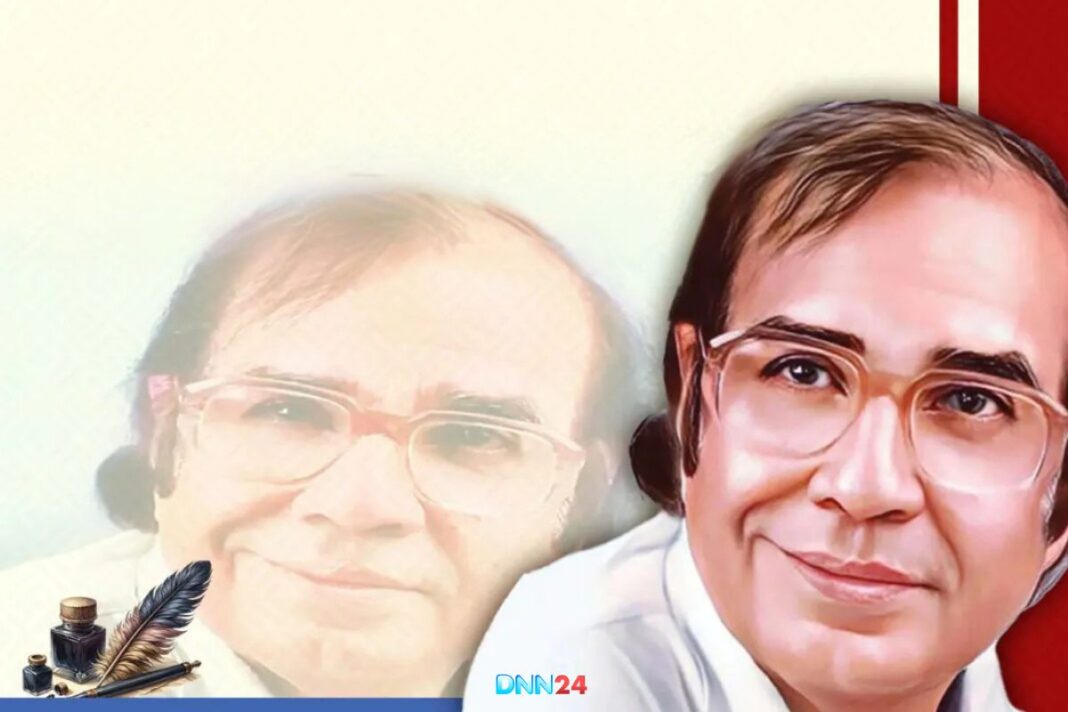

In the world of Urdu poetry, there are some names that don’t make a lot of noise, but they touch the heart. Sudarshan Fakir was one of them. He neither wrote much nor spoke much, but what he wrote is still alive in people’s minds today. His poetry contains the bitterness of life, the tenderness of love, and the silence hidden within the human soul.
Sudarshan Fakir was born in 1934 in the Ferozepur district of Punjab. His real name was Sudarshan Kamra. He belonged to a Sikh family, but he was so passionate about Urdu poetry that he considered Urdu not just a language, but an emotion. In an era when Urdu was associated with religion, Fakir Sahib proved that Urdu is the language of the heart, not dependent on any religion.
Childhood, Education, and the First Stirrings of Poetry
His childhood was spent playing in the streets of Ferozepur. Reading books, watching plays, listening to poetry – he loved all of this from the beginning. His family wanted him to get a proper job after his studies, but Fakir Sahib’s heart was set on something else.
He received his early education in Ferozepur. Later, he came to Jalandhar, where he graduated from DAV College. He also taught for some time at Doaba College. But his heart was more inclined towards imagination than academics. Poetry was not a hobby for him, but a necessity, like breathing.
During this time, he got a job at All India Radio, Jalandhar. The radio station was not just a job for him, but a place where his poetry could breathe. Sitting there, he would observe people, listen to conversations, and experience life. Perhaps this is why his poetry feels so authentic and not artificial at all.
Begum Akhtar and the Day That Changed His Destiny
The biggest turning point in Fakir Sahib’s life came when the famous singer Begum Akhtar visited All India Radio, Jalandhar. The station director told Fakir Sahib, “Go to the Skylark Hotel and bring Begum Sahiba.”
They met at the hotel. Begum Akhtar asked, “What do you do at the radio station?”
Fakir Sahib was a little embarrassed and replied, “I write poetry occasionally.” Begum Sahiba smiled and said, “Then recite something.”
Fakir Sahib hesitantly recited a couplet from a ghazal:
Some of the world’s cruelties broke my heart,
And some of the bitterness of circumstances broke my heart.
Begum Akhtar fell silent. Then she said, “Write the complete ghazal.”
There was no paper available, so Fakir Sahib wrote the entire ghazal on the hotel’s printed stationery.
Fakir’s name echoed on the radio
When Begum Akhtar’s program started on the radio, she said into the microphone, “Now I am presenting a ghazal by Sudarshan Fakir.”
Fakir Sahib, sitting in the duty room, was astonished. The way Begum Sahiba sang that ghazal silenced the entire station. After the program, people started congratulating him.
Begum Akhtar came out, put her hand on Fakir Sahib’s shoulder, and said, “What are you doing here? Come to Bombay. Your poetry will find its rightful place there.”
That was the moment that gave Fakir Sahib his wings.
Mumbai: The city of dreams, struggle, and the first big victory
Fakir Sahib quit his radio job and reached Mumbai. A new city, a new world, new faces. But the poetry remained the same, true and profound. In Mumbai, he got the film Dooriyaan. He wrote his first song:
“Come to my house, life…”
This song, sung in Bhupinder’s voice, touched people’s hearts. In 1980, this song received the Film World Award. This was a great achievement in itself; Fakir Sahib became the first lyricist to receive a major award for his very first song. Then came the Filmfare Award. He started making a name for himself in the film industry.
‘Woh Kagaz Ki Kashti’ and Jagjit Singh’s friendship
His friendship with Jagjit Singh gave Fakir’s poetry a new dimension. “Woh Kagaz Ki Kashti” became not just a song, but a story of broken hearts.
Jagjit and Fakir’s gatherings were famous. They would debate poetry for hours, refining every couplet.
“What is before us, people call bad
What they haven’t seen, they call God”
“My killer is my judge
What kind of verdict will he give in my favor?”
“Love is love, it’s not a joke
Don’t make a decision in a few moments”
The final journey and a living legacy
On February 19, 2008, Sudarshan Fakir passed away in Jalandhar at the age of 74. But his poetry lives on today in songs, in memories, and in hearts. Sudarshan Fakir wrote little, but what he wrote became immortal. This is true fakiri (spiritual detachment).
Also Read:Qurratulain Hyder: An Unmatched Voice in Urdu Fiction
You can connect with DNN24 on Facebook, Twitter, and Instagram and subscribe to our YouTube channel.