
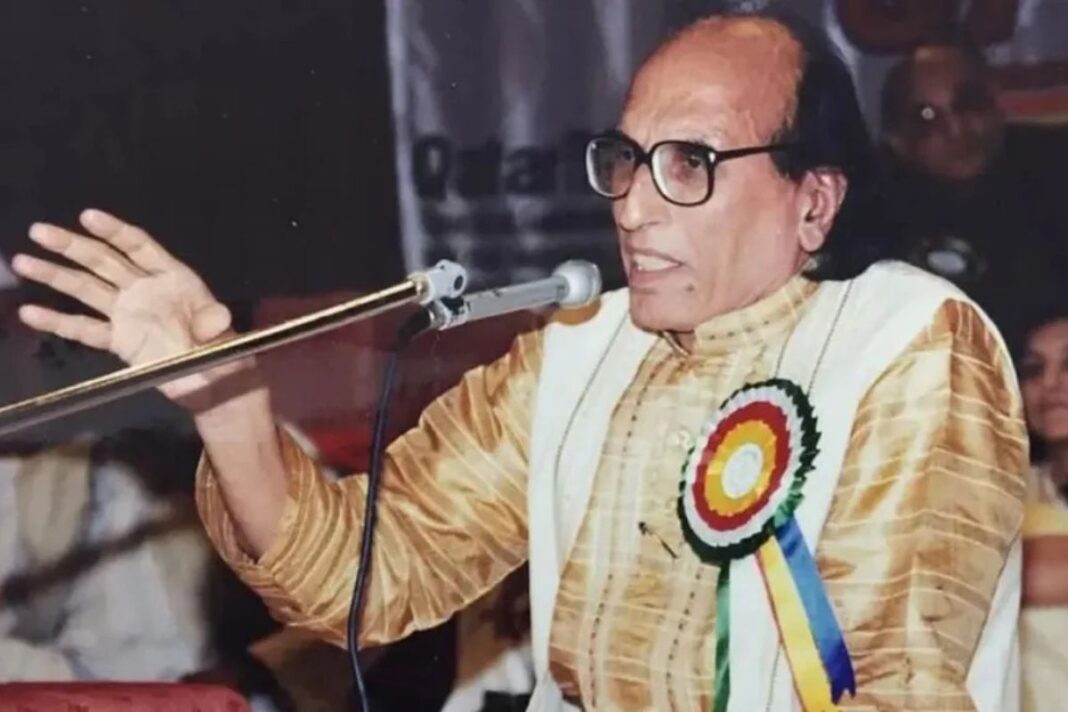

The mushaira has lost the man who kept it alive in living rooms, on dusty maidans, and in the hearts of people. Dr. Bashir Badr, widely regarded as the most accessible and widely loved ghazal poet of modern India, died at his home in Bhopal on Wednesday afternoon at the age of 91. He was suffering from dementia in his final years.
Badr leaves behind a body of work that redefined what the Urdu ghazal could achieve- not just echo in grand halls for trained ears, but settle quietly into the language of ordinary grief, ordinary affection, and ordinary endurance.
A Life That Began Modestly
Born Syed Muhammad Bashir on 15 February, 1935 in Uttar Pradesh (some records note 1936), he came from a Muslim family of modest means. He pursued Urdu literature with uncommon seriousness, completing both an MA and a PhD, before joining Aligarh Muslim University as a teacher. There, he shaped students for decades while simultaneously reshaping the sensibility of Urdu poetry outside the academy.
The pen name he chose, Bashir Badr, became, in time, one of the most recognised names in Hindi-Urdu literary culture. Not because it appeared in syllabi, but because it appeared in text messages, on wedding invitations, and was quoted by even those whose knowledge of Urdu poetry was limited.
His personal life carried real sorrow. He reportedly lost a great deal during communal violence, the kind of rupture that might easily have pushed a writer toward rage or despair. Instead, his poetry moved toward tenderness.
The Ghazal He Brought Into the Street
The classical Urdu ghazal is a demanding form. Its language has historically been ornate, its allusions layered, its emotional register pitched at a kind of operatic distance from everyday speech. Dr. Badr changed the frequency without abandoning the form.
He wrote in words that felt spoken rather than composed. His couplets had the quality of something a thoughtful friend might say during a long walk, something you could repeat to yourself later without needing to look it up.
One of his most recited sher captures this plainness in its full force:
“Ujale apni yaadon ke hamare saath rehne do, na jaane kis gali mein zindagi ki shaam ho jaaye.”
(Keep the light of your memories with me, who knows in which lane the evening of life may fall.)
There is nothing difficult here. No obscure classical reference. Only a very clear-eyed admission that life can turn without warning, and that memory is the one lamp worth protecting.
Another couplet that circulated widely, in print and later on social media, catches something precise about emotional distance in modern city life:
“Koi haath bhi na milaayega jo gale miloge tapaak se, ye naye mizaaj ka sheher hai, zara faasle se mila karo.”
(Nobody will even shake your hand if you embrace too warmly; this is a city of new temperaments. Keep a measured distance.)
The observation is rueful rather than bitter. It does not condemn. It describes. Moreover, in describing, it names an experience that millions recognised but had not found words for.
Perhaps no other couplet of his has been quoted more in times of public disagreement than this one:
“Dushmani jam kar karo lekin ye gunjaish rahe, jab kabhi hum dost ho jaayein to sharminda na hon.”
(Oppose me with everything you have, but leave this room: that if we become friends one day, neither of us needs to feel ashamed.)
In current times where disagreements can easily slip into contempt, these two lines read almost like civic instruction delivered in verse.
The Performer and the Mushaira Circuit
Dr. Badr was not a poet who wrote and withdrew. He was, by temperament and by habit, a man of the mushaira- the public gathering at which poets recite- and audiences respond, often line by line, sometimes from memory.
For more than five decades, he travelled to mushairas across India and in over two dozen countries. He recited in Pakistan, in the Gulf, across North America and the United Kingdom, wherever South Asian communities had taken their languages with them. He was, as more than one observer noted, among the last poets who could fill a large ground simply by being announced.
His delivery was unhurried. He did not perform his own suffering. He brought the audience into the poem and left them there, with the feeling that they had remembered something they had always known.
Recognition, Collections and the Weight of the Work
His published collections are substantial. Among the best known are Ikaii, Aamad, Image, Aahat, and Aasman. Kulliyaat-e-Bashir Badr compiled his ghazals. The collection Aas, comprising 69 ghazals, earned him the Sahitya Akademi Award in Urdu in 1999, the same year the Government of India honoured him with the Padma Shri. The collection Ujale Apni Yaadon Ke was published in Devanagari script to reach Hindi-reading audiences, and some editions in Gujarati as well, an acknowledgement that his readership did not conform to neat linguistic borders.
His verse appears not only in literary anthologies but in popular Hindi cinema, in the background of television scenes, and in the collected WhatsApp forwards of a generation that often could not have named his other works. That is a particular kind of cultural penetration: to enter the anonymous circulation of everyday feeling.
The Long Silence Before the End
Dementia took his public voice before death took the rest. In his final years, Dr. Badr was largely confined to his home in Bhopal, away from the stages that had been his natural habitat for half a century. There is a particular cruelty in a disease that takes memory from a man whose gift was to give others the feeling of being remembered, of having their experiences named.
However, his couplets did not wilt with him. They continued their own separate circulation, undiminished. Younger poets quoted him. Actors recited him. His lines turned up in political speeches, in wedding toasts, in public eulogies for people whose families had no other words that fit.
In one of his well-known shers, he had written:
“Musaafir hain hum bhi, musaafir ho tum bhi, kisi mod par phir mulaqaat hogi.”
(I am a traveller, and so are you; at some bend in the road, we shall meet again.)
The tributes that arrived within hours of his death used the word “sultan” repeatedly, a title that admirers had given him while he was alive. It is not a word that fits easily on a man known for quietness and conversational ease. However, it points at something real: the authority he carried, earned entirely through the quality of his attention to human feeling.
The mushaira will go on. His seat will be vacant. But his voice will always be around.
Also Read: Pandit Daya Shankar Naseem Lakhnawi: Urdu’s Kashmiri Genius
You can connect with DNN24 on Facebook, Twitter, and Instagram and subscribe to our YouTube channel.