
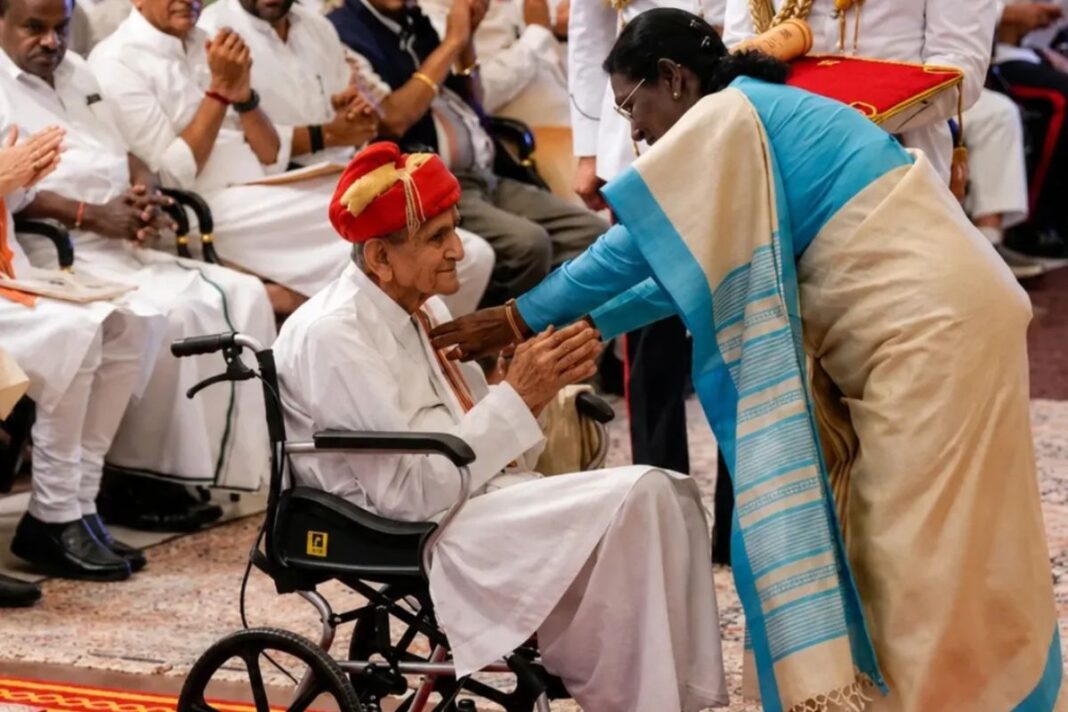

There is a man in Vadodara who has spent longer practising one art form than most people spend alive. Dharmiklal Chunilal Pandya is 94 years old. He began performing the Manabhatt Akhyan tradition in 1953, meaning he has sustained this singular devotion for 73 years through independence, the aftermath of partition, five decades of television, the arrival of the internet, and the complete transformation of Indian public life. On 24 January 2026, the Government of India awarded him the Padma Shri, the country’s fourth-highest civilian honour. He may also be the last person alive who can do what he does.
What Is Manabhatt Akhyan?
The tradition is roughly 400 years old and originates in Gujarat. It belongs to no single category that modern audiences would recognise; it is not quite music, not quite theatre, not quite storytelling, though it draws from all three in equal measure.
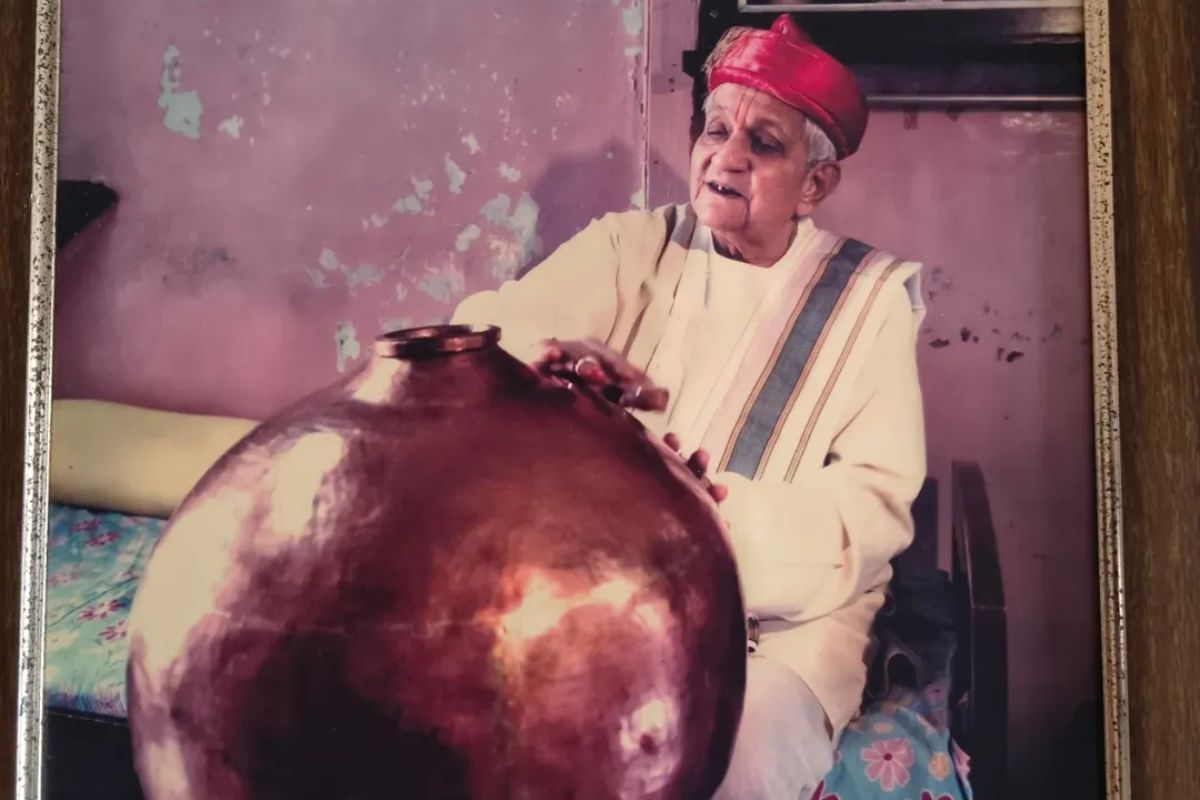
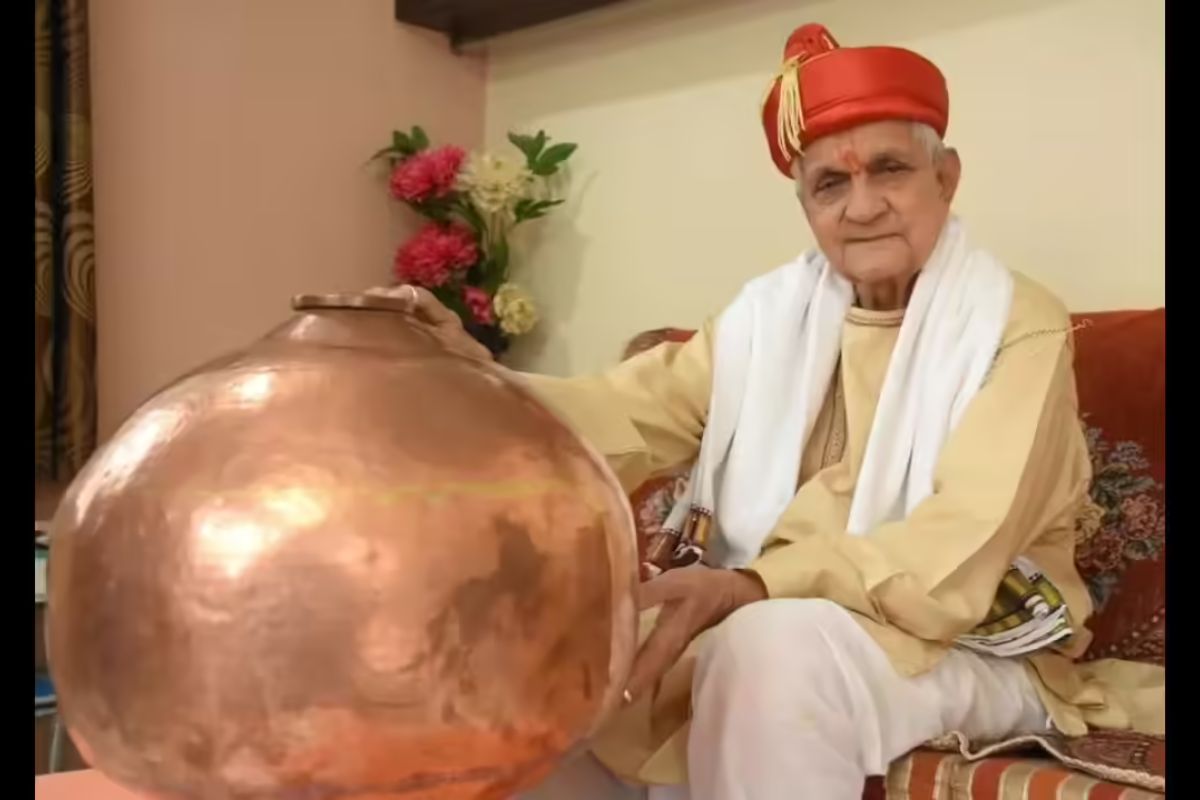
The performer sits with a large copper vessel called a “maan.” The maan is wide at its middle and narrow at its mouth, and when struck, it produces a deep, resonant tone that carries across an open space. The performer wears metal rings on his fingers and beats the vessel’s shoulders in rhythmic patterns, while harmonium, pakhawaj, tabla, and small cymbals provide accompaniment. Then he speaks, or rather, he narrates. Stories from the Ramayana, the Mahabharata, the Puranas, and the fabric of ordinary moral life pour out in a voice that can shift from comedy to grief within a single sentence.
Before print reached the villages of Gujarat, these performers carried the great texts on their backs, travelling from town to town, translating sacred narratives into a form that working people could absorb and carry home. They were, in the plainest sense, the keepers of collective memory.
A Family Trade, A Personal Calling
Pandya was born in Baroda (now Vadodara) in 1932. His father, Chunilal Vyas, was himself an accomplished akhyankar, and the son grew up watching and absorbing the tradition from childhood. He began formal practice as a young man and has not stopped since.
Over the course of seven decades, he is estimated to have given more than 2,500 performances. He established a teaching institution in Vadodara and trained students in the full discipline of the form, not merely the percussion technique, but also the vocal delivery, the repertoire, and the dramatic intelligence that gives the tradition its force. The Gujarat Sahitya Adhiveshan and other cultural bodies worked alongside his efforts to bring the akhyan back into public attention during periods when it had begun to fade.
His awards accumulated quietly over the years. The Sangeet Natak Akademi recognised him in 1983. The Gujarat State Sangeet Nritya Natya Akademi added its own honour. The Padma Shri, announced at the start of 2026, arrived when he was already 94, a state acknowledgment, however late, that something extraordinary had been happening in Vadodara for the better part of a century.
The Art Itself: What a Performance Looks Like
When Pandya performs, the maan sits before him like a quiet collaborator. His fingers move across its copper surface with the authority of long habit, not searching for the rhythm, but already inside it. The accompanying musicians follow rather than lead. His voice takes the audience into Ashok Vatika, where Sita waits in captivity; into the plains of Kurukshetra, where armies arrange themselves before the killing begins; into village households where ordinary people face the common dilemmas of loyalty, greed, and love.
The power of the form comes partly from its intimacy. Unlike staged theatre, the akhyankar sits close to his audience. There is no separation between performer and listener, no proscenium to cross. The storyteller’s emotion becomes the audience’s, and the copper vessel amplifies not just sound but feeling.
The Question That Cannot Be Avoided
Pandya is considered the last of the great practitioners. A handful of others, including Shrilalita Desai, continue in the field, but the depth of mastery and the length of his commitment have no clear parallel. He has trained students, but whether any of them will carry the full tradition, the repertoire, the vocal range, the dramatic sense, the years of daily practice remains uncertain.
This is the uncomfortable fact that sits beneath all the celebration. The Padma Shri honours a man. It does not guarantee a tradition. The award draws national attention to a form that has existed largely outside that attention for decades, and there is some reason to think attention matters. After the announcement, interest among younger audiences increased. Media coverage, social media exposure, and government platforms, including Doordarshan National and DD News, brought Pandya’s work to people who had never heard of the maan.
Whether that interest translates into the kind of sustained, years-long apprenticeship the tradition requires is another question entirely.
The Government’s Role: Recognition and Its Limits
The Indian government’s cultural architecture offers several instruments for preservation. The Sangeet Natak Akademi, founded in 1952, runs training programmes, festivals, and documentation projects. Its events, Lokrang, Lok Jan Pratha Utsav, and Lok Sangam, bring folk artists before national audiences. The seven Zonal Cultural Centres hold regional programmes. The Central Cultural Resources and Training Institute administers talent search scholarships. Senior artists aged 58 or older are eligible for modest monthly stipends from central government schemes.
At the state level, Gujarat’s own academy has recognised Pandya, and the Hastakala Setu scheme has improved artisan incomes more broadly. Documentation projects aim to record oral traditions before they disappear.
These structures exist and, in some cases, function well. However, they are general instruments applied to a specific emergency. Manabhatt Akhyan is not fading slowly; it is very close to ending entirely. The government’s preservation machinery was built for traditions that still have a critical mass. A form with one master requires something more targeted: emergency apprenticeship funding, a structured succession programme, a digital archive of performances, and genuine integration into school and college curricula where young Gujaratis might encounter it before they develop other habits.
What Pandya Represents
There is a temptation, when writing about figures like Pandya, to treat the story as uplifting: the older man who kept going, the award that came just in time, the tradition saved at the last moment. That framing would be dishonest.
What Pandya represents is a discipline so complete and so extended that it has become almost impossible to replicate under modern conditions. Seventy-three years of daily practice, thousands of performances, a repertoire drawn from texts that take years to absorb, this is not a path that institutional support alone can create. It requires a particular kind of life, a particular understanding of what art is for, and a community willing to value that understanding over a long stretch of time.
The Padma Shri is a well-deserved recognition of his contributions. It is not a solution to what happens next.
A Record That Will Not Fade
What can be preserved, regardless of whether the performing tradition survives, is the record. Every performance Pandya gives now is a document. Every recording is an archive. The copper man does not rust easily, and the stories it has carried, Sita’s endurance, the Pandavas’ exile, the quiet moral weight of village life, have survived in other forms for millennia.
Dharmiklal Chunilal Pandya turned 94 and is still performing. That fact alone is extraordinary. That he has spent 73 of those years in service to a single, demanding, largely uncompensated tradition is something that sits outside ordinary categories of achievement. Gujarat’s four-century-old voice has had, in him, an unusually faithful guardian. What it needs now is an heir.
Also Read: Padma Shri Bhiklya Ladkya Dhinda- The Man Who Kept a 400-Year-Old Sound Alive
You can connect with DNN24 on Facebook, Twitter, and Instagram and subscribe to our YouTube channel.