

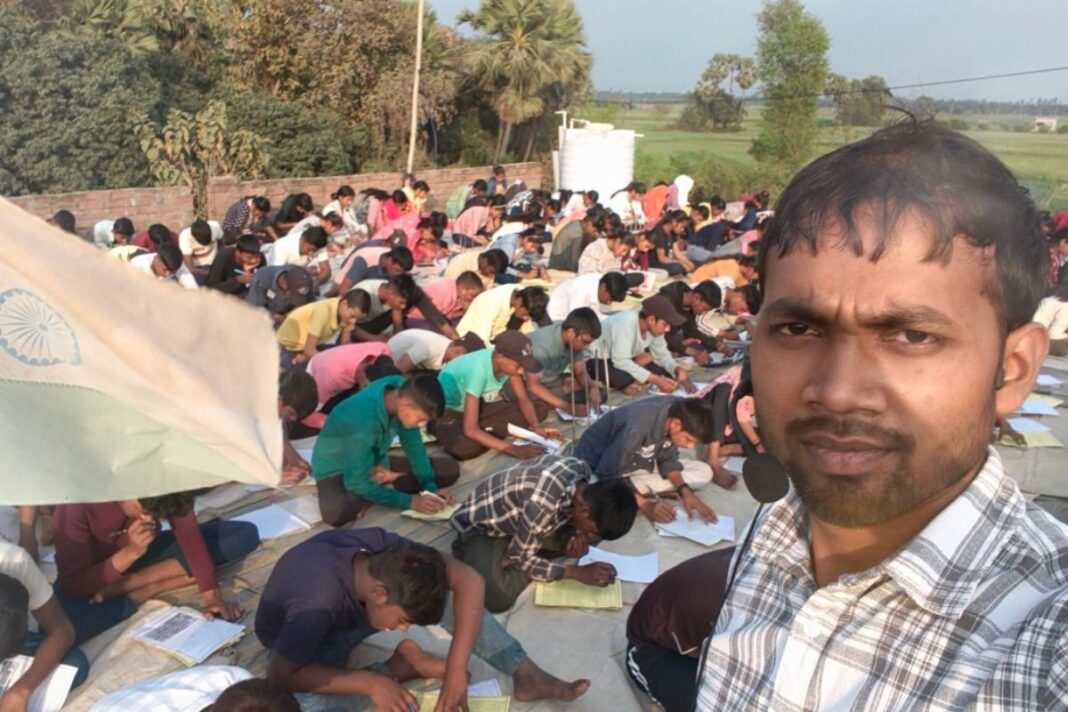

Every morning at five, before the tea stalls open for business, a queue of children climbs a narrow staircase in Nalanda district, Bihar. There is no school bell waiting at the top. No fluorescent lights. No desks or chairs. What they find instead is a bare concrete rooftop, a weathered blackboard fixed to a wall, a sheet of tarpaulin pulled against the sun, and a thirty-year-old former vegetable seller who once failed his Class 10 board examinations. His name is Rohit Kumar. And on most days, more than a thousand students sit on mats around him, notebooks propped on their knees, learning mathematics and science. The fees at the school is a modest 125 rupees a month. For many, he waives that.
This is not a charity project funded by a corporation. It is not a government pilot scheme. It is one man, a piece of chalk, and a rooftop that has quietly become one of the most unusual classrooms in the country.
A Boy Who was Written Off
Rohit Kumar was not considered promising by any conventional measure. His family lived on the income his mother earned selling cow dung cakes. There was no money for private tuition, no coaching centre within reach, and no one at home who could sit beside him with a textbook. When he failed his board examinations, the neighbourhood had its verdict ready. He was, in the local reckoning, simply another boy who did not have what it took.
He spent his early twenties selling vegetables from a cart, moving through the same lanes where children from poorer homes either drifted through school without understanding much of it, or stopped going entirely. He watched this pattern repeat itself with a kind of slow, frustrated resignation. These were not unintelligent children. They were children who had never been taught in a language or manner that made sense to them.
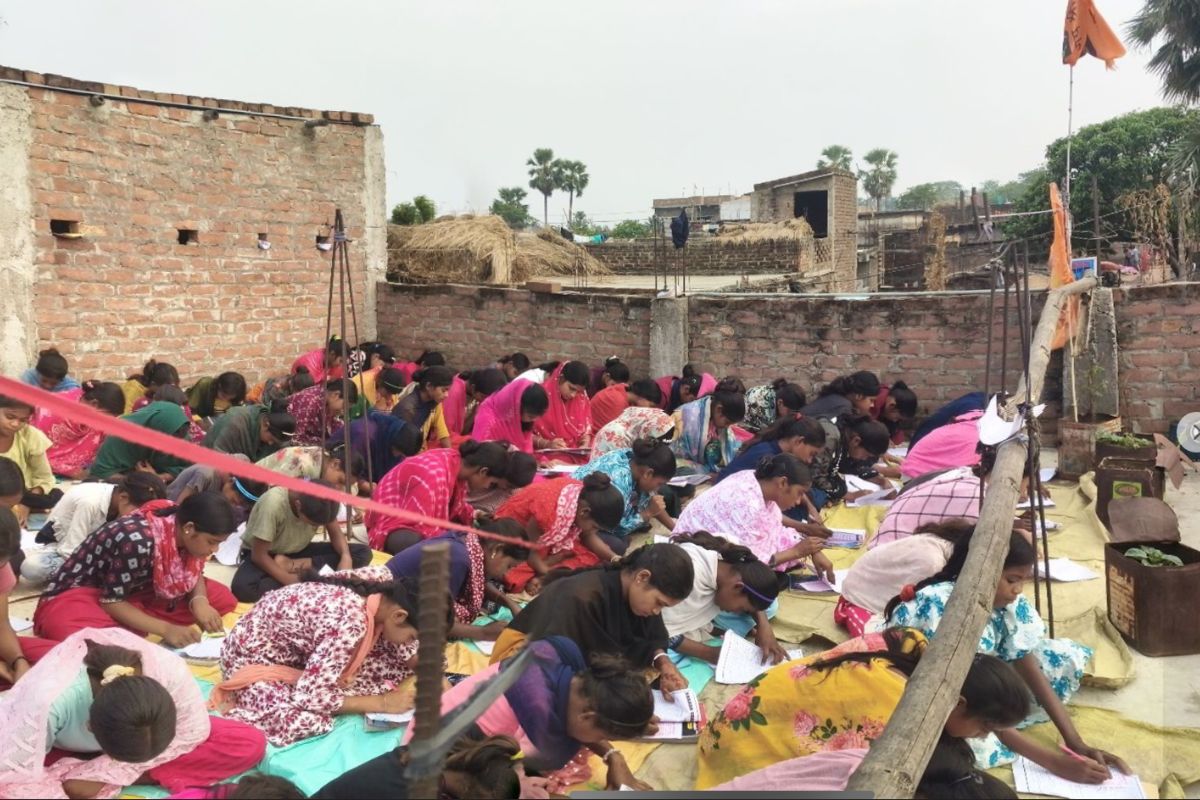
In 2022, Rohit carried a blackboard up to the rooftop of his rented house and called over four children. He charged them a token amount and asked them to sit for the lessons. That was the beginning of his rooftop school.
The School with a Difference
Nothing about the space suggested it could endure as a classroom. The terrace was open to rain and wind. Students sat on the floor, sometimes packed so tightly that they balanced their notebooks against each other’s shoulders. In the monsoon months, a tarpaulin served as the ceiling. In summer, lessons began before the temperature climbed.
What made the space work had nothing to do with its appearance. Rohit taught in Hindi, the language his students actually thought in. He built his science lessons around objects children could find in their own homes. He welcomed questions. In a system where many students quietly bear shame about not understanding, this was not a small thing. It was, for many of them, the first time a teacher had made them feel that confusion was a starting point rather than a personal failing.
He structured his day across multiple batches, beginning at five in the morning and running through until five in the evening. This arrangement was deliberate. Children who worked in the early hours could still attend school. Farm children could fit in a session between tasks. Boys and girls who helped in small family shops attended when they could. The rooftop adjusted to their lives rather than demanding they adjust to it.
From Four Students to a Thousand
In 2026, attendance at Rohit’s rooftop classes has grown to over a thousand students on any given day. Some of them arrive before heading to their formal schools. Others come in the evening to work through what they had not understood in class. The exact count fluctuates with the season and the day, but the direction of growth has never reversed.
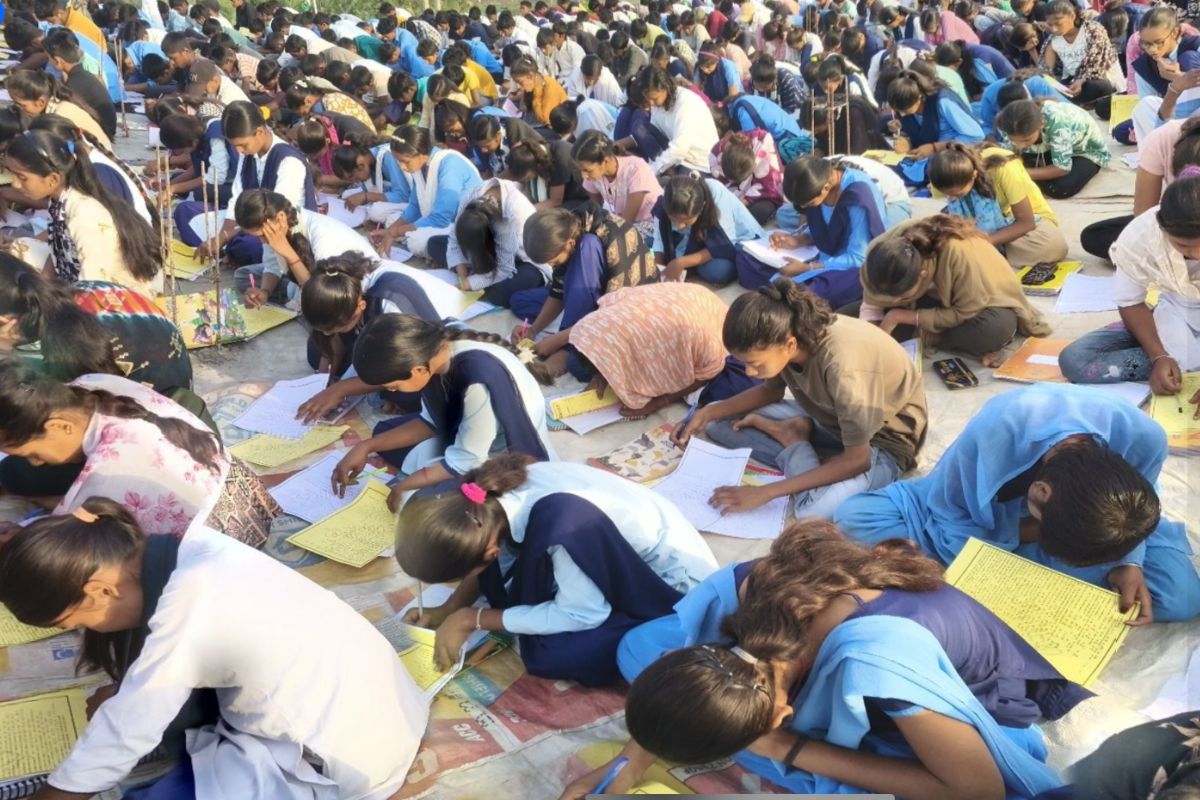
Among those attending are girls whose families had not initially intended for them to study beyond basic literacy. Rohit’s method, patient and unhurried, combined with visible improvement in grades, helped shift some of those family decisions. Results were not overnight. They accumulated slowly, as it happens with social initiatives.
Students on the rooftop eventually created social media accounts and began posting short recordings of Rohit’s lessons. These reached audiences well beyond Nalanda. Several videos garnered hundreds of thousands of views, and the rooftop school gained visibility that Rohit himself had never anticipated.
Recognition From Unexpected Quarters
Regional newspapers were the first to take notice. Then, national media including The Indian Express and The Better India carried accounts of what was happening on that Nalanda terrace. Business Today reported that Sridhar Vembu, the founder of the technology company Zoho, publicly praised Rohit’s model and offered support, recognising the practical intelligence behind a low-cost, community-anchored approach to education.
Even as acknowledgements and praise poured in, Rohit went about his mission with the same dedication. In interviews, he spoke about what he still wanted to build: an affordable digital platform that could carry his method to students in other districts and states, particularly, in areas where competent teachers were few and coaching fees were prohibitive. He was careful to frame this not as a replacement for formal schooling but as a bridge for those the system was not currently reaching.
Bihar’s Longer Educational Story
Nalanda district carries a name of considerable historical weight. The ancient Nalanda University, which drew scholars from across Asia for centuries, stood in this region. The contrast between that legacy and the current condition of education is uncomfortable. Bihar continues to record literacy figures below the national average, and dropout rates at the upper primary and secondary stages remain among the highest in the country. Access to quality coaching is concentrated in towns and cities, and rural families with modest incomes have few options.
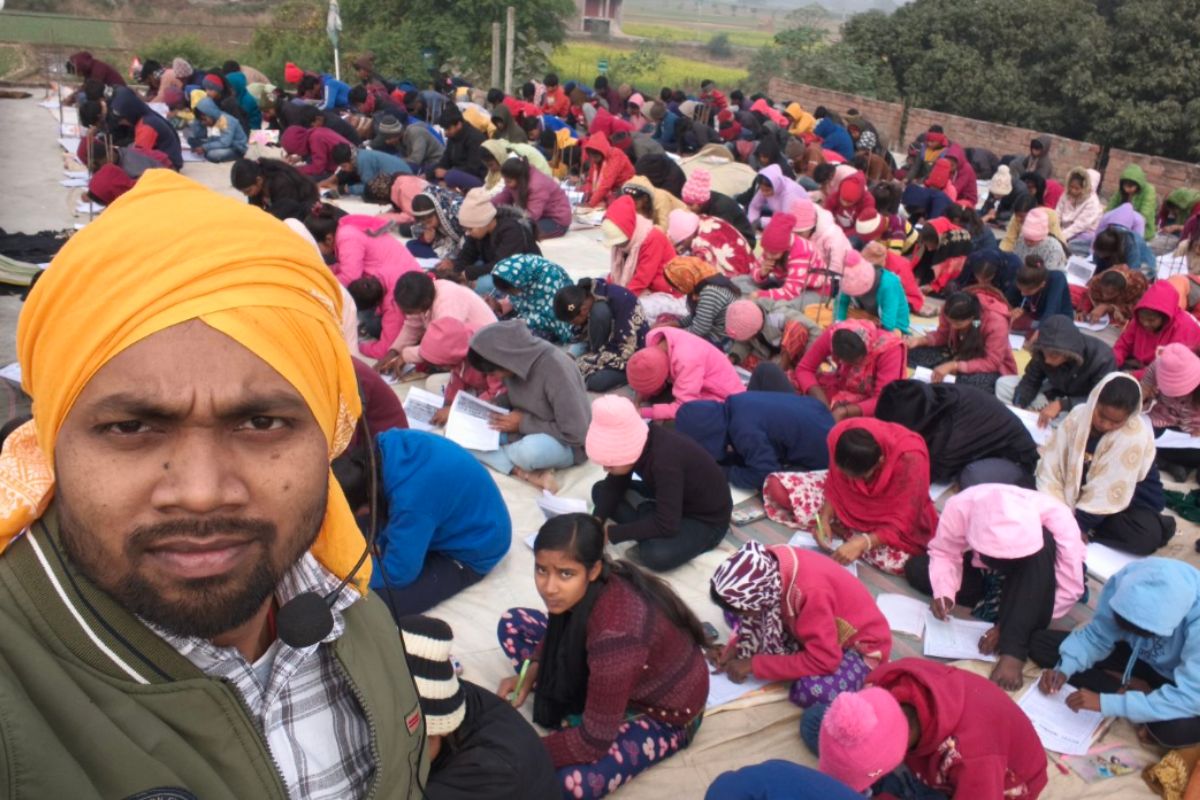
Rohit Kumar stepped into this gap without fanfare. His approach belongs to a broader, quieter tradition of informal learning spaces: community halls, verandas, and open courtyards where local volunteers and self-taught teachers have long worked without institutional backing. What distinguished Rohit was scale, consistency, and the particular clarity with which he dismantled the fear that surrounds mathematics and science for students who have never been taught those subjects with care.
The Question the Rooftop Asks
There is an uncomfortable question that Rohit Kumar’s rooftop school raises for the formal education system. If a man who failed Class 10 can build a functioning classroom for more than a thousand students using a blackboard and a terrace, what does that say about the priorities of institutions that have budgets, buildings, trained staff, and government backing, and still produce graduates who cannot read a paragraph or solve a basic arithmetic problem with confidence?
Rohit himself does not frame the question as such. He speaks about filling gaps, not replacing structures. But the gap he is filling is real, and the fact that a rooftop in Nalanda is helping students says something more than any report or policy review can say.
For now, the rooftop is still there and the children are still climbing the stairs.
Also Read:India’s First Transgender Football League Brings 70 Players Into the Game on Their Own Terms
You can connect with DNN24 on Facebook, Twitter, and Instagram and subscribe to our YouTube channel.