
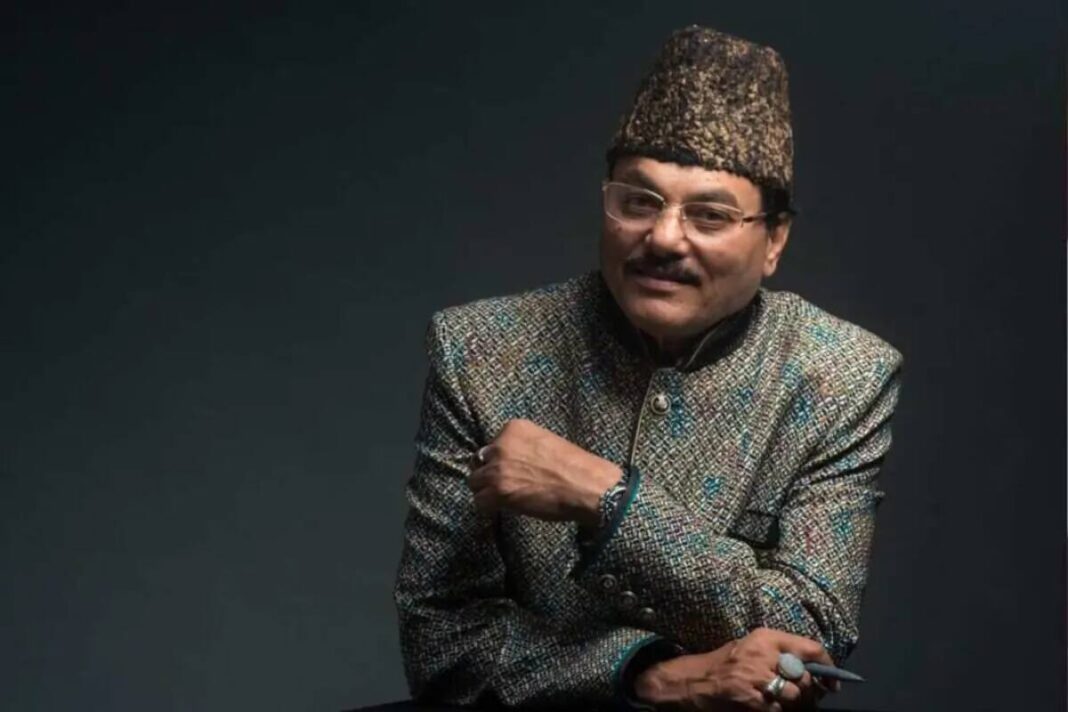

Manzar Bhopali is not just the name of a poet, but the identity of a city’s soul, its culture, and its shared heritage. When he utters his name, the word “Bhopali” does not only indicate where he is from, but also shows that he carries the weight of his city with him. Raised in Bhopal, the capital of Madhya Pradesh, Manzar Bhopali carried with him the softness, warmth, and tradition of coexistence of that city to every stage. His real name is Syed Ali Raza, but the literary world knows him by the name Manzar Bhopali.
He chose this name with great care, because he believes that when you add the name of your city to your own name, you represent its history, its identity, and its values. This year- 2026, when he was honored with the Gopal Das Neeraj Award, that honor was not merely the achievement of one poet, it was the recognition of that shared culture which he carried from stage to stage, country to country. In that honor lay the essence of his fifty years of literary journey.
The path of poetry that began at home
Manzar Bhopali’s childhood was spent in an atmosphere where books, debates, and gatherings were part of daily life. His father had hundreds of couplets memorized. At friends’ gatherings, conversation often turned to poetry. At an age when children play with toys, Manzar was learning to play with words. His home was filled with Urdu literature. Books lived not only in cupboards, but in conversations too. This environment became his foundation.
He often says that he did not begin writing poetry with any plan, poetry seemed to have chosen him. His mentor was Raza Rampuri. He not only guided him, but also gave him the confidence to recite on stage. This was the turning point where a hobby took the form of a professional journey.

The halo of literary heritage
“Bhopali” for him is a declaration of love, of shared heritage, of responsibility. He says that if Agra has the Taj Mahal, then Bhopal has its lakes and its culture. That is its identity. The literary world of Bhopal has remained rich. The name of Kaif Bhopali is taken with great respect. His songs became immortal in films like Pakeezah and Razia Sultan. Names like Asad Bhopali and Bashir Badr gave this city a distinct identity on the literary map.
Manzar Bhopali saw these personalities up close, heard them, and learned from them. He believes that the true wealth of a city is not its buildings, but its intellectual and cultural capital. He considers it a matter of pride that he got the chance to recite in mushairas with many great names of the 19th and 20th centuries. They honored Manzar Bhopali with their love for his poetry and their opinion of him. So far, he has published 14 books in India and Pakistan, and this journey is still continuing.
A rose pot and the punishment of 100 trees
One incident from childhood brought a new turn in his life. There was a competition in school- the one who planted the most beautiful plant would get more marks in the exam. He did not have a plant. He picked up a pot of rose from a neighbor’s house and submitted it at school. When his mother came to know of it, she called it ‘theft’ and announced a punishment: “Plant 100 trees.” That punishment, with time, became a mission.
Years later, when he bought land and planted a hundred saplings, he took his mother there and said, “Now please forgive me.” That day there were tears in his mother’s eyes, but they were tears of pride. This incident was the beginning of his love for the environment. After that day, he developed a different kind of affection for trees and plants. Later, he planted thousands of trees. Not only that, he dedicated his book- ‘Saaye Mein Chale Aao’- to trees.

The first mushaira and the beginning of the journey
His first major mushaira took place in the city of Dewas in Madhya Pradesh. At that time he had only two ghazals to present, but his confidence was sky high. As soon as he began to recite, the audience loved it. After the mushaira, people gathered around him saying, “Please come to our city too.” That was the moment when he felt that the stage was not just a place of presentation, but a means of dialogue. In 1987, he went to Pakistan for the first time and recited at a mushaira in Karachi. Thus began a series of international recitals.
A voice echoing beyond borders
In 1991, when he went to the United States of America for the first time, people were looking at him and wondering- “What will he recite?” But as soon as he read the first couplet- “Tell Mir and Ghalib, we too write verse, this century is ours, that century was yours,” the atmosphere changed. That couplet became the symbol of his confidence. He believes that if poetry comes from the heart, language and borders cannot block its path. In the US, he was given honorary citizenship. For him, that was a very big honor. It proved that people recognized him not only as a poet, but as the voice of his culture and country.
‘Aitbar-e-Adab’: a journey of 50 years
His new book ‘Aitbar-e-Adab’ is a document of his 50 years of literary life. In it, he has mentioned all those poets and writers with whom he spent time. Sharing the stage with greats like Jaun Elia, Ahmad Faraz, Faiz Ahmad Faiz, Nida Fazli, Parveen Shakir, and Gopal Das Neeraj was an opportunity to learn. He shared a deep friendship with the famous poet Rahat Indori. The two saw days of struggle, traveled together, and filled stages with new energy. He says, “I am proud that in my century there was Rahat Indori.”

Social concerns and a fearless voice
Manzar Bhopali’s famous nazm “Mujhko Apni Bank Ki Kitaab Dijiye” is the voice of ordinary people. Even today this nazm echoes on stage. He believes that the work of a poet is not just to write, but also to question injustice. He says that God has installed a “digital camera” in the eyes of a poet. He records every scene, every injustice, every joy, and when the time comes, gives it words.
An evening of Ramadan and a couplet for daughters
One evening in Ramadan, amid preparations for iftar, suddenly a couplet came to his mind. He picked up the pen and wrote, “Raise your hands for daughters too, Manzar, one does not ask Allah only for a son.” This couplet became a symbol of respect for daughters. When he first recited it at home, everyone’s eyes became moist. When he recited it on stage, applause rang out. He considers it a gift from Allah- such a couplet that arrives without planning, straight from the heart.
A song of the Ganga and humanity
Manzar Bhopali says that when Bismillah Khan took him to the Ganga ghat in Banaras, many poets were present there, including Rahat Sahib. There, in that sacred and spiritual atmosphere, with his encouragement and inspiration, a song came into his heart. “You drink too, let us drink too, by God’s grace, in the bowl of love, the water of the Ganga.” This song gives the message of humanity beyond religions. In it, the colors of Holi, the sweetness of Eid’s sevaiyan, the bells of the temple, and the azaan of the mosque are all symbols of a shared culture. He says that hatred has a short life, while love walks with us from the mother’s womb to the grave.

The golden era of the film world
Manzar Bhopali believes that there was a time when lyricists like Sahir Ludhianvi, Majrooh Sultanpuri, and Anand Bakshi, composers like Naushad Sahib, and voices like Mohammed Rafi and Lata Mangeshkar were present. That truly was a golden period. In that era, songs were written according to the story and situation, so they came from the heart and reached people’s hearts.
Songs like “Kabhi-Kabhi Mere Dil Mein Khayal Aata Hai” did not remain merely film songs, but became part of literature and life. Today, technology is fast, songs are made quickly, and often their life too is short.
The changing era of the mushaira
He remembers that there was a time when mushairas began at eight in the night and continued till five in the morning. 10,000- 20,000 people stood and listened. The stage used to be a symbol of literature and culture. Poets listened to one another, read books. At that time the stage was not only for entertainment, but also a means to improve people’s thinking and help them learn something new.
In today’s time, social media has increasedthe reach, but depth has declined. Speaking of the “WhatsApp generation,” he says that in the desire to earn fame quickly, the habit of reading and writing is fading. People want to become famous instantly and pay less attention to effort and depth. Yet, he is not disappointed with the youth. He says that for those who truly work hard and want to learn, the paths to move ahead always remain open.
Also Read: Kaif Bhopali: The Poet Who Made Bhopal’s Streets Sing
You can connect with DNN24 on Facebook, Twitter, and Instagram and subscribe to our YouTube channel.