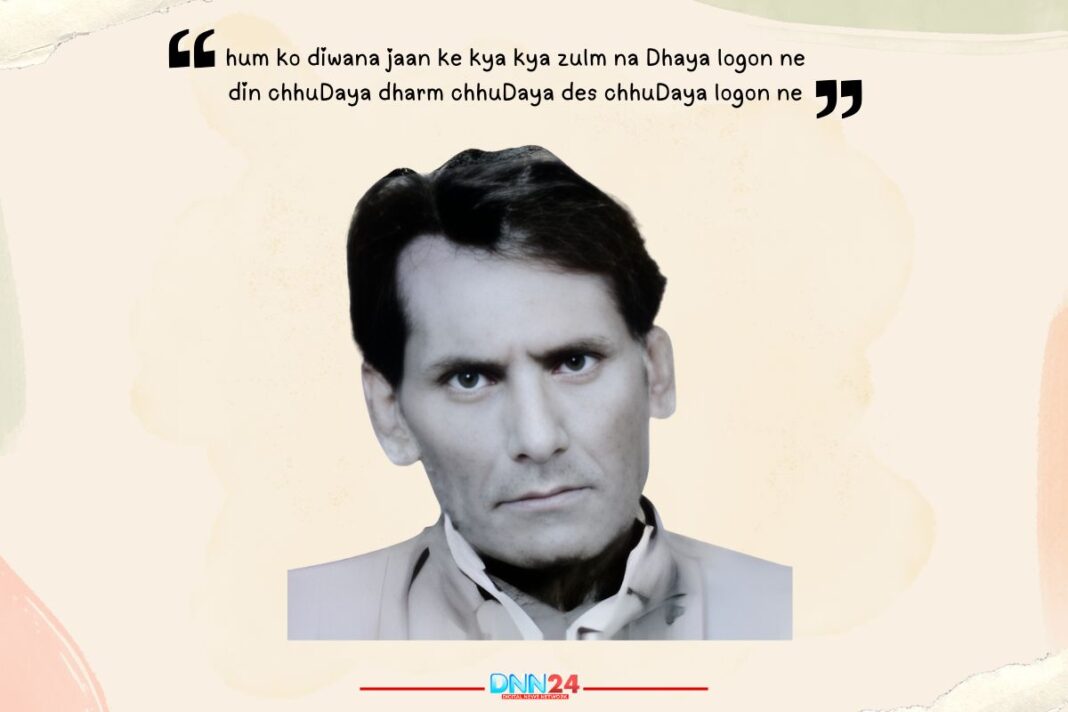

A boy from the dusty lanes of Bhopal grows up whispering verses that strike the heart like monsoon rain on dry earth. This is Kaif Bhopali’s story, a poet who shaped ordinary words into quiet magic.
kaun aaega yahan koi na aaya hoga
Kaif Bhopali
mera darwaza hawaon ne hilaya hoga
From Khwaja Mohammad Idris to Kaif Bhopali: A Poet Takes Shape
Born on 20 February 1917 as Khwaja Mohammad Idris, the boy who would become Kaif Bhopali grew up in a city that breathed poetry. Bhopal then was different. The Begums ruled with grace, Urdu flowed through conversations like honey, and every corner had someone reciting verses. His family originally came from Kashmir, passing through Lucknow before settling in Bhopal. They were not wealthy people, but they understood the value of words and culture.
tera chehra kitna suhana lagta hai
Kaif Bhopali
tere aage chand purana lagta hai
Young Idris absorbed it all like a sponge soaking up water. He skipped regular school lessons whenever he could, sneaking off to poetry gatherings instead. There, he watched older poets recite Ghalib and Mir, their words painting pictures in the air. His heart raced with excitement. He chose “Kaif” as his pen name, meaning ecstasy or joy, and added “Bhopali” to indicate his roots. The 1940s brought freedom struggle fever to India, and he watched British power slowly crumble. His home was modest, nothing fancy, but ink flowed freely there.
dagh duniya ne diye zaKHm zamane se mile
Kaif Bhopali
hum ko tohfe ye tumhein dost banane se mile
His early poems were raw and honest, speaking of love’s quiet pains and life’s simple truths. People clapped when he recited at small gatherings. Poverty was always near, threatening to pull him down, but poetry became his shield and sword both. He learned early that simple words could carry the most profound truths. One of his famous couplets goes: “Kaun aaega yahan, koi na aaya hoga, mera darwaza hawaon ne hilaya hoga.” It means someone knocked at my door, but nobody was there, just the wind playing tricks. This captures loneliness perfectly, using everyday language that anyone can understand and feel.
dagh duniya ne diye zaKHm zamane se mile
Kaif Bhopali
hum ko tohfe ye tumhein dost banane se mile
Stage Lights and Stardom: The Mushaira Years
Picture Bhopal’s moonlit halls in the 1940s, where Kaif’s voice first trembled with nervousness, then grew strong and clear like a temple bell. Mushairas were the entertainment of that era, where poets competed for applause and hearts. Kaif ruled these gatherings across Madhya Pradesh. His ghazals painted love and longing in colours so vivid that listeners sat silent with tears rolling down their cheeks.
hae logon ki karam-farmaiyan
Kaif Bhopali
tohmaten bad-namiyan ruswaiyan
He never used fancy, difficult Urdu that only scholars understood. Instead, he picked everyday words and arranged them like flowers in a garland. Lines like “dagh duniya ne diye” hit listeners like sudden thunder on a clear day. His family history of migration gave his poetry a wanderer’s soul, always searching, always remembering distant homes even while staying rooted in Bhopal.
jhum ke jab rindon ne pila di
Kaif Bhopali
shaiKH ne chupke chupke du’a di
Fame spread quickly. Delhi wanted him. Lucknow invited him. Even Bombay’s grand mehfils craved his presence. He would recite “Tera chehra kitna suhana lagta hai,” and the entire room would hold its breath, suspended in the melody of his words. But success never changed him. After performances, he would sit with ordinary people, drinking tea and chatting as if he were nobody special. He used to say, “Shayari lives in people’s ears and hearts, not on thrones or in palaces.”
tujhe kaun jaanta tha meri dosti se pahle
Kaif Bhopali
tera husn kuchh nahin tha meri shairi se pahle
His style was flash-simple, meaning it appeared simple on the surface but carried deep meaning underneath. Ghazals like “Jhoom ke jab rindon ne pila dee” celebrate life’s drunken joys even as they acknowledge its pains. Bhopal’s Hindu-Muslim harmony is reflected in his verses, defying the ugly divisions that Partition brought. When India gained independence in 1947, people recited his verses at freedom rallies as anthems of unity and hope.
When Cinema Called: Bollywood’s Hidden Treasure
Destiny pulled Kaif from the soft glow of mushaira lamps to the harsh arc lights of Bombay’s film studios. By the 1950s, he was broke but still full of poetry, knocking on the doors of the film industry with hope in his pocket. His first break came with the film Daaera in 1953. But real magic happened when director Kamal Amrohi asked him to write for Pakeezah in 1972. The song “Chalo dildar chalo, chand ke paar chalo” sung by Mohammad Rafi became instant history.
tera chehra subh ka tara lagta hai
Kaif Bhopali
subh ka tara kitna pyara lagta hai
It captured eternal romance, making listeners feel Sahibjaan’s longing for the courtesan heroine as profoundly as if they knew her personally. Kaif brought mushaira purity to films, never writing anything vulgar or cheap, always keeping heartfelt depth alive. Another gem from Pakeezah was “Teer-e-Nazar,” which felt like arrows of desire piercing through the heart. In 1977, Shankar Hussain gave us Lata Mangeshkar singing “Apne aap raaton mein,” a nocturnal whisper about solitude that still gives listeners goosebumps.
ye daDhiyan ye tilak dhaariyan nahin chaltin
Kaif Bhopali
hamare ahd mein makkariyan nahin chaltin
Then came Razia Sultan in 1983, where he wrote “Aye Khuda shukr tera,” blending devotion with drama perfectly. His personal style in films was conversational, as if he were chatting with the stars themselves. The words were simple, seductive, and always served the story. Bollywood did not tame Kaif. Instead, he tamed Bollywood, building a bridge between classical Urdu poetry and the masses who watched films. Behind the scenes, he would haggle over fees because his family needed money, yet he poured his soul into lyrics freely without holding back.
The Man Behind the Words: Family and Struggles
Life was not all applause and acclaim for Kaif Bhopali. Dark shadows walked beside him through Bhopal’s narrow lanes, but his family anchored him like a boat in a storm. He married young and had a daughter, Parveen Kaif, who grew up to become a respected mushaira performer herself, carrying her father’s flame with pride. Poverty was a constant companion. Bombay film work put food on the table, but his heart always pulled him back home to Bhopal.
dar-o-diwar pe shaklen si banane aai
Kaif Bhopali
phir ye barish meri tanhai churane aai
In the 1960s, he juggled film scripts and children, cycling through Bhopal’s streets and reciting verses to the lakes for peace of mind. Struggles tested him repeatedly. Pakeezah took sixteen years to complete, keeping him waiting with patience that would break most people. He had quirks too, like chain-smoking while composing and writing letters to imaginary lovers in verse, purely for poetic practice.
bimar-e-mohabbat ki dawa hai ki nahin hai
Kaif Bhopali
mere kisi pahlu mein qaza hai ki nahin hai
The terrible Bhopal gas tragedy of 1984 occurred after his most active years, but even then, industrial whispers and warnings appear in some of his lines about progress carrying hidden poisons. He stayed completely away from politics, focusing instead on family. He taught Parveen that poetry serves souls, not fame or money. Health problems came late in life.
thoDa sa aks chand ke paikar mein Dal de
Kaif Bhopali
tu aa ke jaan raat ke manzar mein Dal de
Diabetes dimmed his eyesight, but his pen never stopped moving across paper. He returned to Bhopal fully in the 1980s, hosting small poetry gatherings in his courtyard with neighbours as his audience, recreating the intimacy of his early days. Death found him on 24 July 1991, aged 74, in his birthplace, bringing his story to a complete circle.
Why Kaif Still Matters Today
Kaif Bhopali did not die in 1991. Instead, he transformed into something eternal, his verses continuing to live and breathe in unexpected places. Today, you can find his ghazals on Spotify playlists and YouTube covers. “Dagh duniya ne diye” trends on social media, its themes of loneliness and hurt resonating with young people living in crowded cities who still feel alone. Modern poets on Instagram emulate his flash-simplicity, sometimes even blending his verses with rap for mental health awareness reels.
tan-e-tanha muqabil ho raha hun main hazaron se
Kaif Bhopali
hasinon se raqibon se ghamon se gham-gusaron se
Bollywood still nods to his genius, with recent films sampling his memorable lines, proving that good poetry never ages. Bhopal honours its son with the annual Kaif Bhopali Samaroh, a festival that draws huge crowds and mixes tradition with technology through live streams reaching Indians living abroad. His relevance grows stronger in troubled times. When the world feels divided and angry, his unity-themed lines offer healing, reminding India of its strength in diversity.
kaam yahi hai sham sawere
Kaif Bhopali
teri gali ke sau sau phere
His daughter, Parveen, runs workshops that mentor young people and preserve Urdu as a cultural treasure in a Hindi-dominated landscape. Digital platforms like Rekhta feature his complete collection of poems, with downloads increasing every year. Artificial intelligence poetry tools now cite Kaif’s approach, particularly his themes of displacement and belonging that speak to migrants everywhere. He keeps getting rediscovered by new generations who stumble upon his words and feel instantly connected.
hum un ko chhin kar lae hain kitne dawedaron se
Kaif Bhopali
shafaq se chandni-raaton se phulon se sitaron se
Imagine him today, perhaps chuckling at phone screens showing reels of his poetry, saying with a smile, “Hearts still sway to the same old tunes!” His life story teaches an important lesson: write with simplicity, live with depth. In 2025’s fast-scrolling India, where everything moves at lightning speed, Kaif Bhopali’s poetry makes us slow down and remember that love, loss, and life dance together in every breath we take. Bhopal’s son still scripts our souls.
Also Read: Aazam Khursheed : The Poet Who Made Faces Speak & Still Matters
You can connect with DNN24 on Facebook, Twitter, and Instagram and subscribe to our YouTube channel.