
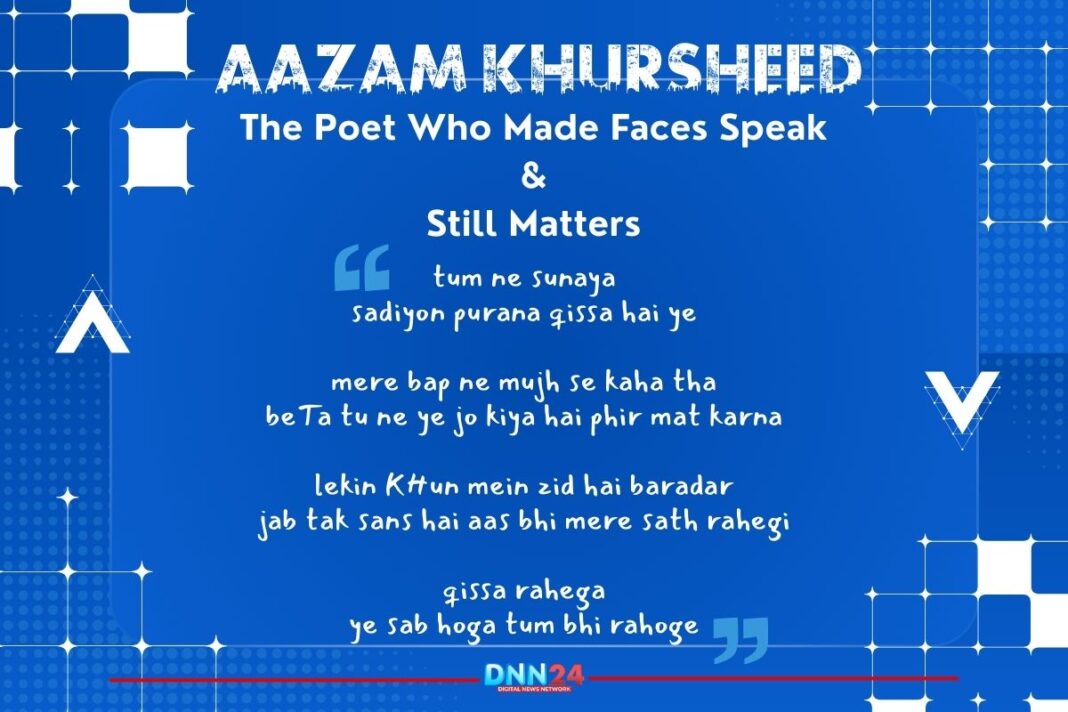

When Aazam Khursheed published Lafz Chehre in 2001, he gave Urdu poetry something rare: a mirror that refused to flatter.
A Quiet Beginning in Lahore’s Literary Streets
Lahore, in the decades following Partition, was a city trying to remember itself. Streets carried the weight of families torn apart, and neighbourhoods echoed with languages that no longer belonged to anyone completely. Into this fractured world came Aazam Khursheed, a writer who understood that the most honest stories live in the expressions people wear when they think nobody is watching.
tere honTon pe saja hai kya hai
Aazam Khursheed
tera har rang du’a hai kya hai
The mid-twentieth century gave birth to a generation that learned early about masks. Children grew up hearing whispered conversations about relatives left behind on the other side of new borders. Aazam absorbed these contradictions the way soil absorbs rain. He spent his youth in the old quarters where storytellers still commanded audiences under banyan trees, where shopkeepers recited Ghalib between customers, where the rhythm of daily survival mixed with an ache for something lost.
tere aangan mein luTa hai kya hai
Aazam Khursheed
wo bhi barish mein khula hai kya hai
Archives offer little about his formal education or family background. What remains are his verses, which suggest a man who spent considerable time observing rather than announcing himself. The Urdu literary tradition he inherited was magnificent but often ornate, filled with Persian vocabulary that sometimes distanced poetry from common experience. Aazam took a different approach entirely. He became interested in what people revealed through their faces, the truth that leaked out despite careful words.
rang chaDhte hain utar jate hain
Aazam Khursheed
mausam-e-hijr pata hai kya hai
By the time democracy returned to Pakistan in the late 1980s, Aazam had been writing for years. His notebooks are filled with observations from tea stalls and bus stands, places where ordinary people dropped their guard for brief moments. He noticed how a mother’s expression changed when she counted coins for her children’s school fees. He saw how young men arranged their features into confidence they did not feel. These details became his material, and he shaped them into poetry that felt uncomfortably personal even to strangers.
log alfaz badal lete hain
Aazam Khursheed
aur chehron pe likha hai kya hai
The Poetry That Stripped Away Pretence
Before Lafz Chehre appeared, Aazam Khursheed was known mainly in Lahore’s mushaira circuit. Poets who heard him perform recognised something unusual in his work. His ghazals did not aim for the beautiful melancholy that audiences expected. Instead, they offered sharp observations about human behaviour that made listeners shift in their seats.
apni barbaad nigahi ke sitam
Aazam Khursheed
ek dar aur khula hai kya hai
The collection that Salman Khan Lodhi published in 2001 runs to 193 pages. Each poem functions as a small portrait, capturing someone in a moment of revelation. A bride adjusting her veil becomes a meditation on arranged marriages and silent compromises. A beggar’s refusal of charity becomes a question about dignity and dependence. Aazam had the gift of making universal themes feel specific and personal, and of giving historical weight to details.
mere hathon ki lakiron pe na ja
Aazam Khursheed
tu ne KHud hi to likha hai kya hai
His style drew from multiple sources without copying any of them directly. The directness of progressive writers appealed to him, but he avoided their overtly political tone. Sufi poetry’s emotional intensity influenced his work, yet he stayed rooted in urban rather than mystical landscapes. What emerged was a voice that sounded conversational even in formal verse, accessible without being simple.
KHud se milta hun bichhaD jata hun
Aazam Khursheed
KHwab zanjir hua hai kya hai
The timing of the book’s publication mattered. In 2001, Pakistan was navigating between military rule and uncertain democratic prospects. Into this moment came poetry that insisted on seeing people as individuals rather than types, that treated contradictions as human rather than failures. Stories suggest that personal betrayals shaped some of these poems, friends who proved false, and romantic relationships that proved to be performances. Aazam transformed private pain into public art without self-pity. His verses acknowledge that everyone wears masks, including the poet himself.
naddiyan KHushk hui jati hain
Aazam Khursheed
koi us par khaDa hai kya hai
Understanding Lafz Chehre as Living History
The title translates roughly as “Words Faces” or “The Faces of Words.” Both meanings work. Aazam explored how words themselves can mask or reveal, how language serves as both disguise and confession. His poems move between these possibilities, sometimes within a single couplet.
meri aankhon se qayamat barse
Aazam Khursheed
jo bhi kuchh tu ne diya hai kya hai
Readers familiar with Urdu poetry after Partition recognise how the language split along with the subcontinent. Pakistani writers generally maintained closer ties to Persian and Arabic vocabulary, while Indian Urdu increasingly mixed with Hindi. Aazam wrote from Lahore, but his vocabulary remained surprisingly accessible across this divide. He chose words for their precision rather than their pedigree, which gave his work a wider reach than more purist approaches allowed.
apne waqton ki zaban bolta hun
Aazam Khursheed
phir ye bazar laga hai kya hai
The faces in his collection come from specific historical contexts, even when he does not explicitly name them. Elderly characters remembering Hindu and Sikh neighbours evoke the communal harmony that preceded 1947. Young people navigating conservative social expectations reflect the pressures of the Zia era. Women managing household economies during inflation reveal the gendered dimensions of national struggles. Each portrait contains layers that reward readers who bring historical awareness to the text.
meri basti mein udasi kaisi
Aazam Khursheed
shahr ki samt chala hai kya hai
Current readers find different meanings in these same poems. The refugee faces Aazam, who now resonates with stories of displacement from across the world. His observations about religious hypocrisy speak to contemporary debates about faith and politics. The masks people wear to navigate social expectations feel even more relevant in an age of curated online personas. The poetry has grown rather than dated, because Aazam focused on patterns that repeat across generations.
kitni KHush-posh faza hai ‘KHurshid’
Aazam Khursheed
teri aankhon ka nasha hai kya hai
Why These Words Still Cut Through Modern Noise
We live surrounded by images now in ways Aazam could not have imagined when he wrote. Social media platforms encourage constant self-presentation. Filters smooth skin and adjust features. People craft versions of themselves for public consumption. Against this backdrop, poetry that insists on uncomfortable truths about human nature finds new audiences.
kis se dil bahlaun main
Aazam Khursheed
kis ke naz uThaun main
Young poets in both India and Pakistan cite Aazam as an influence. His work appears in university curricula as an example of post-Partition literature that refuses easy nationalist readings. Literary festivals feature sessions analysing how his approach to identity and authenticity speaks to current concerns. Digital archives, particularly platforms like Rekhta, have made his poems accessible to global audiences who might never encounter the original published volume.
nind bhari in aankhon mein
Aazam Khursheed
KHwab kahan se laun main
The interfaith dimensions of his work deserve particular attention. At a time when religious divisions generate headlines and violence, Aazam’s poetry recalls a time when such boundaries mattered less to ordinary people. His verses about shared neighbourhoods and mixed friendships preserve a social memory that official histories often minimise. This makes his work valuable not just as art but as testimony to possibilities that still exist beneath political rhetoric.
meri baaten teri hain
Aazam Khursheed
kaun si baat chhupaun main
Journalists and activists sometimes quote Aazam when discussing cultural heritage and community relations. His phrases appear in articles about monument preservation, language rights, and efforts to maintain pluralistic traditions. The poetry transcends its original literary context to become part of broader conversations about identity and belonging.
shahr ne puchha ganw ka
Aazam Khursheed
us ko kya batlaun main
Aazam Khursheed never pursued fame with the determination some artists show. His later years remain mysterious, known mainly through letters he wrote to younger poets seeking guidance. He offered detailed critiques of their work, encouraging them toward honesty over decoration, substance over style. Recognition came slowly and then suddenly, as often happens with artists who refuse to compromise. Academic studies began analysing his contribution to Urdu literature. Translations introduced his work to readers who could not access the original language.
rah mein kaise der hui
Aazam Khursheed
kis kis ko samjhaun main
The absence of major awards during his lifetime now seems fitting. Aazam wrote for readers rather than committees, for the long conversation rather than immediate acclaim. His legacy builds through individuals who encounter the poems and feel understood, who recognise their own faces in his verses.
sahra sahra barish hai
Aazam Khursheed
dhup kidhar se laun main
Looking at South Asian literature today, we see many poets attempting to strike the balance Aazam achieved between accessibility and depth, between tradition and innovation, between the personal and the political. Few manage it as successfully. His particular genius was making difficult truths feel not like accusations but like invitations to self-awareness. The faces in Lafz Chehre do not judge readers so much as encourage them to drop their own masks.
soch di hai jawab bhi de
Aazam Khursheed
kuchh to yarab hisab bhi de
As digital communication accelerates and attention spans fragment, poetry that demands nothing except honest attention becomes more valuable. Aazam’s verses will not go viral in the usual sense. They require patience, reflection, and willingness to sit with discomfort. These old-fashioned virtues may be precisely what the current moment needs. In a world of quick reactions and performed emotions, his work offers something increasingly rare: a chance to meet ourselves without filters, to see our faces as others might see them, to acknowledge the gap between who we are and who we pretend to be. That gift does not expire.
Also Read: Tomb of Sher Shah Suri: An Emperor’s Dream Palace Floating On Water
You can connect with DNN24 on Facebook, Twitter, and Instagram and subscribe to our YouTube channel.