

A French patent, a Bengali craftsman, and a keyboard that divided the greatest minds of Indian music
The instrument that now sits on the floor of nearly every Indian music classroom began its life on a workbench in Paris, designed for homemakers and drawing rooms, never intended to travel anywhere.
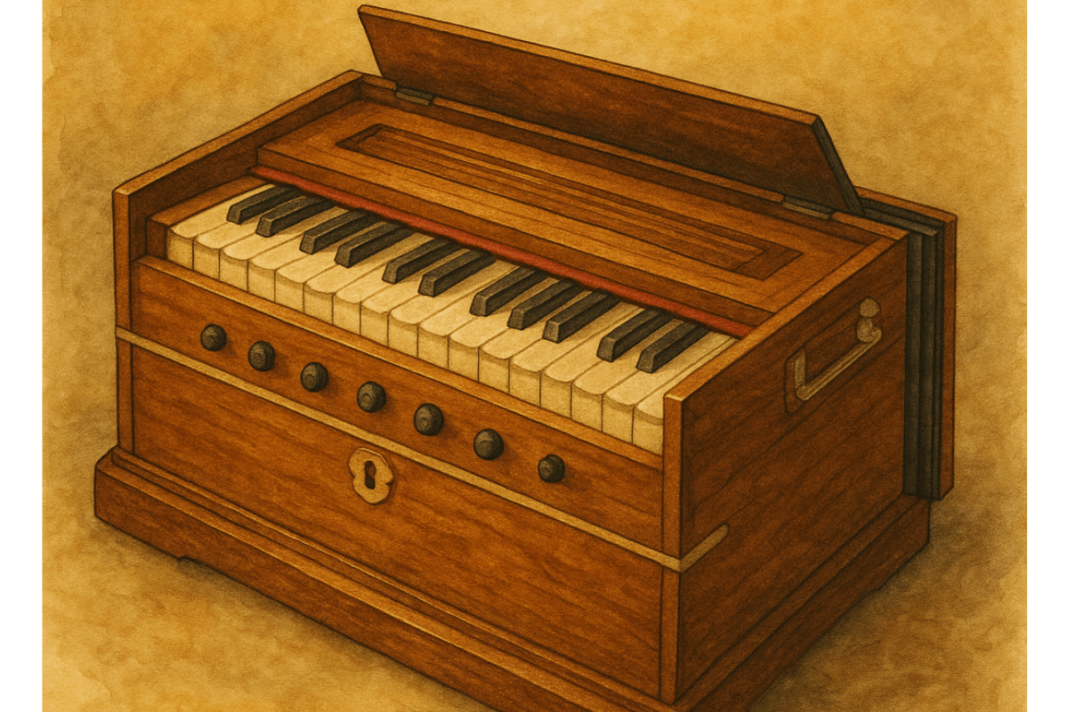
Alexandre-François Debain, a Parisian instrument maker, registered the patent for the modern harmonium in the early 1840s. His design was straightforward: a wooden case housing a keyboard, bellows and free metal reeds. Pressing a key opened a valve, air from the bellows passed over a single reed, and a clear, sustained note came out. No strings to snap, no pipes to crack, no tuner required every season. Debain’s instrument was compact, affordable, and reliable enough for amateur musicians in domestic settings. He would have never imagined what it would become in Bengal forty years later.
The Harmonium vs. The Piano
The journey of Western instruments to India in the mid-19th century was governed less by musical preference than by the rigours of sea travel. Large pianos were treacherous cargo. Six months at sea with fluctuating humidity and salt air warped their wooden frames, loosened their glue joints and snapped their strings. Many were rendered unplayable. The delicate actions of grand pianos, engineered for the controlled interiors of European concert halls, were poorly suited to tropical conditions.
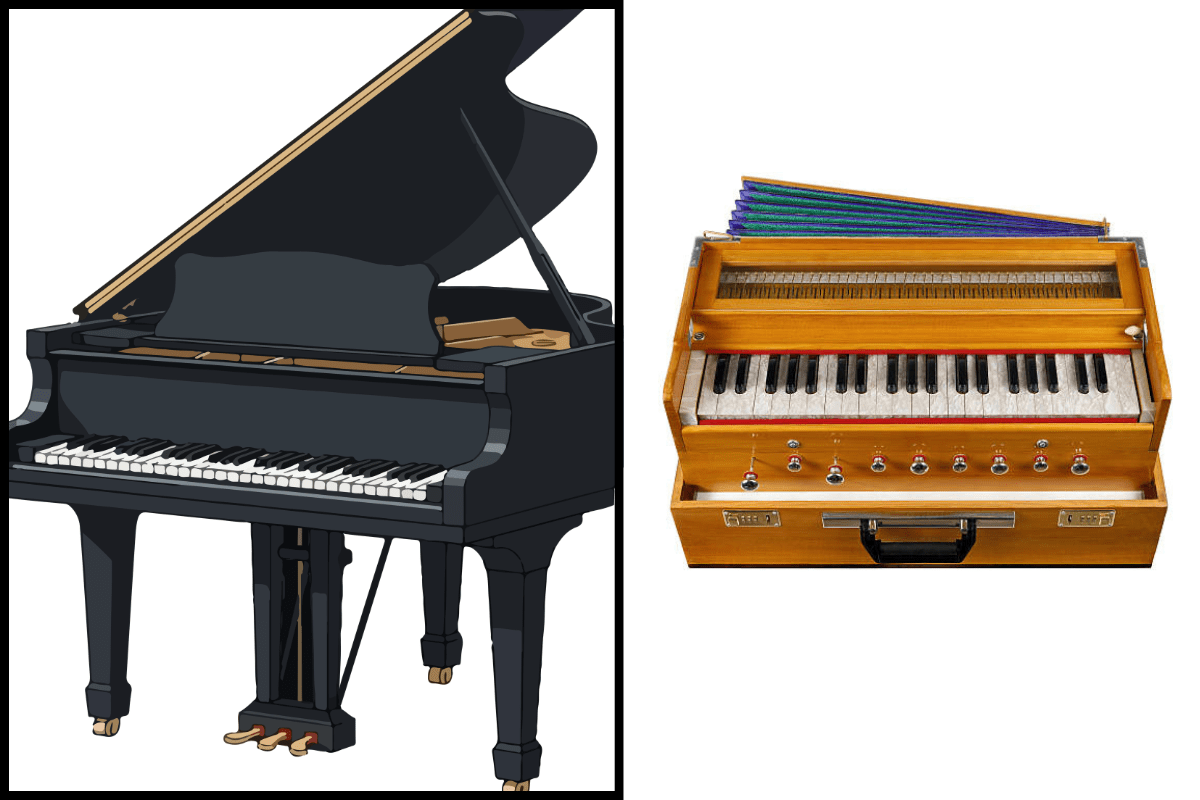
Reed organs and small harmoniums were a different matter though. Lighter in construction, sturdier in design and free from tensioned strings, they survived the voyage in reasonable condition. Missionary societies and European traders who needed keyboard instruments for churches, schools and domestic use found the harmonium far more practical. It could be maintained locally with modest skills and kept in working order without specialist visits. This, more than any musical consideration, is why the harmonium arrived in India in quantity and the piano did not.
The Bengali Who Rebuilt It for Indian Floors
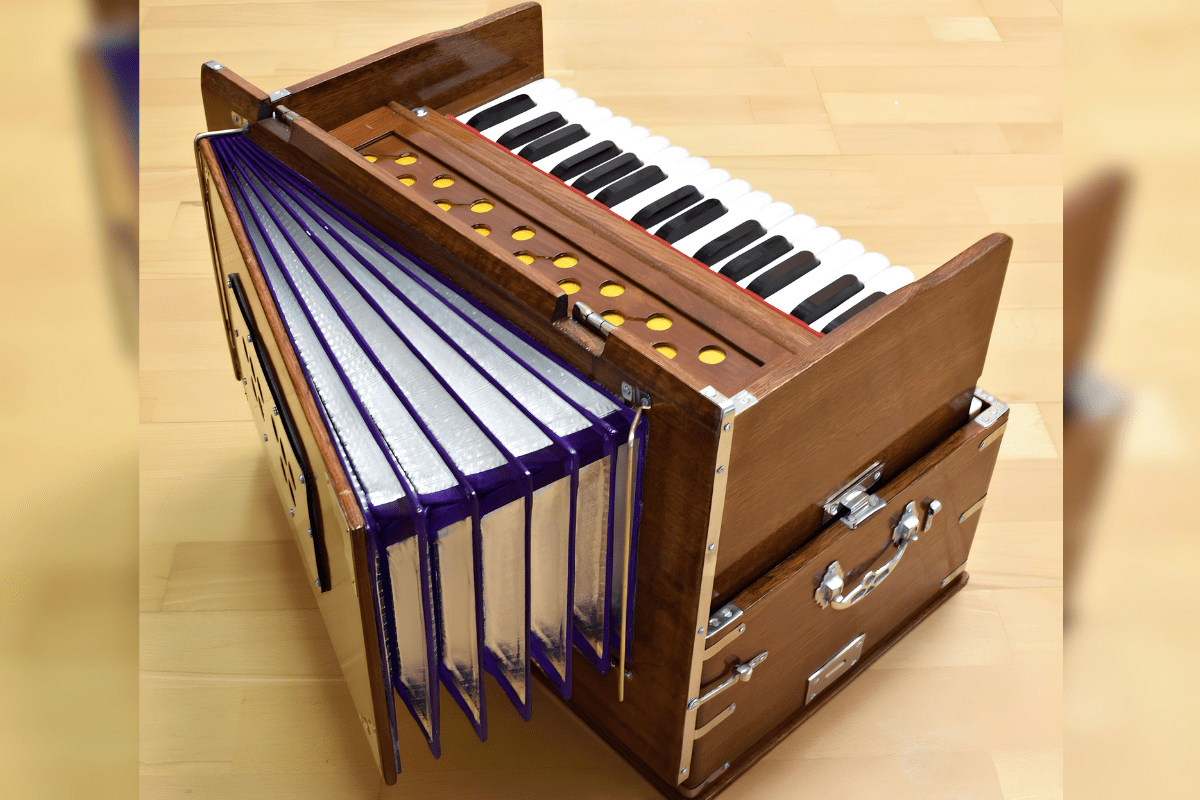
An instrument designed for a European parlour chair was of limited use on the floor of an Indian courtyard. This problem was addressed with some ingenuity by a Bengali craftsman named Dwarkanath Ghose around 1875. Ghose, whose name was anglicized to Dwarkin by many who wrote about him, opened a workshop on Lower Chitpur Road in Calcutta and set about modifying the imported harmonium in fundamental ways.
He removed the foot pedals that operated the bellows in the European model. He repositioned the bellows to the back of the instrument. He reduced the overall weight and adjusted the casing so that a musician seated cross-legged on the floor could operate both the keyboard and the bellows simultaneously, or have an assistant manage the bellows. At the same time, the player focused on melody and accompaniment.
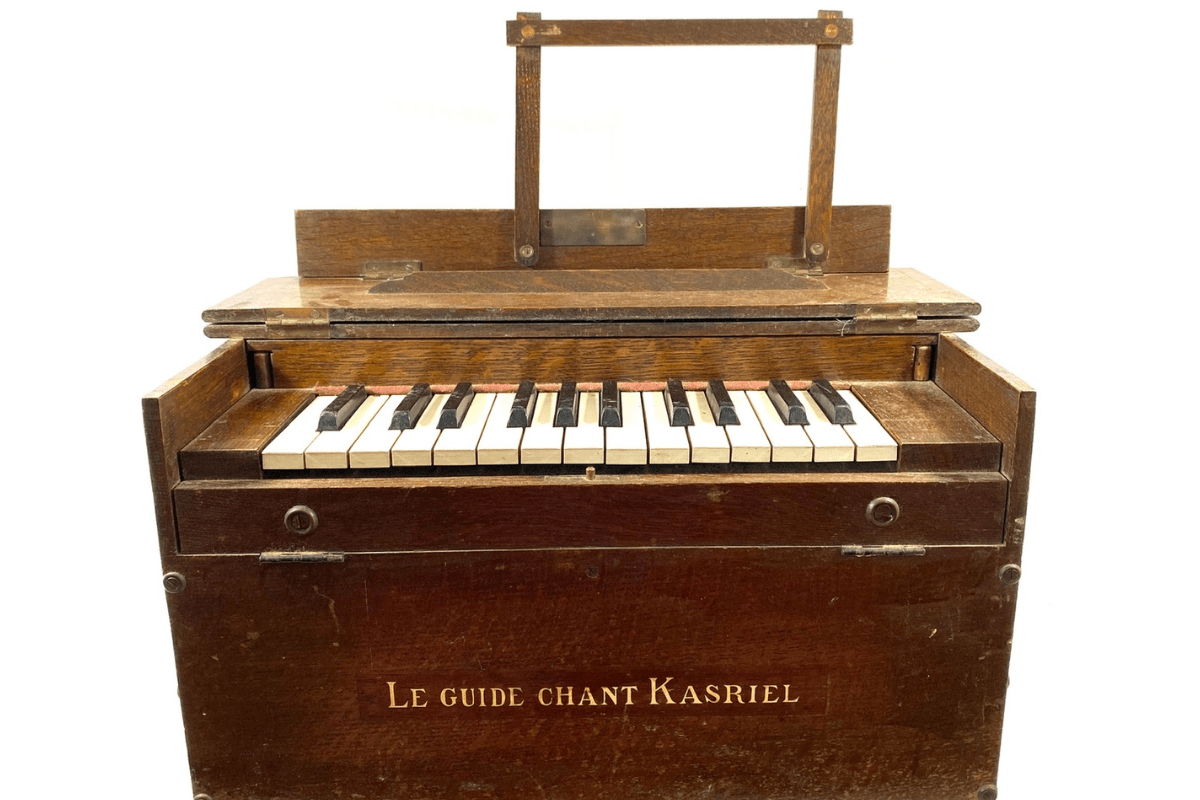
These were not cosmetic changes. They altered the instrument’s relationship with the player’s body and, in doing so, fitted it to the postural and practical requirements of Indian musical practice. What Ghose produced was, in essence, a new instrument wearing the outward shape of the old one.
Harmonium’s Spread Across a Subcontinent
Once reworked, the hand-pumped harmonium moved rapidly through India’s musical networks. By the close of the 19th century it had found favour with devotional gatherings, theatrical companies and music schools across regions and traditions.
Marathi theatre in western India adopted it for stage songs. Qawwali ensembles and Sufi devotional groups in the north wove it into their accompaniment. Bhajan and kirtan singers in temples and courtyards across the country kept one for daily use. By 1915, Indian workshops were manufacturing harmoniums in considerable numbers, and within a generation, the subcontinent had shifted from importing the instrument to producing it at scale. India became not merely a market for harmoniums but a centre of supply for the whole of South Asia.
The instrument’s popularity owed much to economics. A harmonium in colonial India cost a fraction of what a piano demanded. It could be carried in a rickshaw, moved between stages, stored in modest homes and repaired by local craftsmen. These facts made it accessible across class lines in ways no European keyboard instrument had ever been before.
What It Offered That Others Could Not
Indian classical music is built on continuous pitch movement. The glide between notes, the oscillation on a held pitch, the microtonal inflections that shift a phrase from one emotional register to another: all of these techniques depend on the voice or a bowed string instrument moving freely through gradations that a fixed keyboard cannot produce. The harmonium’s tempered tuning assigns each note a single, unvarying pitch, which places an obvious ceiling on its expressiveness within classical styles.
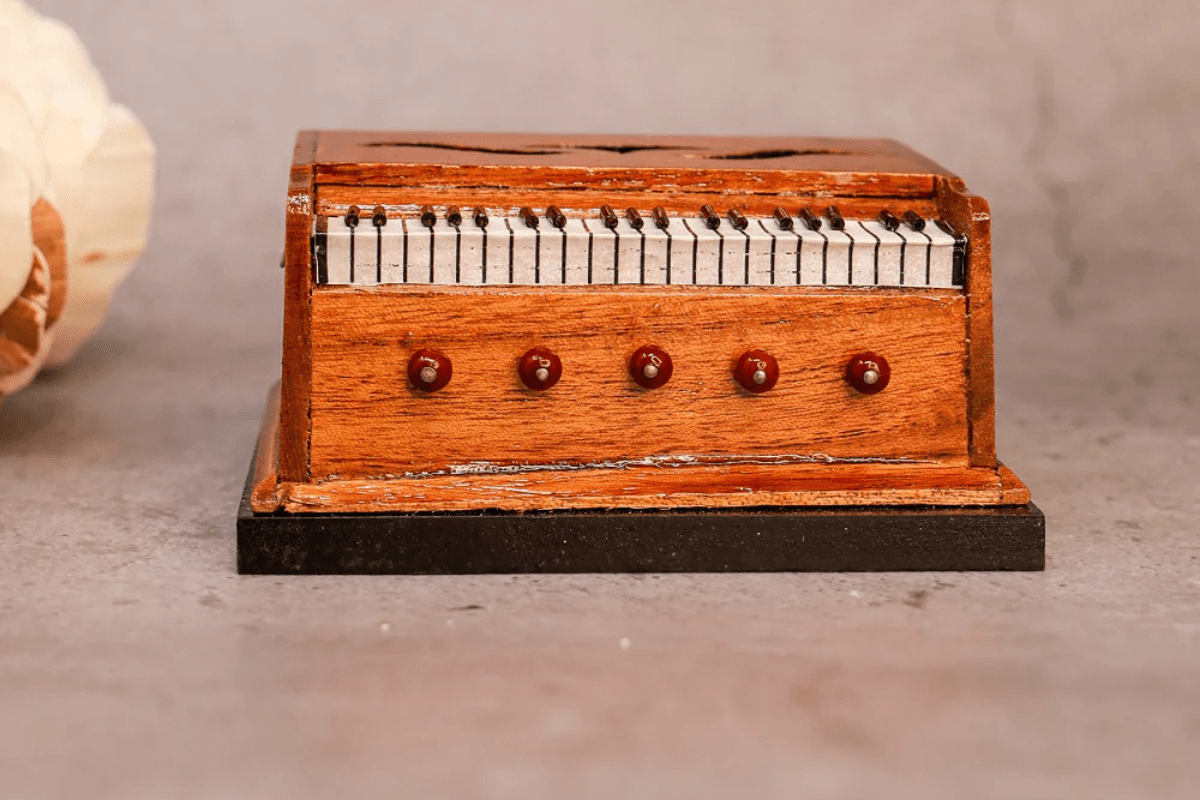
Yet the harmonium filled a gap that other instruments could not. It provided sustained pitch support, drone-like foundations and chordal textures that helped anchor melodic frameworks for both performance and teaching. A teacher demonstrating a raga could use the harmonium to establish tonal context quickly and reliably. An accompanist could hold a note steadily while a singer moved away and returned to it.
Musicians developed techniques to work within the limits of the instrument. Rapid ornamentation, bellows pressure adjustments and careful voicing allowed accomplished players to approximate some of the fluidity the keyboard could not achieve by design. These were compensations, not solutions, but they proved sufficient for the instrument’s purpose in most genres.
Tagore’s Objection and the Broadcasting Ban
The harmonium’s rise was not without resistance, and the most articulate objection came from the leading cultural voice of early 20th-century India.
Rabindranath Tagore, poet, educator and composer, refused to allow the harmonium at Shantiniketan, his school and arts centre in Bengal. His argument: the fixed keyboard imposed rigidity on Indian music, damaging the musical sensibility of students trained on it. He described its effect on learners as a form of bondage, constraining the ear and the voice to tempered intervals at the expense of the subtler pitch language required by Indian music.
In 1940, Tagore wrote directly to All India Radio expressing his concerns about the instrument’s influence on musical education and public taste. The correspondence reflected a broader institutional debate, and AIR subsequently maintained policies that restricted or banned harmonium accompaniment in certain broadcasts for an extended period. The restrictions were periodically revised and debated, but their existence confirmed that Tagore’s objections had been taken seriously at the highest levels of cultural administration.
An Instrument of Compromise and Community
The harmonium was, and remains, both a product of colonial exchange and a creation of local ingenuity. It survived its critics for reasons that cultural argument could not easily overcome. It was practical, portable and economical. It required no orchestra, no large hall and no complex logistics. A single musician could carry it to a village temple, a school assembly or a Sufi gathering and provide adequate musical support for any occasion. It democratised accompaniment in the most direct sense: it brought musical structure within reach of teachers, students and community singers who lacked the resources for larger ensembles.
Today the harmonium occupies an integral position in South Asian musical culture. It may be contested in academic circles yet remains indispensable in practice. Its continued presence in classrooms, temples and concert halls is evidence of something durable: the stubborn usefulness of an instrument that people found, again and again, impossible to set aside.
Also Read:Palace on Wheels: A Taste of the Royal Life
You can connect with DNN24 on Facebook, Twitter, and Instagram and subscribe to our YouTube channel.