
A whisper originating at one end of this chamber reaches the opposite wall with full clarity. The building is four centuries old, and nothing has changed.
That is how Gol Gumbad introduces itself to the unprepared visitor. It does not dazzle with gold leaf or painted ceilings. It does not compete with Mughal artistry or the ornamental excess of Fatehpur Sikri. What it offers instead is scale, silence, and an acoustics so precisely shaped that the building itself seems to be listening. Standing inside its central hall in Vijayapura, Karnataka, one feels not so much welcomed as measured.
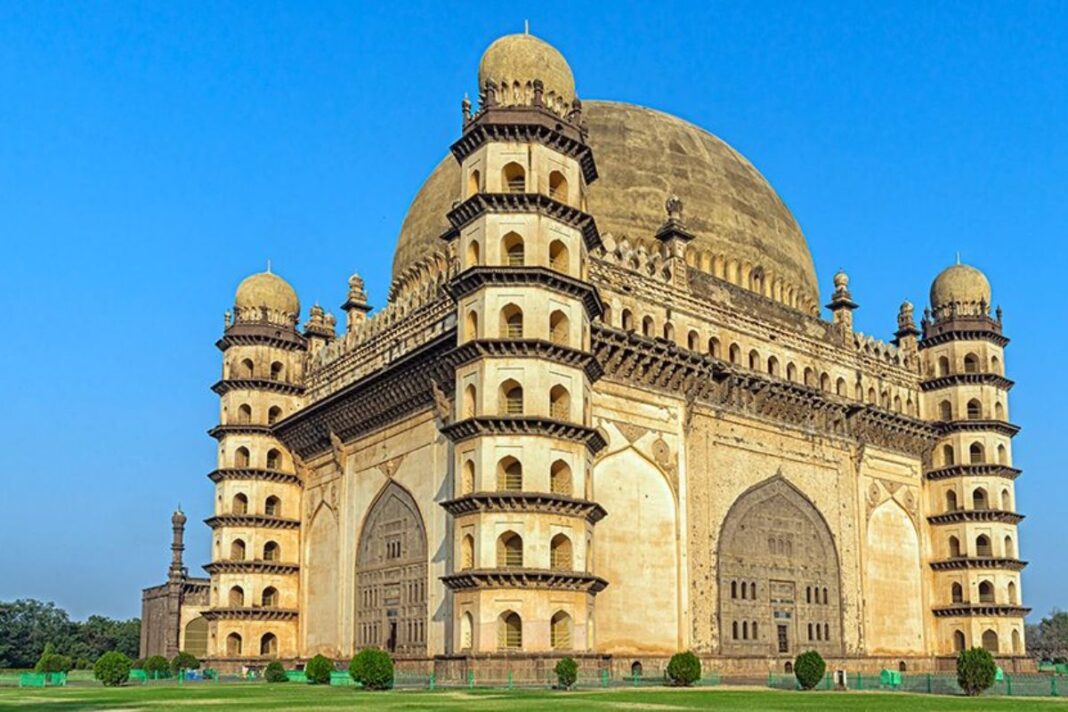
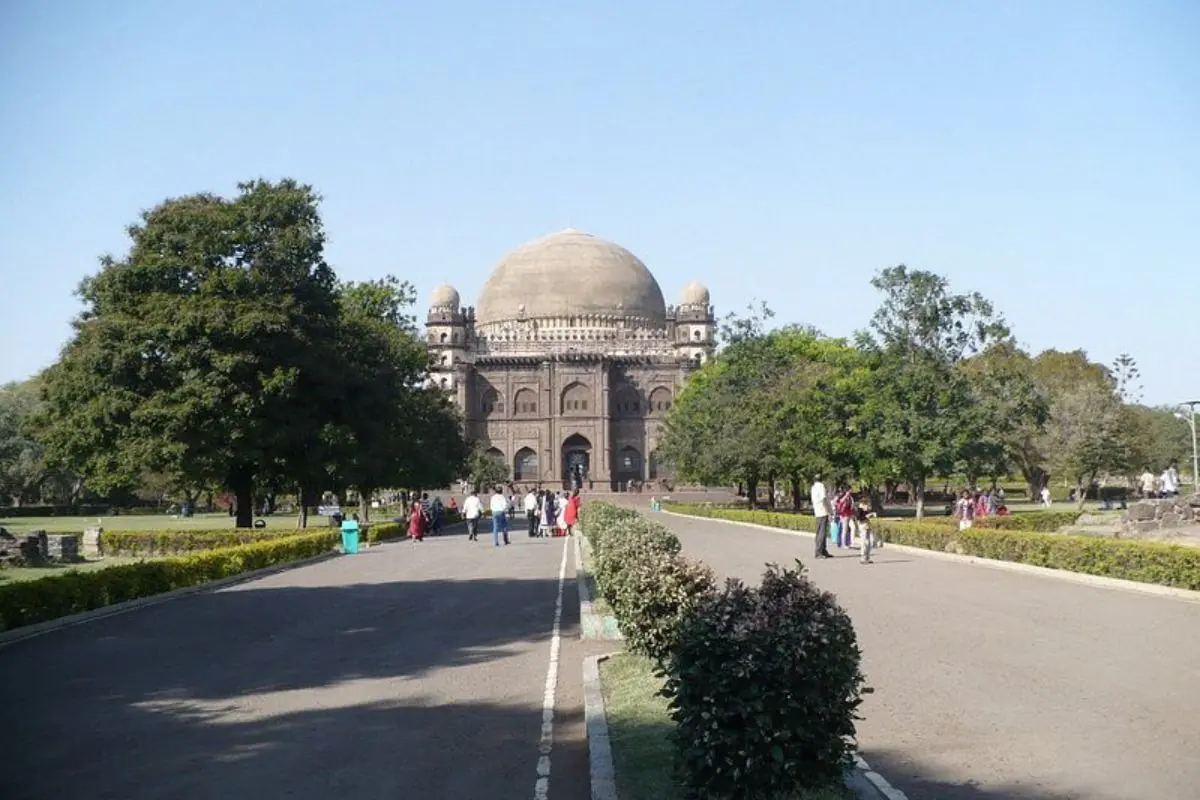
This is the mausoleum of Mohammad Adil Shah, the seventh Sultan of the Adil Shahi dynasty, who ruled Bijapur from 1627 to 1656. By most architectural accounts, it is the second-largest unsupported dome in the world, surpassed only by St. Peter’s Basilica in Rome. Its internal span is roughly 38 metres. No pillar holds any part of it.
The Sultan Who Wanted to Be Remembered
Mohammad Adil Shah came to power in 1627 and appears to have decided early that ordinary commemoration would not satisfy him. His father, Ibrahim Adil Shah II, had already commissioned Ibrahim Rauza to build a tomb of such graceful proportions that it is sometimes called the Taj Mahal of the Deccan. The son chose an entirely different approach. Where the father had gone for elegance, Mohammad Adil Shah went for enormity.
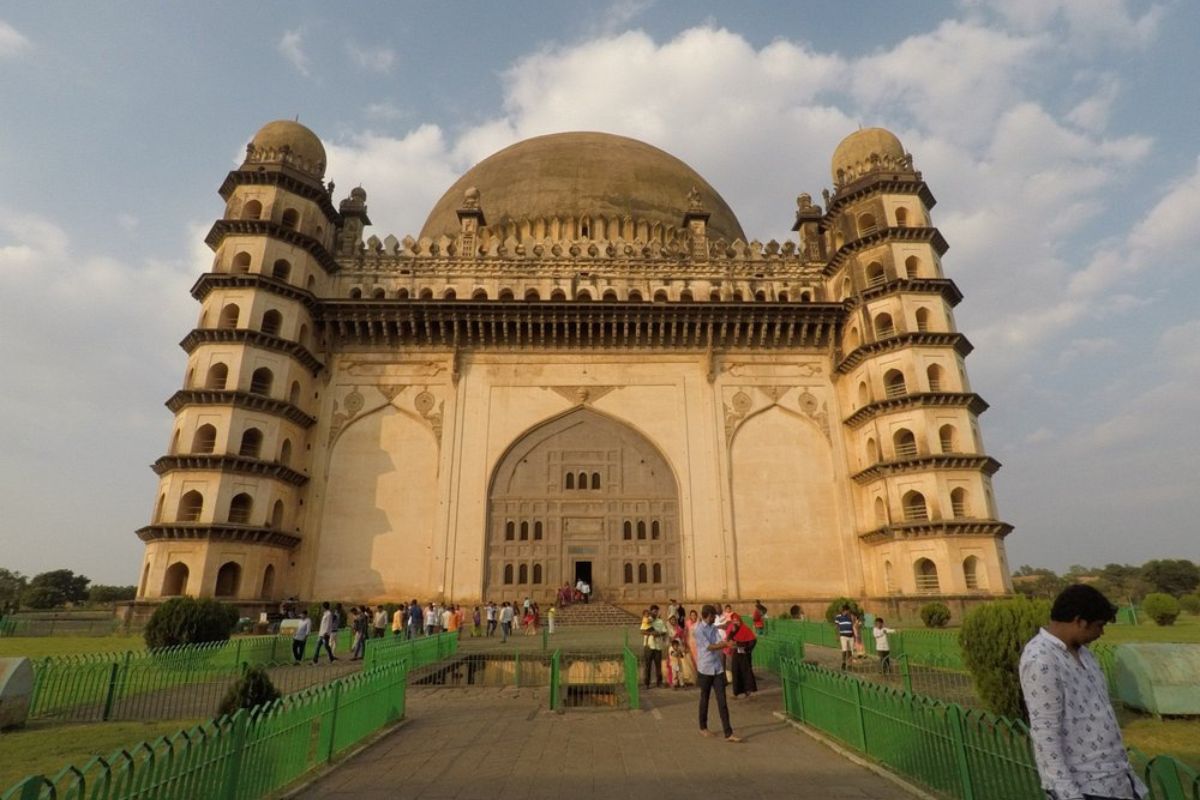
The construction of Gol Gumbad began around 1626-1630, and the building was never formally completed. When the Sultan died in 1656, work appears to have stopped, though the central dome and main chamber had already been finished. What survives is sufficient to make the point the Sultan intended.
Historian Richard M. Eaton, writing on the Deccan Sultanates, places the monument within a pressing political context. It was built during a period when the Mughal Empire under Shah Jahan was advancing steadily southward, absorbing neighbouring kingdoms one by one. Eaton interprets the dome’s sheer scale as a declaration of Adil Shahi independence, a warning cast in stone that Bijapur was not a provincial outpost but a court of genuine weight and authority. Art historian Elizabeth Merklinger describes Gol Gumbad as an architectural manifesto, a formal assertion that Bijapur, though smaller in political reach than Delhi or Agra, could match them in structural ambition and raw imagination.
The Architecture of Gol Gumbad
The building occupies a cubical area of approximately 47.5 metres per side, rising to a total height of about 60 metres. Eight intersecting arches rest on four corner towers, each a hollow octagonal structure, and together they carry the enormous dome above. A system of pendentives and overlapping arches distributes the dome’s weight outward into the walls without requiring any internal support. When completed, this was the most technically advanced dome in the Islamic world outside the Ottoman tradition.
Architectural historians George Michell and Mark Zebrowski have described Gol Gumbad as the most technically sophisticated domed structure in the Deccan Sultanate tradition. They note that the engineering logic it embodies was rare in southern India at the time and likely drew on Persian and Ottoman precedents filtered through the Bijapur court’s own craftsmen and master builders.
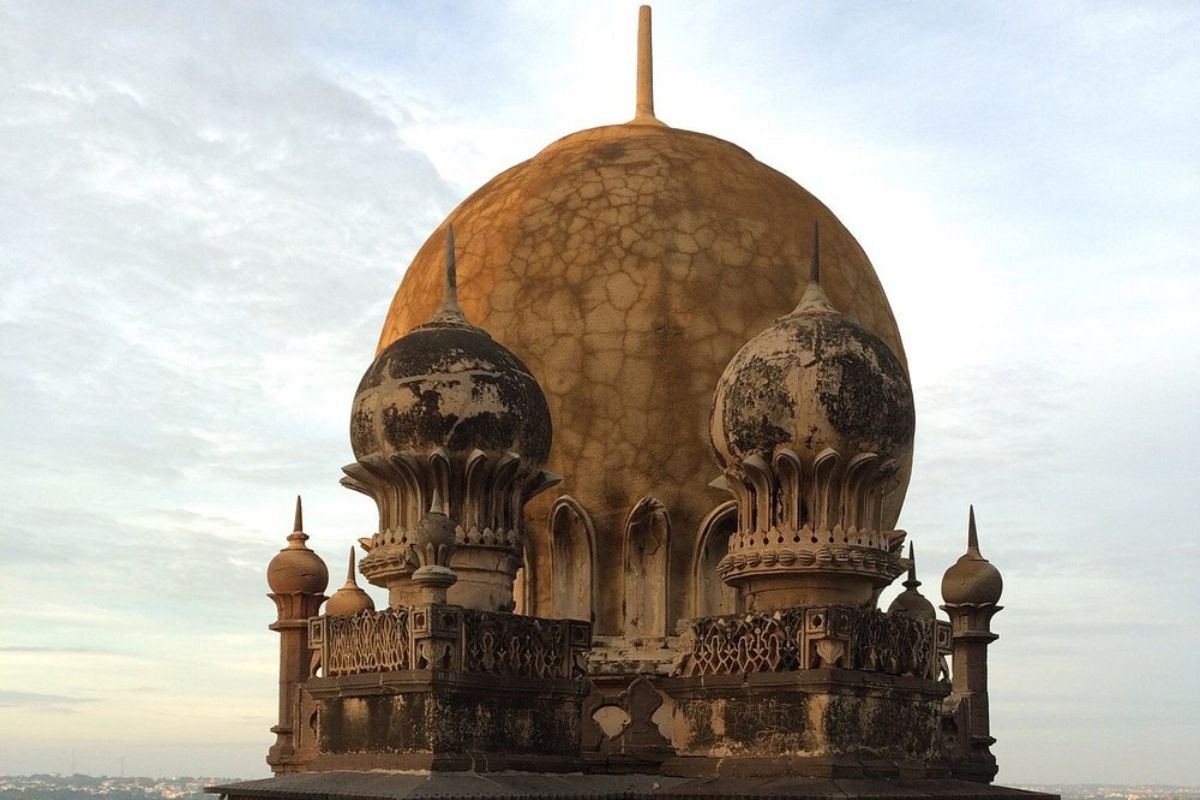
The four corner towers are not decorative. Each is a full working structure with internal staircases leading up to the base of the dome. Visitors who climb to the gallery running around the base find themselves on one of the most unusual platforms in Indian architecture, with the dome curving wide above them and the plains of the Deccan stretching flat in every direction below.
The Whispering Gallery
At the base of the drum on which the dome rests, a continuous open gallery runs around the full circumference of the building. This is the whispering gallery, and its reputation is not exaggerated. A person standing at one point of the gallery and speaking in a low voice is heard clearly by a person standing directly across, roughly 37 to 38 metres away. Sounds reportedly echo as many as seven to ten times around the curved interior before fading. Tourism literature, perhaps with some licence, claims that a pin dropped at one end can be heard at the other.
The effect is not magic. It is geometry. The curved dome surface reflects sound waves uniformly around its circumference, a property of hemispherical vaulting that the builders almost certainly understood through observation of other domed structures. Whether the gallery was built specifically to exploit this quality, or whether the acoustics were an unintended consequence of the dome’s dimensions, no surviving document clarifies.
Who Lies Inside
On a raised stone platform at the centre of the chamber, cenotaphs mark the resting places of Mohammad Adil Shah, two of his wives, his favourite companion Rhamba, his daughter, and a grandson. These are memorial markers. The actual graves lie in a crypt beneath the floor, accessible by a staircase under the western entrance. A carved wooden canopy shelters the Sultan’s cenotaph, believed to be a later addition. The simplicity of the interior, given the monumentality of the exterior, is one of the building’s more striking qualities. There is very little ornament. The dome speaks for itself.
The Legends That Gathered Over Centuries
Every large monument accumulates stories, and Gol Gumbad has collected several. The most enduring tales tell of a dancer from Ceylon who performed at the building’s inauguration. She fell in love with the Sultan and was promised a burial beside him after her death. According to one version of the tale, she chose to leap from the top of the dome rather than outlive him, and was buried in the complex as promised. Historians treat this as folklore, but the story appears in nearly every popular account of the building and shows no signs of disappearing.
Adjacent to Gol Gumbad stands the Bara Kaman, a ruined sequence of arches intended to serve as the mausoleum of Ali Adil Shah II, Mohammad’s son. Local guides have long told visitors that the son planned a tomb whose shadow would fall across his father’s dome, symbolically overtaking it in permanence and scale. The project was never finished. Whether court politics, lack of funds, or the patron’s death halted it, is unknown. The incomplete arches remain, and the story of the shadow persists.
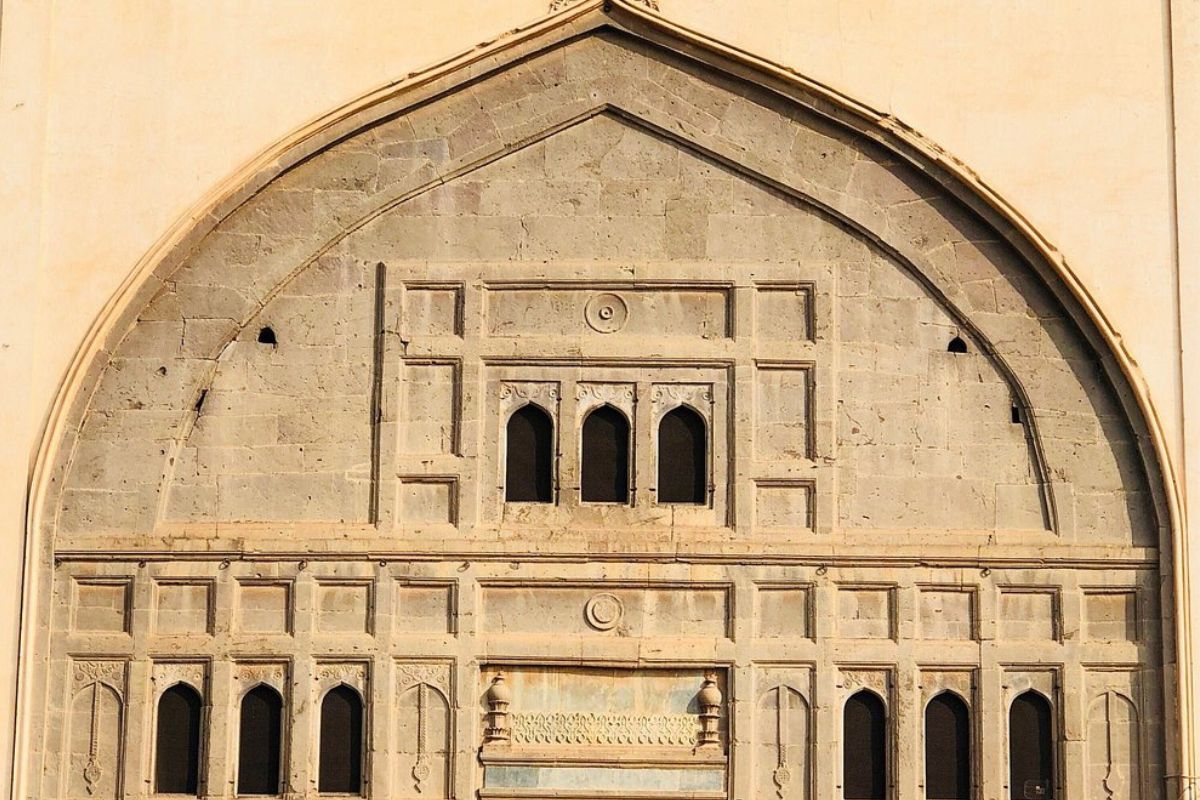
A stone above the main entrance is known locally as the Bijli Pathar, or the Lightning Stone. Folklore believes it was a meteorite and credits it with protecting the building from lightning strikes over the centuries. The monument has survived rather well, which is precisely the kind of thing that keeps such beliefs alive.
The Monument Today
The Archaeological Survey of India maintains Gol Gumbad, and it is a protected national monument. It is included in UNESCO’s tentative list for World Heritage designation as part of the monuments of the Deccan Sultanate. An on-site museum holds inscriptions, manuscripts, and architectural fragments from the Bijapur region.
Several hundred thousand visitors pass through the site each year. Most come for the dome. Many stay for the whispering gallery. A few read the placards in the museum and leave with a clearer picture of the Deccan Sultanate, a group of kingdoms that held the subcontinent’s south for two centuries before the Mughals. Later, the Marathas dismantled them piece by piece.
In the words of one heritage scholar, Gol Gumbad is not just the tomb of a sultan, but the last voice of a proud Deccan kingdom that wanted the world to hear its name once more, even from the grave. And every time a whisper runs along its gallery, Bijapur answers.
Also Read:Palace on Wheels: A Taste of the Royal Life
You can connect with DNN24 on Facebook, Twitter, and Instagram and subscribe to our YouTube channel.