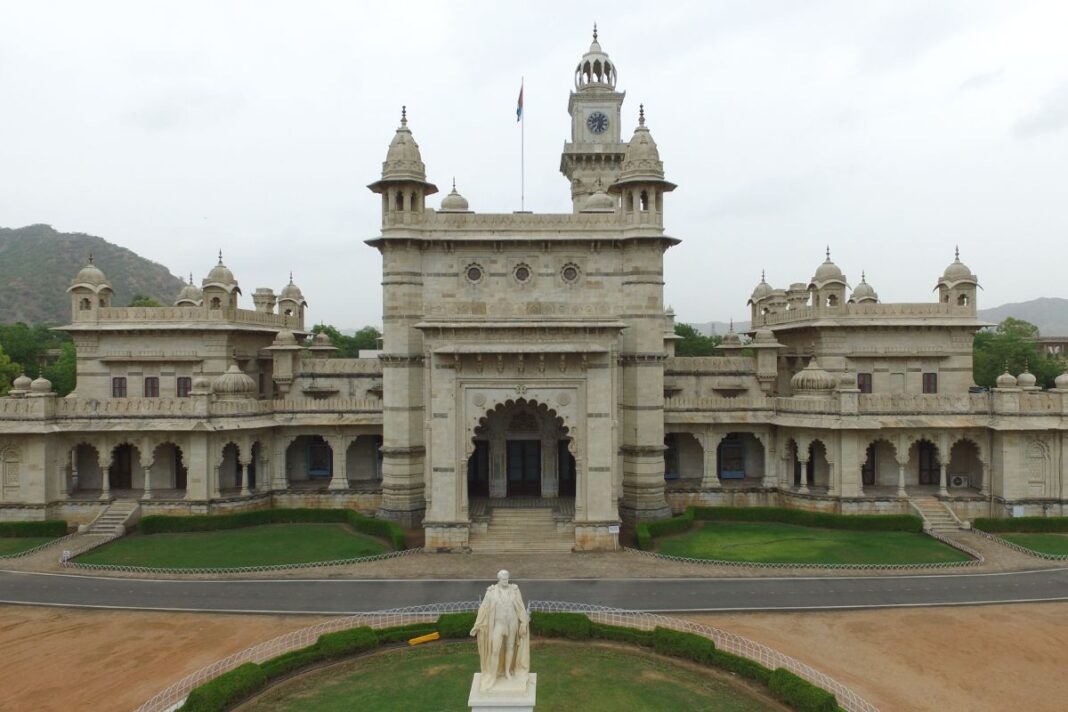

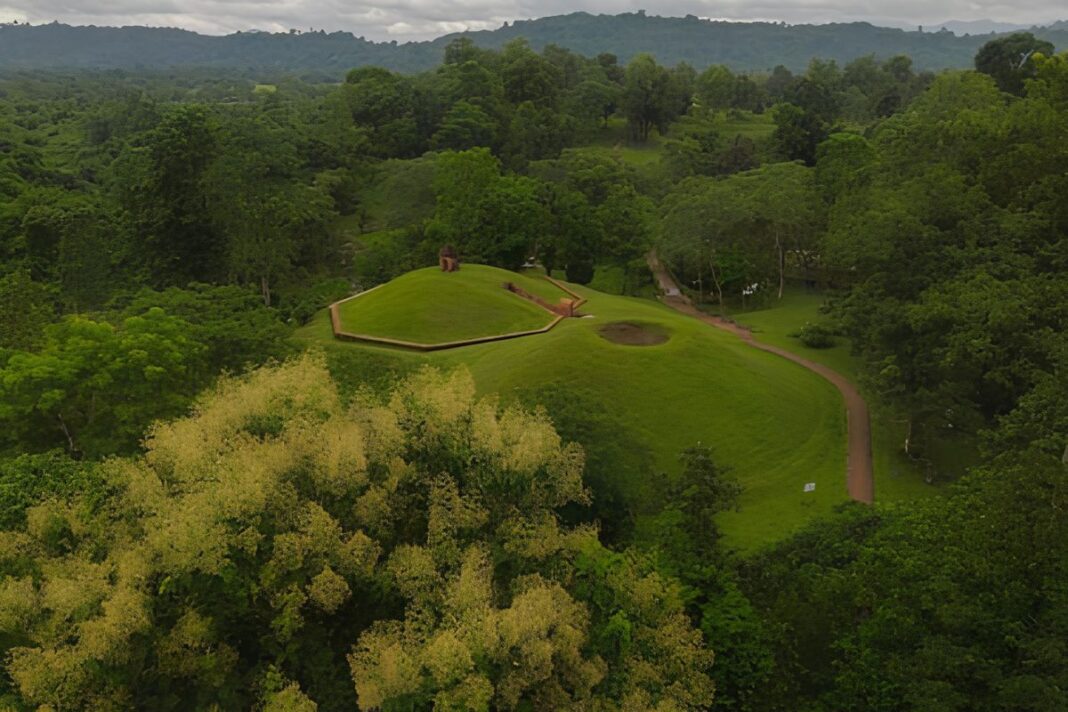

The kingdom that outlasted the Mughals was buried under Assam’s grass for centuries. In 2024, the world finally looked down.
Most people who can name five UNESCO World Heritage Sites from India will list the Taj Mahal, the Red Fort, perhaps the caves at Ajanta or the temples of Khajuraho. Very few will mention the low, grass-covered mounds of Charaideo. That oversight, repeated across school curricula and travel guides for decades, has now been formally corrected. In 2024, the Moidams and the wider archaeological landscape around Sivasagar and Charaideo in Assam were inscribed as India’s 43rd UNESCO World Heritage Site. It was the first cultural inscription from the entire Northeast of India, and it was long overdue.
A Dynasty That Ran Longer Than the Raj
The Ahom kingdom is not well known outside Assam, which is curious given its record. Founded in 1228 by Sukaphaa, a Tai prince from what is now Yunnan province in southern China, the Ahom state governed large portions of the Brahmaputra valley for 598 consecutive years until it fell to Burmese pressure in 1826. That is a longer continuous run than Mughal authority over most of the subcontinent, and considerably longer than British colonial rule.
Sukaphaa and his successors did not simply conquer and administer. Over the centuries, the Ahoms absorbed, negotiated with, and wove together an enormous diversity of peoples, languages, and practices across the valley. They built agricultural networks, coded their own administrative language, and produced a literary and ritual culture that eventually merged with broader Assamese identity in ways that persist today. Their story is not that of a foreign dynasty that swept in, built a few impressive structures, and then disappeared. It is a story of sustained political and cultural growth across a period that most Indian textbook chronologies pass over in a paragraph.
What a Moidam Is
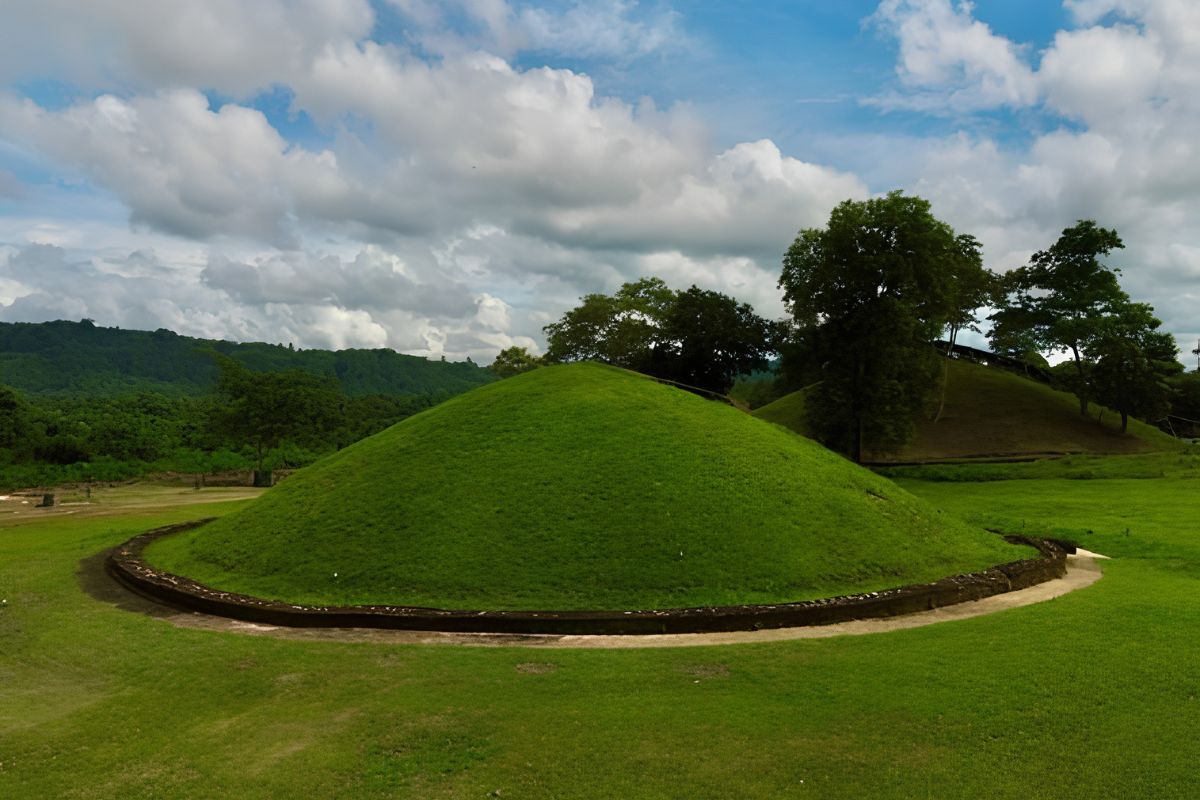
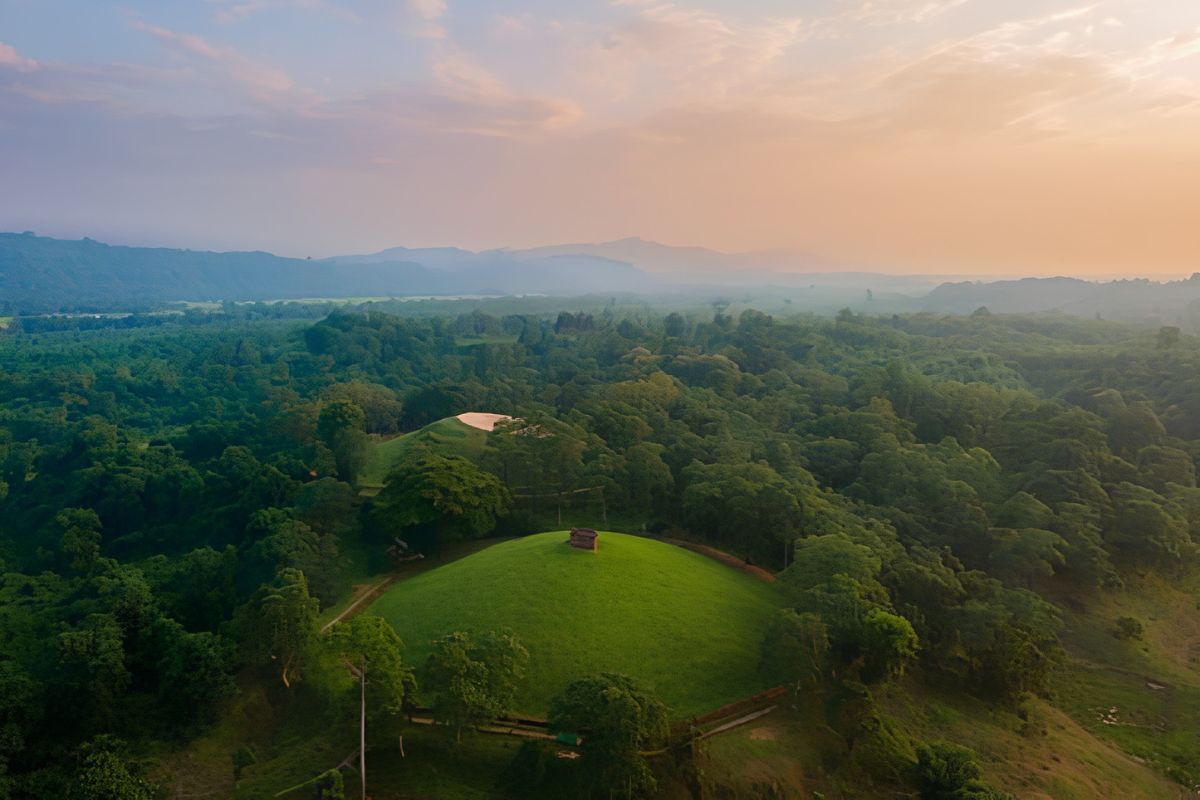
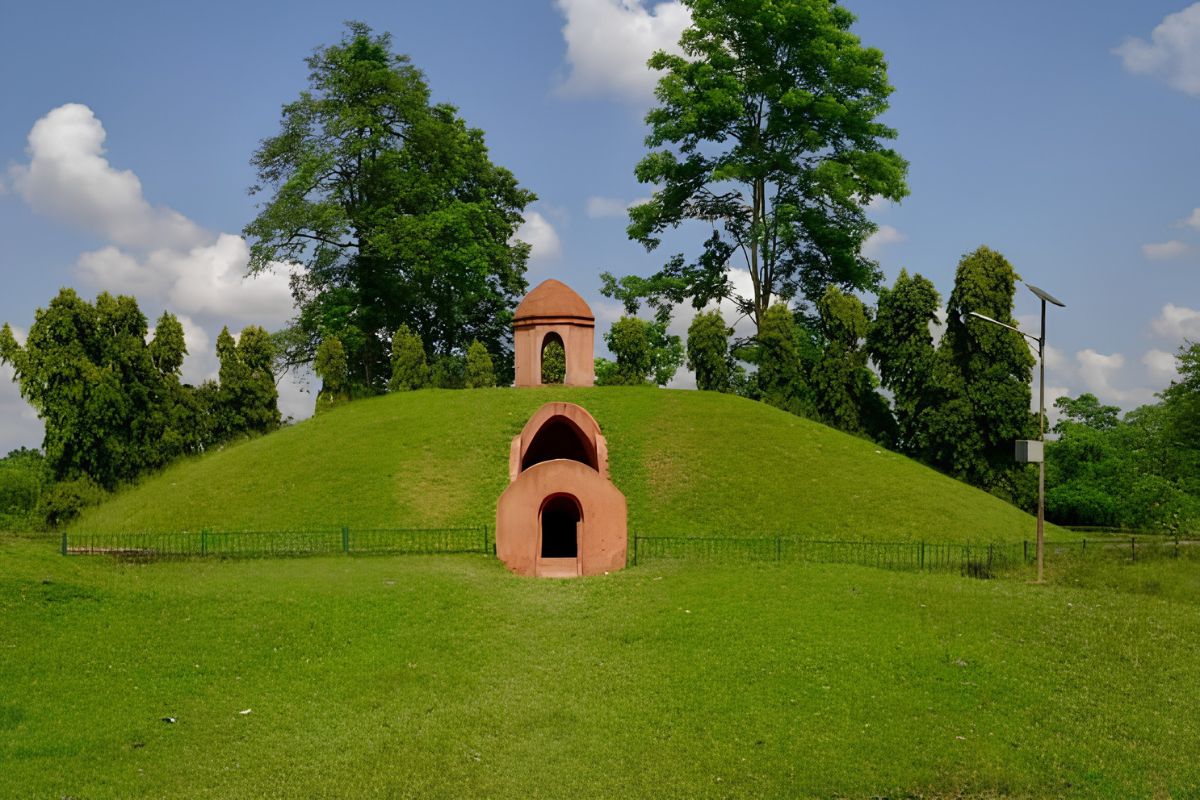
The word moidam derives from the Tai-Ahom term for burial mound, and these structures are precisely that: the royal tumuli of Ahom kings, queens, and nobles. Spread across the Charaideo and Sivasagar landscapes, they appear at first glance as natural rises in the earth, gently rounded and covered in thick grass. Closer examination reveals their deliberate construction: fired brick, lime mortar, carefully arranged stone, and, in the earlier examples, wooden chambers within.
Each moidam was built to house the remains of royalty along with personal belongings, attendants in some historical accounts, and ritual objects considered necessary for the afterlife. The outer mound was, in many cases, surmounted by a memorial structure and surrounded by a brick boundary wall. Scholars and journalists have described them as India’s pyramids, and the comparison has some logic: both traditions used monumental earth and stone to encode dynastic memory. The Ahom moidams, however, are their own thing. Their form, their ritual context, and the community practices that still surround them are specifically rooted in the Assamese landscape.
Charaideo: The Sacred Hill
Charaideo was the Ahoms’ first capital and remained their primary royal burial ground throughout the dynasty’s long history. The forested ridge at Charaideo holds dozens of moidams in varying conditions. Some have been conserved with visible brick courses and decorated stonework. Others have been reclaimed almost entirely by forest vegetation. Together, they form a royal necropolis spanning centuries.
What distinguished the UNESCO nomination was its insistence on treating Charaideo as a living cultural landscape rather than an excavation site. Local communities continue to perform rituals at the moidams. Annual ceremonies mark the royal dead. The connection between living people and buried ancestors has not been severed. That continuity was central to the nomination’s argument, and to the inscription’s significance.
The Sivasagar Ensemble
The UNESCO listing covers more than the moidams of Charaideo. It recognises a broader group of monuments around Sivasagar that together document the full range of Ahom statecraft, civic life, and religious patronage.
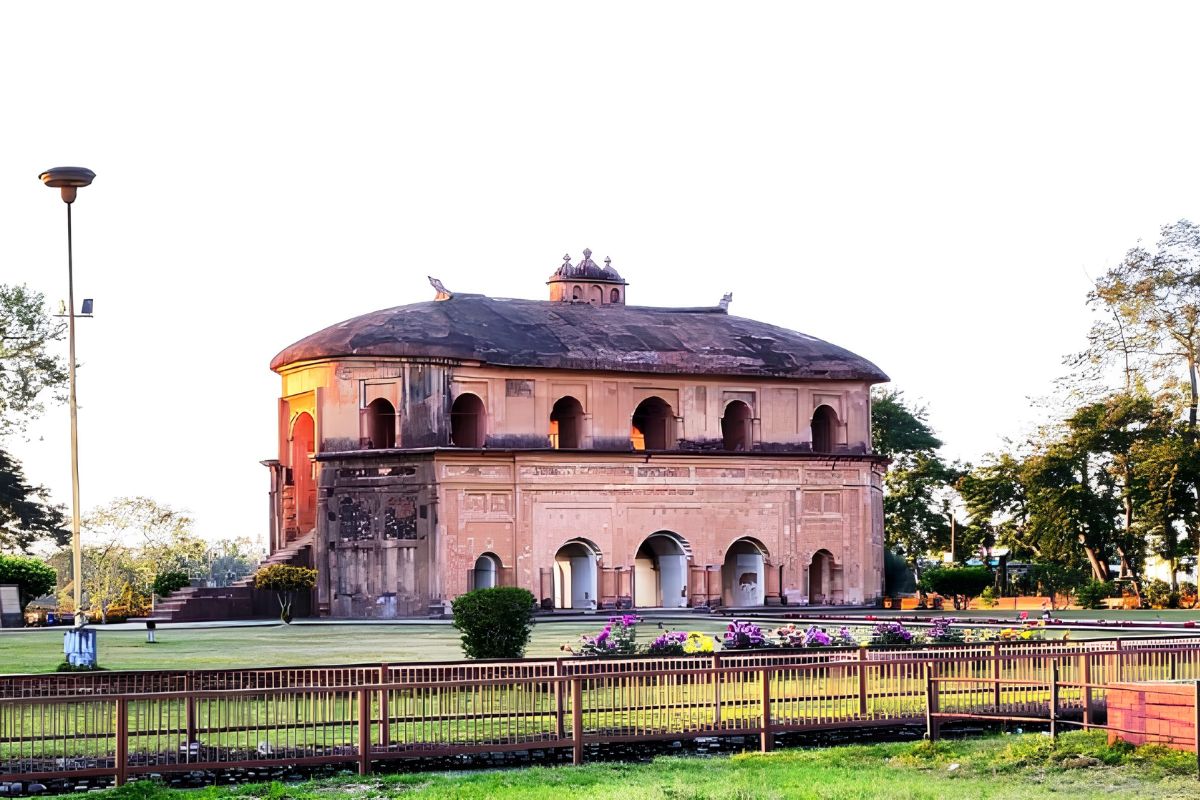
Rang Ghar was built in 1744 under royal patronage and is regularly described as one of the oldest surviving amphitheatres in Asia. Its raised, pillared pavilion overlooked Bihu performances, buffalo fights, and public festivals. The semicircular galleries and elevated royal platform made it an architecture of spectacle: a space designed for rulers to be seen ruling.
Talatal Ghar was the principal palace and military complex of the later Ahom period. It spans several floors, extends into subterranean chambers, and connects via passages that served both residential and defensive purposes. The building adapted to the political pressures of inland warfare and the practical difficulties of Assam’s climate. It is not a palace in the decorative sense of Rajasthan’s havelis; it is a functional statement of power, modified across generations.
Sivadol, the towering Shiva temple in Sivasagar town, was commissioned in 1734 by the Ahom queen Ambika. At roughly 104 feet in height, it remains one of the tallest Shiva temples in the region. It is still an active centre of worship, particularly during Shivratri, and its construction stands as evidence that Ahom queens were patrons of significant public architecture.
Joysagar Tank was ordered to be dug by King Rudra Singha in memory of his mother, Joymoti. The scale is considerable: an artificial lake surrounded by temples and bathing ghats, built as an act of remembrance that also functioned as civic infrastructure for surrounding settlements. It is perhaps the clearest illustration of how private sentiment and public duty were managed simultaneously within Ahom governance.
Namdang Stone Bridge, constructed in 1703, was built using local engineering knowledge that included lime, rice paste, and organic binding agents to bond stone and masonry in an environment subject to monsoon flooding. The bridge endured. It is a modest structure compared to the temples and palaces, but its survival is testimony to the practical intelligence that ran through Ahom building traditions.
Women in the Ahom Record
It is worth dwelling on the queens. In the conventional story of premodern Indian dynasties, royal women tend to appear as wives, mothers, or tragic figures. The Ahom record offers a different account. Queen Ambika built Sivadol. Queen Joymoti’s memory moved a king to construct a lake. Ahom noblewomen influenced succession, shaped ritual life, and left their names attached to monuments and places that still exist. This is not an argument for retrospective idealism; the social structures of Ahom Assam were those of their time. But the material record shows women acting as public patrons in ways the standard textbook histories of medieval India rarely acknowledge.
Materials, Engineering, and the Environment
The Ahom builders worked with what the Brahmaputra valley provided. Fired brick, lime plaster derived from river shells, organic composites suited to wet conditions, and timber where masonry was not required. The result was a building tradition calibrated to flood, humidity, and siege. Talatal Ghar’s vaulted subterranean corridors, Namdang’s organic mortar, and the earthen construction of the moidams all reflect ecological knowledge translated into architecture. The structures that survived did so partly because they were built for the conditions they would face.
Why This Recognition Took So Long
The UNESCO inscription in 2024 was not a sudden discovery. It was the outcome of decades of sustained work by Assamese scholars, archaeologists, local conservationists, and community organisations who argued consistently that these sites deserved formal recognition. The delay reflects a wider pattern in how Indian heritage has been narrated and promoted: the monuments of the Indo-Gangetic plains received international attention early and often. In contrast, the monuments of the Northeast remained a footnote.
That imbalance has practical consequences. Conservation funding, tourist infrastructure, and academic attention all follow recognition. Charaideo and Sivasagar will now receive the kind of attention that has been concentrated for generations on monuments in Rajasthan, Agra, and Delhi. Whether that attention is managed carefully is a separate question, but the access to resources that comes with UNESCO status is real.
Living Heritage
These sites are not sealed off from the present. Bihu is still celebrated near Rang Ghar. Temples in Sivasagar hold festivals that draw large crowds. Ritual observances at the moidams continue annually. The conservation strategy that produced the UNESCO nomination was built around protecting both the physical fabric of the monuments and the intangible practices that give them meaning. That dual commitment is worth preserving as visitor numbers increase.
What the Ahom Monuments Ask of the Rest of India
The Ahom heritage sites do not simply add names to a list. They ask anyone who has studied Indian history in the standard way: how much was left out? A dynasty that governed for six centuries, built a distinctive architectural tradition, managed a complex plural society, and produced royal women who commissioned lasting public monuments has been treated as a regional footnote for too long.
Visiting Sivasagar and Charaideo is one response to that question. Reading the scholarship is another. The grassy moidams, the amphitheatre, the underground palace, and the tank built for a queen’s memory are all still there. They have been there for a long time. The world has only recently chosen to look.
Also Read:When India Opened Its First Petrol Pump
You can connect with DNN24 on Facebook, Twitter, and Instagram and subscribe to our YouTube channel.