
In 1932, in the old lanes of Aurangabad in Maharashtra, a quiet boy named Qazi Ghaus Muhiuddin Ahmad Siddiqui was born. He would later sign his verses as Saeed and be known to readers as J. P. Saeed. He grew up in a city where Mughal tombs, dargahs and narrow bazaars carried the memories of many empires, but his own home was modest.
kuchh yaad nahin us ko ki kya bhul gaya hai
J. P. Saeed
dil jaise ki jine ki ada bhul gaya hai
Around him, India was slowly moving towards freedom, and people were learning to live between hope and fear. This atmosphere of uncertainty, love, loss, and waiting deeply entered his sensitive heart. He began to listen carefully to the puny sorrows of ordinary people, to their disappointments in love, their confusion about fate and their search for dignity.
ye kisi ne tum se ghalat kaha mujhe karwan ki talash hai
J. P. Saeed
jahan main hun tum ho koi na ho mujhe is jahan ki talash hai
When he started writing poetry, he chose “Saeed” as his takhallus. With this pen name, he tried to give shape to those unspoken feelings. From Aurangabad, far away from Delhi and Lucknow, he quietly became one of those Urdu shayars whose ghazals travelled across India through magazines, mushairas and personal diaries. For many readers, he was not a distant celebrity but a close companion who understood the cracks in their hearts without ever meeting them.
The world inside his ghazals and nazms
J. P. Saeed’s poetry is like a calm conversation with a friend who never raises his voice but still shakes you from inside. He wrote ghazals and nazms that moved easily between love, sadness, social reality and inner struggle. His lines often speak of doubt and faith standing face to face.
ahbab mere dard se kuchh be-KHabar na the
J. P. Saeed
ye aur baat hai wo koi chaaragar na the
In many of his verses, happiness is brief, but the courage to face grief is long. He says that if joy does not stay, at least the taste of suffering gives us depth. Critics and readers saw in his work a blend of Udas poetry and Mohabbat bhari shayari, in which separation does not kill hope and defeat does not fully close the door on effort.
taqat thi jab badan mein to darwaza band tha
J. P. Saeed
jab dar khula qafas ka mere baal-o-par na the
His images are simple. Tears like rain clouds, dawn as pure light, different from the reflection of stars. They leave a strong mark on the mind. He did not chase grand philosophical language. Instead, he held onto those ordinary words that people use when they try to explain why they are restless, why friendship hurts, why trust breaks, yet why the heart still refuses to stop expecting. This is why his poetry fits easily into both classical gatherings and modern online collections.
A poet of love, pain and quiet strength
Over time, J. P. Saeed came to be known as a poet who could write of love without forgetting loneliness, and of sadness without losing dignity. Collections of his ghazals and nazms show how often he returns to themes like broken trust, unanswered friendship, and the strange habit of the heart to remember what it should forget.
anjaan hum the rah se manzil bhi dur thi
J. P. Saeed
achchha hua ki aap sharik-e-safar na the
He writes of tears that first rush like monsoon showers and then suddenly become still, of friends who are not entirely unaware of our pain yet cannot carry it, and of a person who stands between certainty and doubt as if both belong to him. At the same time, there is a hidden resilience in his tone. Even when he accepts that the world is unfair, he refuses to give complete victory to despair.
is waste bhi mujh ko tera gham ‘aziz hai
J. P. Saeed
jitne bhi gham mile wo gham mo’atabar na the
His couplets carry a particular weight when read in quiet moments. They do not demand attention with fireworks of language or dramatic declarations. Instead, they settle into the mind like dust after rain, gentle but impossible to ignore. In one verse, he might speak of waiting for someone who will never return. In another, he acknowledges that promises are fragile things, yet believing in them gives meaning to our days. There is always this double vision in his work, this ability to see both the wound and the hand that tries to heal it.
tarik raat ka tha safar rah pur-KHatar
J. P. Saeed
raushan kahin charagh sar-e-rahguzar na the
Readers who enjoy love poetry, breakup verses or reflective lines about life find in him a gentle guide who neither lies with false optimism nor crushes them with total hopelessness. That balance of vulnerability and inner strength gives his work a special glow. It is as if he is saying: yes, life has wounded me, but I will still speak about it in a graceful voice instead of shouting or turning bitter. His poetry does not try to solve the mysteries of human relationships. Instead, it acknowledges them and allows readers to feel less alone in their confusion.
Why J. P. Saeed matters in our times
Today, when social media fills our screens with very loud opinions and rapid emotions, the slow, measured voice of J. P. Saeed feels unexpectedly fresh and necessary. His poetry teaches us how to sit with our hurt without becoming cruel, and how to remember our failures without eroding our self-respect.
wo din bhi kya the dil mein tamanna na thi koi
J. P. Saeed
takmil-e-arzu ke liye dar-ba-dar na the
For a generation that often feels lonely even in a crowd, his verses on unreturned friendship and silent suffering read like a private diary written decades ago, addressed to us. He also reminds us that Urdu poetry is not only about big cities and famous courts. It is also the story of towns like Aurangabad, where a thoughtful young man can transform the daily struggle of ordinary life into delicate art.
sailab-o-zalzale mein hue kitne ghar tabah
J. P. Saeed
wo log be-niyaz rahe jin ke ghar na the
In a country still wrestling with questions of identity, language and belonging, his calm voice stands against hatred without resorting to slogans. Readers across India continue to share his couplets in printed collections and digital platforms, proving that a sincere line, born in one small corner, can keep travelling as long as hearts recognise themselves in it.
kuchh log mil gae the yunhi rah mein mujhe
J. P. Saeed
jo mere sath sath the wo ham-safar na the
His work also serves another purpose in these times. It preserves emotional honesty that is becoming rare. In an age where people present curated versions of themselves online, his poetry offers permission to feel. To grieve without a deadline. To love without a guarantee.
sab ne mera kalam paDha lekin ai ‘said’
J. P. Saeed
jo mere naqidin the wo dida-war na the
The language of his poetry also carries cultural memory. Reading his Urdu verses connects us to a literary tradition that values nuance over noise. In his hands, the ghazal form becomes a vessel for contemporary emotion while maintaining its classical grace.
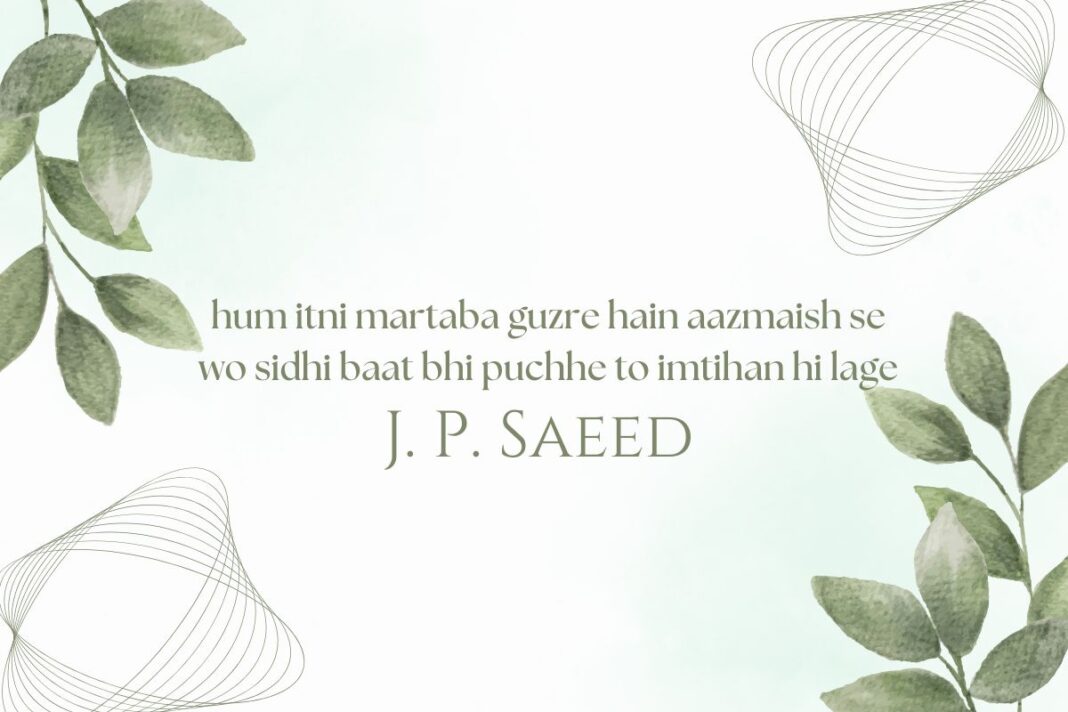
yaqin jis ka hai wo baat bhi guman hi lage
J. P. Saeed
wo mehrban hai lekin bala-e-jaan hi lage
To read J. P. Saeed today is to slow down for a moment and listen to the softer notes of our own inner music, the part of us that still believes in love, remembers pain and yet quietly decides to go on. His legacy is not in grand monuments or literary awards, but in the quiet moments when a reader finds one of his couplets and thinks: yes, this is precisely what I could not say about my own heart.
Also Read:Ibrahim Aajiz: A Quiet Star In A Small Village
You can connect with DNN24 on Facebook, Twitter, and Instagram and subscribe to our YouTube channel.