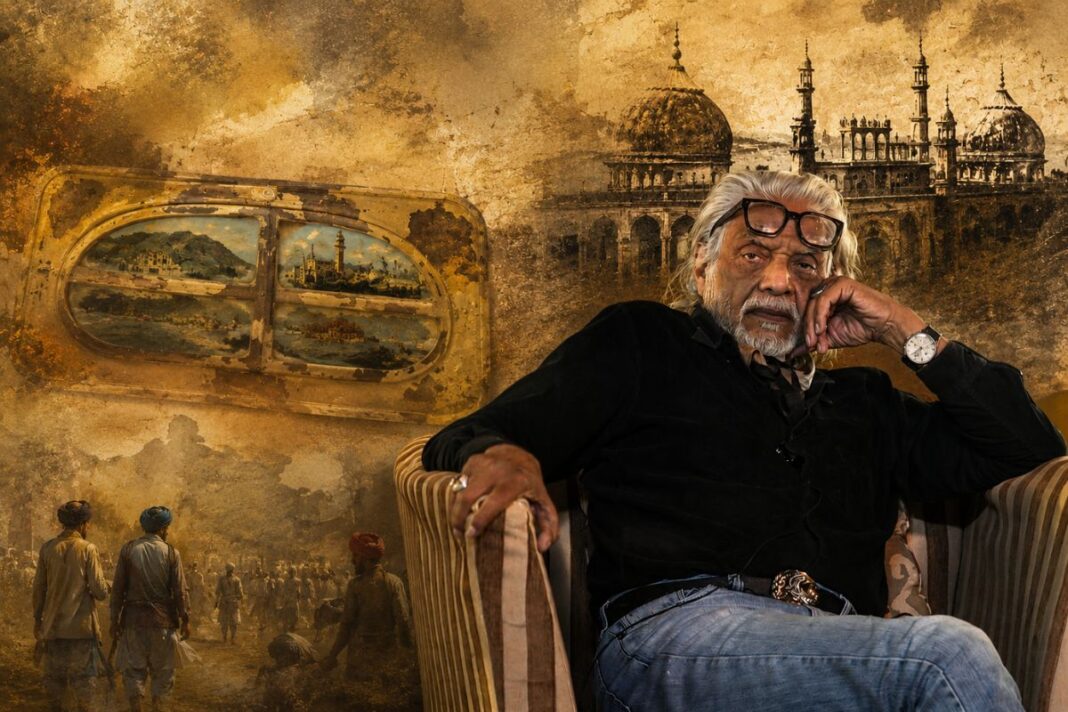

Some people make films, while others use cinema to express their souls’ voices. Muzaffar Ali belongs to that rare group of artists whose identity extends far beyond being an accomplished filmmaker. He is a painter, a lover of poetry, a believer in Sufi philosophy, and, above all, a guardian of India’s Ganga-Jamuni culture who has always placed humanity above all other identities.
Listening to him feels less like hearing an interview and more like experiencing centuries of refined culture speaking through one person. His words carry elegance, his thoughts reflect remarkable depth, and every conversation reveals his deep affection for the land that shaped him. That is why his films are never just stories. They capture an entire era, preserve traditions, and celebrate the emotions that define human life.
A Cinematic Journey Rooted in Awadh
When asked how his early education and upbringing in Awadh influenced his artistic vision, Muzaffar Ali responded with words that reflected his lifelong attachment to his roots.
He said, “My entire journey in cinema begins with Awadh. Unless a person truly understands their roots, they can never understand the pain of being separated from them.”
This is not merely a thoughtful statement but a philosophy that has guided his life.
For Muzaffar Ali, Awadh is much more than a geographical region. It is a living emotion. The grace of Lucknow, the soil of Kotwara, the local language, literature, traditions, and the warmth of human relationships all came together to shape the artist within him.
He believes that anyone who becomes disconnected from their roots also loses the depth that defines genuine artistic expression.
Referring to the great Sufi poet Rumi, he explains that just as a reed flute finds its voice only after being separated from the reed bed, human beings often discover their deepest emotions after moving away from their homeland. That pain, he believes, eventually transforms into art.
Every Emotion Is Enriched by Culture
According to Muzaffar Ali, culture does not belong to a single religion or a particular region.
He believes that once a person embraces courtesy, literature, and cultural values, beauty becomes visible in every civilization. Perhaps it was this outlook that drew him to Kashmir, where he worked with the same sense of belonging that he has always felt in Awadh.
The same philosophy is reflected throughout his films. Narrow identities never confine his characters. They speak the universal language of humanity.
“Without My Father, I Would Not Even Have Become a Human Being”
Behind every remarkable individual stands someone who lays the foundation of their character. For Muzaffar Ali, that person was his late father, Syed Hussain Sahib.
When asked about his father’s influence, he replied without hesitation:
“If he had not been in my life, I would not have been who I am. I would not even have become a human being.”
His response makes it clear that his father gave him far more than education. He taught him the true meaning of being human.
Muzaffar Ali believes that humanity stands above religion, faith, and every social identity. Unless people remove the walls that separate them from one another, they cannot become compassionate individuals or authentic artists.
That is why human relationships remain the emotional foundation of every film he has created.
A Powerful Example of Humanity During the Partition
The Partition of India in 1947 remains one of the most painful chapters in the country’s history. Millions lost their homes, entire communities were uprooted, and people were divided in the name of religion.
However, even during those difficult times, some individuals chose compassion over hatred.
Recalling his father’s actions, Muzaffar Ali shared that after Partition, when many Sikh families were left homeless, his father donated thousands of acres of land to help rehabilitate them. Working alongside Vinoba Bhave, he played a significant role in resettling displaced families.
This was the true spirit of India’s Ganga-Jamuni culture, where humanity always came before religious identity.
Muzaffar Ali acknowledges that many people may no longer remember this remarkable act of generosity, but such deeds live on forever in the character of those who perform them.
For him, humanity was never simply a lesson learned from books. It was a value nurtured at home and passed down through generations.
Also Read: Tribal Village in Manipur Turned Trees Into Classrooms Where Children Learn Their Native Language
You can connect with DNN24 on Facebook, Twitter, and Instagram and subscribe to our YouTube channel.