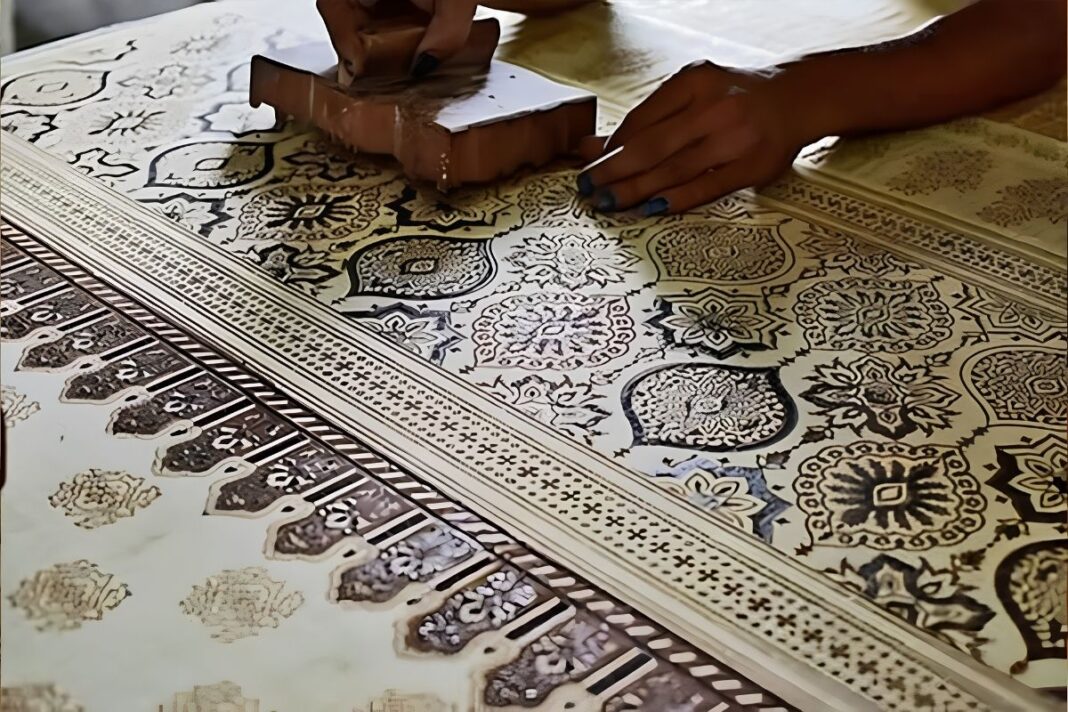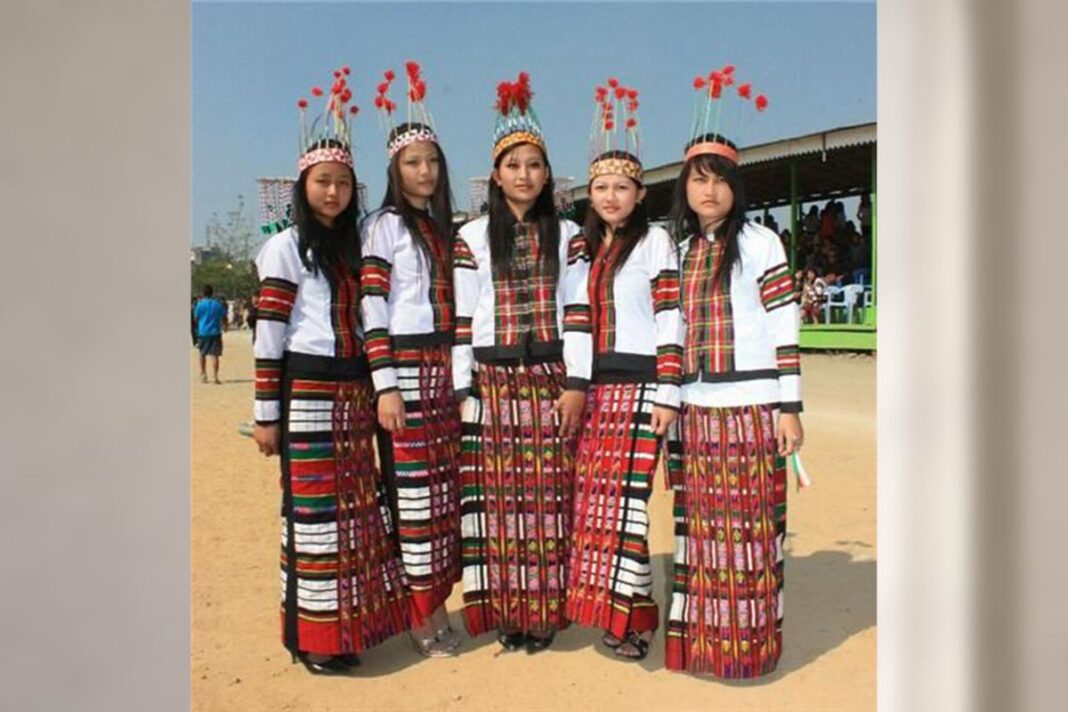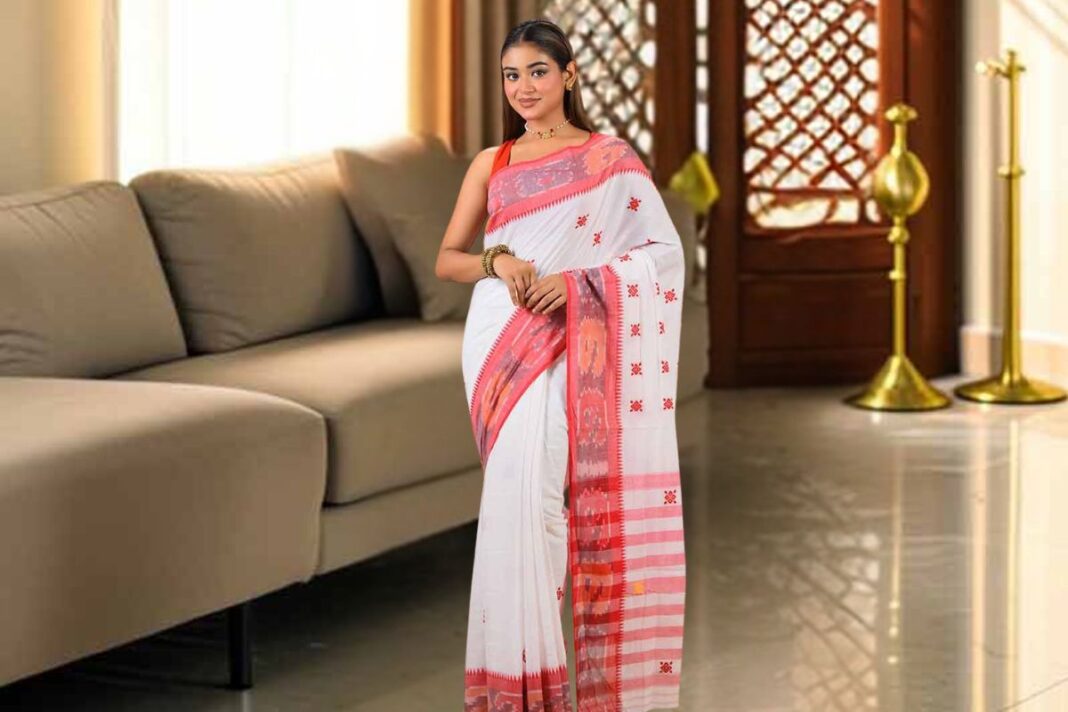

A saree that has outlived empires, floods, and a border drawn in 1947 should not still be hanging in ordinary almirahs across Bengal, yet the tant is, and nobody who wears one seems the least bit surprised by that.
A Loom That Outlasted an Empire
Walk through a Bengali household in June, and you will likely find a woman reaching for cotton rather than silk. The tant saree, woven on a handloom and named for the Bengali word for that very loom, is built for heat. It breathes against the skin in a way synthetic fabric never quite manages, and it grows softer with every wash instead of wearing thin.
The craft has documented roots in fifteenth-century Shantipur, a weaving town in what is now Nadia district in West Bengal. Under Mughal patronage, weavers there worked alongside the makers of muslin and jamdani, and the techniques that shaped those famous fabrics also shaped the borders and texture of the tant. British industrial policy later tried to crush handloom weaving in favour of mill cloth, and the craft survived that too, though not without cost.
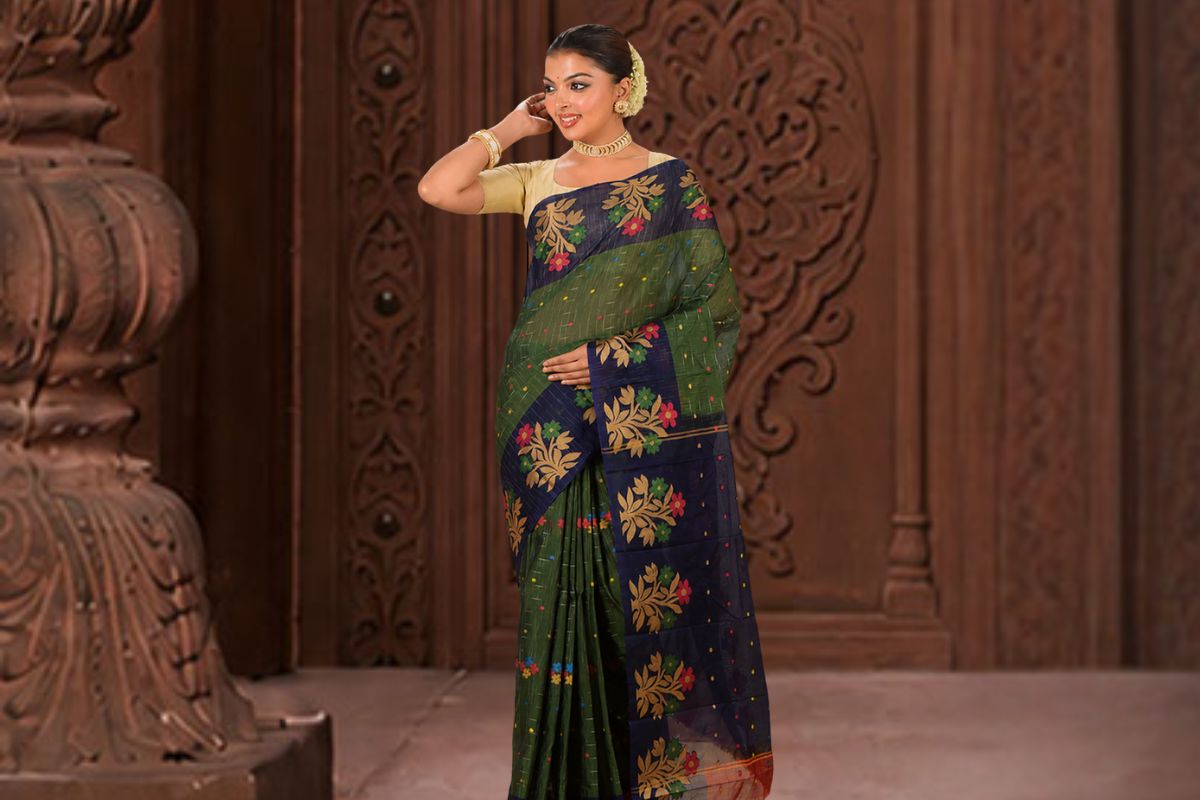
Partition in 1947 scattered many Hindu weavers out of Tangail, a weaving hub now in Bangladesh. Families resettled near Phulia and Shantipur and carried their looms and their patterns with them. Over the following decades, towns across Nadia, Hooghly and Bardhaman districts each built their own version of the craft, adding fresh borders and motifs to a shared tradition that refused to stay still.
How a Bundle of Cotton Becomes a Saree
The process starts with cotton yarn, often handspun, chosen for a balance of softness and strength. Weavers wash the yarn and lay it out in the sun, a step that bleaches the fibre and readies it for dye. Once dry, the thread goes into boiling colour baths, dries a second time, and gets wound onto bamboo bobbins, usually by the women of the household.
That dyed yarn becomes the warp, the long threads strung on a wooden beam that will run the length of the finished saree. This part of the work is close to arithmetic. One misplaced thread and the whole pattern goes crooked.
Weaving itself happens on a pit loom, with the weaver seated at floor level, feet on the pedals and hands guiding the shuttle that carries the weft across the warp. For the ornate borders and the pallu, artisans switch to a discontinuous weft technique, feeding in small separate spools of coloured thread to build motifs directly into the cloth as they go, almost like embroidery done in real time rather than after the fact.
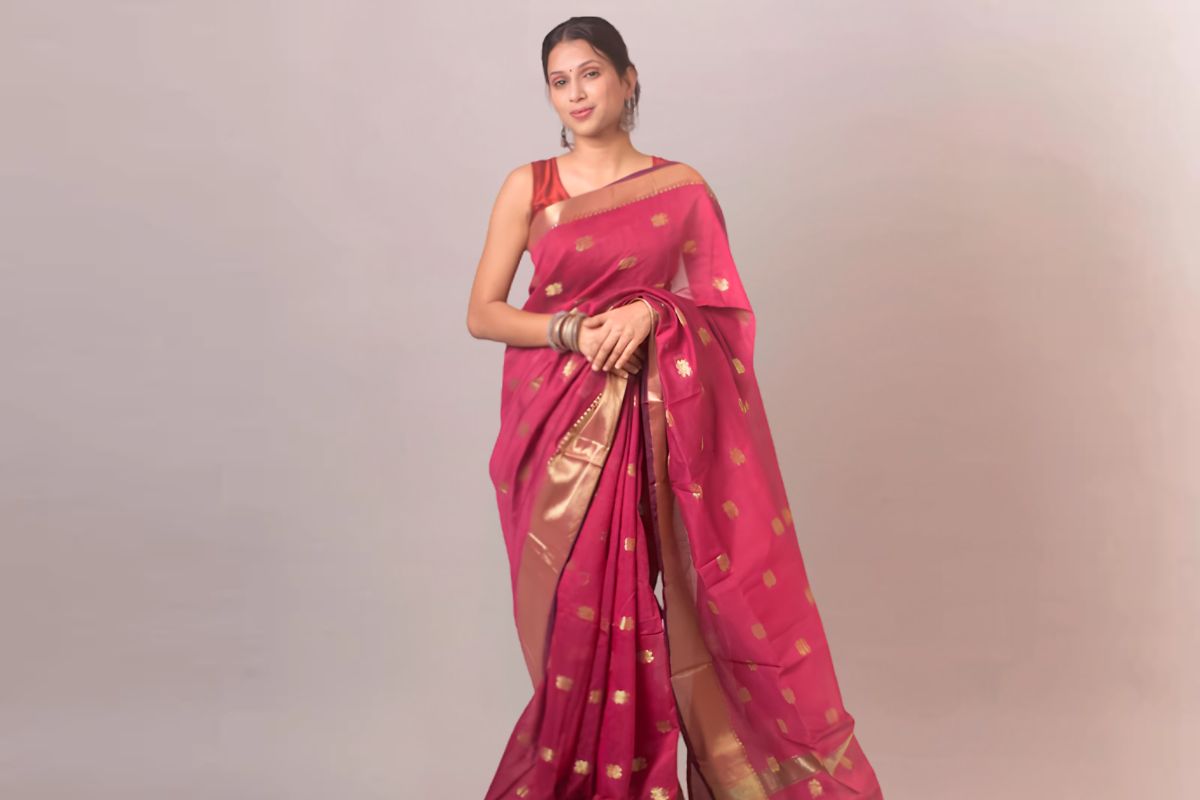
The finishing touch is a paste made from sago or puffed rice, applied as a light starch that gives the tant its familiar crispness and faint sheen. A plain tant can take ten to twelve hours on the loom. A saree with elaborate borders can take a week or longer.
What the Motifs Are Actually Saying
A traditional six-yard tant carries a border two to four inches wide and a pallu dense with pattern. The names given to these patterns read like a small poem on their own. Bhomra means bumblebee. Tabij is an amulet. Rajmahal is a royal palace. Ardha chandra is a half moon. Ratan chokh translates to gem-eyed. Kalka, the paisley, appears almost everywhere.
That paisley is worth pausing on, because it carries more weight than its curved shape suggests. Known in Bengali as kalka and in Hindi as kairi, the motif traces back to the Persian boteh, a design that paired a floral spray with a cypress tree to represent life without end. As the shape moved into Indian craft, it picked up local meaning, and in Hindu weaving traditions it now reads as a sprouting seed or a young mango, a symbol of fertility and steady growth.
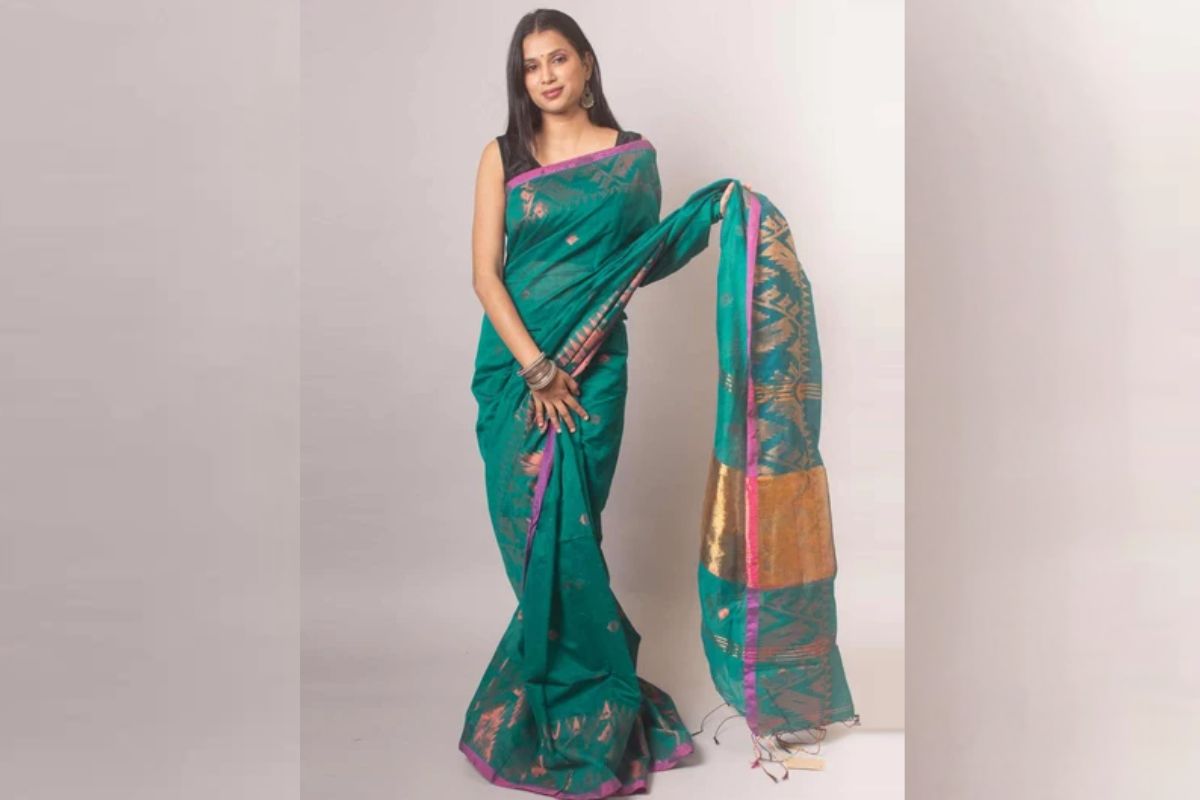
On a tant, the paisley shows up in three places. It repeats along the border, giving the drape its rhythm. It grows larger and more elaborate across the pallu, often mixed with floral vines. In the finer pieces, it appears scattered across the body of the saree as small butis, adding texture without weighing the fabric down.
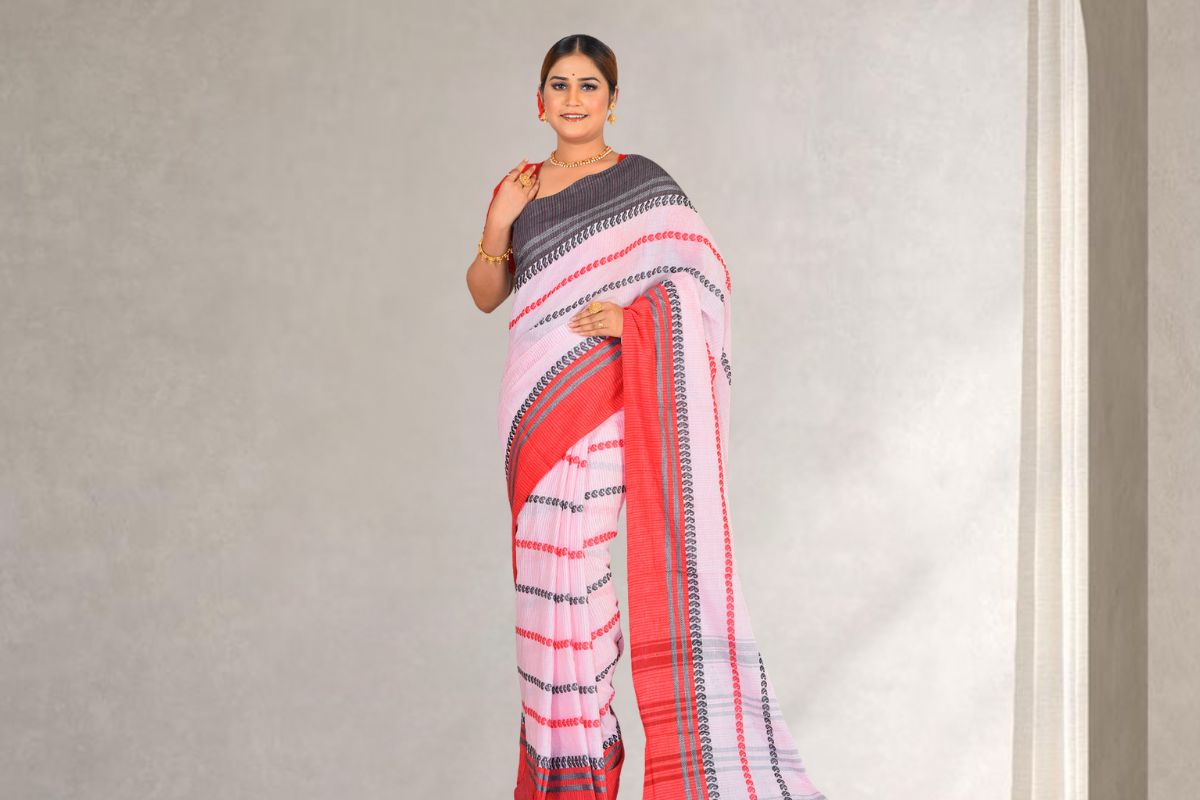
Every region gives the pattern its own accent. Shantipur weaves are known for a soft, fine texture and understated stripes. Dhaniakhali favours a tighter weave and bold borders. Begampur leans into bright colour and wide borders with fewer motifs. Phulia blends jamdani-style detail into its tant weaving. Each town, in effect, speaks the same language with a different accent.
Why a Red and White Saree Means So Much
During Durga Puja, Bengal’s largest festival, women across generations reach for cotton tants, and the white saree with a red border, known as lal paar, is considered particularly auspicious for prayer. That red-and-white pairing has come to stand for strength and devotion, echoing the goddess herself.
The saree shows up again at Poila Boishakh, the Bengali New Year, at Saraswati Puja, at weddings, and at ordinary family gatherings. It is often the gift an elder chooses for a younger woman, a kind of blessing folded into cloth, and it frequently finds its way into a bride’s trousseau, especially versions with detailed jamdani or muslin style borders.
A Livelihood Under Pressure
For many rural families in West Bengal, weaving ranks second only to farming as a source of income. The work is shared across a household. Women prepare bobbins and manage the dyeing. Men run the looms. Children help with drying and finishing touches. March and April are the busiest months of the year, as demand climbs ahead of the Bengali New Year on April 14.
Even so, the craft is under real strain. Power loom copies and cheap synthetic fabric undercut handmade prices, and low pay discourages younger weavers from taking up the trade at all. The pandemic hit particularly hard, with cancelled orders leaving looms silent for months at a stretch in weaving towns that depend almost entirely on this one skill.
A Quiet Comeback
Even under that pressure, the tant is finding new life. Designers are pairing it with crop tops and belts, experimenting with mercerised cotton and silk blends to change how the fabric drapes and catches light. Beyond sarees, tant fabric now appears in scarves, kurtas, stoles, and home textiles, opening new income for weaving clusters in Shantipur, Phulia, and Dhaniakhali.
Government schemes and e-commerce platforms are also cutting out some of the intermediaries, letting more of what a saree sells for reach the weaver who actually made it. Fashion shows and city styling guides increasingly present the tant as a breathable, sustainable choice for Indian summers and a quiet argument against fast fashion.
A Weave That Refuses To Break
There is something worth noticing in a fabric that has survived colonial policy, a violent partition, and a century of industrial competition, and is still being woven by hand on a floor loom today. Every motif on a tant carries a small story, whether it is a fish, a temple, a sky, or a paisley standing in for fertility and continuity across generations.
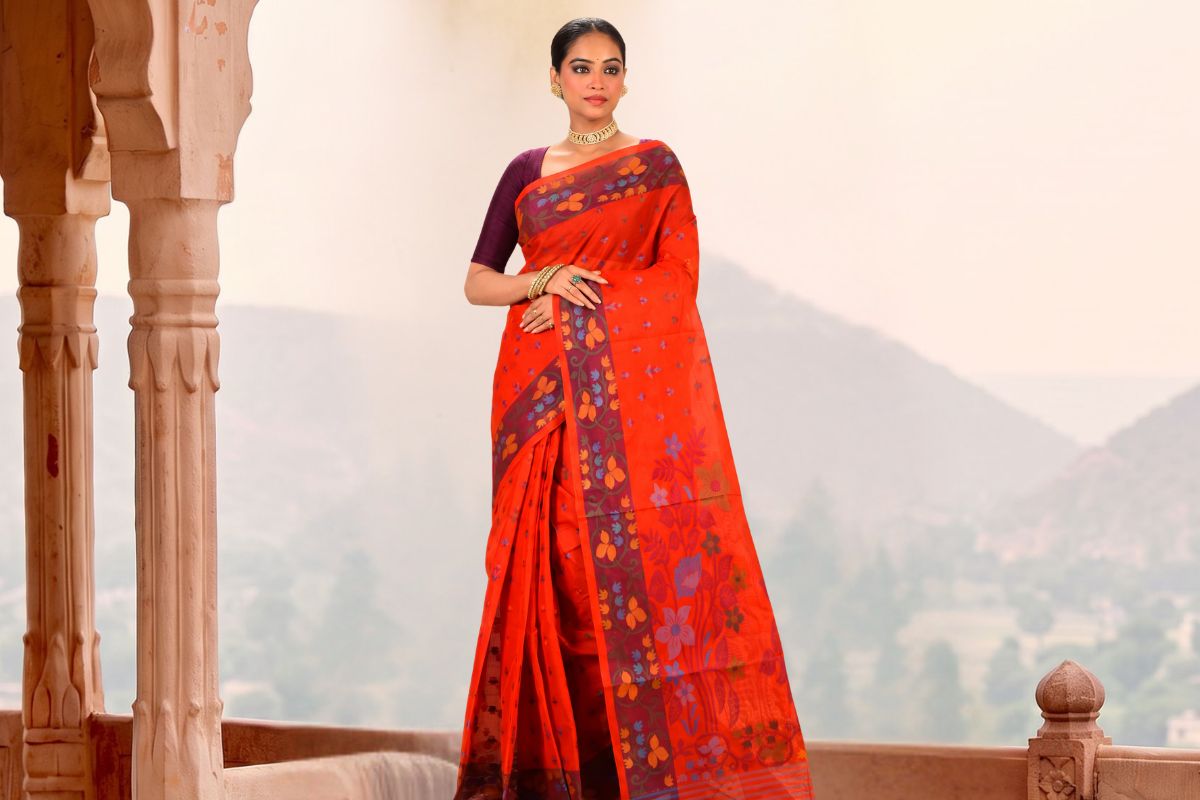
Choosing a tant is rarely just about staying cool in a Bengal summer. It is a way of standing, briefly, inside a five hundred year old line of skill that has never fully broken, no matter how hard the last few centuries tried.
To keep one in good shape, hand wash gently in cold water with a mild detergent, skip the machine and the dryer entirely, and store it in a cotton or muslin bag away from direct sunlight. Light starching before ironing helps the fabric hold onto its crispness for years to come.
As long as weavers are willing to sit at a pit loom and pass a shuttle through cotton warp, Bengal will keep dressing its festivals, its weddings and its ordinary mornings in a fabric that has never needed to shout to be noticed.
Read: Maheshwari Sarees: The Royal Weave of Maheshwar
You can connect with DNN24 on Facebook, Twitter, and Instagram and subscribe to our YouTube channel.