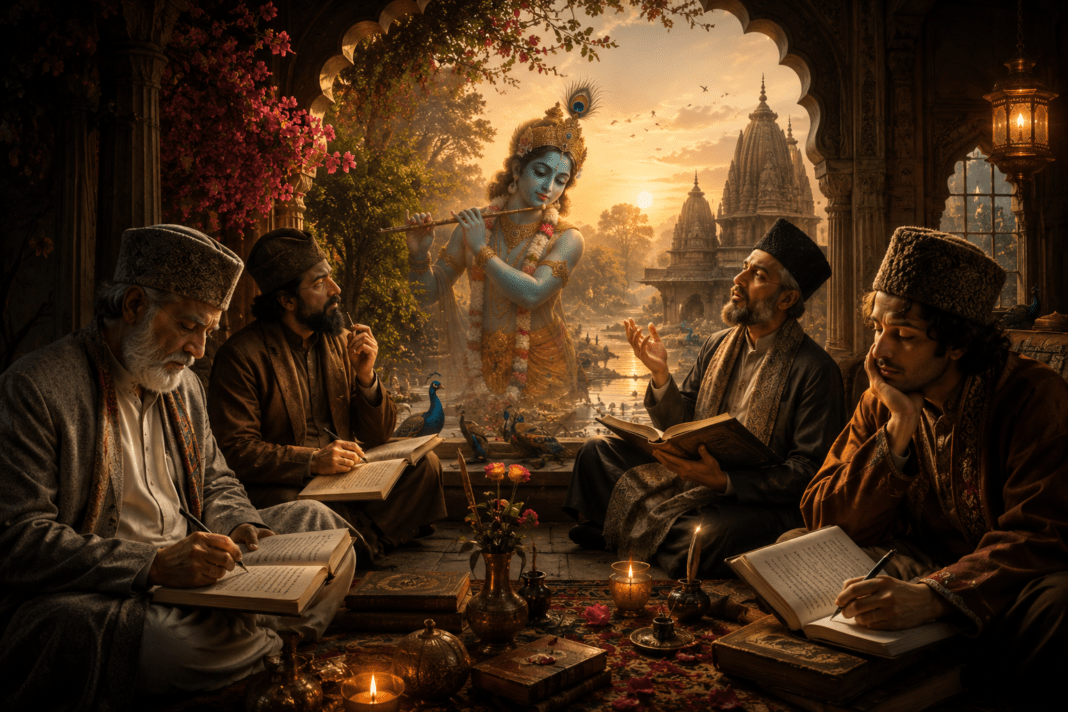

Urdu poets never stopped singing to Krishna, and the reason has nothing to do with politics or fashion. It has to do with love. For nearly four centuries, some of the finest names in Urdu literature- men who prayed five times a day, who made the pilgrimage to Mecca, who wrote verses in praise of the Prophet- also wrote with open devotion about a cowherd god from Braj. They called him Hazrat. They wept for his flute. They asked him for grace at his feet in Mathura. None of them saw a contradiction in this, and neither did the audiences who read them.
This tradition runs so deep that it has its own name in cultural history: Ganga Jamuni tahzeeb, a shared inheritance in which Hindu and Muslim symbols moved through the same imagination without friction. Under the influence of the Chishti Sufis, a genre called Premakhya grew out of this soil. It borrowed the language and imagery of Krishna and Radha to describe something the Sufis called ishq-e-haqeeqi, love for the truth behind all things. In this reading, the gopis who pined for Krishna became stand-ins for every soul that longs for God, and Krishna himself became the beloved that all mystics write toward.
A Tradition That Begins In Braj
The clearest early figure in this line is Syed Ibrahim Khan, better known by his pen name, Ras Khan. Born in 1548, he left Delhi for Vrindavan and spent his life composing bhajans in Braj Bhasha, the local tongue of Krishna’s homeland. He remains part of Braj’s devotional landscape today, and his verses of longing and separation read much like Sufi poetry in a different costume.
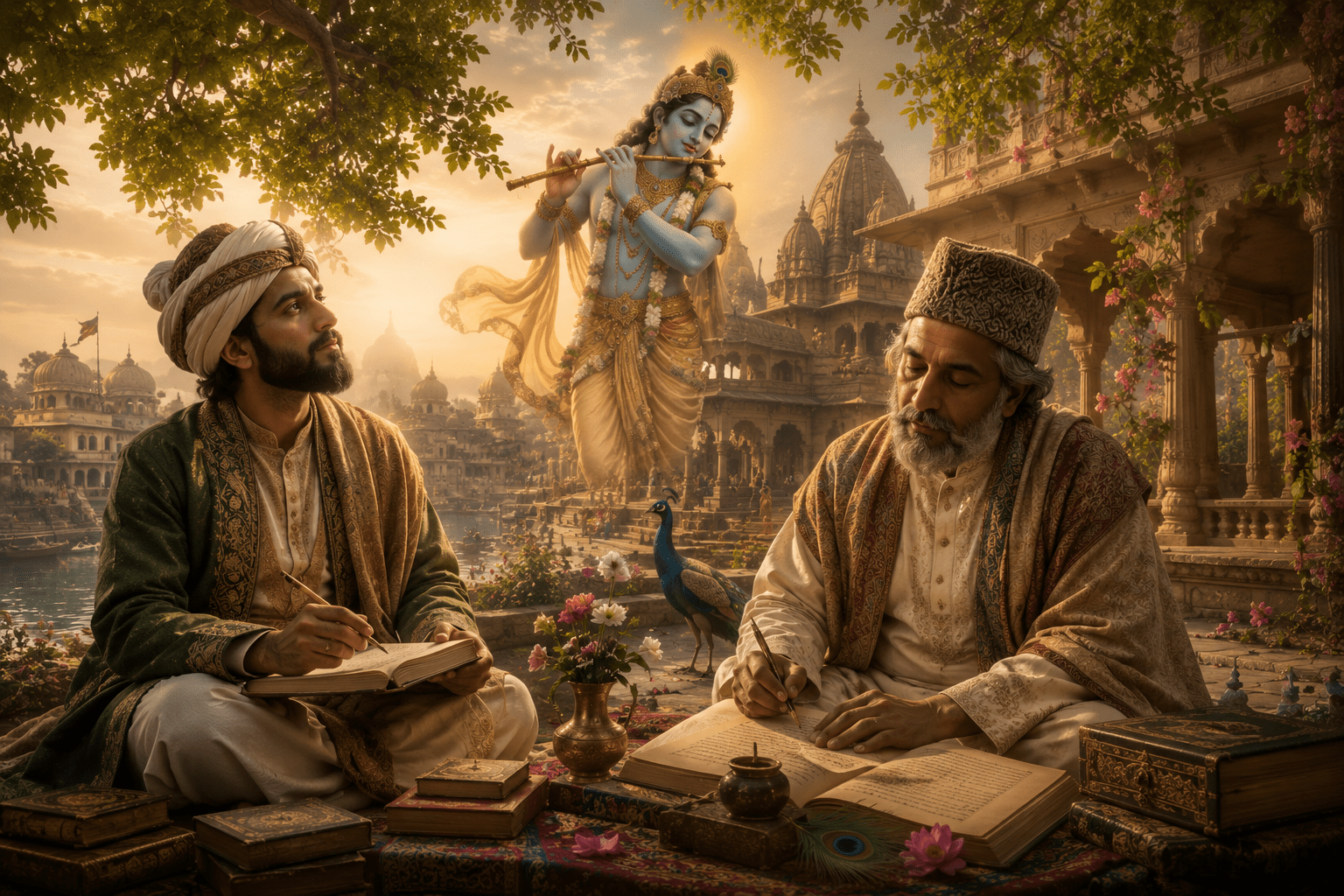
A century and a half later came Nazeer Akbarabadi, often called the poet of the people for his warm portraits of festivals, fairs, and daily life in late Mughal Delhi. Nazeer wrote a long song called “Kanhaiyya Ji Ki Baansuri,” or Krishna’s Flute, in which the music of Krishna’s instrument moves every listener to tears. Yet the same poet, in another verse from the same body of work, reminded fellow Muslims never to forget the kalma, the declaration of faith, even for a moment. For Nazeer, these two impulses were not opposites. They were part of one spiritual economy, and his comfort in holding both set the pattern that later poets would follow.
Hasrat Mohani And The Prisoner’s Ghazal
No figure illustrates this comfort better than Maulana Hasrat Mohani. Born Syed Fazl-ul-Hasan in the town of Mohan in Uttar Pradesh, he went on Hajj eleven times, belonged to the Qadiri and Chishti Sabri Sufi orders, and spent years in British jails for his role in the freedom struggle. Mohani coined the slogan ‘Inquilab Zindabad’. Mohani also addressed Krishna as Hazrat Shri Krishan Ji Maharaj and travelled to Mathura for Janmashtami whenever he could.
His most striking verses on the subject were written during his imprisonment at Yerwada jail near Pune in the early 1920s. Around the festival of Janmashtami in 1923, he composed a short ghazal in formal Urdu that asked Krishna directly for a share of the divine love that his devotees enjoyed, and for permission to stand once more before him in Mathura. In the weeks that followed, he wrote a further set of poems in a simpler dialect close to Braj Bhasha, adopting the voice of a gopi separated from her beloved Shyam. Mohani summed up his own theology in a single line that has outlived him: the creed of love is the worship of beauty, and lovers know nothing of reward or punishment. For him, the mosque and the temple were lit by the same beauty, and Krishna’s flute and the Sufi’s chant were two tunes carrying the same message home.
From Broken Flutes To National Awakening
The poets who followed Mohani often turned Krishna into something larger than a private object of devotion. He became a figure through whom they could speak about the condition of the country itself. Seemab Akbarabadi, a poet who also took part in the freedom movement, wrote of Krishna’s flute as broken, its pieces scattered, and called for the pieces to be gathered so the flute could sound again and wake India from its long sleep.
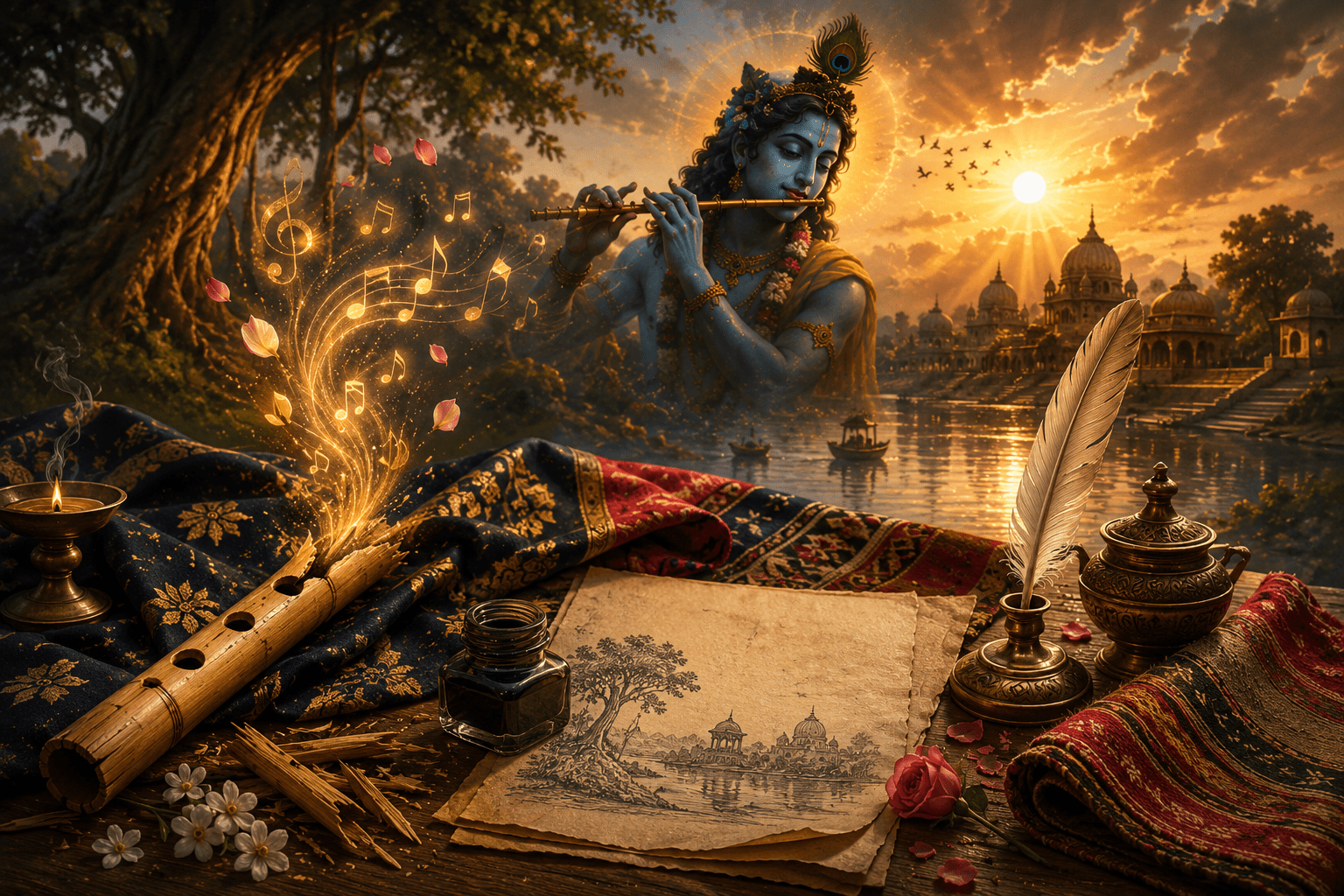
Josh Malihabadi, famous for verses that stirred anti-colonial feeling, wrote of the same flute in gentler terms, describing how its notes brought clouds of kindness raining down on the heart, music that was never meant only for escape but for renewal.
Bekal Utsahi, who later received the Padma Shri and served in Parliament, asked Krishna for something more personal still. He wanted a mirror that would show him his own faults, and a pen that could write with the same grace as Krishna’s flute.
Hafeez Jalandhari, remembered today chiefly as the writer of Pakistan’s national anthem, produced one of the most ambitious poems in this tradition, a long piece called “Krishn Kanhaiya.” It moves from mystical abstraction to plain devotion and then to a stinging allegory drawn from the Mahabharata, in which the humiliation of Draupadi in the Kaurava court stands for a colonised country stripped of its dignity. The poet calls on Krishna to return, asserting that his arrival alone would restore both honour and life.
A Promise That Keeps Returning
Sahir Ludhianvi, writing decades later for the author Krishn Chandar, recalled Krishna’s old promise to return to earth whenever wickedness grew too heavy, turning the myth into a quiet argument that writers and artists carry the same duty in every generation. Nida Fazli pushed the idea to its furthest point, writing a couplet that has become one of the best-known lines in this tradition, in which devotion to Krishn Kanhaiya of Brindavan is simply another form of praise for Allah, and the flute, the song, the scripture, and the cow are all paths leading to the same Creator.
Why This History Still Matters
None of the poets discussed here was secular in any modern sense of the word. Most were devout Muslims who felt no need to explain or apologise for their attachment to Krishna. Their Krishna appears as a child, a cowherd, a charioteer, a warrior, a teacher, and above all a beloved figure with room enough to hold several theologies at once without turning vague or hollow.
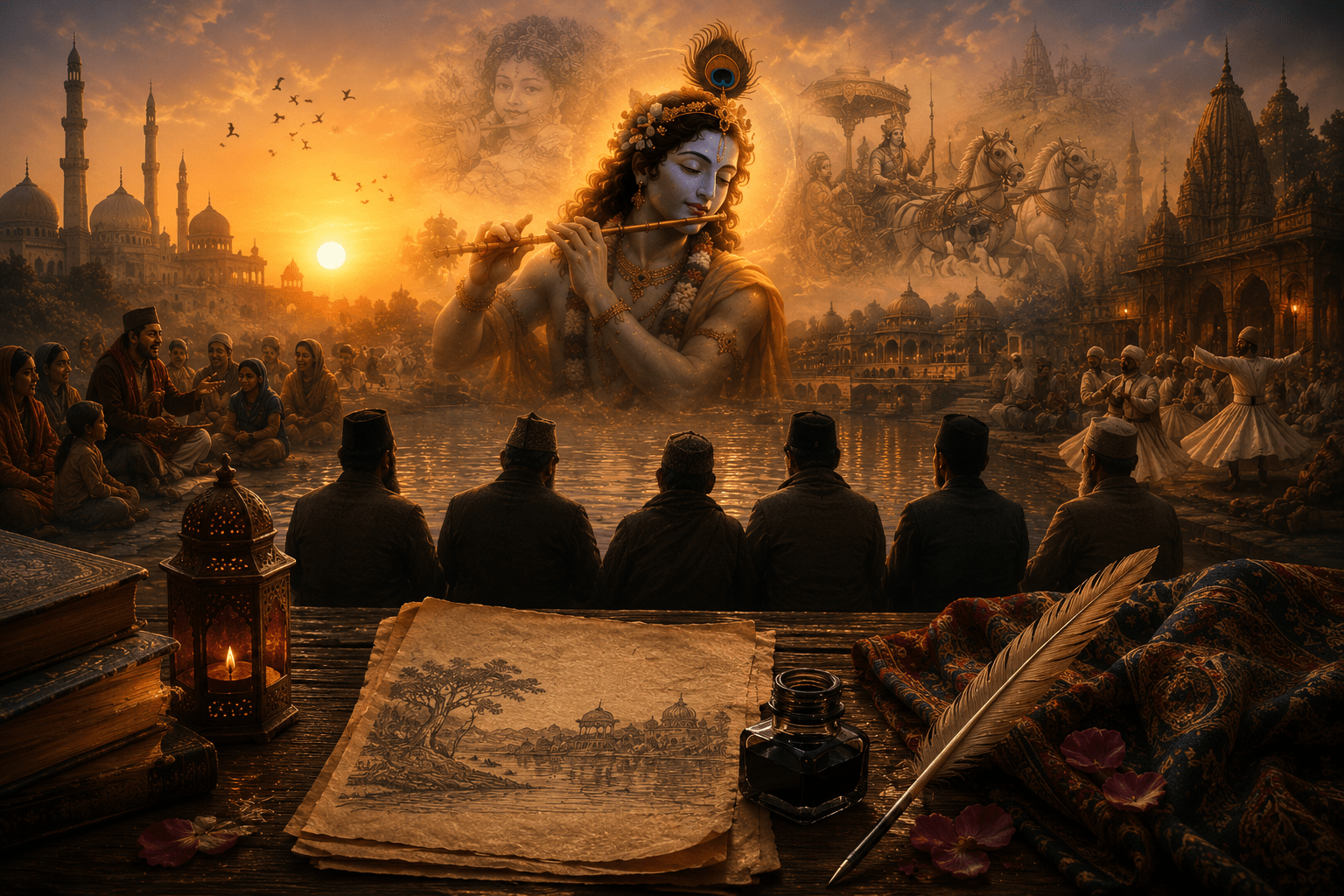
At a moment when cultural and religious lines are so often drawn hard and policed with suspicion, this body of poetry stands as a record of a wider circle of belonging that once shaped Indian literary life. When Hasrat Mohani begs to stand at Krishna’s feet in Mathura, when Seemab dreams of a mended flute waking the nation, when Jalandhari calls Krishna back to restore a wounded country’s honour, these poets are not simply performing devotion. They are describing a shared destiny that Urdu literature was once confident enough to claim. Read together, their verses turn Krishna into something more than a deity from one tradition. He becomes a mirror in which poets examined their own failings, a flute capable of retuning a fractured society, and a promise that love, in whatever language it is spoken, might still close the distances that history keeps opening between us.
Read: Maheshwari Sarees: The Royal Weave of Maheshwar
You can connect with DNN24 on Facebook, Twitter, and Instagram and subscribe to our YouTube channel.