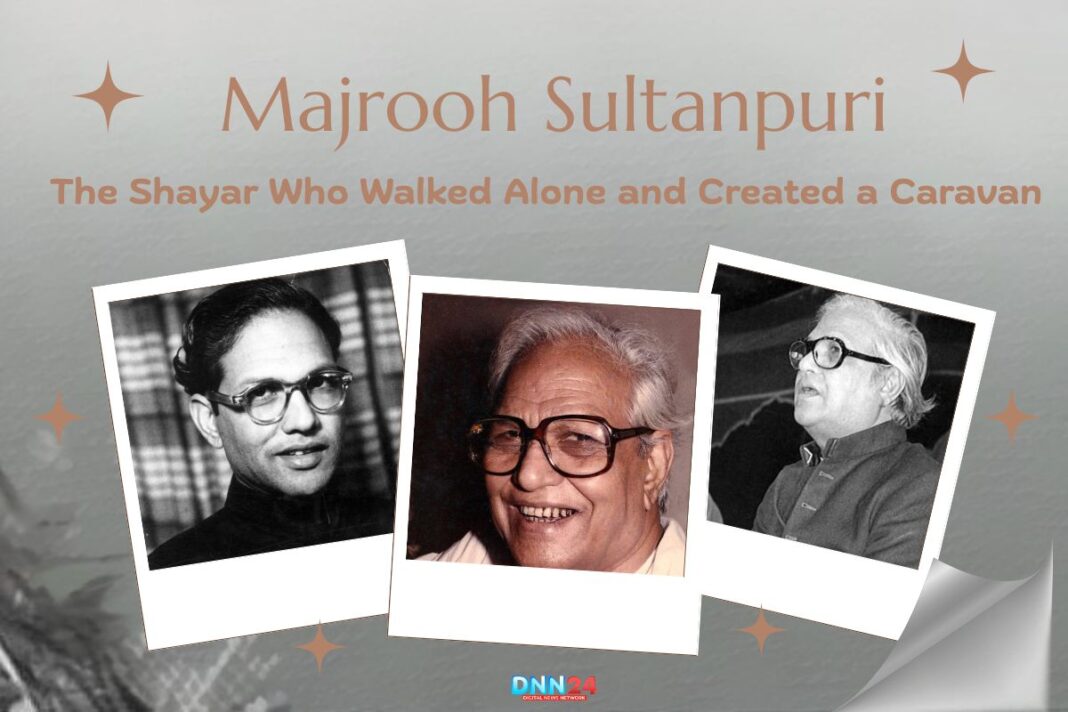

Majrooh Sultanpuri, born as Asrar ul Hassan Khan on 1st October 1919 in Sultanpur, Uttar Pradesh, was not just a poet—he was a phenomenon. His journey from Sultanpur’s small streets to Mumbai’s magnificent studios is a narrative packed with passion, defiance, and an enduring love for language. The son of a police policeman, Majrooh’s early life was impacted by conventional schooling at a madrasa, where he studied Arabic and Persian. But his heart pounded for poetry, and his pen name ‘Majrooh’, meaning ‘wounded’, became a symbol of every heart that has ever loved, lost, or dreamt.
Main akela hi chala tha jaanib-e-manzil magar
Majrooh Sultanpuri
Log saath aate gaye aur karwan banta gaya
Aise hans hans ke na dekha karo sab ki jaanib
Log aisi hi adaon pe fida hote hain
This couplet is not only poetry but the tale of Majrooh’s life. He began alone, but his words affected millions, and soon, he was leading a caravan of fans, dreamers, and lovers of poetry.
Majrooh’s poetry was not restricted to the pages of books. He became the voice of Bollywood, authoring lyrics for timeless songs like “Ek Ladki Bheegi Bhaagi Si,” “O Mere Dil Ke Chain,” and “Kya Hua Tera Wada”. His lyrics were simple, but they held the aroma of profound emotions, making every song a pulse of the country.
Kya hua tera vaada woh kasam woh irada
Majrooh Sultanpuri
Kya hua tera vaada woh kasam woh irada
Bhoolega dil jis din tumhein
Woh din zindagi ka aakhiri din hoga
Unheard Kissa: Once, Majrooh was invited to a mushaira in his hometown. He recited a ghazal, and the crowd was fascinated. That night, he resolved to abandon his medical profession forever and devote his life to poetry. His father was furious, but Majrooh’s heart had discovered its real purpose.
Dekh zindan se pare rang-e-chaman josh-e-bahaar
Majrooh Sultanpuri
Raqs karna hai to phir panw ki zanjeer na dekh
Koi hamdam na raha koi sahara na raha
Hum kisi ke na rahe koi hamara na raha
His trip was difficult, but every wound became a verse, and every sorrow became a song. Majrooh Sultanpuri taught us that if you walk with honesty and love, the world will walk with you.
The Early Life: From Hakim to Shayar
Majrooh’s upbringing was anchored in tradition. He finished the Dars-e-Nizami, a seven-year religious education, and eventually gained the title of ‘Alim’. Later, he studied Unani medicine at Takmeel-ut-Tib College in Lucknow. But fate had other intentions. During his undergraduate studies, he was profoundly interested in music and poetry. He also wanted to enter a music college, but his father’s strictness prevented him. Yet, the fire inside could not be quenched.
Rok sakta hai humein zindan-e-bala kya Majrooh
Majrooh Sultanpuri
Hum to awaaz hain deewar se chun jate hain
Mujhe ye fikr sab ki, pyaas apni pyaas hai saqi
Mujhe ab tak talash-e-zindagi ki aas hai saqi
In 1935, Majrooh recited his first ghazal in a mushaira in Sultanpur. The adulation he got altered his life forever. He became a pupil of Jigar Moradabadi, who pushed him to study traditional Urdu and Persian poetry. Under the mentorship of Professor Rasheed Ahmed Siddiqui, Majrooh perfected his trade, staying at his mentor’s house for three years since he couldn’t obtain admission at Aligarh.
Unheard Kissa: Majrooh’s enthusiasm for music was so deep that he secretly attended music courses. When his father discovered this, he was outraged. But Majrooh, with his lovely grin, replied, “Abba, dil ki awaaz ko kaise chupaoon?” This innocence and disobedience characterised his poems and life.
Teri aankhon ke siva duniya mein rakha kya hai
Majrooh Sultanpuri
Ye uthe subah chale, ye jhuke shaam dhale
Mera jeena, mera marna inhi palkon ke tale
Teri aankhon ke siva duniya mein rakha kya hai
Majrooh’s early tribulations made him compassionate to the anguish of others, and this empathy formed the spirit of his poetry.
Majrooh in Bollywood: The Magic of Words
Majrooh Sultanpuri’s introduction to Bollywood was nothing short of amazing. In the late 1940s, music director Naushad heard him at a mushaira and quickly recognised his skill. He offered Majrooh his first picture, “Shah Jehan” (1946); the rest is history. Majrooh’s songs were not simply words; they were emotions that connected with every listener.
This song from “Dosti” got him the Filmfare Award for Best Lyricist in 19653. For decades, his songs became the voice of love, desire, and hope. Majrooh collaborated with famous composers like S.D. Burman, R.D. Burman, Laxmikant-Pyarelal, and Anand-Milind producing immortal tunes.
Unheard Kissa: During the “Ek Ladki Bheegi Bhaagi Si” recording, Majrooh was unhappy with the lyrics. He spent all night beneath a street light revising the song until he felt the enchantment. The song became an immediate smash the following day, illustrating that genuine creativity demands time and devotion.
Chahunga main tujhe saanjh savere
Majrooh Sultanpuri
Phir bhi kabhi ab naam ko tere
Aawaz main na doonga
Marta hoon main par jeene ki kasam khata hoon
Majrooh’s Bollywood career was not only about stardom but about touching hearts and making every listener feel unique.
The Progressive Poet: Rebellion, Jail, and Courage
Majrooh Sultanpuri was not merely a romantic poet but a rebel at heart. He was profoundly inspired by the Progressive Writers’ Movement and believed in utilising poetry as a weapon against injustice. In 1949, at a conference for mill workers, he presented a poem denouncing Prime Minister Jawaharlal Nehru and the political establishment. The poem generated a controversy, and Majrooh was incarcerated for two years for refusing to apologise.
Chalo ek baar phir se ajnabi ban jayen hum dono
Majrooh Sultanpuri
Na main tumse koi ummeed rakhoon dilnawazi ki
Na tum meri taraf dekho galat andaz nazron se
Na mere dil ko sambhalein, na apna dil sambhalein hum
Even in captivity, Majrooh continued writing. His words became the hymn of the downtrodden, and his heroism inspired millions. He never bowed down to tyranny, and his poems symbolised resistance.
Unheard Kissa: Majrooh inscribed a name on the wall with a bit of coal in prison. The jailor, touched by his remarks, surreptitiously kept the poem. Years later, the jailor’s son became a poet, inspired by those precise words. This is the beauty of Majrooh—his words could soften even the toughest hearts.
Mere mehboob tujhe meri mohabbat ki kasam
Majrooh Sultanpuri
Phir mujhe nargis-e-mastaana bana de koi
Phir teri yaad mere dil ko sata de koi
Phir mujhe aashiq-e-deewana bana de koi
Majrooh’s rebellious attitude made him a legend, and his poetry is a light of hope for those striving for justice.
Majrooh’s Nazm: The Soul of Simplicity and Romance
Majrooh Sultanpuri’s nazms celebrate love, life, and desire. His style was basic, but every phrase was drenched in profound passion. He thought that poetry should touch the heart, not simply the head. His name typically talked of unfulfilled love, silent weeping, and the beauty of dreams.
Majrooh’s nazms were not simply about romance—they were about the tiny moments that made life lovely. He wrote about the anguish of separation, the pleasure of reunion, and the optimism that keeps us living.
Aye husn zara jag tujhe ishq jagaaye
Majrooh Sultanpuri
Soorat teri madhosh hai, aankhon mein nasha hai
Ye dil hai ki phir bhi teri tasveer banaaye
Aye husn zara jag tujhe ishq jagaaye
His name was like a soft wind on a hot summer day—refreshing, relaxing, and memorable. Majrooh’s romanticism was never loud; it was like the smell of a flower—subtle but timeless.
Unheard Kissa: Once, during a train ride, Majrooh spotted a couple softly holding hands. He scrawled a nazm on his ticket, inspired by their modest love. That name became a popular song, illustrating that inspiration may come from the simplest times.
Aaj phir dil ne ek tamanna ki
Majrooh Sultanpuri
Aaj phir dil ko humne samjhaaya
Aaj phir dil ne ek tamanna ki
Aaj phir dil ko humne rulaya
Majrooh’s nazms are a treasure trove of emotions, and every reader discovers a piece of their heart in his words.
Legacy: The Caravan Continues
Majrooh Sultanpuri died suddenly on 24 May 2000 in Mumbai, yet his poetry lives on in every heart he has ever loved or dreamt of. In 1993, he earned the Dadasaheb Phalke Award for his outstanding contribution to Indian film and literature. His melodies are still performed, his Shayari is still recited, and his nazms continuously inspire new generations.
Majrooh’s life was a lesson in bravery, love, and the power of words. He showed us that your truth and passion will build a caravan even if you start alone. His poetry is not only literature—it is a way of life.
Unheard Kissa: At a seminar in Sultanpur, a young poet questioned Majrooh, “Sir, how do you write such beautiful lines?” Majrooh grinned and responded, “Beta, dard ko mehsoos karo, Zindagi khud Shayari ban jayegi.” This simplicity was the key to his excellence.
Tum jo mil gaye ho, to ye lagta hai
Majrooh Sultanpuri
Ke jahan mil gaya
Ek bhatke hue raahi ko
Karwan mil gaya
Majrooh Sultanpuri’s caravan of words will never end. As long as there is love, suffering, and hope in the world, his poetry will continue to touch hearts, inspire souls, and light up the darkest nights.
Also Read: Subhadra Kumari Chauhan: The Poetess of Fire and Feeling
You can connect with DNN24 on Facebook, Twitter, and Instagram and subscribe to our YouTube channel.