
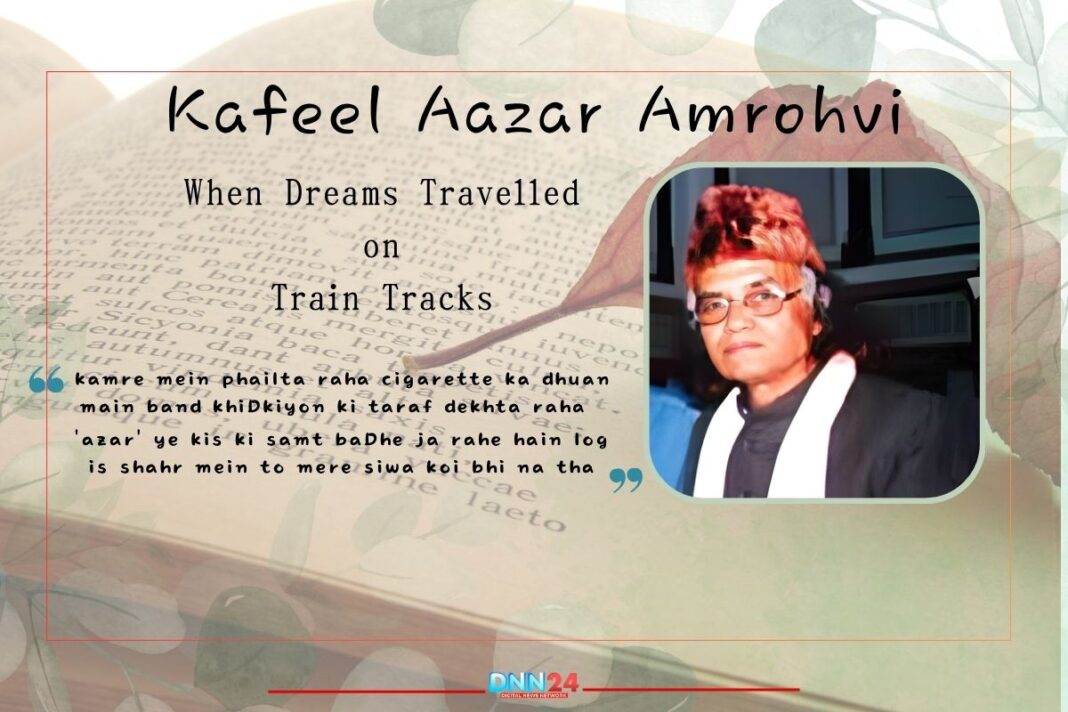

What does it take for a poet’s whisper to become an eternal echo across generations? Kafeel Aazar Amrohvi was born in 1940 in Amroha, a small town in Uttar Pradesh that has quietly nurtured some of India’s most celebrated Urdu poets. Growing up in modest surroundings, young Kafeel found himself drawn to poetry like a moth to a flame. Words became his refuge, verses his silent companions.
us ki aankhon mein utar jaane ko ji chahta hai
Kafeel Aazar Amrohvi
sham hoti hai to ghar jaane ko ji chahta hai
But this was no fairytale beginning. His early years were marked by financial constraints and limited opportunities, circumstances that would have crushed the spirits of lesser men. Yet Kafeel saw possibilities where others saw limitations. He began crafting verses that captured the ordinary sorrows and joys of everyday life, writing not from academic training but from lived experience.
kisi kam-zarf ko ba-zarf agar kahna paDe
Kafeel Aazar Amrohvi
aise jine se to mar jaane ko ji chahta hai
His poetry reflected genuine emotion rather than intellectual exercise, speaking directly to hearts rather than minds. The streets of Amroha witnessed his transformation from a dreamer to a wordsmith, though few recognised his potential then. His family struggled to understand his obsession with poetry in a world that demanded practical pursuits.
ek ek baat mein sachchai hai us ki lekin
Kafeel Aazar Amrohvi
apne wa’don se mukar jaane ko ji chahta hai
But Kafeel pressed on, filling notebooks with thoughts that refused to stay imprisoned within him. These formative years planted seeds that would later blossom into some of Urdu literature’s most touching verses, particularly his immortal nazm that would eventually find millions of listeners through Jagjit Singh’s voice. The town shaped him, giving him roots deep in Urdu tradition while his restless spirit yearned for broader horizons where his words might finally be heard.
qarz TuTe hue KHwabon ka ada ho jae
Kafeel Aazar Amrohvi
zat mein apni bikhar jaane ko ji chahta hai
The Train Ride That Changed Everything
The journey from Amroha to Mumbai represents one of Indian poetry’s most remarkable yet underappreciated stories. Kafeel did not arrive in the city of dreams, clutched in luxury or comfort. Reports suggest he worked as a waiter on trains, serving passengers while carrying his own hopes in his heart. Imagine the scene: a young poet balancing tea cups and dreams, moving through compartments filled with strangers, each mile bringing him closer to an uncertain future.
apni palkon pe sajae hue yaadon ke diye
Kafeel Aazar Amrohvi
us ki nindon se guzar jaane ko ji chahta hai
This was not migration; this was transformation through sheer will. Mumbai in those days was unforgiving to newcomers, especially those chasing artistic ambitions. The city tested everyone who arrived seeking fortune or fame, and Kafeel faced these tests without safety nets or guarantees. His days were spent working humble jobs, his nights devoted to refining his craft.
ek ujDe hue viran khanDar mein ‘azar’
Kafeel Aazar Amrohvi
na-munasib hai magar jaane ko ji chahta hai
The contrast between his daily reality and his poetic aspirations created a tension that actually enriched his writing. He understood struggle not as an abstract concept but as a daily companion. This intimate knowledge of hardship gave his verses an authenticity that resonated deeply with ordinary people.
subh le jaate hain humapna janaaza ghar se
Kafeel Aazar Amrohvi
shaam ko phir use kaandhon pe uTha laate hain
While other poets wrote from comfort or theory, Kafeel wrote from the trenches of experience, making his words ring true in ways that polished verses often cannot achieve. His train journey became symbolic of his entire life: moving forward despite obstacles, serving others while nurturing his own dreams, and travelling toward an unknown destination with faith as his only ticket.
raat-bhar chand ki galiyon mein phiraati hai mujhe
Kafeel Aazar Amrohvi
zindagi kitne hasin KHwab dikhati hai mujhe
Words That Refused to Be Forgotten
“Baat Niklegi To Phir Door Talak Jayegi” became more than just a nazm; it became a cultural phenomenon. When Jagjit Singh’s velvet voice wrapped around Kafeel’s words, something magical occurred. The nazm spoke of how words once spoken continue their journey far beyond their origin, how conversations carry consequences we cannot control. This theme struck a universal chord because everyone has experienced moments when words escaped and could not be recalled.
makaan sheeshe kabanvaate ho ‘aazar’
Kafeel Aazar Amrohvi
bahut aayenge patthar dekh lena
But this success did not arrive overnight. Kafeel spent years perfecting his craft, writing nazms and ghazals that explored love, separation, loneliness, and life’s quiet ironies. His poetry avoided flowery exaggeration, instead presenting emotions with disarming simplicity. He wrote honestly about relationships, sometimes uncomfortably, because it reflected reality rather than romantic fantasy.
din isi farq ke jangal mein guzar jata hai
Kafeel Aazar Amrohvi
raat yaadon ka wahi zahr pilati hai mujhe
His ghazals carried melancholy without melodrama, pain without performance. Readers and listeners found themselves reflected in his verses, discovering their own experiences articulated with the precision they had struggled to find. Kafeel’s genius lay in making complex emotions accessible, stripping away pretence to reveal raw human feeling.
main aandhiyon ke paastalaash-e-sabaa mein huun
Kafeel Aazar Amrohvi
tum mujh se poochhte ho mera hausla hai kya
His work belongs to that rare category of poetry that serves both as art and companionship, beautiful in form yet comforting in substance, challenging thought while soothing spirit. Each line he crafted felt personal yet universal, specific yet timeless, simple yet profound, in ways that continue to touch hearts decades after they were first written.
toD deta hun ki ye bhi kahin dhoka hi na ho
Kafeel Aazar Amrohvi
jam mein jab teri surat nazar aati hai mujhe
The Legacy Living Beyond the Poet
Kafeel Aazar Amrohvi’s contribution to Urdu literature extends beyond individual poems. He represented a tradition of poets who wrote not for elite circles but for ordinary people navigating ordinary struggles. His verses continue finding new audiences through music, recitations, and social sharing, proving that genuine emotion never expires. Young poets still study his work, learning how simplicity can convey depth, how restraint can amplify impact.
in dinon ishq ki fursat hi nahin hai warna
Kafeel Aazar Amrohvi
us dariche ki udasi to bulati hai mujhe
His life story itself serves as inspiration: the waiter who became a voice for millions, the struggler whose words achieved permanence. Kafeel demonstrated that great poetry need not emerge from privilege or formal education but can arise from authentic engagement with life’s realities. His legacy reminds us that art created with honesty outlasts art created with cleverness.
sath jis roz se chhuTa hai kisi ka ‘azar’
Kafeel Aazar Amrohvi
jaise kamre ki har ek chiz Daraati hai mujhe
Today, decades after he penned his most famous works, his verses remain relevant because human emotions remain constant. Love still breaks hearts, words still wound, loneliness still haunts, and his poetry still offers solace. The poet who once served tea on trains left behind verses that now comfort and guide millions seeking understanding.
tanhai ki gali mein hawaon ka shor tha
Kafeel Aazar Amrohvi
aankhon mein so raha tha andhera thaka hua
Kafeel Aazar Amrohvi never sought celebrity or wealth. Yet, he achieved something greater: he created work that survives him, offering comfort and understanding to people he would never meet, in times he would never see. That remains the most accurate measure of any poet’s success, and Kafeel’s measure stands tall among the greats of Urdu literature.
Also Read: Tomb of Sher Shah Suri: An Emperor’s Dream Palace Floating On Water
You can connect with DNN24 on Facebook, Twitter, and Instagram and subscribe to our YouTube channel.