

When a government clerk picks up his pen after sunset and writes verses that outlive monuments, you know there is something remarkable about his story.
A Humble Beginning in Hyderabad
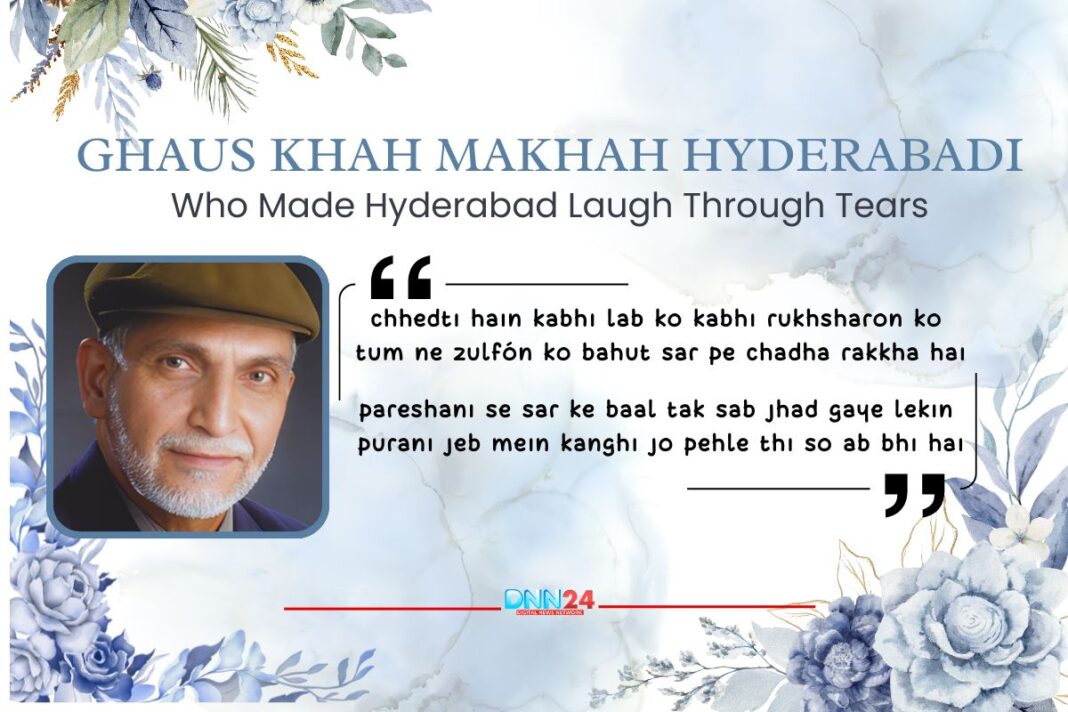
Ghaus Khah Makhah Hyderabadi, born Syed Ghouse Mohiuddin Ahmed in 1929, was born in the ancient city of Hyderabad. In this place, cultures mixed like colours on a painter’s canvas. His family was ordinary, money was scarce, and nobody imagined that this small boy would one day become the voice of thousands. As a child, he loved words the way other children loved sweets.
main ne puchha ki ye kya haal bana rakha hai
Ghaus Khah Makhah Hyderabadi
na to make-up hai na baalon ko saja rakha hai
He listened carefully when the older people told stories, storing every joke and observation in his mind. Financial troubles pushed him into a government job at the Irrigation Department in Maharashtra. It was not what he wanted, but life does not always give us choices. After long hours of paperwork, when others were asleep, he sat by dim candlelight and wrote poetry. His verses spoke of ordinary struggles, of dreams deferred, of laughter found in unexpected places.
chheDti rahti hain aksar lab-o-ruKHsaron ko
Ghaus Khah Makhah Hyderabadi
tum ne zulfon ko bahut sar pe chaDha rakha hai
The Dakhni dialect he used was the language of Hyderabad’s streets, not the formal Urdu of elite gatherings. People connected with his words because they felt real, as if he was speaking directly to their hearts. His early years taught him patience and gave him material for his art. Every disappointment became a line in a poem, every small joy a reason to celebrate. Greatness, he proved, does not require a grand beginning, only persistence and honesty.
muskuraate hue us ne ye kaha shoKHi se
Ghaus Khah Makhah Hyderabadi
ek diwane ne diwana bana rakha hai
The Power of Laughter in Struggle
What separated Ghaus Khah, known forever as Khamakha Hyderabadi, from other poets was his courage to find humour even when life was cruel. His path was full of obstacles. People dismissed his work, friends questioned his choices, and poverty was a constant companion. When he first performed at a Mazahiya Mushaira, his hands trembled and his voice nearly failed him.
jeb ghaeb hai to nefa hai baTan ke badle
Ghaus Khah Makhah Hyderabadi
tum ne patlun ka pajama bana rakha hai
But when the audience laughed, really laughed, he understood something important. Laughter was not just amusement. It was survival. It was a rebellion against despair. He wrote poems that mocked social pretensions and exposed hypocrisy, but always with a gentle touch that made people think rather than feel attacked. Once, at a prestigious gathering, he recited verses that questioned the behaviour of the wealthy.
mashriqi rehn-sahn chaal-o-chalan maghrib ka
Ghaus Khah Makhah Hyderabadi
hum ne tahzib ka shir-KHurma bana rakha hai
Some attendees were offended, but many more recognised the truth behind his words. He believed that comedy could carry serious messages, that a joke could reveal what a sermon could not. His own life was difficult, marked by financial hardship and the exhaustion of balancing two worlds, the bureaucratic one that paid his bills and the poetic one that fed his soul.
gar sila doge mujhe meri wafaon ke ewaz
Ghaus Khah Makhah Hyderabadi
mang lunga tumhein inam mein kya rakha hai
Yet bitterness never touched his writing. Every couplet reflected resilience, every punchline came from personal pain transformed into something beautiful. This quality made his poetry more than entertainment. It became medicine for wounded spirits and proof that hope could survive anything.
jo sabhi dekh chuke hum wo nahin dekhenge
Ghaus Khah Makhah Hyderabadi
wo dikhao hamein jo sab se chhupa rakha hai
Ghaus Khah Makhah Hyderabadi’s True Legacy
The stories about Khamakha Hyderabadi that quietly circulated in Hyderabad are more valuable than his published works. After retirement, when most people rest, he became the heartbeat of literary gatherings across the city. There is one account of how he comforted a young poet whose performance was mocked publicly. He pulled the dejected writer aside and said softly, “Every great mind faces failure.
un ko aghyar mohabbat se lagate hain gale
Ghaus Khah Makhah Hyderabadi
mujh ko apnon ne bhi begana bana rakha hai
Let your words be your revenge.” That young poet later achieved recognition, always crediting those few words for giving him the courage to continue. Another tale speaks of how Khamakha pawned his only wristwatch to help print a struggling friend’s poetry collection. He never mentioned this sacrifice to anyone. People knew him as the King of Laughter, but they did not know about the nights he wept for others, carrying their troubles as if they were his own.
zindagi maut ki tamhid hai par logon ne
Ghaus Khah Makhah Hyderabadi
muKHtasar baat ka afsana bana rakha hai
His published books, ‘Harf-e-Mukarrar,’ ‘Ba Farz-e-Muhal,’ and ‘Kaghaz Ke Teeshe’, stand today not merely as poetry collections but as records of his compassion. Fellow writers often said that he saved their careers with timely encouragement and practical support. His generosity was quiet but constant.
log bhulen na kabhi aisa taKHallus rakhiye
Ghaus Khah Makhah Hyderabadi
nam to nam hai bas nam mein kya rakha hai
These untold stories reveal a man whose true legacy was not fame but kindness. He valued ordinary happiness and believed that helping one person mattered more than impressing a thousand. His life was a lesson in selflessness, showing that greatness lives in small acts of goodness that ripple outward long after we are gone.
qafiye aur radifon-o-taKHallus ke siwa
Ghaus Khah Makhah Hyderabadi
‘KHwah-maKHwah’ aap ke ashaar mein kya rakha hai
The Magic and Message of His Writings
In the bright atmosphere of mushairas and social gatherings, Khamakha Hyderabadi’s poetry became Hyderabad’s anthem. His verses, like ‘jeb ghaeb hai to nefa hai baTan ke badle, tum ne patlun ka pyjama bana rakha hai’, were not simple jokes. They were observations about the absurdities people endure daily, delivered with warmth rather than judgment. One of his most loved poems was written for his daughter’s wedding, blending fatherly emotion with humour so perfectly that guests laughed and wept at the same time.
pahle pahle shauhar ko har mausam bhiga lagta hai
Ghaus Khah Makhah Hyderabadi
yun samjho billi ke bhagon TuTa chhika lagta hai
His work reached far beyond Hyderabad, speaking to anyone who understood that life’s lighter moments often carry the most profound truths. He criticised social evils but always with a smile that made the criticism easier to accept. For him, poetry was not about displaying cleverness. It was a bridge between hearts, a way to connect people, whether in sorrow or celebration.
phika lunch aur dinner bhi umda aur tikha lagta hai
Ghaus Khah Makhah Hyderabadi
naqli tel mein talla samosa asli ghi ka lagta hai
His mastery of both Dakhni and Urdu allowed him to honour tradition while embracing change, reflecting Hyderabad’s own dual nature. He never chased fame or recognition. Each line he wrote carried the flavour of common struggles and everyday aspirations. Today, his couplets pass from grandparents to grandchildren, teaching each generation to find hope in dark times, to laugh when circumstances seem unfair, and to remember their roots with pride. His poetry remains alive because it speaks to something permanent in the human experience.
shadi ek chewing-gum hai jo pahle miTha lagta hai
Ghaus Khah Makhah Hyderabadi
phir munh mein jitna ghologe utna phika lagta hai
Forever in Hearts: Ghaus Khah’s True Inspiration
Khamakha Hyderabadi died in 2017, but his influence continues to grow. His journey demonstrates that true greatness does not require grand recognition or public monuments. It lives in humility, in acts of kindness nobody witnesses, in maintaining a smiling heart when surrounded by troubles. His poetry exists not only in books but in the way people share memories, in the courage of those facing hardship, and in every shy poet who now dares to speak their truth.
aqad hua jab mera us dam koi chhinka lagta hai
Ghaus Khah Makhah Hyderabadi
aaine mein mera chehra aur kisi ka lagta hai
The countless untold stories of his encouragement, his silent sacrifices for fellow artists, and his unshakeable optimism make him an inspiration for anyone pursuing dreams against difficult odds. Whenever literary gatherings take place in Hyderabad today, someone inevitably recalls a Khamakha couplet and shares a story about how he made everyone feel welcome and valued.
mahfil mein jab ghura un ko ek saheli yun boli
Ghaus Khah Makhah Hyderabadi
biwi ko takta rahta hai mua na-dida lagta hai
His real legacy transcends the literary treasures he left behind. It lives in his compassion, his willingness to help without expectation of reward, and his faith in the wisdom and joy of ordinary people. In our fast-paced world, his poetry reminds us to pause, to find meaning in small moments, and to laugh sometimes for no reason other than that laughter itself is valuable.
‘KHwah-maKHwah’ na mera hi na aur kisi ka lagta hai
Ghaus Khah Makhah Hyderabadi
jitne shauhar baiThe hain ye haal sabhi ka lagta hai
This is the essence of Ghaus Khah Makhah Hyderabadi, a man whose words convince us that through every difficulty, hope and humour can show us the way forward. His life proves that one person’s kindness can change countless lives, that art serves people best when it speaks their language, and that the most significant legacy is not what we achieve but how we treat others along the journey.
Also Read: Tomb of Sher Shah Suri: An Emperor’s Dream Palace Floating On Water
You can connect with DNN24 on Facebook, Twitter, and Instagram and subscribe to our YouTube channel.