
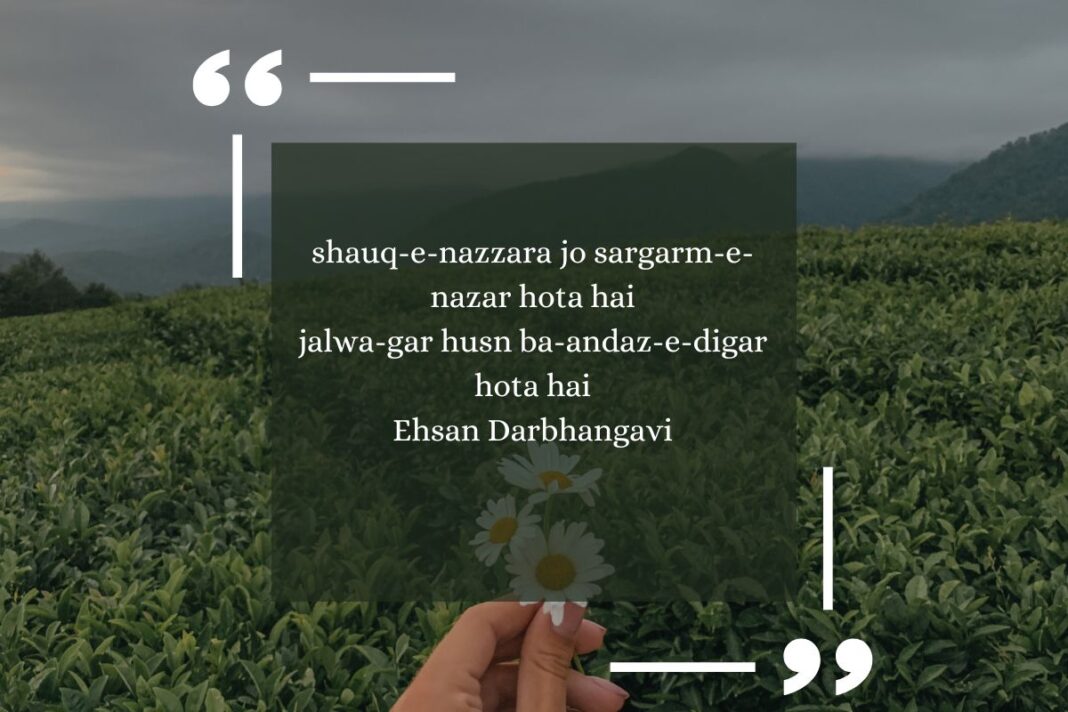

In 1922, in a corner of Bihar that most maps barely noticed, a child arrived who would one day hold an entire poet’s work inside his memory like a sacred flame. Ehsanur Rahman Khan, who would later be known as Ehsan Darbhangavi, was born in Kothia village in Mirzapur, Darbhanga district.
dil ke mariz zehn ke bimar kyon hue
Ehsan Darbhangavi
zulfon se khelte the sar-e-dar kyon hue
His birth was not announced in newspapers or celebrated in literary circles. It happened quietly, the way most beautiful things begin in India: without fanfare, without promises, just the ordinary hope of parents in a small village.
baat ab aai samajh mein ki haqiqat kya thi
Ehsan Darbhangavi
ek jazbaat ki shiddat thi mohabbat kya thi
But this village was no prison. Kothia, with its narrow paths and simple homes, became his first classroom. Here, Ehsan learned to read not just books but faces. He watched farmers return home with bent backs and unbroken spirits.
tari mere shuur pe wijdan hi raha
Ehsan Darbhangavi
aaya KHudi ko hosh to ek aan hi raha
He saw women sing while grinding grain, exhaustion hidden behind the rhythm. He noticed how his neighbours spoke of tomorrow even when today offered them nothing. This ability to see depth in the ordinary, to find poetry in a grandmother’s wrinkled hands or a labourer’s silent prayer, became the foundation of everything he would later write.
yaad teri jo kabhi aati hai bahlane ko
Ehsan Darbhangavi
aur diwana bana jati hai diwane ko
Before he owned the title of progressive poet, he was simply a boy who listened. And in India, where millions live unheard, a listener is the rarest kind of revolutionary.
The Disciple Who Became a Living Library
Every artist needs a north star, and for Ehsan, that guiding light was Jameel Mazhari, one of Urdu’s most respected voices. But Ehsan’s relationship with his ustad went beyond admiration. It crossed into something almost mythical.
KHayal-o-KHwab ki baaton ko dohrane se kya hoga
Ehsan Darbhangavi
haqiqat samne hai jab to afsane se kya hoga
People who knew him said Ehsan had memorised every line Jameel Mazhari ever wrote. Not just famous couplets, but entire collections, rare verses, forgotten poems. If somehow every printed copy of Mazhari’s work vanished from earth, they said, you could recreate it all just by sitting with Ehsan and listening.
wahi hai dast-e-junun hamara badalta rahta hai go qarina
Ehsan Darbhangavi
usi se daman ko chaak karna usi se daman ke chaak sina
Think about that for a moment. In an age before smartphones and cloud storage, this man carried another poet’s entire legacy in his mind. It was not showing off. It was pure love. The kind of devotion that does not ask for credit or recognition.
shair hue to kya hue ‘ehsan’ hi rahe
Ehsan Darbhangavi
‘mirza’-o-‘mir’ ban na sake KHan hi rahe
The kind that says: What you created matters so much to me that I will become its guardian. This tells us more about Ehsan than any biography could. He understood that poetry was not property. It was breath, and breath must be kept alive by passing it from one pair of lungs to another.
KHayal ke phul khil rahe hain bahaar ke git ga raha hun
Ehsan Darbhangavi
tere tasawwur ki sarzamin par nae gulistan khila raha hun
His home breathed poetry, too. His younger brother, Owais Ahmad Dauran, also walked the path of progressive Urdu literature. Imagine growing up in a house where dinner conversations turned into discussions about metre, metaphor, and the dignity of the working poor, where books were treated like relatives, where language was not decoration but a tool to reshape the world. This was the soil that grew Ehsan, and it shows in every line he left behind.
Shahr-e-Aarzoo: The City We All Secretly Live In
In 1985, a book emerged from Calcutta that deserved more attention than it received. “Shahr-e-Aarzoo,” published by Khuda Bakhsh Oriental Public Library, remains the only known collection of Ehsan Darbhangavi’s poetry. The title translates as “City of Desires” or “City of Longings,” and it opens a door into a place we have all visited but never named.
bas ek kashakash ka silsila hai azal se jo aaj tak raha hai
Ehsan Darbhangavi
falak ki munkir zamin rahi hai zamin ka munkir falak raha hai
This city has no brick buildings. Its streets are paved with unfulfilled wishes. Its residents are memories that refuse to leave, loves that never quite arrived, and hopes that keep knocking even after midnight. In one of his most quoted couplets, Ehsan writes: “shauq ke mumkināt ko donoñ hī aazmā chuke / tum bhī fareb khā chuke ham bhī fareb khā chuke.”
samajh sakte nahin jo tere mathe ki shikan saqi
Ehsan Darbhangavi
wo kya jaanen ki hai baada-kashi bhi ek fan saqi
The meaning cuts quietly but deeply: we have both tried every possibility that desire offered; we have both tasted deception. There is no anger in these words, no blame. Just two people looking at each other across the ruins of what they hoped for, and somehow finding companionship even in disappointment.
kisi na-fahm se izhaar-e-tamanna karna
Ehsan Darbhangavi
apni KHamosh mohabbat ko hai ruswa karna
Another verse carries his signature humility: “shāir hue to kyā hue, Ehsan hī rahe.” Even after becoming a poet, I remained just Ehsan. In a world obsessed with titles and status, this is a radical statement. It says: ” My craft does not make me superior; it makes me responsible.
yaad teri jo kabhi aati hai bahlane ko
Ehsan Darbhangavi
aur diwana bana jati hai diwane ko
And that responsibility, for Ehsan, always pointed toward the margins. His poetry about love never forgets the political. His ghazals about separation carry the weight of social injustice. He understood that in India, personal pain and collective suffering are never truly separate. When he died in 1998 in his native Darbhanga, the newspapers gave him little space. But his “Shahr-e-Aarzoo” remains open, waiting for new visitors.
Why a Forgotten Poet Speaks to This Moment
We live now in the age of the loud. Slogans replace sentences. Rage replaces reason. We forward without reading, react without thinking, and forget everything by the next morning. In such times, Ehsan Darbhangavi feels like medicine. His poetry moves slowly, demands attention, refuses to shout. It asks you to sit down, be still, and feel something real.
hijab aane laga ab to bala-e-asmani ko
Ehsan Darbhangavi
KHuda rakkhe salamat tere naz-e-baghbani ko
As a progressive poet, Ehsan believed literature must serve justice, not in an abstract way, but in the daily lives of farmers, labourers, women grinding spices in dark kitchens, and children studying under street lights.
bana ke apne safine ka naKHuda mujh ko
Ehsan Darbhangavi
kisi ne kar diya tufan se aashna mujh ko
India today still wrestles with the same demons he wrote against: caste violence, economic cruelty, religious hatred, and the gap between the powerful and the powerless. His soft insistence that poetry must stand with the wounded makes him not outdated but urgent.
dil ab asir-e-zulf-e-parishan nahin raha
Ehsan Darbhangavi
jab apna gham hua gham-e-jaanan nahin raha
His life also offers something precious to young Indians in small towns. You do not need to be born in Mumbai or Delhi to matter. Kothia gave the world a poet who could hold another man’s entire work in his memory. Darbhanga produced a voice that still echoes. Your postcode is not your destiny. Your soil is not your limit. It is your strength.
main taKHliq-e-sharar karta hun apne soz-e-pinhan se
Ehsan Darbhangavi
main parwana nahin jo aag lun har sham-e-sozan se
And perhaps most beautifully, Ehsan shows us what loyalty looks like. In a culture of instant forgetting, where we scroll past everything, his devotion to his teacher’s words feels almost holy. It reminds us that remembering is also a form of resistance. That carrying someone else’s work forward is not weakness but love.
zaban-e-mai-kada mein jis ko mai-kash jam kahte hain
Ehsan Darbhangavi
use hum apne dil ka dusra ek nam kahte hain
The City Still Stands
Somewhere in that “Shahr-e-Aarzoo,” in the city of longings that Ehsan built from words, there is a lane where hope still walks despite everything. Where broken hearts still believe in repair. Where the poor are not invisible, and the forgotten are given names. This city does not appear on Google Maps, but it exists. And every time someone reads his work, its gates open again.
umid se tha tasawwur umid hi na rahi
Ehsan Darbhangavi
shab-e-firaq mein pahli si be-kali na rahi
Ehsan Darbhangavi may not have monuments. He may not trend on social media. But his quiet, honest voice remains, a whisper from Kothia that asks us: in this noisy, cruel world, can you still feel something true?
Also Read:Saheli Women’s Revolution: When Needles Sparked Strength and Change
You can connect with DNN24 on Facebook, Twitter, and Instagram and subscribe to our YouTube channel.