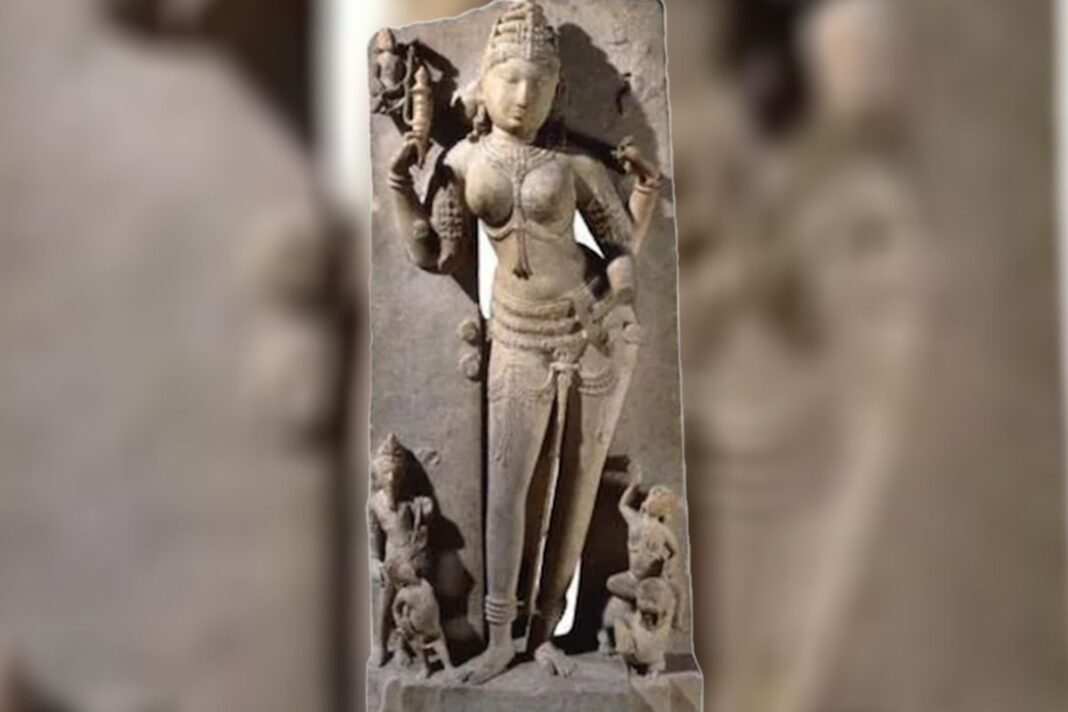

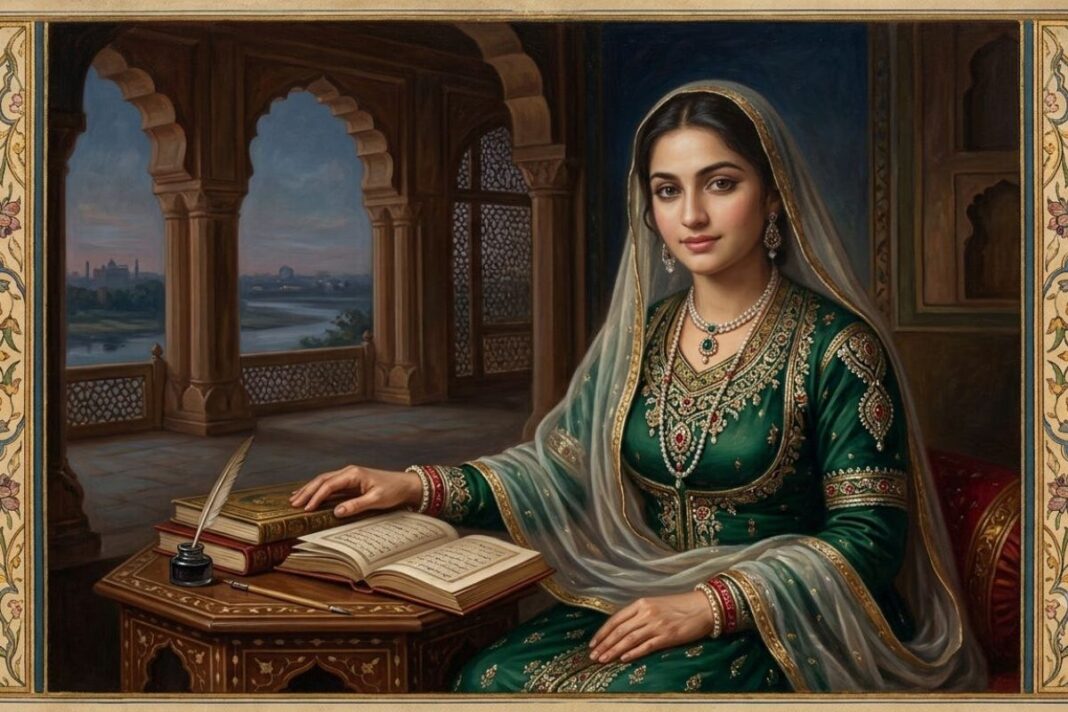

Zeb-un-Nissa, Aurangzeb’s Eldest Daughter, and Twenty Years Behind the Walls of Salimgarh
There is a peculiar irony at the heart of Mughal history that the empire’s most fearsome moral disciplinarian, Emperor Aurangzeb — a man who banned music at court, frowned upon painting, and governed by the strictest reading of the Sharia he could enforce — fathered a daughter who became one of the finest Persian poets of her age, and who spent the last twenty years of her life a prisoner of that very father.
Her name was Zeb-un-Nissa. Her pen name, by which posterity remembers her verse, was Makhfi — “the Hidden One.” It is a name that reads, in retrospect, almost prophetic.
A Princess Raised on Books
Born on 15 February 1638 in Daulatabad, Zeb-un-Nissa was the eldest child of Aurangzeb and his chief consort, Dilras Banu Begum. From infancy she was marked out as exceptional. Court chroniclers record that she had committed the entire Quran to memory by the age of seven — an achievement celebrated with a public feast and a gift of thirty thousand gold coins from her doting father, then still a prince. Her education did not stop at scripture. Under tutors including the learned Hafiza Mariam, she mastered Persian, Arabic, philosophy, astronomy, and mathematics, and developed a fluency in classical literature that few princesses, and fewer princes, of her generation could match.
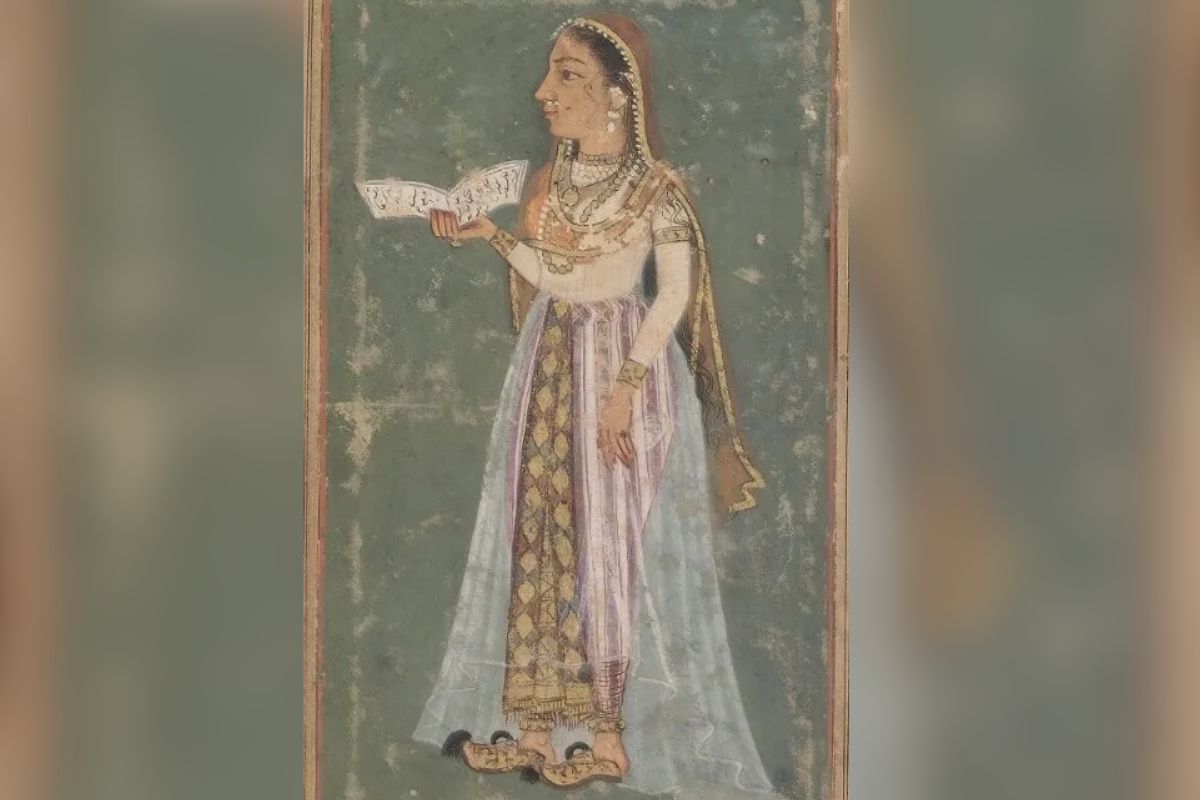
By adulthood she presided over her own establishment in Delhi, a salon of scholars, calligraphers, and poets that she funded from her considerable personal income. She is said to have amassed one of the great private libraries of the age and to have commissioned Persian translations of Sanskrit texts. Writing under the veil of Makhfi, she composed ghazals of striking emotional candour — verses of longing, confinement, and quiet defiance that later generations would collect as the Diwan-i-Makhfi, running, by some counts, to several hundred poems.
She never married. Proposals came and went, some tangled in the political calculations of the Mughal court, but none led anywhere. Whether by choice, by her father’s calculation, or by the sheer weight of court intrigue, Zeb-un-Nissa remained unwed — an unusual, perhaps deliberately chosen, condition for a Mughal princess of her standing.
The Fall
The turning point came in 1681. Aurangzeb’s son, Prince Muhammad Akbar, rose in open rebellion against his father, drawing on Rajput support in a bid that briefly threatened the emperor’s hold on the Deccan campaign. The revolt collapsed, Akbar fled into exile in Persia, and Aurangzeb — ever suspicious of conspiracy within his own household — turned his gaze on those he believed had sympathised with the rebel prince.
Zeb-un-Nissa was among them. The precise nature of her offence remains contested by historians to this day: some accounts speak of intercepted correspondence with her brother; others suggest her independence of mind and her famously liberal court had simply accumulated too much suspicion for an emperor who trusted almost no one, least of all his own children. What is not contested is the outcome. Around 1681-82, Zeb-un-Nissa was confined to Salimgarh Fort on the Yamuna in Delhi — the same grim island fortress where, decades later, INA prisoners would be tried by the British. She would remain there, effectively, for the rest of her life.
Twenty years is a long confinement for any charge, real or suspected, and the poetry attributed to her from this period carries an unmistakable ache — the voice of a woman writing herself free even as the walls held firm. “I will not lift my veil,” runs one recurring theme of her verse, an assertion of concealment turned into a form of resistance.
A Grave That Moved
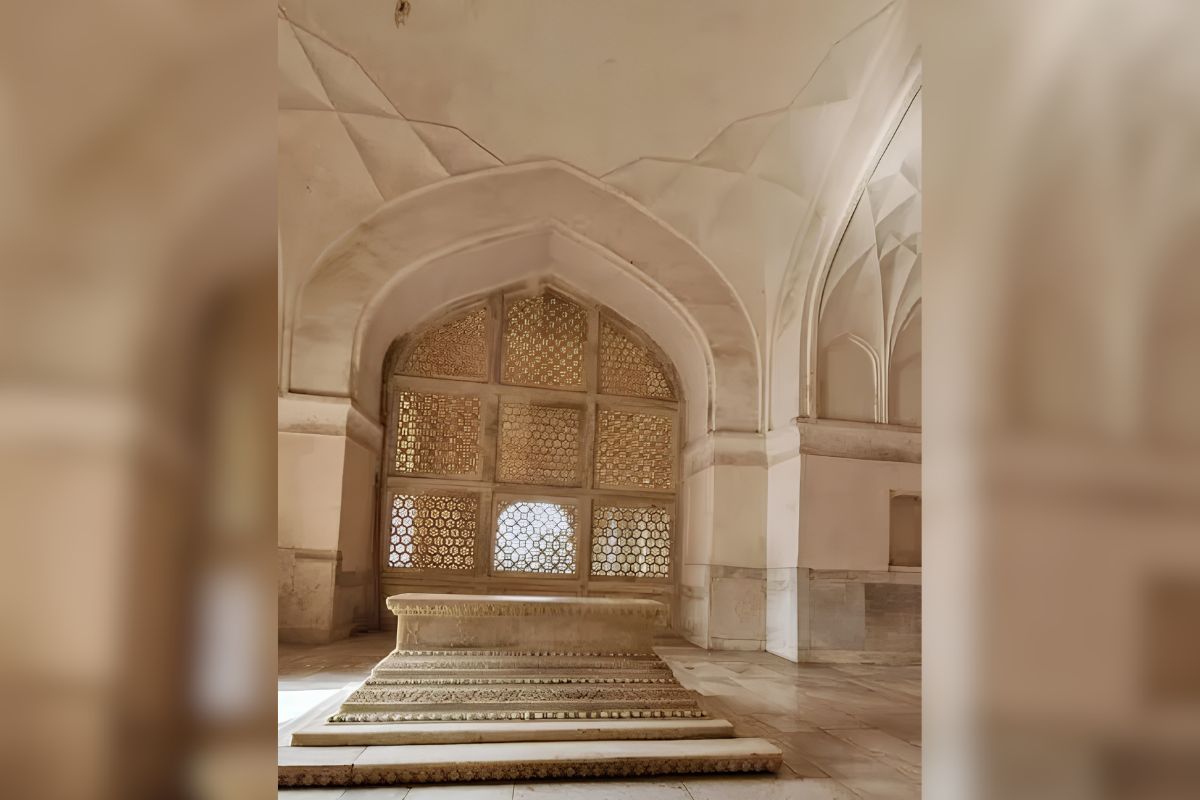
Zeb-un-Nissa died on 26 May 1702, still a prisoner, at the age of sixty-four. She was first laid to rest in the Thirty Garden — Tees Hazari — in Delhi, a resting place that would not prove permanent. In the early twentieth century, as the British drove railway lines through that quarter of the city, her tomb and its inscribed stone were relocated to Sikandra, Agra, and placed within the precincts of Akbar’s own mausoleum. There she lies today, in a chamber alongside two of Akbar’s daughters, Aram Banu and Shakr-un-Nissa — Aurangzeb’s gifted, imprisoned daughter finding her final rest, by historical accident, beside the tomb of the great-grandfather whose pluralism her father had spent a reign trying to undo.
It is a resting place layered with unintended meaning: the poet-prisoner of an austere emperor, sharing eternity’s ground with the memory of Akbar’s more expansive age. Makhfi remains hidden no longer — her verses outlived the fort that held her, and her grave, however displaced, endures at one of Mughal India’s most visited monuments.
A Postscript from Lahore
Curiously, Sikandra is not the only place that claims her. In Nawankot, on Lahore’s Multan Road, stands a weathered Mughal-era structure popularly known as Zeb-un-Nisa’s Tomb, complete with a plaque bearing her name — and generations of Lahoris have grown up believing it genuinely marks her grave. The city’s claim is reinforced by an enduring, if unverifiable, legend: that Zeb-un-Nisa carried on a secret romance with Aqil Khan, a former governor of Lahore, and that a furious Aurangzeb had him put to death before confining the princess to her own garden there until she died. Historians treat this story as apocryphal, but Lahore’s emotional attachment to her memory runs deep — the city had, after all, been the seat of her uncle Dara Shikoh before his fatal contest with Aurangzeb, and something of that romantic, freer strand of Mughal memory seems to have attached itself to her name.
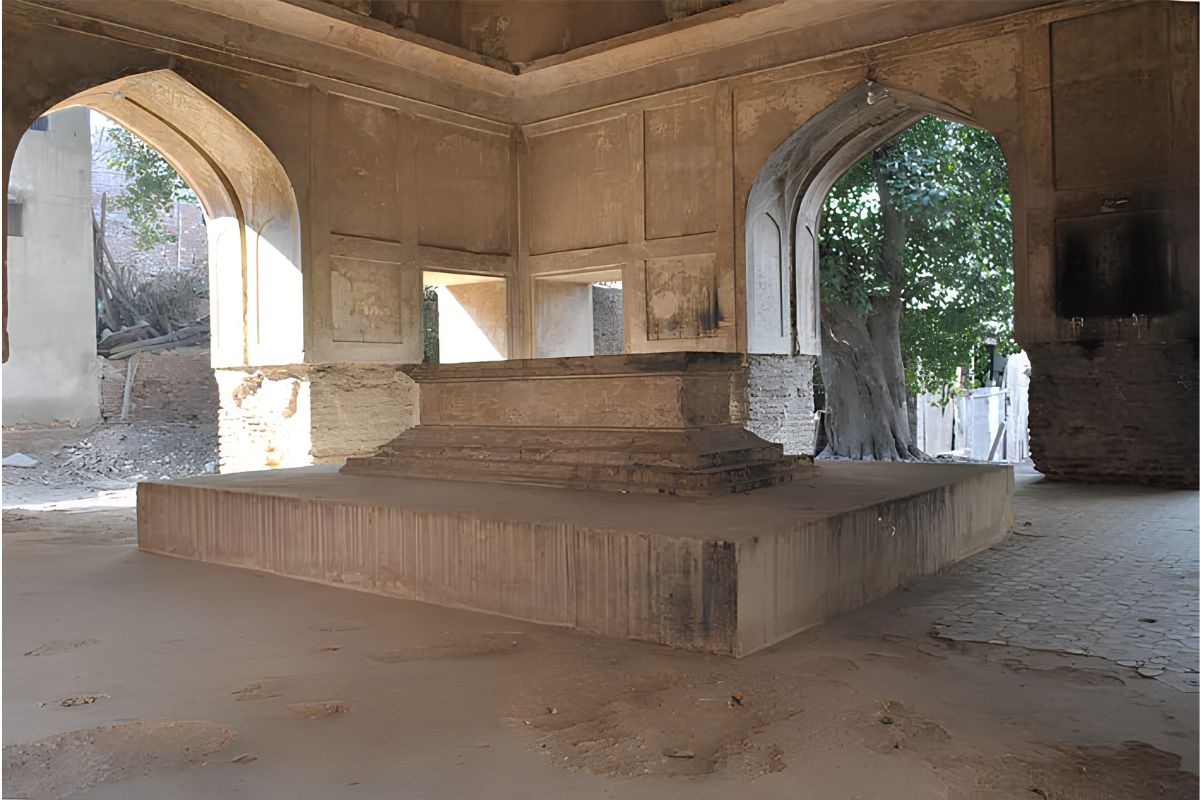
The scholarly consensus, however, favours a more prosaic explanation: that the Lahore tomb likely belongs not to Zeb-un-Nisa at all but to a woman named Mian Bai, or Fakhr-un-Nisa, who was granted the Chauburji garden by Jahanara and later entrusted with the same Nawankot grounds — her identity and Zeb-un-Nisa’s folded together over three centuries of retelling. The structure’s Shah Jahan-era architectural style, dated too early to belong to a tomb Zeb-un-Nisa herself could have commissioned, lends weight to this reading, as does the well-documented trail from her death at Salimgarh Fort to her burial outside Delhi’s Kabuli Gate and the eventual transfer of her remains to Sikandra in 1885.
Two cities, then, each keeping a version of Makhfi alive — one in stone with a name plaque of uncertain provenance, the other in the more reliably documented company of Akbar’s own daughters. Perhaps it is fitting that a princess who wrote under a pseudonym, and who spent twenty years unseen behind fortress walls, should leave behind not one certain grave but two contested ones — history, like her poetry, still declining to lift the veil entirely.
Also Read: Ex-Journalist Built Free Boarding School in India’s Highest Village for Children
You can connect with DNN24 on Facebook, Twitter, and Instagram and subscribe to our YouTube channel.