

On 16 September 1857, exactly 169 years ago, a pen fell silent forever in the streets of Delhi. That pen belonged to Maulvi Muhammad Baqar, remembered today as the first martyr of Indian journalism. His death anniversary reminds us of the price sometimes paid for speaking and writing the truth.
Baqar’s life was closely connected with Delhi’s intellectual culture, Urdu journalism and the events of the 1857 uprising. Through his newspaper, he wrote about the conditions of ordinary people, criticised colonial policies and repeatedly called for Hindu-Muslim unity.
A Brilliant Mind Shaped by Delhi
Maulvi Muhammad Baqar was born around 1780 in Delhi. He received his early education under his father, a respected scholar. In 1825, Baqar joined Delhi College, where he studied Arabic and Persian and also encountered Western ideas and intellectual thought.
In 1828, he was appointed as a teacher at the same institution and remained involved in teaching for nearly six years. Delhi was an important centre of learning and intellectual activity at the time, and this environment played an important role in shaping Baqar’s thinking.
In 1843, he built an imambara called Azad Manzil near Kashmiri Gate. It was not intended only for Shias. Sunnis and Hindus were also welcomed there as part of a shared space for gatherings. Prominent poets such as Ibrahim Zauq and Momin Khan Momin also participated in marsiya recitations. Baqar had prohibited sectarian slogans, known as tabarra, at his imambara. This reflected the broad-minded approach that would later become visible in his journalism as well.
Dehli Urdu Akhbar: A Voice for the People
In 1834, amendments to the Press Act allowed newspapers to be published with permission. Baqar took advantage of the opportunity, bought a printing press, and in 1835 began publishing Dehli Urdu Akhbar as a weekly newspaper. It became Delhi’s first Urdu newspaper and continued for around 21 years, making it an important milestone in the history of Urdu journalism.
At a time when many newspapers supported the British government, Baqar’s publication took a different path. It gave space to the problems faced by farmers, artisans and ordinary people while openly criticising colonial policies. The newspaper became known in Delhi for offering a different perspective on events and developments around the city.
1857: When Journalism Became Resistance
When the uprising that began in Meerut in May 1857 reached Delhi, Dehli Urdu Akhbar became one of the strongest voices reporting on the changing situation. On 12 July 1857, Baqar changed the newspaper’s name to Akhbar-uz-Zafar, after the last Mughal emperor, Bahadur Shah Zafar, around whom the rebel forces had gathered.
He also changed the newspaper’s publication day from Saturday to Sunday to oppose the British. For Baqar, however, the struggle was not simply about restoring the Mughal emperor’s authority. He viewed the conflict as a wider struggle for the country’s freedom.
One of the strongest themes in his journalism during this period was Hindu-Muslim unity. In the 4 June 1857 issue, he appealed to both communities not to let the opportunity slip away, arguing that such an opportunity to escape British rule might not come again.
When reports spread that cow fat had been used in cartridges, Baqar highlighted the danger of allowing religious divisions to weaken the resistance. He argued that if the sentiments of Hindus were being hurt today, Muslims could face the same situation tomorrow. His message was clear: both communities needed to remain united.
Reporting From the Streets of Delhi
Baqar was not merely writing from behind a desk. According to Shafey Kidwai of Aligarh Muslim University, he can be regarded as the first “spot reporter” of Urdu journalism. Baqar reportedly went out into the streets himself to observe the situation, even moving through areas where gunfire could be heard. He gathered information directly and brought eyewitness accounts to his readers.
In this sense, his work has been described as an early example of the kind of investigative journalism that would become more familiar much later. His newspaper therefore served not only as a platform for opinion but also as a record of Delhi’s rapidly changing situation during 1857.
Arrest and Execution
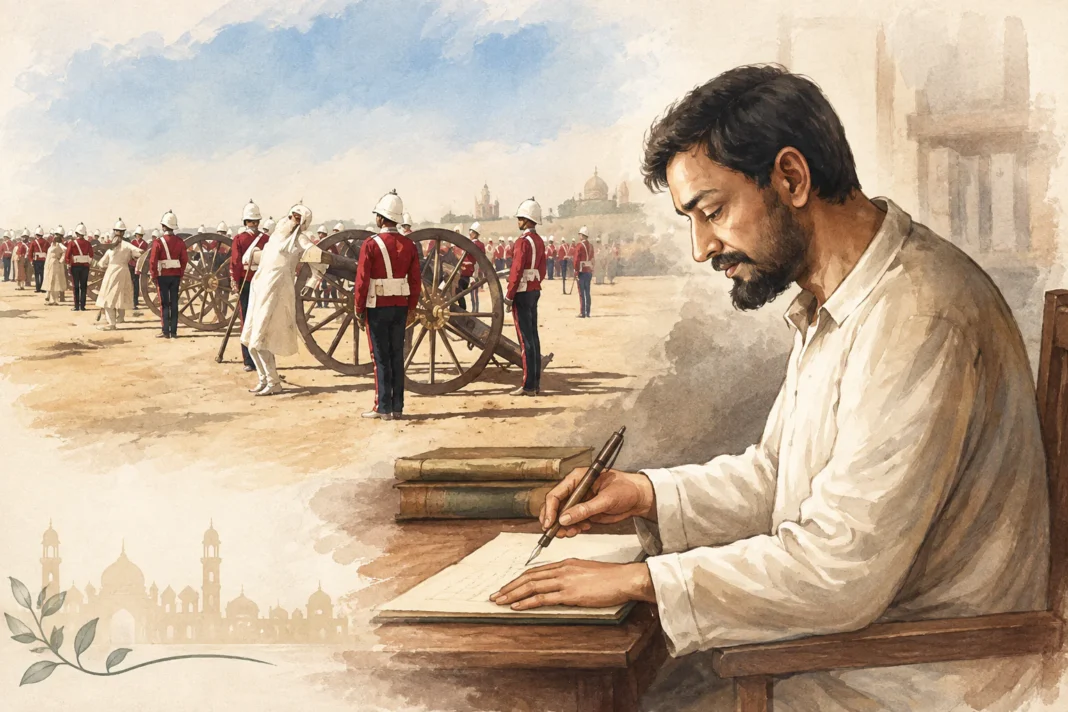
On 14 September 1857, British forces entered Delhi through Kashmiri Gate and began taking control of the city. Baqar was arrested that same day. Two days later, on 16 September 1857, they brought him before Major William Stephen Raikes Hodson. He was ordered to be executed without being given a trial.
Historical accounts differ regarding the precise manner of his execution. Some accounts state that he was shot, while other historical representations, including an 1884 painting by Russian artist Vasily Vereshchagin, depict him being executed by being blown from a cannon.
Whatever the exact method, the central fact remains that Baqar was executed without being given an opportunity for a proper trial. At the time of his death, the Mughal Empire had not yet formally ended, and Bahadur Shah Zafar was still present in the Red Fort.
A Legacy That Lives On
Maulvi Muhammad Baqar’s death gave Indian journalism one of its earliest and most powerful examples of the personal cost of challenging authority through the written word.
After him, figures such as Ganesh Shankar Vidyarthi, Bal Gangadhar Tilak and Mahatma Gandhi would also use journalism and writing as instruments of public resistance. But Baqar had already established an important precedent. Today, as India is known as the world’s largest democracy, questions about press freedom and journalists’ safety remain important.
Baqar’s 169th death anniversary therefore offers an opportunity to remember not only the journalist who lost his life in 1857, but also the principle that shaped his work: journalism should give voice to ordinary people rather than serve those in power. His story remains a reminder that sometimes, the cost of using that voice can be the greatest sacrifice of all.
Also Read: From Guns to Glamour: Surrendered Naxal Women Walk Fashion Ramp
You can connect with DNN24 on Facebook, Twitter, and Instagram and subscribe to our YouTube channel.