


A teenager from Assam has discovered two asteroids, and NASA has taken notice. Aarian Zeeshan Ahmed, a first-year Computer Science and Engineering student at the University of Science and Technology, Meghalaya, grew up watching the night sky from the rooftop of his family home in Rangia, a modest town in Assam’s Kamrup district. That habit, kept up through school and now college, has led to a discovery that few teenagers anywhere in the world can claim. Two objects he identified in the asteroid belt between Mars and Jupiter now carry the provisional names 2024 VE8 and 2024 VC23, and NASA has formally recognized his work.
A Discovery That Put Rangia On The Map
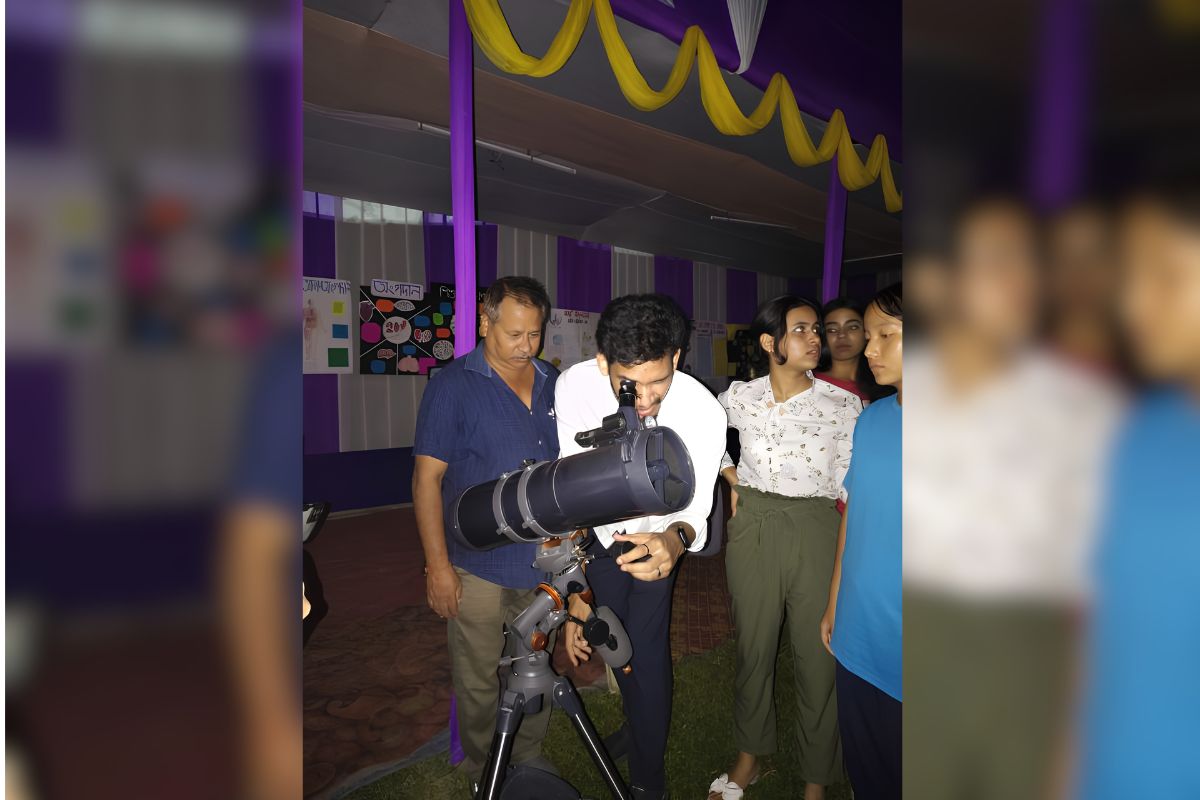
Aarian has had an abiding interest in astronomy. “I have been fascinated by astronomy and the movements of celestial bodies since childhood. I experience immense joy whenever I look at the sky, and I read many books on astronomy,” he says. The fascination sharpened in Class VIII, and by Class XI he had saved up enough money to buy his first telescope. He now owns two, and uses them often, scanning the sky above Ward No. 3 in Rangia whenever the weather permits.
In 2024, he joined a program run by the International Astronomical Search Collaboration, which gives students and amateur researchers access to real observational data collected by professional telescopes. Working with images from the Panoramic Survey Telescope and Rapid Response System, known as Pan-STARRS and operated by the University of Hawaii’s Institute for Astronomy in partnership with NASA, Aarian searched for faint points of light that shifted position between exposures, a telltale sign of an undiscovered asteroid.
His search turned up two such objects, both orbiting in the main asteroid belt. The Collaboration gave them the provisional designations- 2024 VE8 and 2024 VC23. On December 17, NASA contacted Aarian directly to confirm and recognize the discoveries. The space agency is now carrying out a detailed study of both asteroids which is expected to take at least a year. Once that study concludes and the objects receive permanent numbers from the Minor Planet Center, Aarian will earn the right, reserved for the discoverer, to propose permanent names for them.
From Asteroids To The Sun
For Aarian, spotting two asteroids is a beginning rather than an end point. He has already turned his attention to a far larger and more turbulent object- the Sun itself. Working with his friend and collaborator Tanfa Yakin Nur, he is building machine learning models to study the solar cycle and to track solar storms, the bursts of charged particles and radiation that erupt from the Sun’s surface.
They aim to develop an Indian system that can forecast this kind of space weather using data gathered from observatories within the country.
Solar storms are not an abstract concern. They can knock out satellites, strain power grids and disrupt the communication systems that modern life depends on. Reliable forecasting matters for both everyday infrastructure and space-mission planning, and Aarian hopes his work can build a homegrown capability that fits India’s expanding ambitions in space science.
An Ordinary Family, An Uncommon Achievement
Aarian hails from a modest background. His father, Mirajul Islam, is the principal of Jayantipur Yogeshwar Vidyapith Higher Secondary School, and his mother, Ruma Nazrin, has supported his interests from the start. He studied at Fatima Convent School in Rangia, where he did well enough to earn distinction, before moving on to his current college. Even with the demands of an engineering degree, he keeps up his stargazing, reads about astronomy in his spare time, and often lets younger students in his neighborhood look through his telescope.
His father is proud of Aarian’s achievement. “It is truly a matter of pride that a boy from an ordinary family like ours, from a small place like Rangia, has achieved such a major success. I hope people will bless him so that he can establish himself as a successful astronomer in the future.”
Looking Toward ISRO
Aarian is clear about his destination. His long-term goal is to join the Indian Space Research Organization and contribute to the country’s space program. He views his current projects- both the asteroid work and the solar research- as steps on that path rather than separate achievements. “This project uses advanced technologies to understand the Sun and its impact on Earth,” he explains, describing his solar research as groundwork for a future in space weather forecasting.
India’s space story has moved a long way from the early years, when rocket parts were famously carried on a bicycle, to the achievements of recent lunar and solar missions. Aarian’s own story fits naturally into that arc. He draws on data from telescopes in Hawaii, takes part in an international research program, and still keeps his ambitions firmly rooted in Indian institutions.
The Road Ahead
While NASA continues its year-long study of 2024 VE8 and 2024 VC23, Aarian is not waiting idly. He continues to refine his machine learning models and deepen his understanding of solar physics, aware that the path to ISRO is competitive and demands sustained effort. He is preparing on several fronts at once: academic, technical, and personal.
As he sees it, the sky has never been a limit, only a workspace. From the rooftops of Rangia to the asteroid belt, and now toward the restless surface of the Sun, Aarian Zeeshan Ahmed’s story reminds us that some of India’s next steps in space science may begin with nothing more than a telescope, a dataset, and a young person willing to keep looking up at the sky.
Also Read: Himachal’s Sair Festival: Where a Lemon Predicts Your Fortune
You can connect with DNN24 on Facebook, Twitter, and Instagram and subscribe to our YouTube channel.