


A woollen code only Kullu weavers can read runs through every shawl that leaves the looms of this Himachal valley, and once a person learns to read even a few of its symbols, the plain wool blanket sold in a roadside shop starts to look like something else entirely. The pattern is not decoration. It is a record.
People who visit Kullu often buy a shawl the way they might buy a postcard, as a memory of the trip and nothing more. Few of them ask why the border carries triangles and diamonds instead of flowers or stripes, or why one shawl costs three thousand rupees while another, almost identical to the eye, costs three hundred. The answer lies in a history that goes back five thousand years, though the shawl most people now call Kullu Patti took its familiar shape only in the early eighteen hundreds.
A Craft Shaped by Escape
Weaving in Kullu was, for a long stretch of its history, a plain and practical trade. Before 1830, local weavers made twill cloth, checks and striped fabric from the wool of sheep raised in the surrounding hills. The cloth kept people warm through winter. People did not admire it for its beauty.

The change came from Kinnaur, a district some distance to the east. Weavers from the village of Ropa fled the harsh rule of their local chief and settled in the Kullu valley, bringing with them a far more refined tradition of weaving. Their cloth carried symbolic motifs and intricate geometric patterns, the kind seen on ceremonial wraps and ritual cloths back home. When these Kinnauri techniques met the simpler Kullu style, something new was born: a shawl carrying patterns raised above the base fabric using what weavers call the extra weft method.
A second wave of change arrived in the 1940s, when skilled weavers from Bushahr, near Shimla, brought the idea of adding bright, patterned borders to the shawl. In 1944, Thakur Ved Ram founded a weavers cooperative named Bhuttico. That cooperative still exists today and now supports more than four hundred and thirty handloom artisans and their families.
What Makes a Shawl a Kullu Patti
Kullu Patti refers to the traditional woollen weave Himachali women wear on special occasions. What sets it apart is not the wool itself but the arrangement of colour and pattern across the fabric, built from wool and, in finer pieces, silk thread. The finished cloth carries weight, both literal and cultural, because each piece takes real time and skill to complete.
On 10 December 2004, the Kullu shawl received a Geographical Indication tag, making it the first product from Himachal Pradesh to earn this recognition. The tag means only shawls woven by registered weavers in the Kullu Valley can legally carry the name, Kullu Shawl. Anyone caught selling an imitation under that name faces a fine, a jail term of six months to three years, or both, under the Geographical Indications Act of 1999.

The application came from the Himachal Pradesh Patent Information Centre, working under the state science and technology council in Shimla. The registration carries certificate number 15, dated 12 December 2005, and remains valid until 9 December 2034, after which it can be renewed. The Kullu Shawl Weavers Association played a central role in pushing the recognition through, though the paperwork trail shows the original application was filed years before the association is sometimes credited with the effort.
Patterns Borrowed from Temple Walls
The bright motifs that define Kullu weaving, mostly red, yellow, green, orange and white set against black, brown or undyed wool, did not appear out of nowhere. Weavers drew them from the carvings found on temple walls and Buddhist monasteries across the region. Triangles, diamonds, stylised flowers and temple-shaped forms are not random choices. Each carries meaning rooted in local belief.
Some of the named motifs tell their own small stories. The keeda bel takes its spiral shape from an insect’s movement. The akhrot motif, an eight-sided figure, comes from a walnut’s inner structure. The char bulbul chashm pattern echoes the eyes of four bulbuls. The Ganesh motif traces back to the swastika. None of this is printed on a label, yet a weaver reading the cloth can tell you the whole story just by looking at the border.
How the Shawl Comes Together
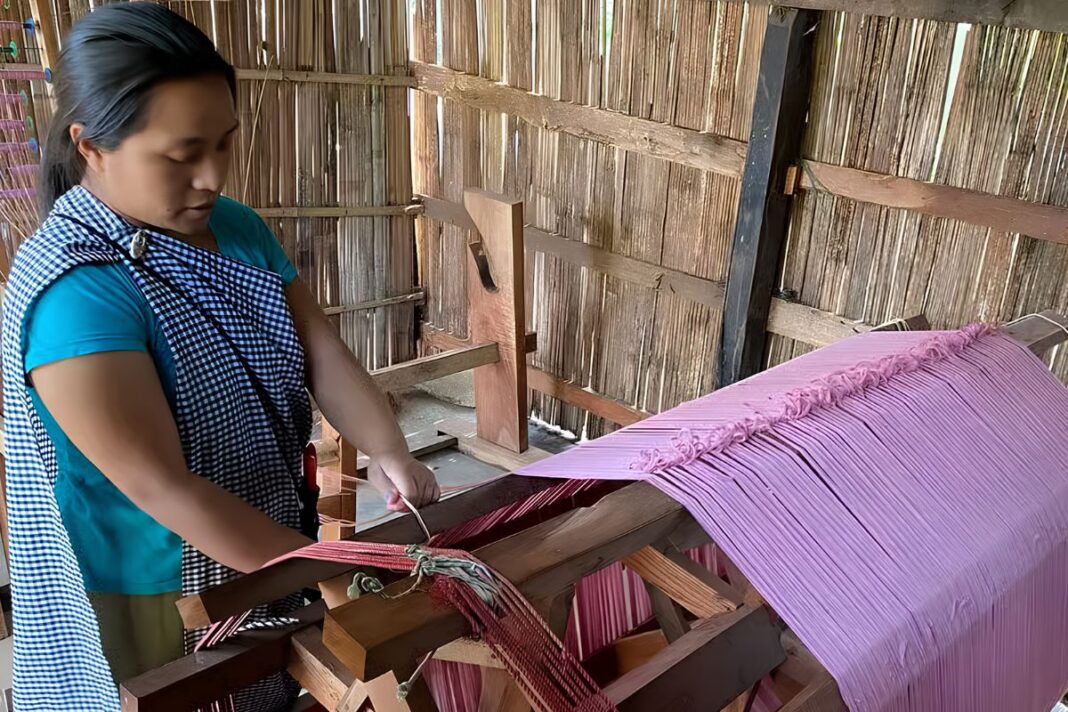
Making a Kullu shawl by hand takes patience that machines cannot replicate. Wool comes first from local sheep and goats raised around the valley. It is cleaned and carded to remove impurities, then spun into thread on a wheel and dyed, traditionally with natural colours drawn from plants and minerals.

The dyed thread then goes to the loom, where a skilled weaver builds the pattern using the extra weft technique, adding extra threads into the base fabric to raise the design above the surface. No stencil or tracing paper is involved. Every motif is counted and aligned by memory and practised hands. Once weaving finishes, the shawl is washed, pressed, and finished with tassels along the edges to keep the threads from coming loose.
A Craft Under Pressure
The industry now faces real strain. Machine-made copies have flooded local markets, and much of the wool used even in genuine Kullu shawls now comes from China and Australia rather than from sheep grazing in the valley. Even so, interest in the authentic handwoven product is growing again, driven by designers and travellers who value heritage and craft over speed and cheap imitation. Government schemes and weaver cooperatives continue to support the trade, and the Geographical Indication tag has given the craft firmer legal and economic standing.
Telling Real from Fake
A genuine handloom Kullu shawl carries a holographic Geographical Indication sticker issued by the Kullu Shawl Weavers Association. Without it, no shawl can legally be called a Kullu Shawl, no matter what the seller claims.

Beyond the sticker, the cloth itself gives clues. Handwoven fabric shows slight irregularities, a texture that is not perfectly even, because a person rather than a machine made it. The edges feel a little rough rather than machine-straight. The wool itself feels dense and warm rather than thin and slippery, and a small burn test on a loose thread tells the rest of the story. Real wool smells faintly of burnt hair and turns to soft ash. Synthetic fibre smells like burning plastic and melts into a hard bead.
Price offers another hint. A pure wool handloom shawl rarely sells for less than fifteen hundred rupees, and genuine pieces are rarely discounted heavily. Anything priced at three or four hundred rupees, especially with a steep sale tag, is almost certainly machine-made.
Buyers looking for the real thing do best to buy from known cooperatives such as Bhuttico, from certified retailers, or directly from weavers in the valley, and to ask for the Geographical Indication certificate before handing over money.
What a Shawl Actually Carries
A Kullu shawl is not simply a piece of clothing bought to survive a cold evening in the hills. It carries the history of a valley, the memory of Kinnauri weavers who once fled persecution and found a new home, and the quiet discipline of artisans who still work by hand in small workshops and on the verandas of village homes. Anyone who wraps one around their shoulders is carrying a small, warm piece of the Himalayas with them, whether they realise it or not.
Read:Jainsem and Dakmanda: Meghalaya’s Woven Stories of Identity, Memory and Heritage
You can connect with DNN24 on Facebook, Twitter, and Instagram and subscribe to our YouTube channel.