

Before television ever arrived, India’s village puppeteers carried history from one courtyard to the next. No one sent for them, and no one built them a hall. A family turned up at dusk with a wooden stage, painted cloth, an oil lamp, a drum and a bag of handmade figures. By nightfall the whole village sat on the ground, waiting to learn how a king would fall or a demon would be beaten. News, mythology, jokes, music and lessons in right and wrong all travelled in that one bag. The tradition still lives, and the real puzzle is how it lasted so long.
A Theatre That Came to the Village
Indian puppetry sits where storytelling, music, dance, religion and theatre meet. In rural areas, where professional theatre was rare, it became everyday public entertainment.
A single performer often did the work of an entire company. He narrated, sang, played an instrument and moved the puppets, changing his voice for kings, gods, demons, clowns and villagers without letting the story slow down. Imagine the skill that takes. A listener had to follow six characters spoken by one throat.
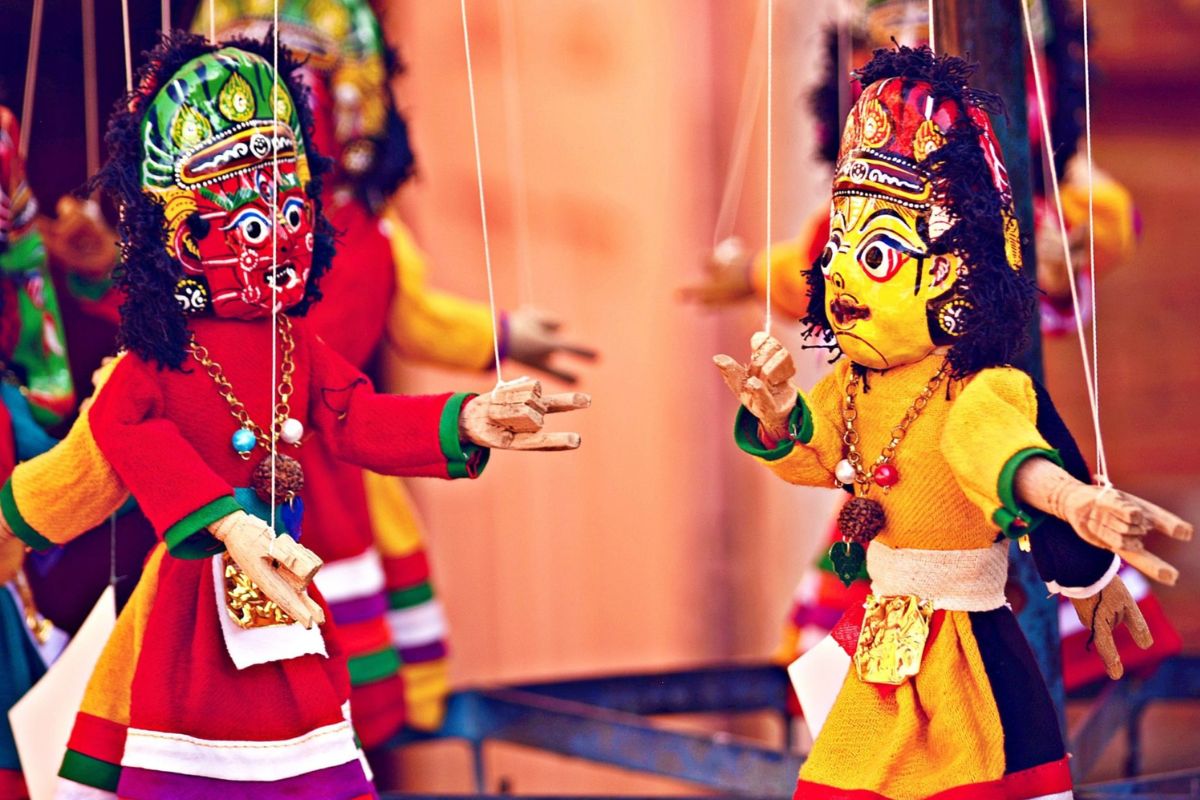
The equipment was purpose-built. Puppeteers could set up in a courtyard, a temple ground, a fair or a village square and be ready within the hour. They adapted their stories to the local language and the crowd. Their material came from the Ramayana, the Mahabharata and the Puranas, from regional legends and local heroes, and from the small comedies of village life. Long before mass literacy, they helped spread a shared body of knowledge across regions.
Roots That Reach Back Two Thousand Years
No one can say exactly when Indian puppetry began, but written evidence suggests it is ancient. The Mahabharata, Panini’s grammar, and Patanjali’s writings mention puppets. Tamil texts from the second century BCE onward refer to string-operated dolls. Scholars believe shadow theatre probably existed in the late first millennium BCE and was widespread by the sixth century CE.
India today keeps more than twenty living puppet traditions. They include string puppets, rod puppets, glove puppets and shadow theatre. Regions differ, yet many forms share core features: a narrator who also sings, live music, movement close to dance, religious or moral themes, and skills passed down within families.
A Country of Many Puppet Stages
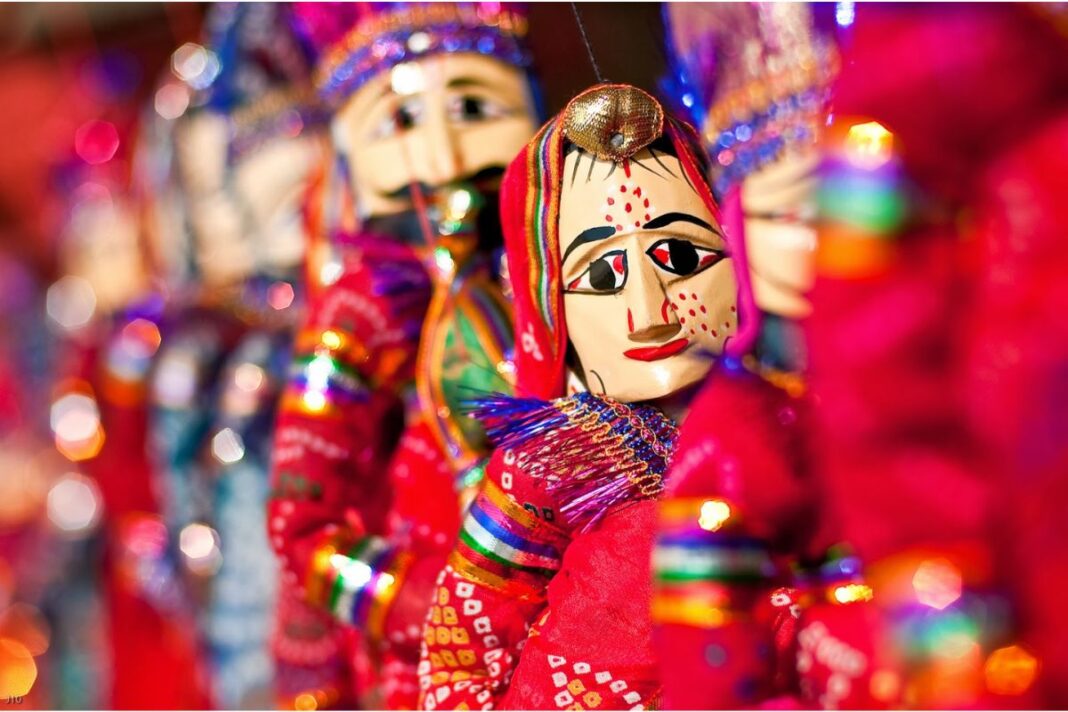
The variety is wide. Rajasthan has Kathputli, a string tradition built on wooden puppets, bright costumes, folk tales and the stories of Rajput heroes. Andhra Pradesh and Telangana have Tholu Bommalata, a shadow form with large translucent leather figures, often used for Ramayana and Puranic stories. Karnataka has Togalu Gombeyata, which uses coloured leather shadows to tell epic tales. Odisha has Ravanachhaya, where small black-and-white figures create striking visual effects.
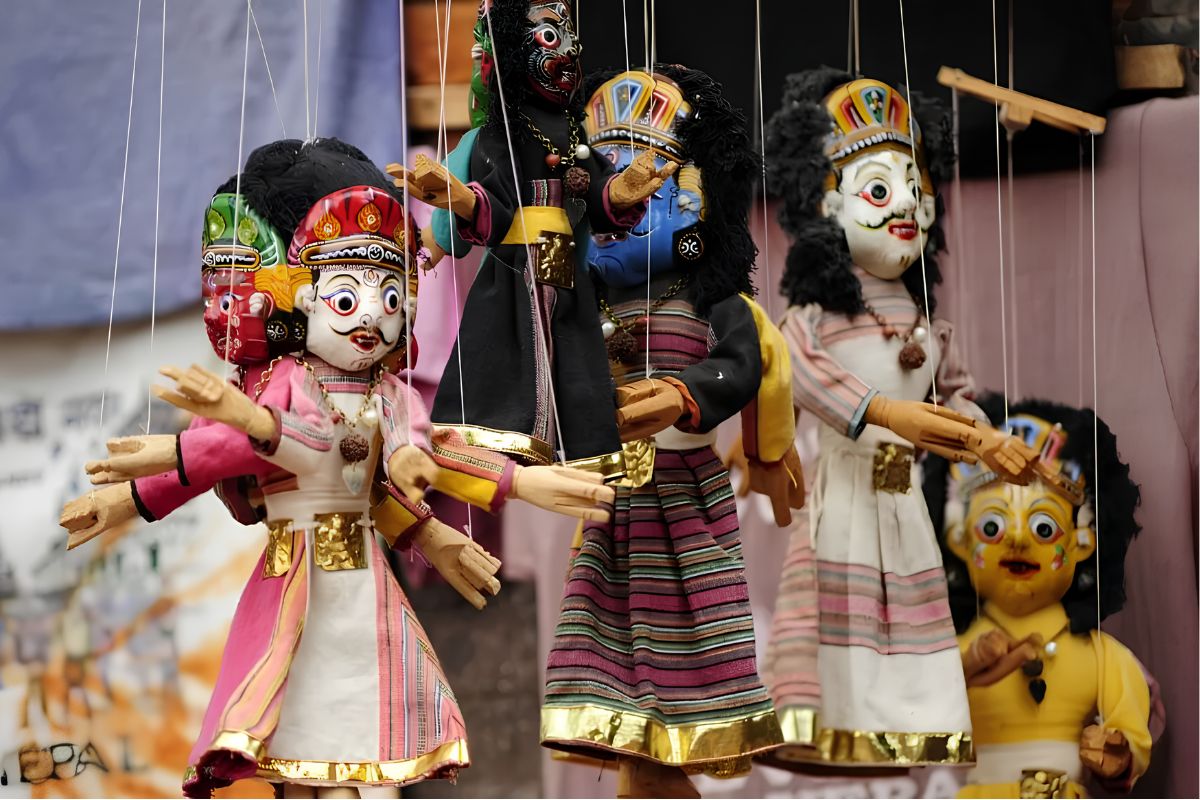
Kerala developed Pavakathakali, a glove puppet version of Kathakali that took shape in the 18th century. West Bengal has Putul Nach, a rod tradition whose large puppets were shaped by Jatra theatre. Tamil Nadu has Bommalattam, which uses rods and strings and features some of India’s largest and heaviest marionettes.
The Wooden Dolls of Rajasthan
The name Kathputli joins two words, kath for wood and putli for doll. It is perhaps the best-known string puppet form in the country. The figures have wooden heads, bright traditional dress and long skirts that hide the fact that they have no separate legs. The puppeteer winds the strings around his fingers and often speaks in a high, whistling voice that has become the form’s signature.
For centuries Kathputli performers travelled through Rajasthan and beyond, offering tales of bravery, romance, trickery and sharp social comment. The art is closely tied to the Bhat community, for whom puppetry was both a living and an inherited identity. Children learned by watching their elders, helping behind the stage, memorising the stories and slowly taking over the performance.
Shadow Theatres of the South
In the south, puppetry took a spectacular turn into shadow theatre. In Andhra Pradesh and Telangana, Tholu Bommalata places big translucent leather figures against a lit screen. Some of them stand several feet tall. The Goethe-Institut notes that figures in this tradition can reach up to four metres, with movable arms, legs, heads, and sometimes waists.
Karnataka’s Togalu Gombeyata, Kerala’s Tholpava Koothu, Tamil Nadu’s Thol Bommalata and Odisha’s Ravanachhaya show how far shadow puppetry travelled across the subcontinent. Performances often ran through the night at festivals. Epic battles and divine tales became a shared evening of light, colour, music and suspense, with the whole village awake together.
Teachers in Disguise
Puppeteers were educators as much as entertainers. Their stories reinforced courage, loyalty, justice, and devotion, and showed what happens to the greedy and the proud. They also made room for satire. A puppet stage creates distance, so a performer could, through a clown, a demon, or a king, say what might have been dangerous to say in his own voice.
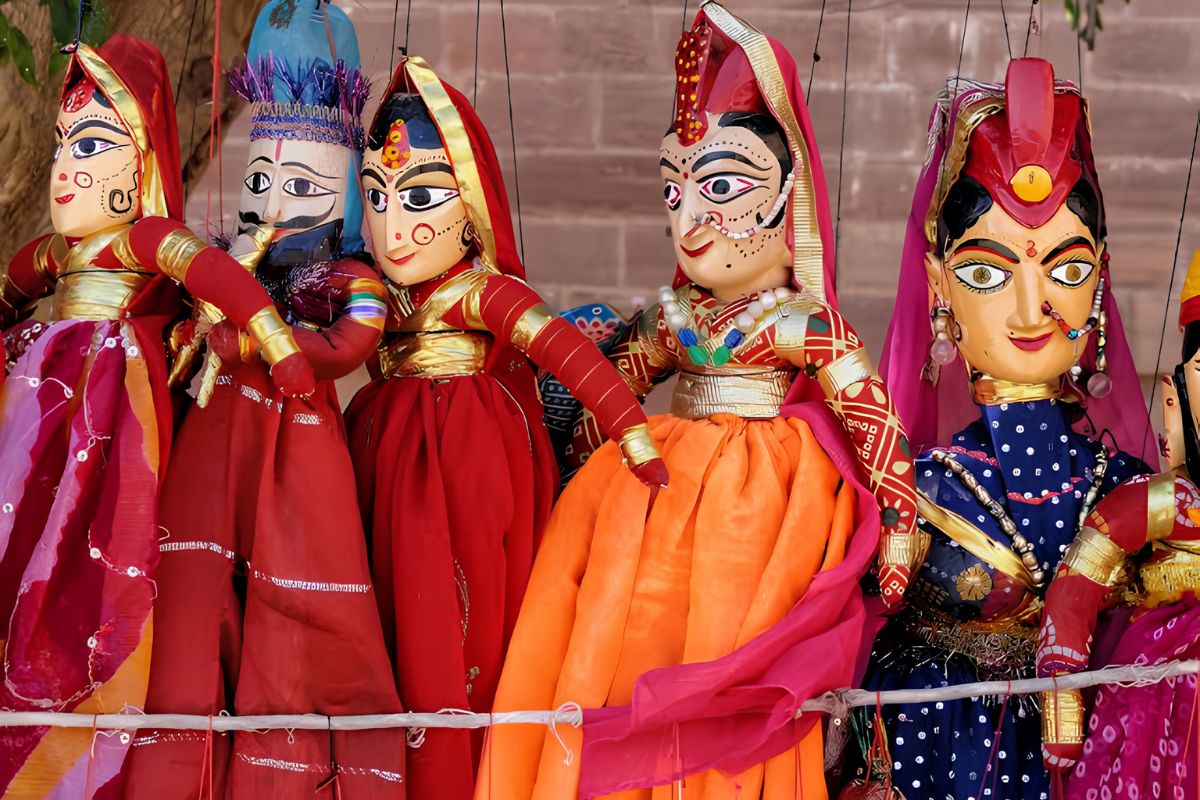
Puppet shows were also woven into community life. They appeared at festivals, celebrations and rituals. Some performances were traditionally believed to drive off evil or ease common worries, including drought. That gave the puppeteer a place in village life beyond amusement. He kept the stories alive, soothed the community’s mood, and carried its local identity from place to place.
A Craft Handed Down in Families
Indian puppetry has long been a family trade. Families treasured puppets, passing them from one generation to the next, and sometimes including them in a bride’s dowry. The knowledge involved was extensive. A puppeteer had to carve or stitch figures, paint them, manage strings and rods, memorise long story cycles, sing, play instruments, and run a travelling show.
This inheritance explains both the art’s strength and its weakness. The skills survived because they stayed inside families. But changing economies, migration, growing cities, and the pull of mass entertainment have made a full-time career in traditional puppetry very hard. The World Encyclopedia of Puppetry Arts notes that many traditional performers held low social positions and met real barriers when they tried to move into modern professional performance.
Efforts to Keep the Stage Alive
Cultural institutions have done much to support these arts. The Sangeet Natak Akademi, established in 1953 as the country’s apex body for the performing arts, works to preserve and promote India’s living heritage in music, dance, and drama. Its documentation, festivals, awards, and training have brought traditional puppeteers before wider audiences.
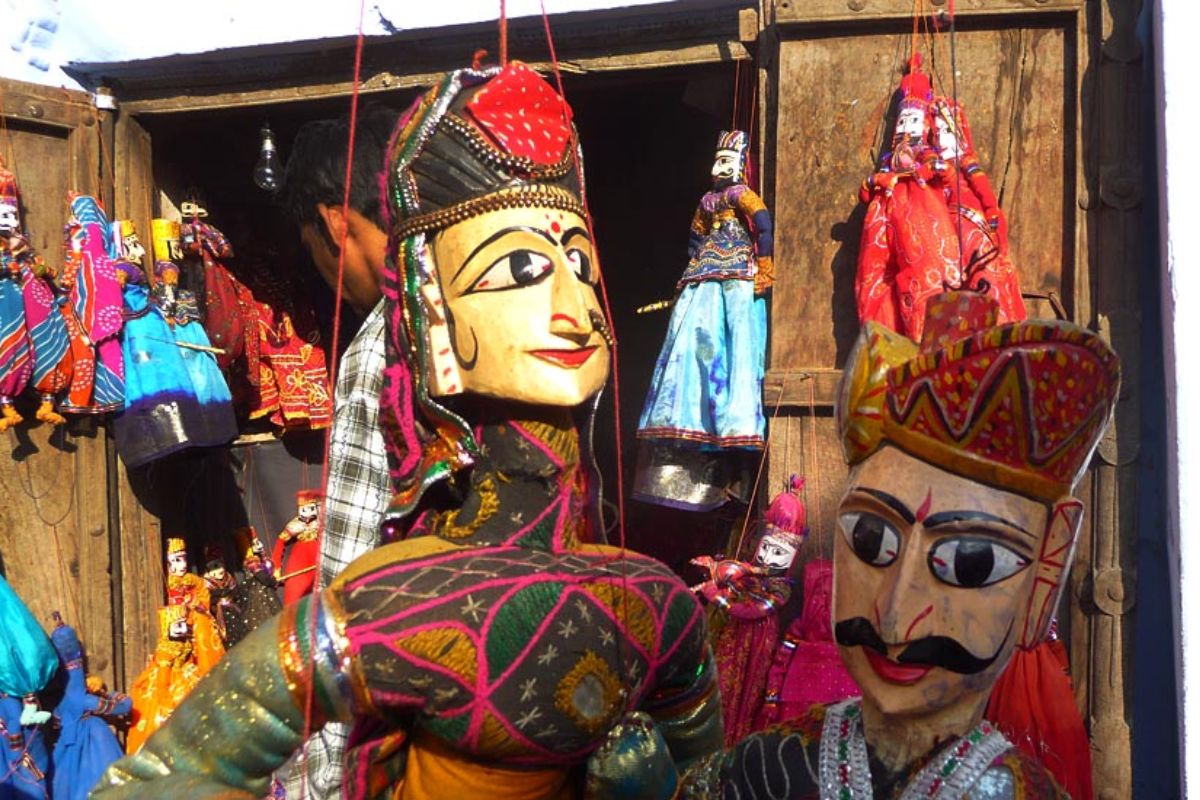
Some revival has come from inside the communities. Kerala’s Pavakathakali was close to extinction before the Natana Kairali Research and Performing Centre for Traditional Arts revived it in 1982. Cases like this teach a plain lesson. Survival depends on training, performance opportunities, fair income, and new audiences. Fond memories alone will not do it.
Why the Journey Still Matters
India’s traditional puppeteers once carried history from village to village as moving shadows, singing voices and dancing wooden figures. Textbooks and monuments played no part. They made the great epics feel close to home, turned moral teaching into an evening’s fun, and gave rural communities a cultural language they could share.
Their story also questions a common belief that heritage belongs in a museum. In India, it has often survived in artists’ hands, folded into cloth bundles, carried over long roads, and woken up again wherever people gathered to watch. Supporting these puppeteers means supporting an unbroken chain of memory, one in which history sits in no archive. It walks, sings, fights, laughs and dances across a village stage.
Also Read: How Persian Art Found a Home in Kashmir and Became Part of Its Cultural Identity
You can connect with DNN24 on Facebook, Twitter, and Instagram and subscribe to our YouTube channel.