

When Alexandra David-Néel sent her passport for renewal on her 100th birthday, the passport office asked why she wanted to renew it at such an old age. Her reply was simple: “Just in case.”
That short answer perfectly reflected the life she had lived.
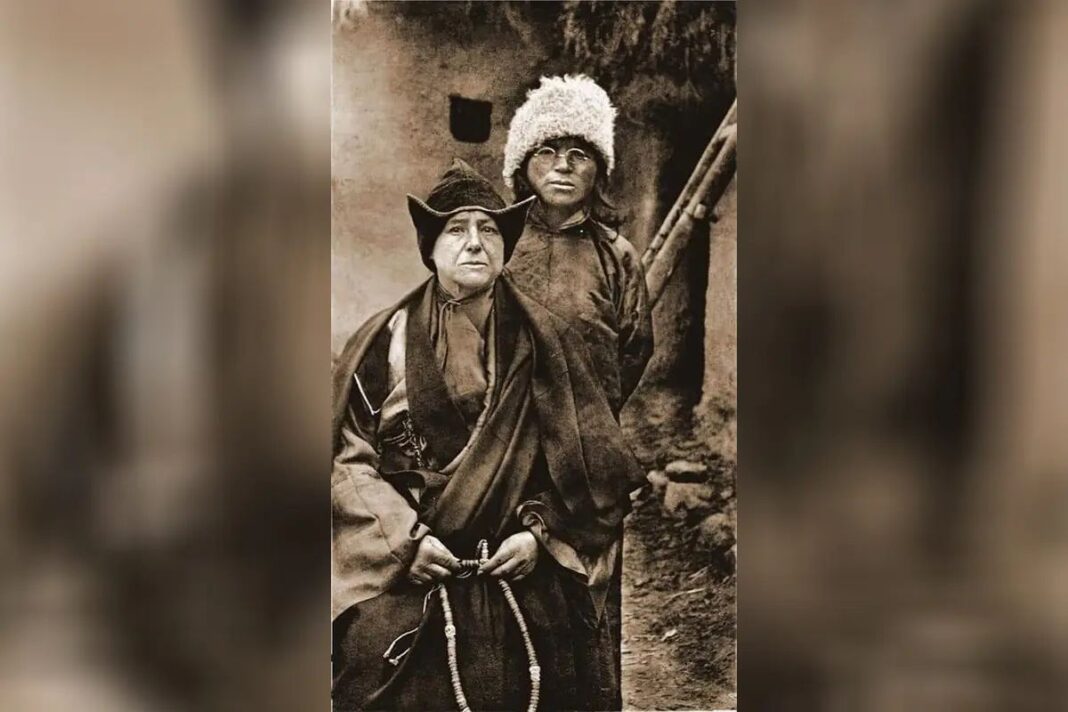
Born about a century and a half ago, Alexandra David-Néel lived an extraordinary life filled with travel, learning, adventure, and rebellion. She became the first foreign woman to reach Tibet. In 1924, at age 56, she secretly entered Lhasa, the capital of Tibet, where outsiders were not allowed.
To avoid being recognized, Alexandra disguised herself as a beggar. She darkened her face with soot and wore a fake braid made from yak-tail hair. Hiding her real identity, she managed to enter the forbidden city.
A Rebel From Childhood
Alexandra was born into a bourgeois French family, but she had an independent and rebellious nature from an early age. At just 15, she ran away from home for the first time and traveled to the Netherlands. She wanted to reach London and learn English, but she ran out of money and had to return home. Her family scolded her, but it did not stop her.
Soon, she left home again. By the age of 18, Alexandra had already visited London and traveled on her own through Spain and Switzerland.
While staying at the Theosophical Society in London, she became interested in Buddhism. This interest soon became an important part of her life. At 21, she traveled through India and Sri Lanka for about a year and a half. She financed this journey with money she unexpectedly inherited after a relative’s death.
A Lifelong Connection With Asia
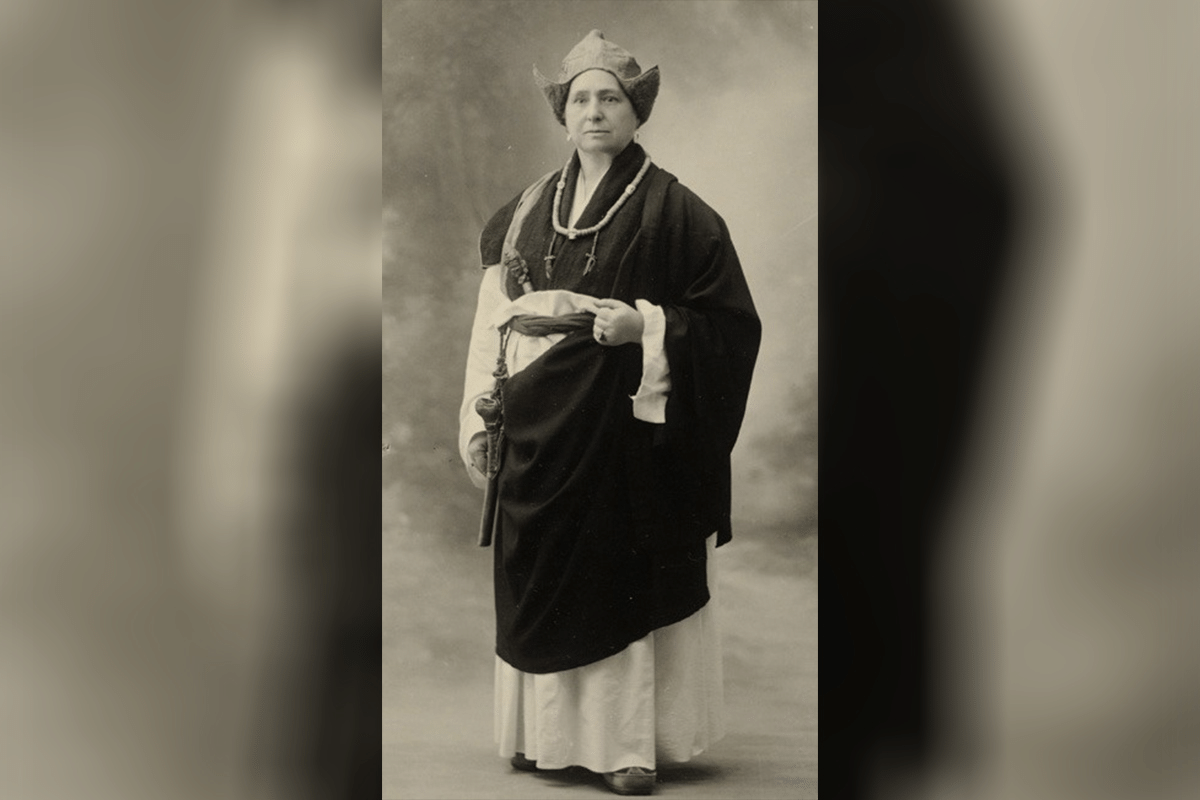
India and Buddhist Asia remained important to Alexandra throughout her life. She spent several decades traveling and studying in the region. She learned Sanskrit and Tibetan and translated several religious texts into French. She also became a writer and produced around 30 books, including several accounts of her journeys.
From the early 1900s until 1946, Alexandra made many long journeys through the high Himalayan regions. During these travels, Yongden, her adopted Tibetan son and a Buddhist lama, often accompanied her.
Travel was not simply an occasional adventure for Alexandra. It became central to her life.
A Marriage Lived Mostly Apart
At 36, Alexandra married a wealthy railway engineer. However, the couple spent very little time together. Before leaving for India, Alexandra told her husband that she would return within 19 months. Instead, it took her 14 years to return home. When husband and wife finally met after this long separation, they spent only a few days together before deciding to divorce.
Their relationship, however, did not simply disappear. After their divorce, they continued exchanging letters for a long time. Their correspondence became a record of the affection, love and devotion they continued to have for each other.
Many Lives Within One Lifetime
Alexandra’s adventures were not limited to traveling through Asia.
At one point, she ran a casino in Tunisia with a friend. At another stage of her life, she spent several years performing classical singing at the Hanoi Opera House. She also spent months conducting research at the British Museum in London.
Alexandra had strong political opinions and expressed them openly through several pamphlets. During her younger years, she was also well known in Paris society and became a famous social figure.
Her life moved constantly between scholarship, travel, music, politics, writing, and adventure. At 78, Alexandra formally retired. She settled in a village in France and turned her experiences into books. But even retirement could not completely stop her restless nature.
Starting Again at 87
Alexandra lived for many years after the deaths of both her husband and her adopted Buddhist son. While many people slow down after retirement, Alexandra continued finding new missions for herself.
At 87, she decided to leave France and settle in Monaco. Initially, she planned to build a house there, but later decided that she preferred living in hotels. Yet finding the right hotel was not easy. Sometimes she disliked the food; elsewhere, she was unhappy with the staff.
For the next two years, she kept moving from one Monaco hotel to another. Finally, in June 1959, she met a young woman named Marie-Madeleine, who agreed to become her secretary.
Marie-Madeleine remained with Alexandra until her death. She was not only her secretary but also her daughter, mother, and student in Alexandra’s later life.
An Inspiration for a New Generation
The 1960s brought youth rebellion and the rise of hippie culture across Europe and America. Many young people left behind comfortable lives to travel and discover the world.
Writers and poets of that rebellious generation looked to Alexandra David-Néel as a role model. Writer Jack Kerouac and poet Allen Ginsberg were among those who admired her.
It was also a period of rebellion in music and art, when artists such as Jimi Hendrix and Bob Marley were developing strong cultural followings. But Alexandra had already lived according to many of these ideas decades earlier.
She had rejected many of society’s expectations and chosen to live life on her own terms. Long before such rebellion became associated with an entire generation, Alexandra had already traveled independently, challenged social rules, and created a life shaped by her own choices.
Her Final Journey
Alexandra David-Néel died on September 8, 1969. She was only one month away from turning 101. Even after her death, one final journey remained. Four years later, Marie-Madeleine traveled to India carrying the ashes of Alexandra and her adopted son Yongden.
Following Alexandra’s wishes, they took their ashes to Banaras and immersed them in the Ganga. It was a fitting end to the life of a woman whose connection with India, Tibet, Buddhism and Asia had shaped much of her extraordinary journey.
Alexandra David-Néel lived more than a century, but the remarkable part of her story was not simply how long she lived. It was how many different lives she managed to live within those years.
Traveler, writer, scholar, singer, researcher, and rebel, she kept choosing new paths even at an age when most people had stopped looking for them.
And perhaps nothing describes her spirit better than the answer she gave when asked why she needed a passport at the age of 100:
“Just in case.”
Also Read: Arunachal’s Solung Tradition: The Festival Where Villages Become Living Museums
You can connect with DNN24 on Facebook, Twitter, and Instagram and subscribe to our YouTube channel.