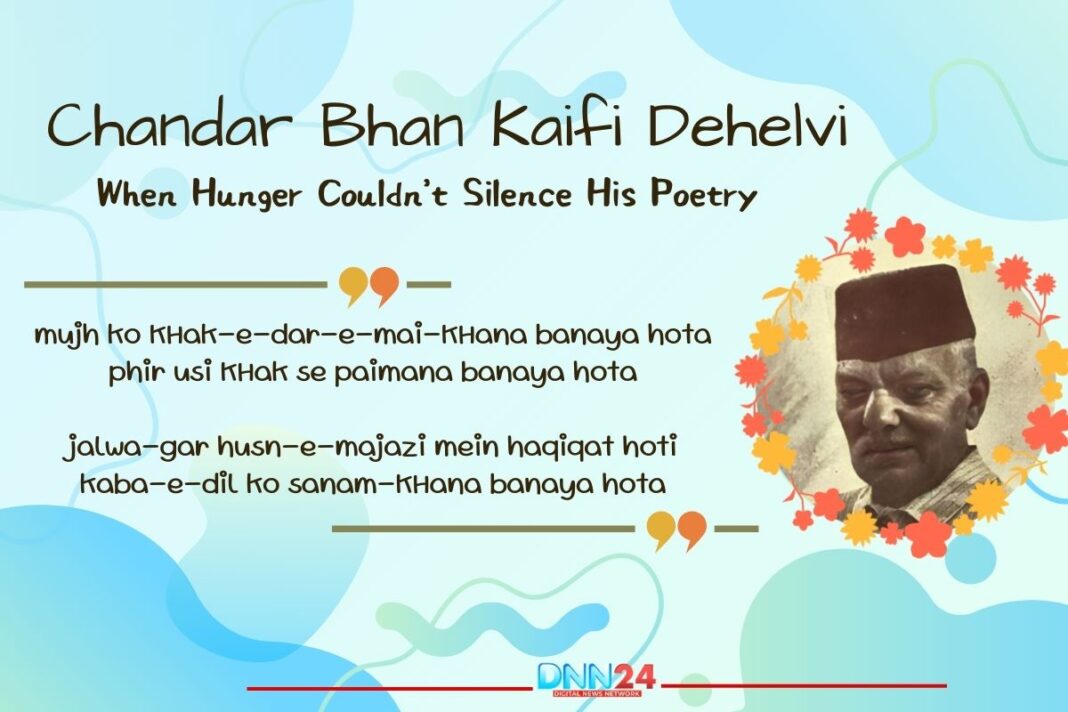

When the old city of Delhi would stir with the call of azaan at dawn and the birds sang their first cries, a sensitive soul sat at his desk, wrestling with emotions far bigger than himself. Chandar Bhan Kaifi Dehelvi, born around 1878, was not just a poet; he was Delhi’s own heartbeat, echoing its spirit, pride, and agonies. His life’s story feels less like a historical tale and more like a heartfelt letter to anyone who has ever felt lost or forgotten.
kya husn hai yusuf bhi KHaridar hai tera
Chandar Bhan Kaifi Dehelvi
kahte hain jise misr wo bazar hai tera
Kaifi belonged to that rare breed of poets who treated their pen like a lantern, carrying warmth and light into the darkest lanes of human experience. His verses, while woven with classical discipline, were always alive with feeling, and each one shimmered with his unique sincerity. He saw literary art not as an escape, but as a shield and a sword in a world that could often be both cruel and uncaring.
taqdir usi ki hai nasiba hai isi ka
Chandar Bhan Kaifi Dehelvi
jis aankh se kuchh wada-e-didar hai tera
He wrote with the hope to heal, inspire, and lift, sentence by sentence, verse by verse. Life did not offer him grandeur, but it gifted him with the courage to find elegance in struggle and to tell stories in which longing, hope, and perseverance became heroes in themselves. Today, looking back at his journey is like tracing dew in the sunlight: tender, fleeting, yet brilliantly alive with hope.
ta-zist na TuTe wo mera ahd-e-wafa hai
Chandar Bhan Kaifi Dehelvi
ta-hashr na pura ho wo iqrar hai tera
Rising from the Shadows
Born in Delhi’s rich milieu, Kaifi witnessed the world changing rapidly around him, a world squeezed by the pressure of colonial rule and social transitions. The stories whispered in the bazaars were stories of loss, survival, and rare triumphs, and Kaifi absorbed them all. Yet, his own journey was not crowned with comfort. Despite being blessed with an education that made him fluent in Persian and Urdu, the doors of prosperity did not swing open for him.
barchhi ki tarah dil mein khaTakti hain adaen
Chandar Bhan Kaifi Dehelvi
andaz jo qatil dam-e-raftar hai tera
He was the teacher who polished others’ stars while his own dreams flickered silently. There were times when poverty threatened to muffle his poetic voice, when the cost of a simple meal would shame him more deeply than harsh criticism. In those moments, Kaifi’s heart became both his refuge and his battlefield. He famously wrote about abandoning wine not out of moral piety, but because poverty turned a kaafir into a pious soul.
kya tu ne khilae chaman bazm mein ‘kaifi’
Chandar Bhan Kaifi Dehelvi
kya rang-e-gul afsha-e-guftar hai tera
This line stings with irony and truth for anyone who has known hunger. His struggles were not just financial; they were deeply emotional, a constant dance between his humble circumstances and an inner world exploding with beauty and thought. Through it all, he remained gentle, never letting bitterness cloud his verses. In every setback, he found a story to tell and a lesson to share, elevating his hardships into something profound and universal.
jahan rang-o-bu hai aur main hun
Chandar Bhan Kaifi Dehelvi
bahaar-e-arzu hai aur main hun
Whispered Legends of the Poet’s Life
The world remembers the poems, but few recall the hidden tales that made Kaifi’s life an epic of resilience and subtle heroism. One such story is of how he continued to write and teach Persian while his contemporaries moved towards more fashionable careers. Despite financial struggles, Kaifi refused to let go of his love for classical learning, even as student numbers dwindled and the allure of colonial administration drew many away from poetry.
sukun ka kaam kya is mai-kade mein
Chandar Bhan Kaifi Dehelvi
azal se ha-o-hu hai aur main hun
His humility made him beloved among students, and old tales recall that on cold winter nights he would gather neighbourhood children, reciting Persian verses and teaching them not just language but how to embrace their own roots with pride. Another untold story: when Delhi’s mood turned heavy with the uncertainty of colonial times, Kaifi’s home would become a meeting ground for thinkers, dreamers, and rebels.
ilahi shara mein rakkha hi kya hai
Chandar Bhan Kaifi Dehelvi
namaz-e-be-wazu hai aur main hun
He inspired not just with his words but with his quiet, steadfast presence, always encouraging hope, never letting despair dominate the room. His poetry often carried subtle messages of patriotism, hidden behind the elegant metaphors and sweet images of classical Urdu. Even in his struggle, Kaifi’s silent acts, a helping hand, a timely word, a sacrifice, became the threads of a legend not written in history books, but etched quietly in the memories of those who walked alongside him through Delhi’s twisting alleys.
jo tum aae to aai jaan mein jaan
Chandar Bhan Kaifi Dehelvi
muqaddar ru-ba-ru hai aur main hun
The Soul and Substance of Kaifi’s Writings
Kaifi’s poetry was a rare bridge, connecting the grandeur of Persian imagination with the simple ache of every Indian’s heart. He did not chase novelty for its own sake but reimagined classical forms in ways that made them new, urgent, and real for his generation. His ghazals and nazms throbbed with personal longing and national pride, but always with dignity and grace.
meri ruswaiyan hain aur tum ho
Chandar Bhan Kaifi Dehelvi
tumhaari guftugu hai aur main hun
Themes of heartbreak, faith, beauty, and hope beat constantly in his verses, mirroring the grand struggles and quiet joys of everyday life. He gave a voice to universal emotions, filling them with the fragrance of Indian soil and the pulse of Delhi’s restless heart. It was his quiet mastery, his clarity of language and thought, that made his work timeless. Every poem bore the weight of centuries but danced lightly with human feeling.
tere didar ki juya hain aankhen
Chandar Bhan Kaifi Dehelvi
talash-e-chaar-su hai aur main hun
His words were gentle enough to heal but bold enough to challenge. He once wrote lines about longing for a loved one in their absence, and readers could feel the ache of an entire city longing for justice, dignity, and peace. Kaifi’s writing lives on as a lighthouse for those battered by the storms of circumstance. His poetry urges us never to give up, always to try to see beauty in pain, and to remember that even the smallest voice can reshape the world.
ajab shai KHud-faramoshi hai ‘kaifi’
Chandar Bhan Kaifi Dehelvi
surahi hai subu hai aur main hun
Legacy: The Endless Flame of Hope and Humility
As years pass, Kaifi’s name may not be shouted from rooftops, but his spirit continues to echo in every heart seeking solace in poetry. He lived and died in Delhi, the city he cherished, the city he never abandoned. His real greatness was not in public acclaim, but in the quiet strength he gave to generations that followed.
har aarzu mein rang hai bagh-o-bahaar ka
Chandar Bhan Kaifi Dehelvi
kanTa bhi ek phul hai us KHar-zar ka
He stayed loyal to his art, his students, and his city, never chasing after fame or fortune, but building a citadel of integrity in a world of compromise. Even today, his legacy is not measured by grand memorials, but by the gentle ripple of hope he set in motion. Teachers, students, and lovers of poetry each discover in Kaifi a friend who speaks their pain and celebrates their joys.
kuchh is tarah se aao ki dil ko KHabar na ho
Chandar Bhan Kaifi Dehelvi
kuchh wasl mein bhi lutf rahe intizar ka
In a time of division and distress, his verses remind us that poetry can be both a lamp and a lifeboat. To remember Chandar Bhan Kaifi Dehelvi is to remember that real greatness lies in honesty, in kindness, and in the refusal to let hardship silence the music within. His life stands as living poetry, a lesson and blessing for all who keep searching for beauty and meaning against all odds.
Also Read: Tomb of Sher Shah Suri: An Emperor’s Dream Palace Floating On Water
You can connect with DNN24 on Facebook, Twitter, and Instagram and subscribe to our YouTube channel.