

Both Haridas Ramchandra Vhatkar’s grandfather and father were tabla makers. Haridas spent 10–12 hours every day with them at the workshop. At that age, he didn’t even realize that he was learning an art.
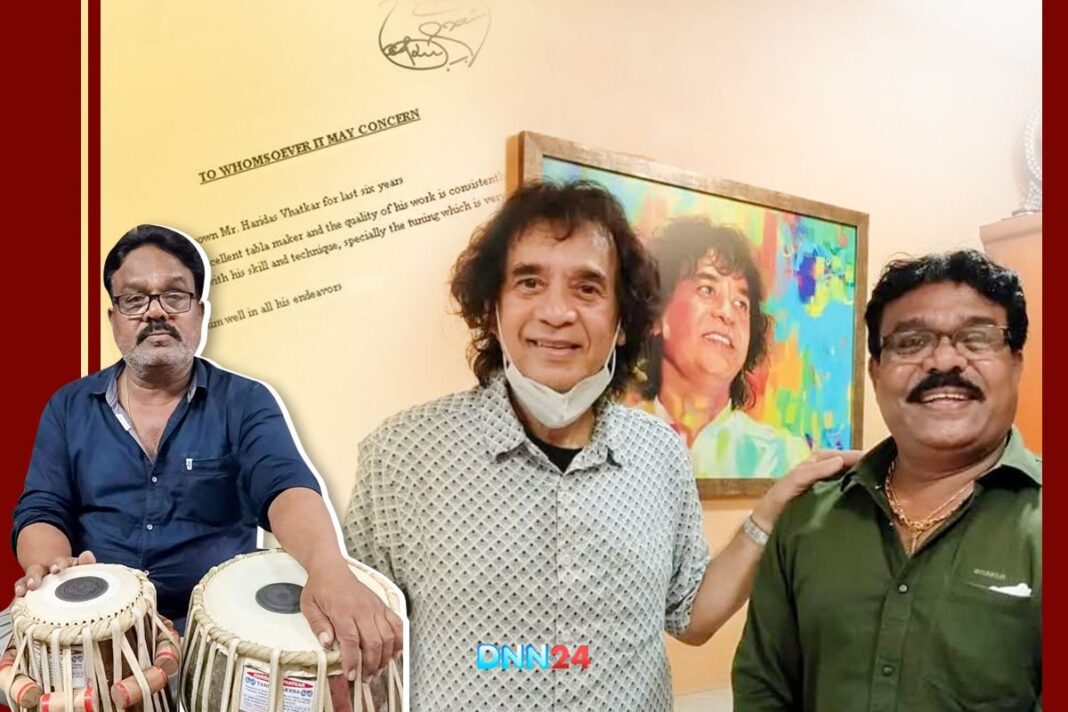
The journey from Miraj in Maharashtra to Mumbai is the story of a craftsman whose handmade tablas have carried the rhythms of the greatest artists of India and the world. Third-generation tabla maker Haridas Ramchandra Vhatkar built a special identity in the world of music through hard work, patience, and skill. The tablas he crafted became the first choice of legendary artist Ustad Zakir Hussain.
Although Ustad Zakir Hussain left this world on 15 December 2024, his rhythm, his music, and his legacy are still alive. By making countless tablas for him, Haridas Ramchandra Vhatkar strengthened that legacy further. Even today, when Haridas places his hands on a tabla, Zakir Hussain’s memories, affection, and teachings seem to resonate within it.
A childhood spent not in playgrounds, but in a workshop
Haridas Ramchandra Vhatkar’s childhood was not spent on playgrounds like most children, but inside a tabla workshop. He recalls that when he was young, his grandfather took him to the shop every day. Both his grandfather and father were tabla makers.
“I used to stay with them for 10–12 hours every day. At that age, I didn’t even realize that I was learning an art. I simply watched, listened, and slowly learned everything on my own.”
At that time, it was commonly believed that children should not be made to work. But Haridas feels that somewhere in his grandfather’s mind was the belief that if the child stayed close, the art would survive and move forward.
The decision to carry the legacy forward
From a young age, Haridas Ramchandra Vhatkar saw the respect artists had for his grandfather and father. Great maestros would visit the shop, discuss notes and rhythm, and value the craftsman’s work.
“That’s when I understood that this is not just work. It is a profession of respect. Sometimes, respect and affection are far more valuable than money.”
This thought drew him towards the profession, and he decided early on that he would follow the same path.
Haridas believes his grandfather had a clear vision that this skill should never end, which is why he always kept him close.
“I decided then that I would do this work in the future, because I felt that respect and love are far more precious than money.”
From Miraj to Mumbai: struggle with dreams
When Haridas Ramchandra Vhatkar came to Mumbai from Miraj, he carried two big dreams. The first was to take responsibility for his family, as their financial condition was weak. The second—and the biggest—was to make tablas for Ustad Zakir Hussain. He arrived in Mumbai in 1994, and the beginning was extremely difficult.
After reaching Mumbai, Haridas Ramchandra Vhatkar didn’t even have a place to stay. He only knew that Lalbaug had several tabla shops. He went there in search of work and found a job at one shop. After a few days, he asked the shop owner if he could get a small place to stay, promising to work day and night. The shopkeeper not only gave him shelter but also provided food. Haridas says,
“It was through the help of such people that I slowly moved forward.”
Struggle and the first support
During this time, he met Dilip ji, the owner of Haribhau Vishwanath Musicals, known to people as Nana Seth. For Haridas Ramchandra Vhatkar, he was not just a businessman, but like a guru and a father.
“Nana Seth had a deep understanding of rhythm and sound. He taught me what the sound of the tabla rim should be like and how much sweetness should be in a stroke.”
Haridas believes that whatever recognition he has today owes a lot to Nana Seth’s teachings and trust.
Lessons from Ustad Alla Rakha
Reaching Zakir Hussain was not easy. Haridas Ramchandra Vhatkar struggled for nearly four years. In 1998, he finally got the chance to make tablas for Zakir sahib for the first time. Haridas also made some tablas for Zakir Hussain’s father, Ustad Alla Rakha. Alla Rakha sahib told him,
“Your work is very good, but handle it with care. Do not become arrogant.”
This advice became the guiding principle of Haridas’s life.
Family and the fourth generation
Today, both sons of Haridas Ramchandra Vhatkar work with him. His elder son has received the Government of India’s Young Generation Best Tabla Maker award. His younger son, Manoj, is also a skilled tabla craftsman. Haridas says,
“I never forced my children. I educated them, and they chose their own path.”
For him, it is a matter of pride that the fourth generation of his family is carrying this art forward.
The first meeting with Zakir Hussain
The year 1998 was when Haridas made a tabla for Ustad Zakir Hussain for the first time. Before that, he had made tablas in Mumbai for Pandit Arvind Murgaonkar. Around the same time, a seminar was organized in Maharashtra by Pandit Suresh Talwalkar, attended by senior artists and students from across the country. Pandit Arvind Murgaonkar brought Haridas’s tablas to that seminar. As soon as artists saw and heard them, they started talking about them.
Those tablas became Haridas’s identity. Gradually, word spread that a fine tabla maker had arrived in Mumbai. This reached Zakir Hussain as well. His guru-brother Yogesh Samsi was the first to visit Haridas. Haridas made tablas for him, and Yogesh Samsi was so impressed that he messaged Zakir Hussain, saying there was a craftsman in Mumbai who made excellent tablas.
Zakir Hussain said, “Order tablas for me as well.” Haridas then made six to eight tablas. Soon after, a message came: “Call Haridas.” Haridas says his dream was to go and meet Zakir Hussain, but instead he was called to Zakir’s home. His tablas had already reached, and later Zakir Hussain sent his driver to bring Haridas from the shop to his house. That first meeting remains just as fresh in Haridas’s heart today. When asked how many tablas he made for Zakir Hussain, Haridas smiles and says,
“Countless. Like asking how many morsels you ate in a week.”
Love hidden in anger
Haridas recalls that he spent a lot of time with Zakir Hussain. Remembering one incident, he says that once he had malaria and was admitted to a hospital in Mumbai. He had been admitted for just one day when a call came from Zakir Hussain’s house, asking him to come at 7 pm that evening.
Haridas says he could not tell Zakir bhai about his illness. He told the doctor that he had to go meet Zakir bhai at any cost. After much insistence, he left the hospital and went straight to Zakir Hussain’s home. When Zakir Hussain later found out that Haridas had come despite being ill, he became emotional and said,
“From today, I will not make you work. What you have done is more than enough.”
Haridas says he broke down and asked what mistake he had made. Zakir Hussain replied,
“I did not expect this from you. You did not think of telling me that you were unwell. If you had told me, we would have come to meet you ourselves. Never do this again.”
After this, Zakir Hussain gave him a letter of appreciation, stating that he had known Haridas for years, that he was an excellent tabla maker, and that his tuning was balanced and pure. He wished him a bright future.
When Zakir Hussain introduced Haridas after a recording
Haridas shares another story. Once, Zakir bhai had a recording and took Haridas along. Haridas was standing outside when Zakir Hussain came out. After a while, a cameraman stood in front of Haridas. Zakir Hussain smiled and said, “Please say something.” Then, introducing him on camera, Zakir bhai said,
“This is Haridas ji, who makes tablas for me.”
“For me, that was a moment of great honor,” Haridas says.
When Haridas’s tablas reached artists across India and abroad
Artists from India and abroad come to Haridas to get tablas made. He has worked for Pandit Anindo Chatterjee, Pandit Nayan Ghosh, Shubankar Banerjee, Vijay Ghate, Pandit Suresh Talwalkar, and countless others. Haridas says,
“I don’t know how to play the tabla, but I often attend concerts because I get to learn there.”
He then returns home and experiments with new ideas. Apart from tablas, Haridas also makes many rhythm instruments such as dholak, dholki, pakhawaj, dhol, and other traditional instruments.
The last meeting with Zakir Hussain
Today, Haridas Ramchandra Vhatkar says,
“I remember him every moment. When he was around, I worked with full energy. Now it feels as if something is empty.”
Haridas shares that Zakir Hussain had gifted him a car. The last time Haridas met him, he went in that very car. Zakir Hussain asked him,
“Did you drive yourself?”
Haridas replied,
“The driver brought me.”
Hearing this, Zakir Hussain was very happy. Haridas says that if God ever asks him what he wants, he would say that in his next life too, he wants to make tablas for Zakir bhai.
Also Read: Padma Shri Ghulam Mohammad Zaz: Kashmir’s Seven Generation Santoor Legacy
You can connect with DNN24 on Facebook, Twitter, and Instagram and subscribe to our YouTube channel.