

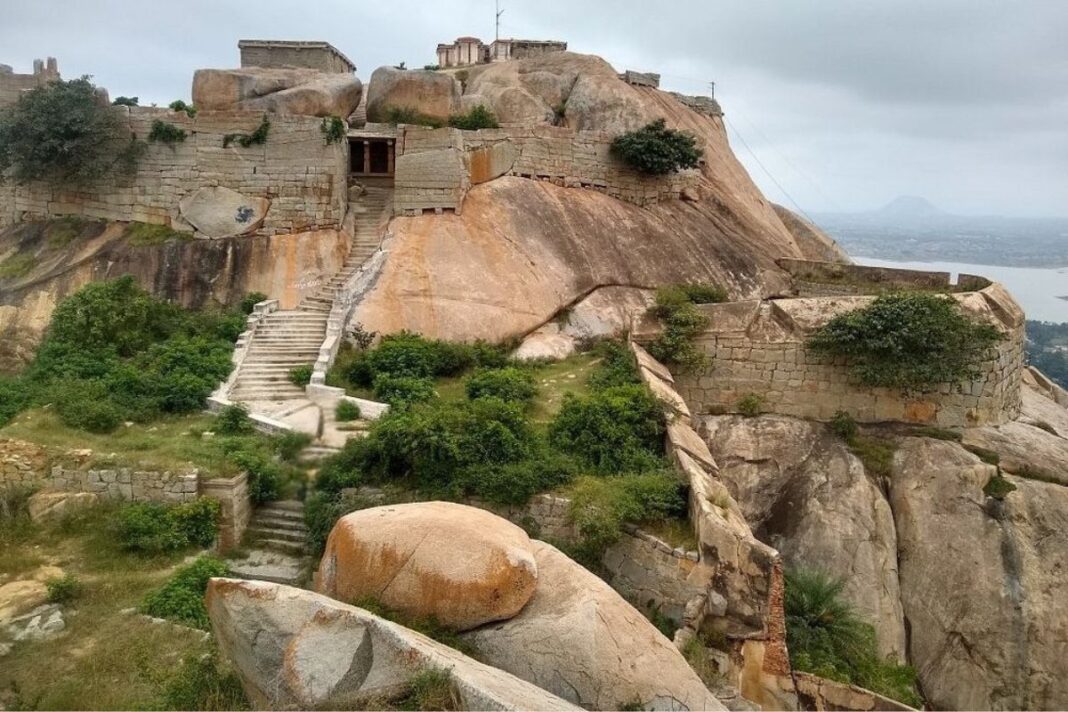

Gudibande Fort rises from the Karnataka plains like a question mark carved in stone. This fortress has counted every footstep on its ancient stairs: soldiers rushing to battle stations, devotees climbing toward temple bells, colonial surveyors taking measurements, and modern trekkers huffing toward Instagram moments, yet after centuries of visitors, the fort keeps its own counsel.
Hill of a Thousand Watchful Eyes
Gudibande itself means “temple on the rock”, and that is exactly how the place feels: half fortress, half open-air shrine, all wrapped in wind and sky. About 100 kilometres from Bengaluru, the fort sits on Surasadmagiri hill in Chikkaballapur district. This rugged outcrop once guarded approaches to Nandi Hills and the northern routes into the heart of old Karnataka.
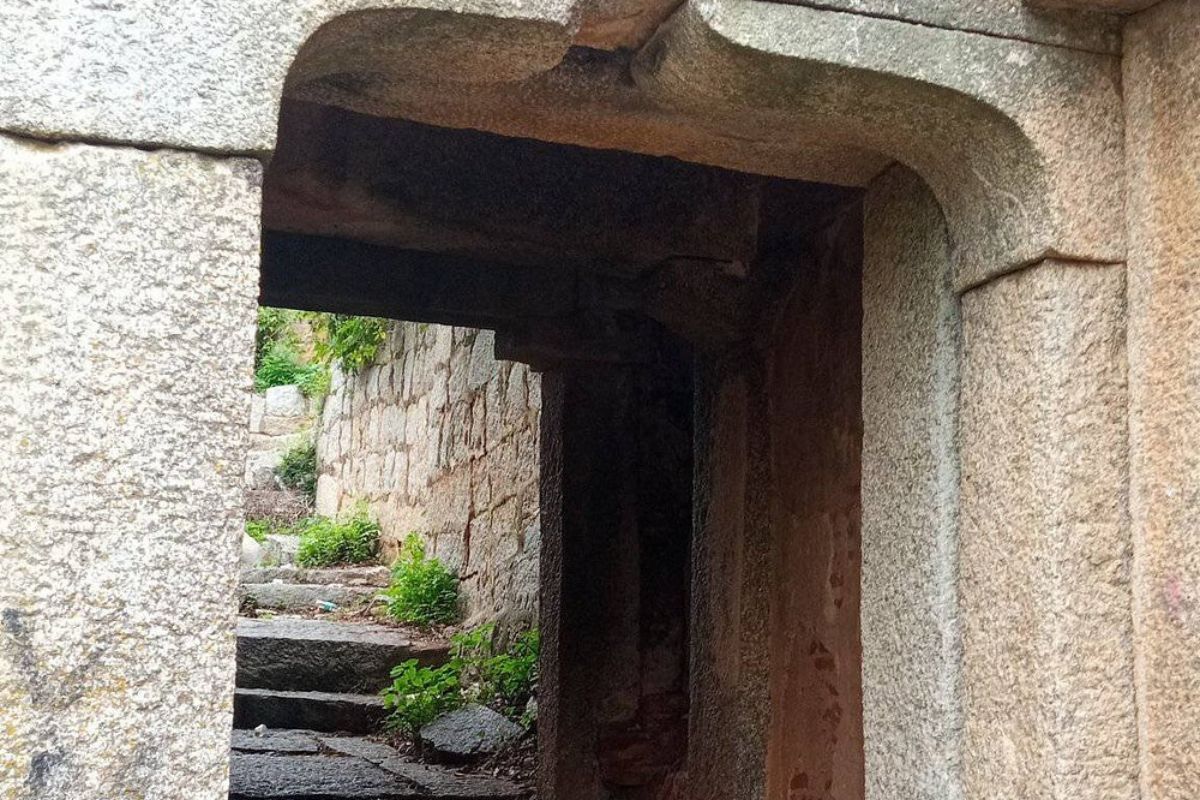
Today, when you stand at the base and look up, you see seven rising levels of walls, turns, and terraces, each one like a pause in a long sentence written in granite. The climb looks simple from the highway, but as you start walking, the path twists, hides, and reveals itself, just as the history of this place does. One moment, you are between high stone flanks that narrow the sky, the next, you step onto a ledge where the entire countryside opens like a painted scroll: fields, lakes, and the hazy outline of distant hills.
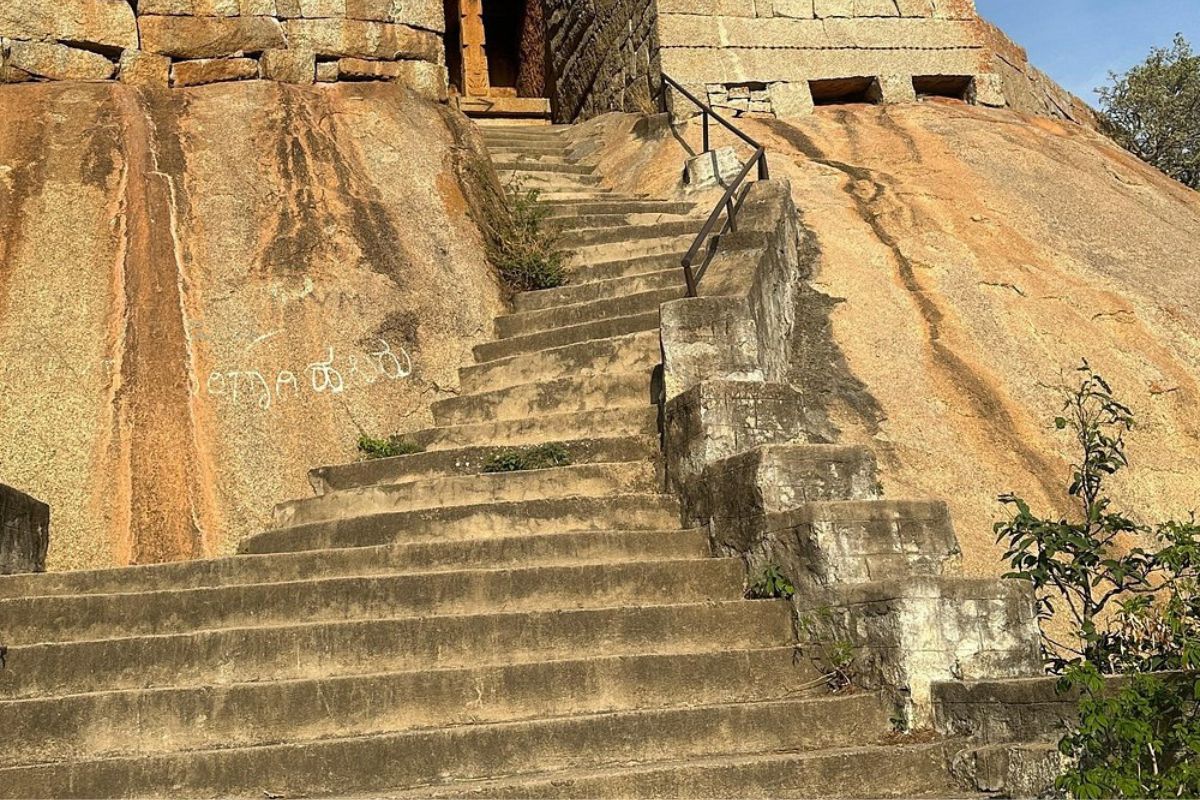
It is easy, on such a path, to forget the noise of the present and feel your breathing fall into rhythm with those who climbed here four centuries ago with swords, not selfie sticks, in their hands.
Byre Gowda’s Rebel Blueprint
The fort as seen today was built in the 17th century by Byre Gowda, a local palegar, yogi, and folk hero who ruled this region with an eye for both strategy and justice. Legends describe him almost in Robin Hood terms, a man who plundered the rich and helped the poor, turning his stronghold into a refuge for the people rather than a cage for them.
Politically, this was a time when the Vijayanagara empire had fractured, and minor chieftains were trying to hold their ground amid the push-and-pull of larger powers. Byre Gowda chose his hill carefully. Gudibande’s height provided a clear view of Nandi Hills and the surrounding plains, enabling early warning of enemy movements and control over trade and military routes.
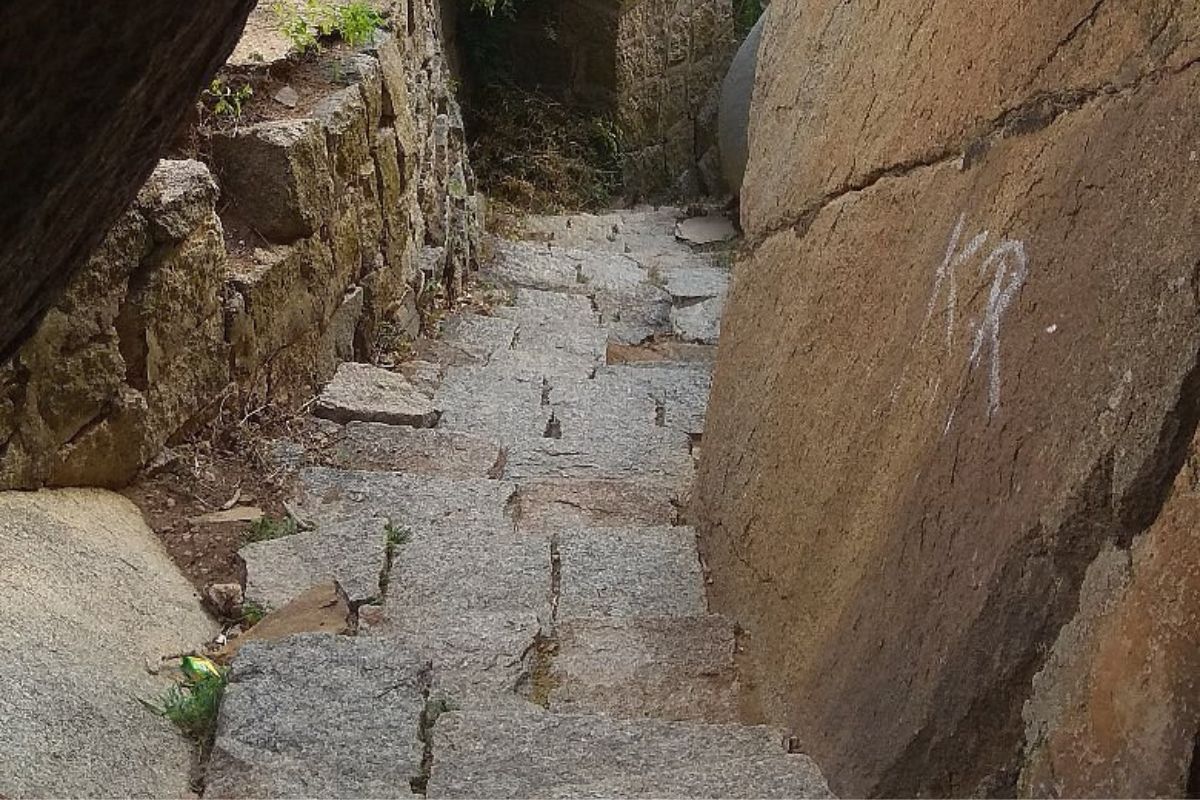
Inspired by the great Madhugiri fort, some even call Gudibande its smaller echo. He designed a seven-tiered defence system, each level with bastions, narrow entrances, and watchpoints that forced invaders to slow down and expose themselves. Interconnected escape routes snake through the fort, giving defenders secret options to fall back, regroup, or disappear entirely when surrounded. In these practical stone decisions, you can almost read Byre Gowda’s mind: cautious but daring, rooted in the land yet alert to every threat on the horizon.
Stone, Water, and the Art of Survival
If the outer walls speak of war, the inner design whispers about survival. Gudibande Fort is famous for its intricate rainwater-harvesting system, a network of rock-cut ponds and channels that trap and guide every precious drop that falls on the hill. Sources describe around 19 ponds spread across the levels, cleverly connected so that overflow from one fed the next, forming a cascading chain of storage that could sustain soldiers and residents during a long siege.
Standing beside one of these reservoirs, now often half filled and ringed with grass, it is impossible not to feel respect for this quiet engineering. No giant dams, no concrete, just angled rock, gravity, and patience. The fort once housed living quarters, granaries, and shrines woven into its terraces, making the hill a self-contained world where people could pray, sleep, fight, and live for weeks without coming down.
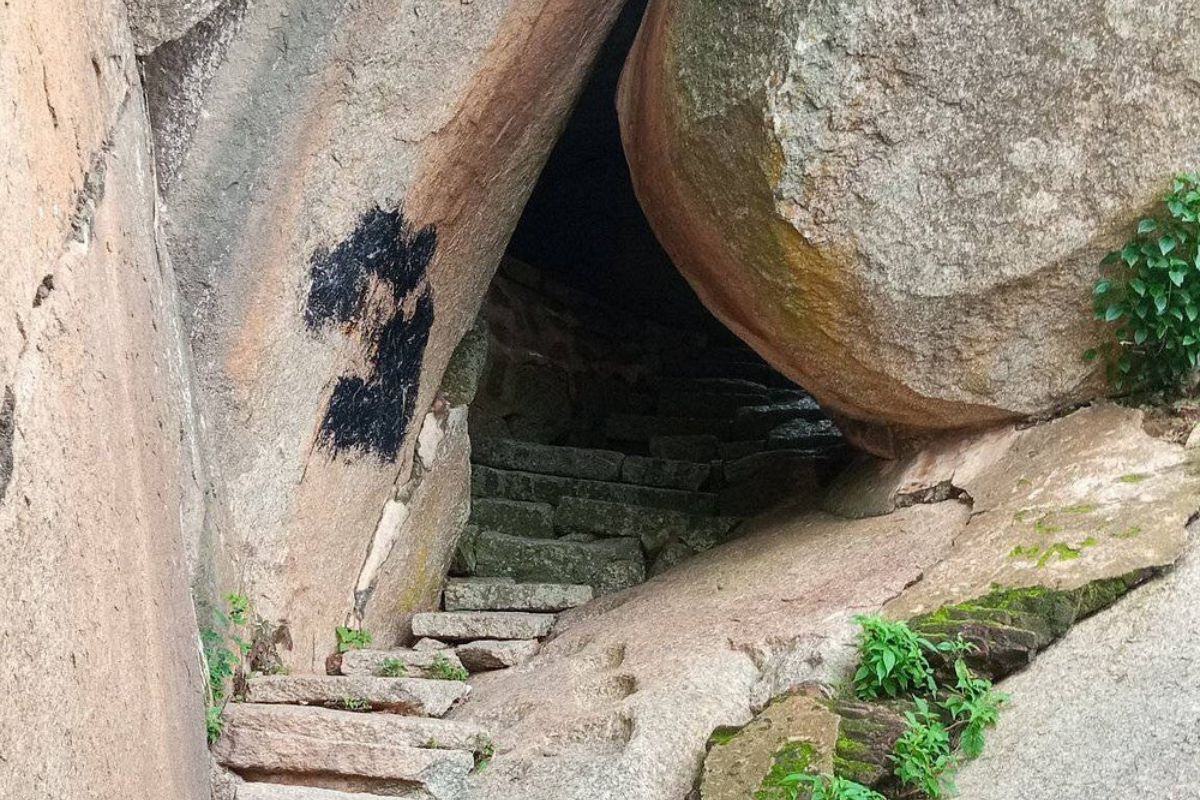
At the summit rests the Rameshwara Temple, dedicated to Lord Shiva, which local belief links to sage Vishwamitra and the Ramayana, tying Gudibande to a mythic timeline that stretches far beyond Byre Gowda’s turbulent century. Here, faith and defence do not clash. The temple crowns the military structure like a calm conscience placed above a restless mind.
From Forgotten Outpost to Weekend Pilgrimage
Over time, the cannons fell silent, rulers changed, and Gudibande slipped from the strategic map to local memory. The British era drew attention to larger cantonments and cities, leaving this hill fort to weather the sun, the monsoon, and the slow insistence of lichen and grass. Yet abandonment never fully claimed it. Villagers still climbed to the temple, herders still used its slopes, and stories of Byre Gowda’s courage and eccentricities passed from one generation to the next.
In the last decade or so, Gudibande has quietly re-entered the spotlight: that of trekkers, photographers, and city-tired travellers looking for a day trip from Bengaluru that offers history without crowds. The trek is considered easy to moderate, making it possible for families and first-timers to reach the top in about an hour, resting at each terrace and reading the land like an old script.
Travel bloggers call it a hidden gem, a place where you can watch sunrise paint the lakes below and still find enough empty corners to sit alone with your thoughts. On weekends, the stone steps hear languages from across India, as people arrive with packed breakfasts, DSLR cameras, and a hunger for something older than their notifications.
Why Gudibande Matters Now
In an age of glass towers and instant water from taps, Gudibande Fort stands as a fierce reminder of how carefully earlier generations negotiated with land and sky. Its water system is not just an archaeological curiosity. In a drought-prone state, those linked ponds feel like a handwritten note from the past on how to respect every drop.
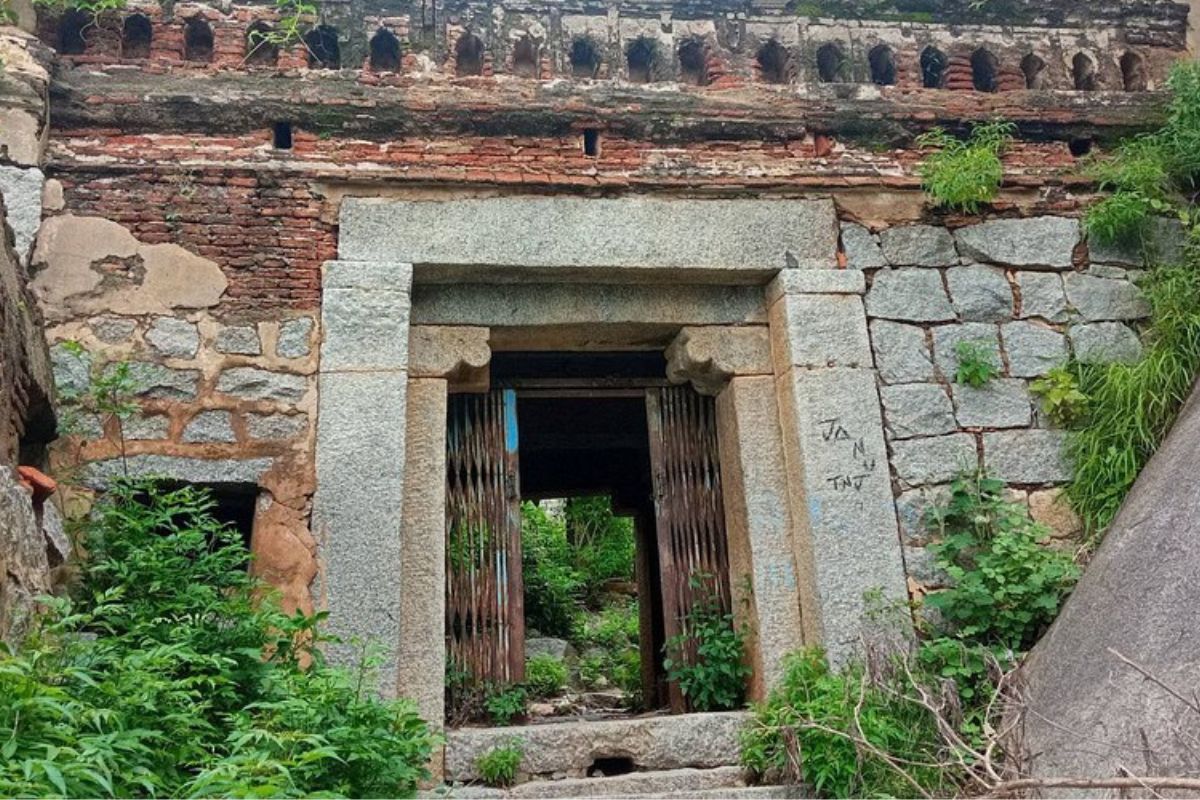
The fort’s modest scale compared to grander sites like Chitradurga or Srirangapatna is, in a way, its deepest strength: you can walk almost every corner in a few hours, touch the walls, trace the channels, and feel the design in your own tired muscles. For today’s writers, artists, and students, Gudibande offers more than a scenic backdrop. It provides a narrative template of resilience, how a local chieftain built something precise and enduring in a chaotic time, using limited resources and infinite imagination.
For local communities, the growing attention brings both opportunity and responsibility: tourism can support small shops and guides, but it also demands care so that plastic bottles do not replace wildflowers along the path. And for anyone who climbs that last stretch to the Rameshwara Temple and looks down at the layered fort below, Gudibande becomes a quiet personal lesson: power is temporary, stone also erodes, but thoughtful work, whether in architecture, water management, or storytelling, can outlast empires.
Also Read: Udaygiri Caves: Where Ancient Kings Carved Gods Into Mountains
You can connect with DNN24 on Facebook, Twitter, and Instagram and subscribe to our YouTube channel.