

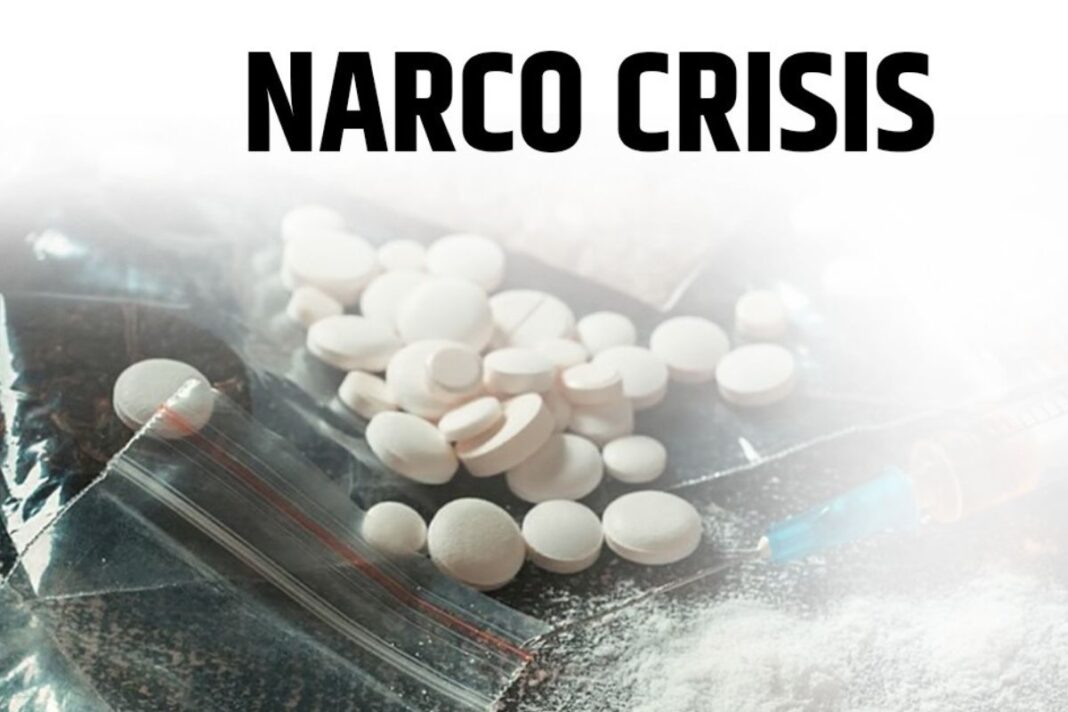

Jammu & Kashmir is facing a new menace- drug addiction- which combined with terrorism throws a new challenge for the region’s security. The surge in narcotics seizures and related arrests is a warning signal of a deeply entrenched ecosystem that is targeting the region’s youth and funding militancy. Ruchika Kakkar, Research Assistant, Institute for Conflict Management, analyses the trend.
Jammu and Kashmir (J&K) has seen an exponential increase in drug use in recent years. During the first week of 2026, a number of narcotics-related arrests and recoveries were recorded in the Union Territory (UT):
On January 7, police recovered 4.5 kilograms of charas during routine patrolling in the Kulpora area of Pulwama district and arrested one peddler, Parvez Ahmed Dar.
On January 6, police seized heroin worth lakhs from a truck and arrested one accused in Pulwama district. On the same day, in Kathua district, drug peddler Mohd Sadiq alias Siku was detained and sent to Jammu Jail. In Samba district, police arrested two peddlers – Deepak Sharma and Adil Hussain – recovering 9.72 grams of heroin from their vehicle at Vijaypur.
On January 1, the Anti-Narcotics Task Force (ANTF) in Kashmir arrested Tamana Ashraf, a woman who had been absconding for three years, in Srinagar’s Batamaloo area. She was detained in connection with a 2023 Narcotic Drugs and Psychotropic Substances (NDPS) case involving the trafficking of over 7 kilograms of charas to Mumbai, via courier.
On January 6, 2026, Maqsood-ul-Zaman, Deputy Inspector General of Police (DIG) for North Kashmir Range, stated that drug abuse was the “gravest internal threat” confronting J&K, after terrorism. Similarly, on January 3, 2026, Anshul Garg, Divisional Commissioner of Kashmir, called drug addiction a “major challenge” and one of the “gravest social issues” facing the region.
He described it as a “huge problem” and a “major warning signal” for society, noting that addiction rates in the Kashmir Valley have tripled over the past three to three-and-a-half years, with an alarming surge in heroin consumption, especially among young people in educational institutions.
Official assessments indicate that approximately 1.3 million people in J&K are affected by substance abuse or drug addiction. In 2025, the J&K Police mounted an aggressive crackdown, registering around 1,000 cases under the Narcotic Drugs and Psychotropic Substances (NDPS) Act. This led to around 1,400 arrests, spanning street-level peddlers to major suppliers.
In Jammu District alone, police arrested 311 drug peddlers – including 35 women – and seized over 15 kilograms of heroin valued at more than INR 600 million in the international market, along with 78 kilograms of ganja, 114 kilograms of poppy straw, and large quantities of prescription drugs and opium.
Authorities also destroyed massive quantities of seized narcotics, including 5,293 kilograms of poppy husk, 49 kilograms of cannabis, and 44 kilograms of hashish in Jammu District. 11 hardcore peddlers were detained and properties worth millions linked to drug proceeds were attached. These figures underscore a resilient trafficking ecosystem. Despite sustained operations, the frequency of large consignments – often detected at checkpoints or through intelligence – indicates deeply entrenched networks continuously recalibrating routes and methods.
A disturbing trend seen in 2025 was the increasing involvement of women and married couples as traffickers. In Jammu, 35 of the 311 arrested peddlers were women, some operating independent all-women networks to evade detection. Couples were often tasked with distribution, exploiting familial cover. Security agencies view this shift as a strategic adaptation by syndicates to outmanoeuvre law enforcement.
Sophisticated networks are exploiting vulnerable borders and adapting tactics with links to narco-terrorism that undermine the social structure, prey on youth, and potentially finance militant operations. Investigations indicate that Pakistan-based syndicates are the principal source of heroin inflow into J&K, with proceeds from the drug trade systematically being diverted to finance terrorism.
This narco-terrorism nexus not only sustains militant operations but also deliberately targets vulnerable youth, recruiting drug addicts as over-ground workers (OGWs). Through inducement or coercion – using narcotics, cash, or weapons – these individuals are compelled to provide logistical support, intelligence, and facilitation for terrorist activities, effectively turning drug trafficking into a recruitment mechanism.
Traditional smuggling routes such as Poonch-Chakkan da Bagh and Uri-Salamabad remain active. However, traffickers have increasingly shifted their operations to areas south of the Pir Panjal range, reflecting the evolving patterns of cross-border terrorism.
Pakistan is reported to be channelling drug proceeds to terrorist organisations such as Lashkar-e-Toiba (LeT), Jaish-e-Mohammed (JeM), and Hizbul Mujahideen. The surge in narcotics trafficking has not only facilitated cross-border terrorist infiltration but has also exacerbated drug addiction among the youth, deepening the security and social crisis in the region.
Drones have emerged as a primary method for cross-border narcotics smuggling. In 2025, India recorded 791 drone incursions along the western border, with the vast majority (782) in Punjab and Rajasthan, and nine along the J&K International border (IB).
Indian forces neutralised 237 drones, including 72 carrying narcotics, five with weapons and 161 empties. This tactic allows Pakistan-based handlers to bypass traditional routes, fuelling narco-terrorism, while targeting border vulnerabilities in J&K.
The narcotics surge threatens J&K’s youth – 90 per cent of users are aged 17 to 30 – fuelling addiction, crime, and vulnerability among them. It sustains a conflict economy, blurring lines between crime and terrorism. With synthetic drugs and new smuggling methods, including drones, complicating detection, enforcement alone falls short. What is needed is integrated governance, real-time intelligence, forensic upgrades, and community rehabilitation.
Disclaimer: The views expressed in this article belong solely to the author and do not reflect the views or opinions of DNN24 or any affiliated organization.
About the Author:

Ruchika Kakkar
Research Assistant at the Institute for Conflict Management, masterfully dissects conflict trends with razor-sharp insight. Her op-eds in The Wire, News18, Eurasia Review, and News Vibes of India illuminate South Sudan’s turmoil, J&K’s silences, and the surge in global antisemitism. A Delhi University alum, she blends academic rigour with urgent narratives, making complex geopolitics pulse like a thriller
Also Read: From Iron Will to Living Spirit: How Sardar Vallabhbhai Patel’s Dream Still Shapes Modern India
You can connect with DNN24 on Facebook, Twitter, and Instagram and subscribe to our YouTube channel.