


U.S. leadership in frontier AI research, combined with India’s talent pool, creates powerful opportunities to develop solutions for global challenges.
In February 2026, researchers and practitioners from the United States and India convened in Mohali for the Workshop on Building U.S.-India Research Collaborations in Artificial Intelligence (AI). The event was hosted by Plaksha University in collaboration with U.S. Embassy New Delhi. The goal was clear: to move beyond dialogue and build sustained, working partnerships in AI research.
The workshop highlighted both progress and areas for growth. While the United States continues to lead in frontier AI research, India contributes a large, skilled talent pool and extensive real-world deployment contexts. Experts also noted opportunities to align funding and institutional priorities more closely to strengthen collaboration. These observations set the stage for deeper discussions with researchers actively shaping U.S.-India AI initiatives.
State of collaboration
“In fact, U.S.-India collaboration in AI is very high,” says Rajesh Gupta , distinguished professor and dean of the School of Computing, Information and Data Science at the University of California San Diego. “Part of the reason I know this is because I am involved in building six AI schools in India, and foundations in the United States support them.”
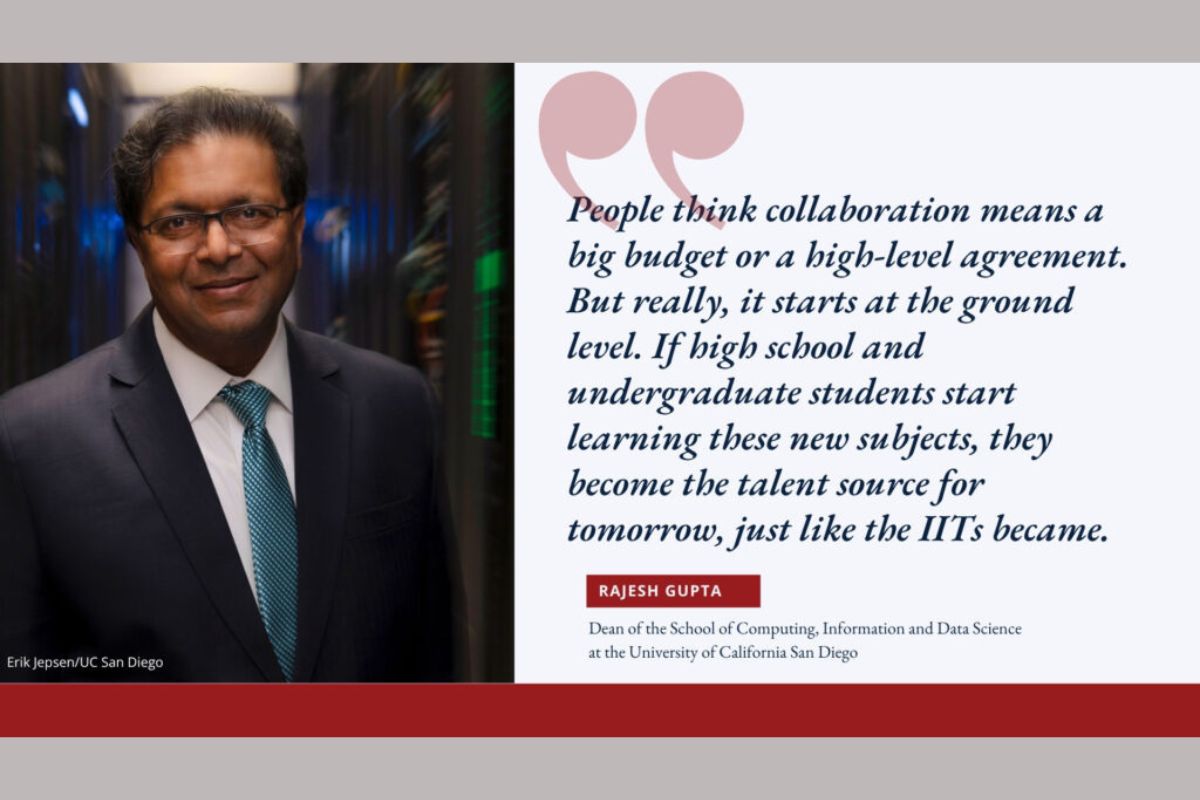
Building on this perspective, Rajeev Barua, professor of electrical and computer engineering at the University of Maryland , notes that collaboration is becoming more strategic and institutional. “The complementarity is clear: the U.S. contributes depth in frontier research and global product ecosystems, while India contributes exceptional talent at scale and diverse real-world deployment contexts,” he says. “The biggest shared opportunity is building reliable, safe, and cost-effective AI systems that can be adopted across sectors.”
Barua highlighted three key takeaways from the workshop: building shared research infrastructure to enable collaboration across institutions, using education as a force multiplier, and embedding AI principles like safety, security, and robustness from the outset rather than as an afterthought.
Building academic bridges
Education and talent development remain the foundation of long-term cooperation. Gupta draws on historical examples, pointing to the Indian Institute of Technology (IIT) Kanpur. “What the American government did was connect eight U.S. universities to help build IIT Kanpur. Those universities might never have known where Kanpur was, but they made the connections,” he says.
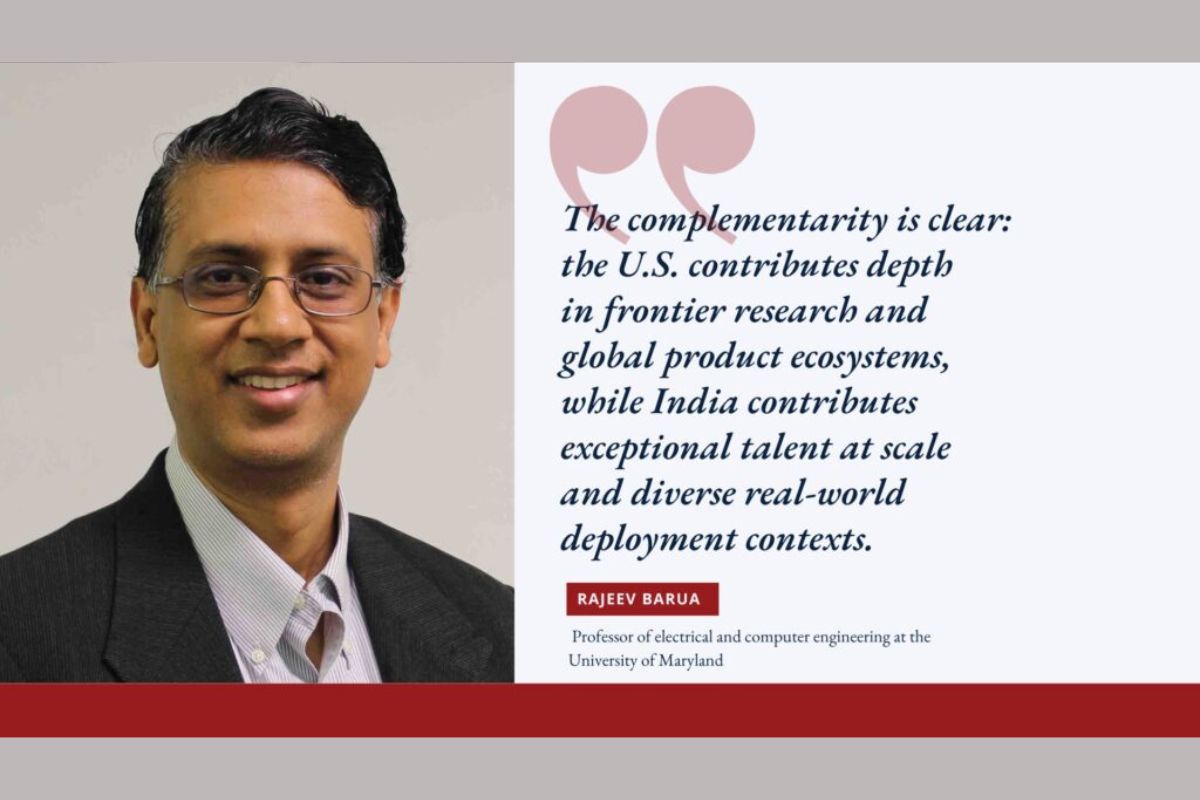
Today, emerging AI institutions in India could benefit from similar partnerships. “Several Indian institutes, including IIT Palakkad, IIT Ropar, and IIT Guwahati, now have schools focused on AI. Connecting these institutions with U.S. partners could accelerate collaboration,” Gupta notes. He adds that collaboration often begins at the grassroots level. “People think collaboration means a big budget or a high-level agreement. But really, it starts at the ground level,” he explains. “If high school and undergraduate students start learning these new subjects, they become the talent source for tomorrow, just like the IITs became.”
Barua highlights practical mechanisms to strengthen talent pipelines and collaboration. “Bilateral programs that support binational teams and emphasize translation to real-world impact are particularly effective,” he explains. “Successful collaborations share three traits. They have clearly defined goals, shared artifacts like code, data, or benchmarks, and sustained people-to-people connections through co-mentoring, visits, and recurring workshops.
Successful partnerships also benefit from the U.S. culture of intellectual freedom, where individuals can take on challenges regardless of age or degree, helping drive innovation across borders.
Shared research infrastructure
Both experts stress the importance of moving beyond conversations toward shared research platforms. “Move from conversations to shared collaboration infrastructure—common problem statements, benchmark datasets, and reproducible testbeds—so results travel across institutions,” Barua explains. Impact also accelerates when national agencies set “challenge agendas” in areas like health access, agriculture, and cybersecurity. These ensure research drives measurable benefits for communities while also boosting productivity and the economy. “The bridge from lab to citizen benefit requires entrepreneurship: more joint pilots, innovation sandboxes, and incentives for companies to co-develop and adopt research outputs,” says Barua. Stronger industry participation improves realism by providing data, constraints, and deployment feedback, helping ensure results become products and services rather than just papers.
Impact and potential
The rise of AI also raises questions about how society guides autonomous systems. Gupta observes that while traditional machines follow human instructions, AI systems increasingly make autonomous decisions, making governance frameworks essential. “Since machines do not naturally follow social rules, only physical laws, we must develop systems of governance that guide AI,” he says.
Gupta emphasizes that skills shaped by human experience, like communication, emotional intelligence, creativity, and craftsmanship, will remain valuable. Certain trade skills, including plumbing, carpentry, and physical craftsmanship, may also grow in importance because they rely on complex abilities that machines still struggle to replicate.
Rather than replacing jobs, AI is likely to enhance productivity. “AI will likely increase the productivity of software engineers. Instead of replacing them, it may enable them to do the work of several people and create entirely new products and services,” Gupta explains. He predicts the next wave of innovation will include highly personalized products spanning medicine to digital services.
Looking forward, Barua outlines three foundations for leadership in the coming decade: shared research infrastructure, shared standards for trustworthy AI, and strong talent pipelines. Gupta adds that while AI technology may currently score only three or four out of ten in maturity, its potential is vast. “The future is bright,” he says. “With thoughtful policy and collaboration, the opportunities ahead are immense.”
-By Giriraj Agarwal, SPAN Magazine, U.S. Embassy New Delhi
The above article was published in SPAN Magazine and is being reproduced here with their permission.