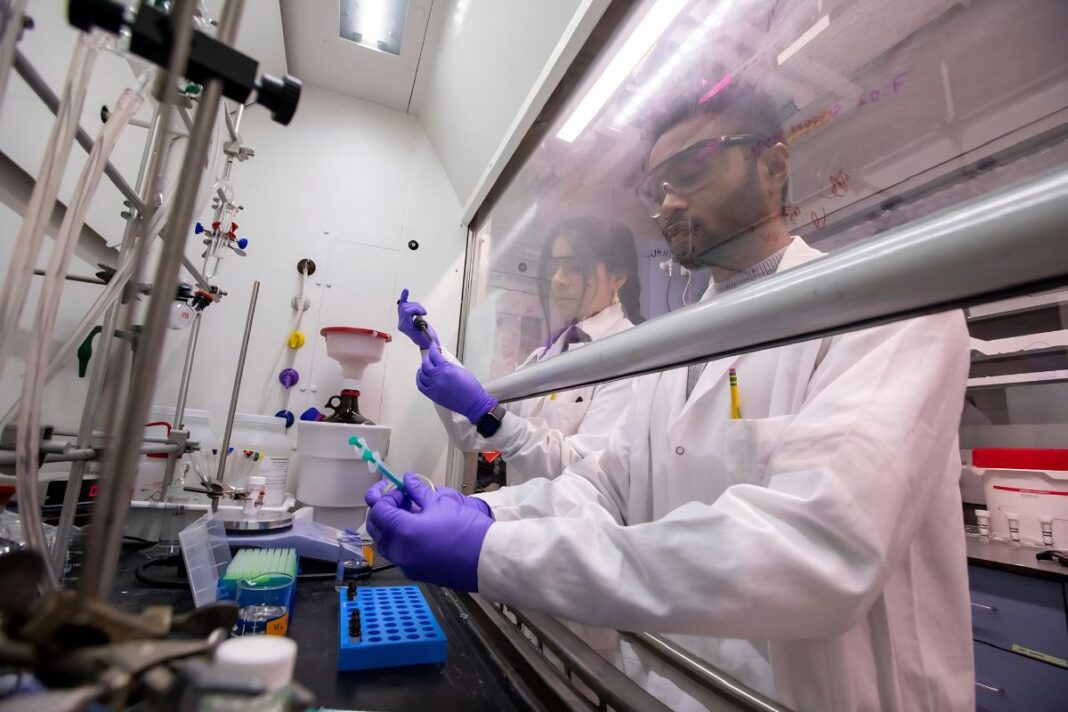

The IIT Kanpur-NYU Tandon School of Engineering partnership shows how joint research in emerging technologies is moving from lab to deployment while strengthening U.S.-India collaboration.
As universities deepen cooperation in advanced technologies, academic partnerships are increasingly focusing not only on shared research output but also on how effectively they translate ideas into deployable solutions.
The collaboration between the Indian Institute of Technology Kanpur (IITK) and New York University (NYU) Tandon School of Engineering reflects this shift, bringing together joint research across cybersecurity, biotechnology, artificial intelligence, robotics, and wireless communications.
“We launched seven joint research projects within the first year of the formal agreement, which is exceptionally fast for this kind of partnership,” says Juan de Pablo, Executive Dean of the NYU Tandon School of Engineering and Executive Vice President for Global Science and Technology. “The NYU Tandon-IITK Advanced Research Centre at IITK gives the collaboration a permanent home. And our doctoral dual-degree program is training researchers with genuine institutional ties on both sides.”
The collaboration began in 2016 when the NYU Tandon Cyber Security Awareness Week expanded to India, with IIT Kanpur hosting the competition. This initial engagement laid the foundation for a broader, multidomain research partnership, with a memorandum of understanding to engage in joint research on critical areas signed in 2023.
The sustained collaboration is built on complementary institutional strengths across talent, infrastructure, and research ecosystems.
“Partnerships like this work because both institutions bring something unique to the table,” says Professor Manindra Agrawal, director of IIT Kanpur. “In India, we have access to a vast pool of engineering talent, and recent developments in fields such as biotechnology, health care, and space technology have demonstrated that India leads in the development of low-cost solutions to global problems.” U.S. universities, on the other hand, have good research infrastructure and access to significant research funding. “This complementarity in strengths is what really makes the IITK-NYU partnership successful.”

De Pablo echoes this sentiment, noting that NYU brings globally recognized centers in cybersecurity and 6G wireless, plus a New York ecosystem that matters for commercialization, while IITK contributes a highly competitive faculty, student base, and experience operating at India’s scale.
From lab research to real world systems
This focus on complementary strengths is most visible in the range of technologies the partnership is advancing. A major area of the IITK-NYU collaboration focuses on secure authentication systems for supply chains and biomedical applications, particularly through physically unclonable materials and biochip technologies. Research teams have developed fingerprinting systems that generate unique material signatures for authentication.
These patterns are processed using machine learning models to enable high-accuracy identification under noisy conditions. This makes it possible to create highly secure, hard-to-replicate identification systems. These systems can help prevent counterfeiting in supply chains and ensure reliable authentication in sensitive biomedical applications.
According to Agrawal, the system achieves both precision and resilience. “These physical features are processed and authenticated using deep learning techniques, achieving 95.8 percent accuracy and demonstrating robustness against adversarial noise,” he explains.
Beyond secure systems, the collaboration extends into biomedical research, where the partnership explores therapeutic pathways. De Pablo describes the significance of this direction. “One, for example, is developing a specialized protein designed to cut off a key survival signal that allows cancer tumors to keep growing, offering a potential new pathway for cancer treatment,” he says.
The emphasis, he adds, is on immediacy of application rather than long-horizon theoretical exploration. “What I think is so important about this work is the real-world immediacy,” he says.
A similar applied focus extends to advanced engineering systems. A key area of collaboration involves wireless power transfer and the design of engineered surfaces that operate in the radio frequency range. Agrawal describes this as system-oriented engineering research. “The work was carried out by focusing electromagnetic waves using engineered surfaces to enable efficient wireless power transfer,” he says. This research is significant because the team is developing advanced antennas that use engineered surfaces to direct signals more efficiently in a specific direction. The approach holds strong potential for improving power transfer to millimeter-scale biomedical implants.
Driving deployment
A defining feature of the collaboration is its focus on translating research into deployable technologies and commercial applications.
De Pablo highlights several projects explicitly designed with commercialization in mind, including wireless electric vehicle charging systems that integrate advanced safety features. “All our joint projects reflect the same principle: research that is designed for real deployment from day one.”

He also points to early intellectual property outcomes emerging from the collaboration, particularly a biochip authentication technology, which has already resulted in a pending U.S. patent application.
Agrawal emphasizes that joint structures and funding mechanisms enable faster progress from research to application. “Researchers working together get access to major funding opportunities and advanced research facilities,” he says.
Advancing strategic technology partnerships
Both institutions frame the partnership as part of a broader convergence in U.S.-India collaboration in advanced technologies.
“The U.S. and India have many complementary strengths,” says Agrawal, adding that collaborations like these can bring together their unique capabilities for frontier research in critical and emerging technologies.
Moving forward, de Pablo says, there are multiple areas of research in which the NYU Tandon School of Engineering is making major investments. They include AI and robotics, quantum information sciences, chip design, materials science, systems engineering, and smart cities. “We are looking forward to extending the partnership with IIT Kanpur into these areas,” he says.
He adds that this collaboration reflects a broader structural balance between the two countries. “India has the engineering talent pool, the domestic scale, and increasingly the ambition to lead in these fields. The United States brings research infrastructure and global industry networks. Neither country or university has everything required on its own,” he says.
“When institutions from both countries build genuine working relationships, not just signed agreements, they develop technical capacity that is far more durable than any single research project.”
By Zahoor Hussain Bhat, SPAN Magazine, U.S. Embassy New Delhi
The above article was published in SPAN Magazine and is being reproduced here with their permission.
Also Read: Space Cooperation Moves to Commercial Action
You can connect with DNN24 on Facebook, Twitter, and Instagram and subscribe to our YouTube channel.