

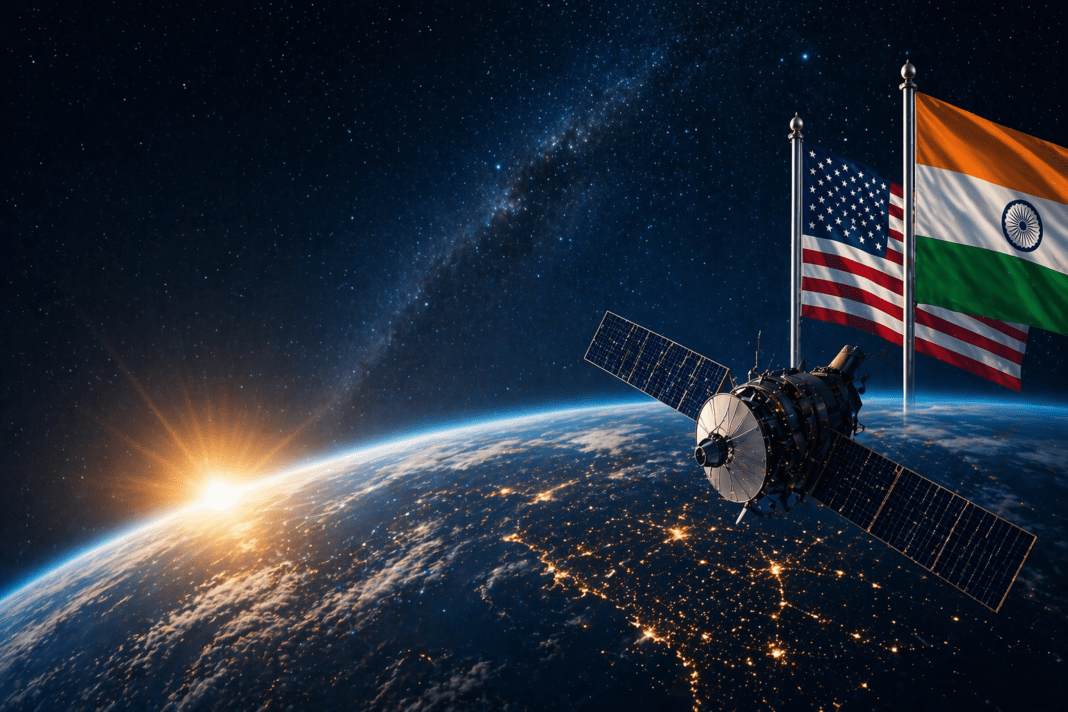

By connecting policymakers and industry leaders, the U.S.-India Space Business Forum advances commercial partnerships and opens new avenues for U.S. and Indian companies.
A new phase in U.S.-India space cooperation is taking shape, driven less by policy dialogue and more by private sector action. That shift was on display in Bengaluru, where policymakers, industry leaders, and entrepreneurs from both countries convened to advance commercial space collaboration. Hosted by the U.S. Consulate General Chennai with support from the U.S.-India Strategic Partnership Forum (USISPF) , the U.S.-India Space Business Forum in February 2026 brought together more than 200 government and industry participants from both countries, underscoring strong interest in expanding commercial linkages.
The forum also served as the flagship event of the first U.S. trade mission to India dedicated to the space sector, organized by the U.S. Department of Commerce and the Business Council for International Understanding, which brought 23 executives from 14 leading American space companies to India.

From alignment to action
The shift from strategic alignment to commercial execution is already visible to those working at the center of this engagement.
Rose Croshier , an international relations specialist at the National Oceanic and Atmospheric Administration Office of Space Commerce , sees the forum as a response to both policy momentum and rapid industry growth.
“Many factors prompted this forum, but two stand out,” Croshier says, pointing to “the rapid maturation of India’s private space ecosystem and the unprecedented strategic alignment between U.S. and Indian leadership.” She notes that India’s space start-up ecosystem, now numbering more than 400 companies, has achieved “hard milestones” in areas like suborbital launch and hyperspectral imaging. These developments, she says, have led the U.S. private sector to recognize India as an anchor partner.
Croshier places this progress within the broader TRUST initiative , which marks a transition “from decades of government-to-government cooperation to a productive commercial partnership.” If that framework provided the architecture, she adds, “this forum serves as the commercial catalyst, converting policy tailwinds into industry action and cross-border investment.”
Nivedita Mehra , managing director for India at the USISPF, says the U.S.-India space relationship has matured beyond policy dialogue and is now ready for execution. “A few years ago, much of this conversation happened in conference rooms and joint statements,” she says. “Today, we are seeing joint missions, shared platforms, and real commercial partnerships taking shape.”

Mehra adds that the forum served as “a catalyst for unlocking investment, scaling commercial engagement, and building supply chain integration that creates lasting economic value for both countries.”
Leveraging complementary strengths
Croshier describes this convergence as the emergence of “a new marketplace.” Citing remarks by U.S. Assistant Secretary of Commerce Taylor Jordan , she says, “We are no longer just two nations with parallel space programs; we are two ecosystems weaving together to define the global space economy.”
The United States offers advanced technologies, deep venture capital networks, and a mature commercial space infrastructure. India, she says, offers quality research, world-class frugal engineering, and a rapidly scaling manufacturing base. Initiatives like the Space Business Forum help bridge these strengths by creating opportunities for direct collaboration.
Croshier highlights the business-to-business matchmaking sessions, where executives from 14 U.S. companies engaged with India’s start-ups to discuss potential deals and joint ventures. “Engagement from the Indian government, particularly ISRO and IN-SPACe, was phenomenal,” she says, recalling discussions focused on building an “enabling environment” for space commerce.
Mehra offers a complementary view from the industry side, pointing to the “genuine sense of urgency and ambition on both sides.” She says U.S. companies came prepared to engage seriously with India’s expanding private space ecosystem, while Indian companies are increasingly export-ready and looking to integrate with global supply chains. She also notes strong convergence across key segments, including Earth observation, geospatial analytics, satellite manufacturing, and downstream applications.

From opportunity to execution
As engagement deepens, both Croshier and Mehra emphasize the need to align business strategy with regulatory frameworks.
Croshier encourages companies to act early. “Don’t wait for policy perfection; start building your relationships now,” she says. While acknowledging challenges such as intellectual property concerns and export control differences, she notes that both governments are increasingly responsive to industry needs.
“Companies that invest in building trust, quality, and compliance standards now will be best positioned to capture emerging opportunities,” Mehra says. She also highlights the role of sustained institutional engagement in supporting industry growth. Efforts such as the Civil Space Joint Working Group continue to advance bilateral dialogue, while frameworks like INDUS-X and COMPACT are expected to strengthen innovation linkages and support near-term commercial execution.
Shaping the future of the space economy
Looking ahead, the next phase of U.S.-India space cooperation will be defined by scale, integration, and measurable outcomes.
Croshier says meaningful progress will include “better integrated supply chains; aligned, well-understood, and predictable regulations; and shared in-space and on-Earth space infrastructure.” She adds that success will be evident when cross-border collaborations can move with the same speed and efficiency as domestic efforts.
Mehra emphasizes that the future of the global space economy will depend on alignment between governments and industry. “When governments and industry move in step, scale becomes possible,” she says.
From her perspective, progress will be measured through the depth of integration of Indian firms into global space supply chains and the operationalization of frameworks such as TRUST, COMPACT, and INDUS-X through tangible outcomes, including joint ventures, co-developed technologies, and shared infrastructure.
The U.S.-India Space Business Forum reflects more than a moment of convergence; it marks a shift in how the two countries engage in the space sector. As policy frameworks mature and industry linkages deepen, the focus is increasingly on speed, scale, and shared outcomes.
The real test, as both Croshier and Mehra suggest, lies in what follows—how quickly ideas translate into investment and engagement into operational projects. The momentum is no longer about possibility; it is about delivery.
By Zahoor Hussain Bhat, SPAN Magazine, U.S. Embassy New Delhi
The above article was published in SPAN Magazine and is being reproduced here with their permission.
Also Read: Operationalizing the U.S.-India Defense Partnership
You can connect with DNN24 on Facebook, Twitter, and Instagram and subscribe to our YouTube channel.