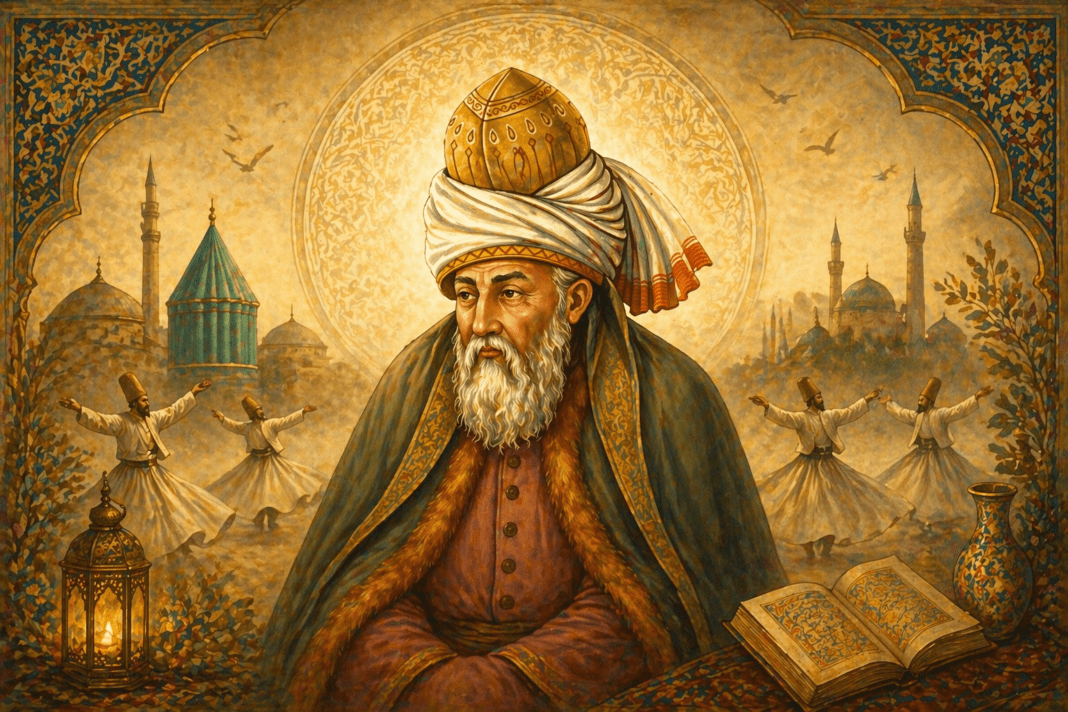

In the world of literature, certain names transcend their own works and become movements unto themselves. Jalaluddin Muhammad Rumi stands as one such figure. He was a Sufi mystic, a scholar, and above all, a bearer of divine love. His poetry contains affection, spirituality, and a path that connects humanity to the sacred.
Rumi was born on September 30, 1207, in Balkh, a renowned city in ancient Persia. His father, Bahauddin Walad, served as a prominent scholar and Sufi of his time. His knowledge and influence drew people from distant regions seeking counsel and religious guidance.
When Rumi was five or six years old, political disputes forced the family to abandon their homeland. This departure marked more than a change of cities. It initiated a spiritual journey that would shape his entire character.
Early Years and the Flight from Balkh
During their journey through Nishapur, the family encountered Fariduddin Attar, a celebrated Sufi saint. Attar observed the young boy and recognised something exceptional. He declared that this child would one day set the entire world aflame with divine love. These words were not mere praise. They proved prophetic decades later.
The family travelled through multiple cities before settling in Konya, a Turkish city that would become an inseparable part of Rumi’s identity. His father established a religious school there. After his father’s death, Rumi pursued knowledge with renewed determination.
The Scholar’s Path
He journeyed to Damascus and Aleppo to continue his education. His scholarly abilities grew so formidable that people began calling him “Sultan-ul-Ulema,” which translates as “Chief of Scholars.” He became a distinguished theologian. He guided people in matters of religion, issued legal opinions, and taught students. Yet his life still lacked the element that would transform him into the Rumi known across centuries.
He lived as a respected teacher and jurist. His days followed predictable patterns of study, prayer, and instruction. Students filled his classrooms. Colleagues sought his opinions on complex theological questions. But something remained dormant within him.
The Meeting That Changed Everything
The greatest turning point arrived when Rumi encountered Shams Tabrezi. Shams lived as a wandering Sufi mystic, fearless and indifferent to convention, absorbed entirely in spiritual matters. Shams awakened Rumi’s hidden passion. He taught that knowledge alone remained insufficient. The true path moved through love and direct experience rather than mere intellectual comprehension.
This encounter revolutionised Rumi’s existence. He began listening to his heart more than to his books. His poetry acquired a quality that continues to move people today. Where once he had written careful theological commentary, he now produced verses that seemed to dance across the page.
The transformation startled his students and colleagues. The measured scholar who had taught Quranic interpretation now spent days in Shams’ company, discussing mysteries that books could not resolve. Some disciples felt abandoned. Others grew jealous of the strange dervish who had captured their master’s attention.
Separation and Sorrow
This relationship could not endure. Shams’ growing importance provoked resentment among certain people. According to various accounts, circumstances deteriorated until Shams was either murdered or disappeared under mysterious conditions.
The event left Rumi shattered. He withdrew from society, plunged into grief, and pursued God with intensified fervour. This suffering deepened his poetry immeasurably. He began transforming his emotions into verse, and from this pain emerged his famous collection, the “Diwan-e-Shams.”
The grief never fully left. Yet it became the furnace in which his greatest work was forged. He wrote thousands of lines addressed to Shams, sometimes as if to a beloved companion, sometimes as if to God himself. The boundary between human and divine love blurred in these poems.
The Masnavi: A Spiritual Encyclopedia
Rumi’s most celebrated work remains the “Masnavi,” considered among the most important texts in Sufi literature. It contains approximately 26,000 verses divided into six volumes. The Masnavi extends beyond poetry into philosophical territory. Through stories, it instructs readers in several domains. It teaches how to approach divine love, avoid corruption, and embrace genuine humanity.
Rumi maintained that love formed the only path through which humans could comprehend the divine. Intellectual study had its place, but without the transformative power of devotion, knowledge remained hollow.
The work begins with the voice of a reed flute. This reed represents the human soul, separated from its source and crying out in longing. Rumi suggests that human existence consists fundamentally of this search, this yearning to reunite with the creator.
The stories within the Masnavi range from simple folk tales to complex theological discussions. A merchant loses his parrot. A king falls ill and seeks healing. A grammarian drowns because he valued rules over practical wisdom. Each narrative carries layers of meaning, revealing new insights with repeated reading.
The Whirling Dervishes
Rumi founded the Mevlevi Order, known today as the Whirling Dervishes. These practitioners worship through spinning movements. For them, this rotation represents far more than dance. It constitutes a spiritual connection, a moment when the individual self dissolves into the divine presence.
The ceremony follows precise protocols developed over centuries. Dervishes wear specific garments. They turn counterclockwise, one hand raised toward heaven, the other lowered toward earth. The movement symbolises receiving divine grace and transmitting it to the world. Music accompanies the ritual, typically including the reed flute whose voice opens the Masnavi. Observers often find themselves moved by the practice, even without understanding its theological foundations. The dancers achieve a state that appears both focused and abandoned, disciplined yet ecstatic.
Final Journey and Enduring Legacy
Rumi died on December 17, 1273, in Konya. His tomb remains a place of pilgrimage. Every year, people gather there to honour his memory and celebrate his teachings.
His poetry continues to reach readers worldwide. He ranks as the most widely read Persian poet, and his work has been translated into dozens of languages. Western readers discovered him relatively recently, but his influence has spread rapidly through translation and adaptation.
His verses appear in unexpected contexts. Wedding ceremonies quote his lines about love. Therapists reference his insights about human nature. Musicians set his words to contemporary melodies. This broad appeal stems from his ability to address universal experiences through specific spiritual language.
Rumi transcends the category of poet. He represents a particular approach to existence, one that prioritises love over doctrine, experience over abstraction, and unity over division. His philosophy suggests that beneath differences on the surface, humanity shares fundamental longing and capacities. His words provide comfort to readers confronting loss, confusion, or spiritual emptiness. The medieval Persian context fades away, and what remains speaks directly to contemporary struggles. This timelessness marks his greatest achievement.
The world remembers him not merely as a scholar or mystic, but as someone who articulated the deepest human yearnings with extraordinary clarity and beauty. His message persists because it addresses needs that remain constant across centuries and cultures.
Also Read: Zubair Ali Tabish: A journey of love-filled poetry from a simple poet
You can connect with DNN24 on Facebook, Twitter, and Instagramand subscribe to our YouTubechannel