
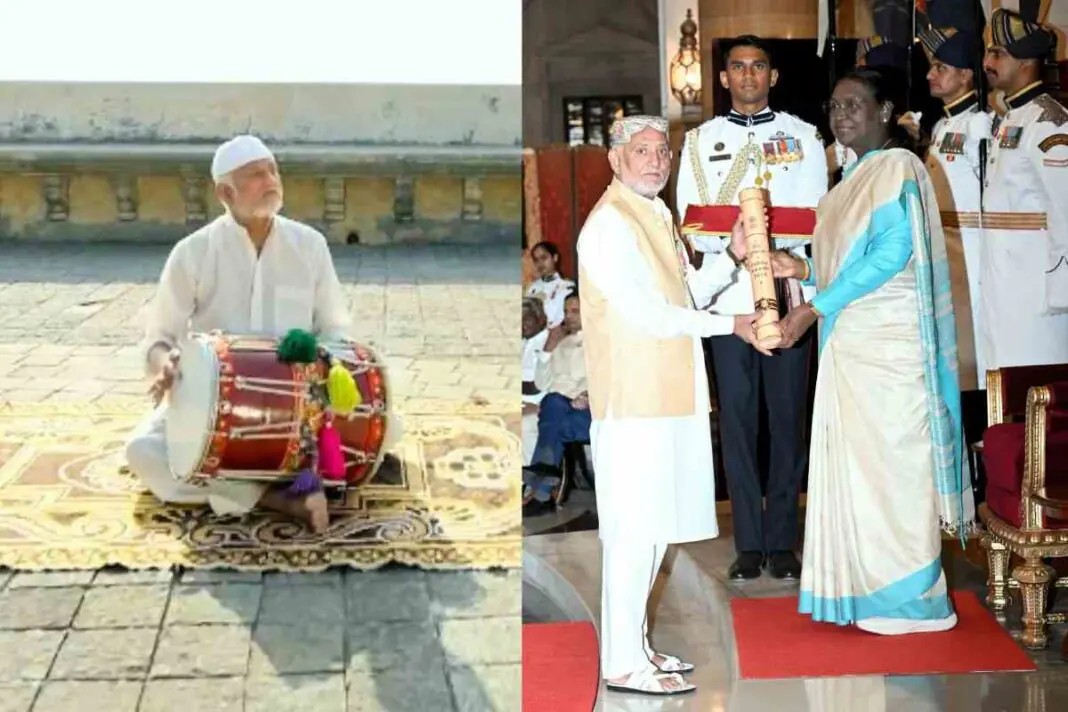

Mir Haji Kasam, popularly known as “Haji Ramakdu”, is not known through television fame, corporate sponsorships, or viral recordings. He is known in village squares and festival grounds where he has quietly put in fifty years of steady, unannounced work. His charity drives, where the audience came for a cause rather than a celebrity, got him the Padma Shri award for 2026.
Born in Junagadh, Gujarat, into a household where music paid the rent, Kasam grew up watching his father play the dholak at local events. The family belonged to the Mir community, a group with deep roots in Gujarat’s folk performance traditions. His mother died when he was young. He grew up amidst practice schedules, the routine of attending performances, and the particular discipline of learning an instrument by watching someone else play it daily. Kasam did not attend a music school, he sat beside his father and copied strokes until his fingers acquired a rhythm of their own.
The dholak occupied him thoroughly. He practised for hours without instruction, working out the subtle variations in pressure and palm placement that produce different tones from the same skin. Those sessions were the kind of repetitive, unglamorous work that most people quietly abandon. Kasam did not abandon it.
Hotels by Day, Stages by Night
As a young man, Kasam supported himself by working at a hotel while accompanying his father to bhajan, qawwali, and folk programmes in the evenings. That double life was less a burden and more a structure. It gave him the material security to keep performing without desperation, and it gave his music a grounding in ordinary life that would later inform his style.
The festival circuit in Gujarat, especially Navaratri, provided him his early stage. He played alongside local performers, including noted folk singer Diwali Ben, and those appearances gradually embedded him into the region’s performing community. Audiences began to notice the dholak not merely as background rhythm but as a voice of its own.
The Night Pranlal Vyas Said He Was Better
Then came the event that changed the direction of Kasam’s career. His father had been scheduled to play at a programme featuring Pranlal Vyas, one of the most prominent names in Gujarati folk music. BUt he was unable to attend, so Kasam filled in. His dholak playing drew attention in a way that playing for support rarely does. Vyas, by various accounts, told Kasam’s father that his son had moved two steps beyond him. That comment was both a compliment and an invitation.
The collaboration between Kasam and Vyas lasted roughly fifty years. Over that half-century, Kasam learned to accompany devotional bhajans, ghazals, and the ecstatic rhythms of qawwali with equal confidence. More importantly, he learned to make the dholak feel like a participant in the music rather than an accompaniment.
What He Did With the Dholak
Kasam’s distinctiveness as a player lay in treating the dholak as an expressive instrument rather than a timekeeping device. He experimented continuously with how small adjustments in stroke angle and palm pressure could yield a wider range of tones than most players extracted. The result was a sound with texture and personality, something audiences could follow the way they followed a melody.
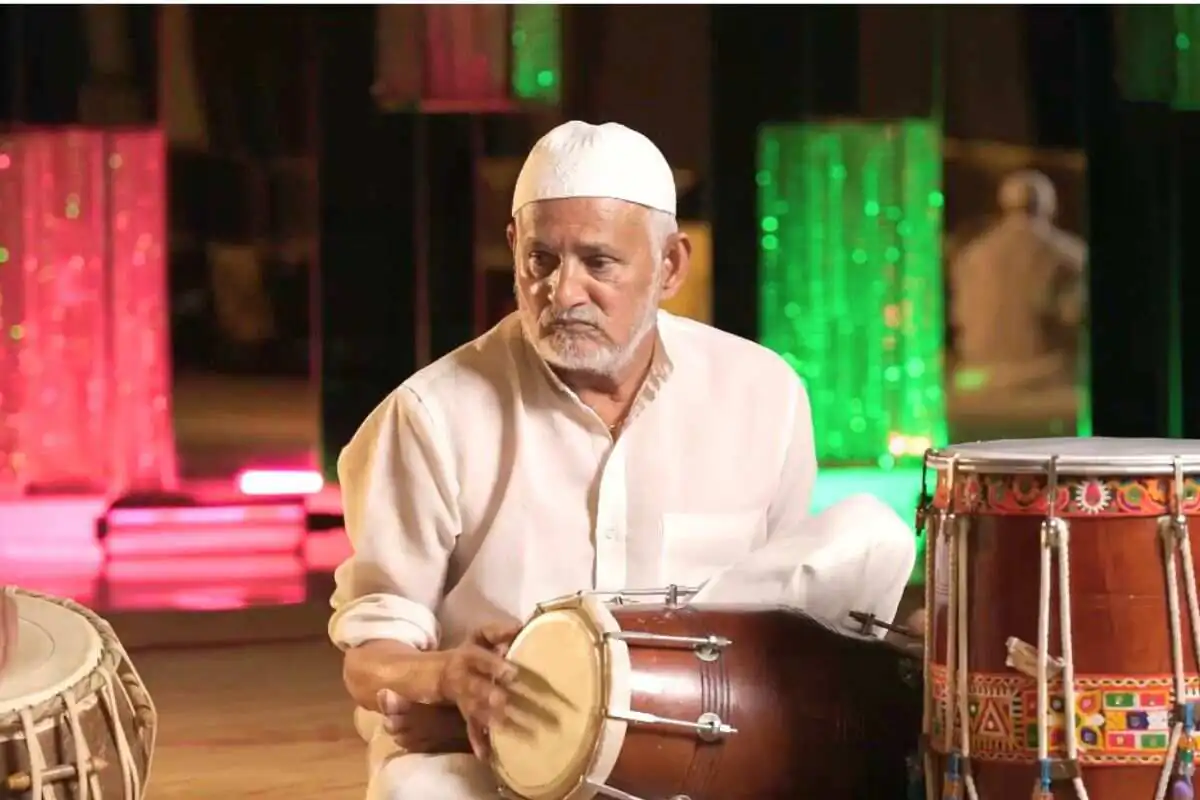
He spoke about this without technical vocabulary. He described the instrument as something he treated like a toy, something he could coax into voices. That language is not false modesty. It reflects a player who developed his technique through curiosity rather than formal method, and, therefore, kept a certain playfulness alive in his playing that technical rigour sometimes extinguishes.
“I never learned to speak much,” he said of himself. “My dholak speaks.” That one line covers most of what needs to be said about his approach to his craft and public life alike.
Thirty Thousand Shows for Cattle
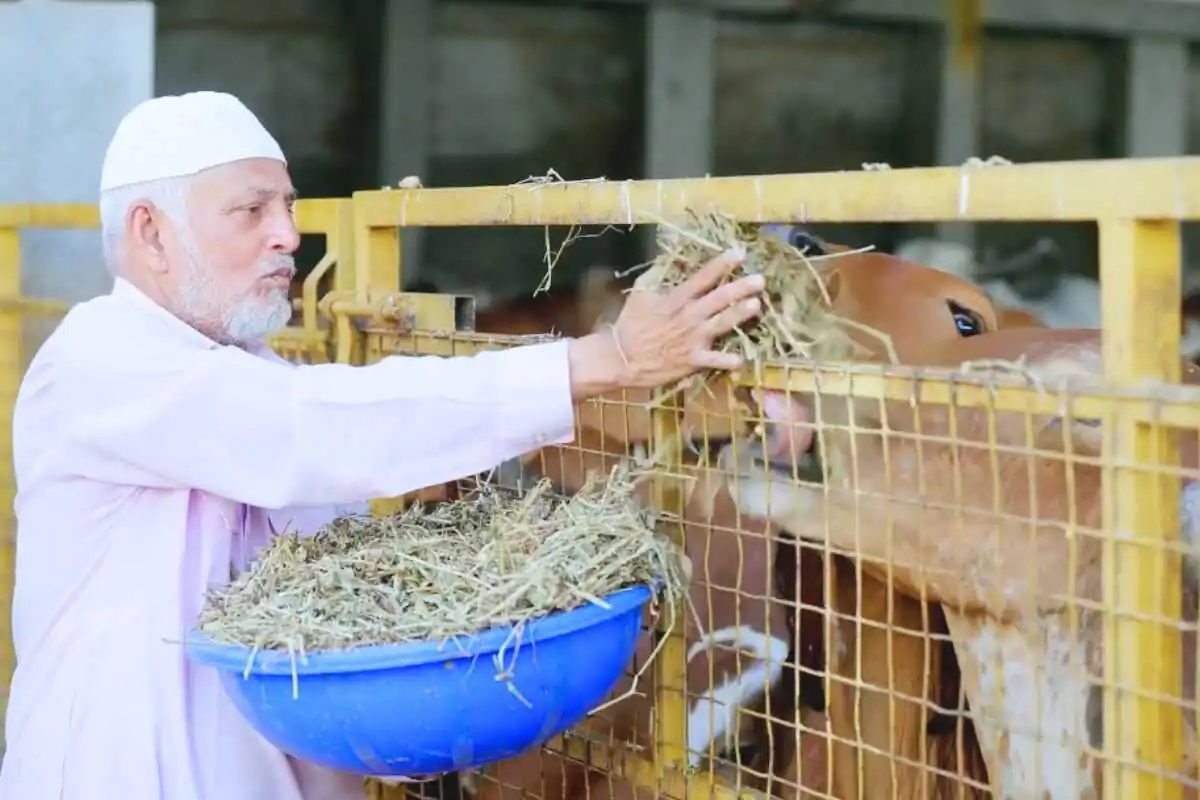
Any account of Kasam’s career that stays within the borders of musical craft misses the more unusual chapter. During a severe drought across parts of Gujarat, he decided to use performance as a vehicle for relief work. He organised and performed at charity programmes to raise funds for gaushalas, the shelters that house cattle, and to purchase fodder during the shortage.
He did this not once or twice but, by his own count, approximately thirty thousand times over the course of his career. He walked from village to village and town to town. He played at programmes where the ticket money went toward feed and shelter for animals, not toward the performer. Communities rallied around him because he was credible. He was known. He showed up, and he played, and the funds were raised and directed to practical use.
This chapter of his life is not a footnote to the music. It is part of the music, in a different register. For Kasam, performance was never purely aesthetic. It was a form of community participation that had sustained him. The thirty thousand shows are the clearest expression of that belief.
The Padma Shri at the End of a Long Road
Folk musicians in India occupy a complicated position. Their traditions are cited in cultural policy documents and celebrated in institutional speeches. The individual practitioners, however, often live at the margins of recognition until a belated honour arrives. Kasam’s Padma Shri belongs to that pattern.
He received it without apparent ceremony. Those who know him describe a man who does not court attention, whose stage presence is quiet and focused rather than theatrical, and who has consistently measured his career against the services he rendered rather than the honours he accumulated. Younger musicians speak of him as a teacher who instructs through example, a player who persevered and adapted rhythmic forms without drawing attention to the effort.
What His Career Demonstrates
Kasam’s life records three noteworthy things. First, that accompaniment is a form of artistic leadership, not a subordinate role. His dholak did not simply support singers; it shaped how audiences heard them. Second, that modesty in a public performer is not the absence of personality but a particular expression of it. His restraint was a choice with its own consequences. Third, art and social service are not competing priorities. His charity work did not diminish his music. It gave it a public purpose that most performers are never able to find.
The photographs of him on stage show a man bent over his instrument, face composed, fingers at work. Nothing in the image asks for attention. Everything in it commands it.
A Tradition That Survives Through People
Gujarat’s folk music is not at risk of disappearing in the near term. However, what sustains a living tradition is not documentation. It is practitioners who understand the music, who carry its feel in their hands and its purpose in their working lives. Kasam has been that kind of practitioner for more than five decades, during which he has used his art for the public good.
Also Read:Padma Shri Awardee Devaki Amma: The Woman Who Grew Forests
You can connect with DNN24 on Facebook, Twitter, and Instagram and subscribe to our YouTube channel.