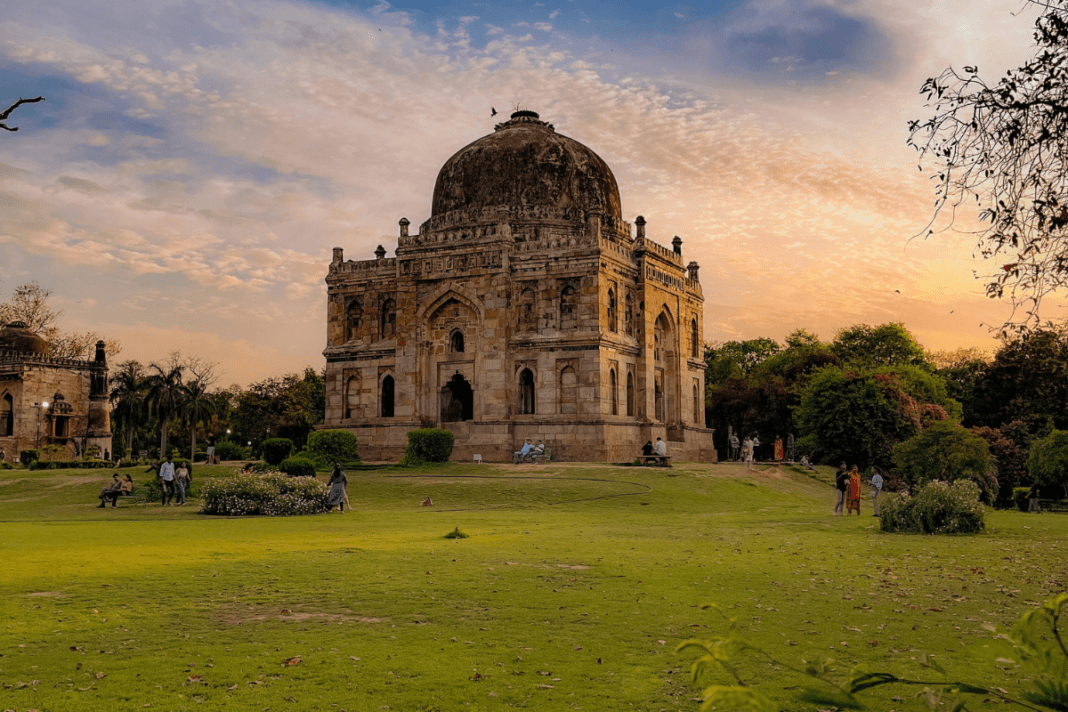



It was called Shahjahanabad once- the pride of empires. Even today, Delhi carries the reflection of every era within its folds. Delhi is not just a city, but memories collected over centuries. In its lanes, history lives, in its buildings, culture breathes, and in the lives of its people exists a shared heritage. It is this Delhi that Sohail Hashmi offers a glimpse into when he takes people on his famous walks. People call him an “oral historian,” but he considers himself simply “a Delhi man.”
Childhood, education, and a bond with Delhi
Sohail Hashmi’s early education began at an experimental nursery school of Delhi University’s Central Institute of Education. Thereafter, he spent a few years in Aligarh. After completing higher secondary education, he did his Bachelor’s from Kirori Mal College and later studied geography at Jawaharlal Nehru University (JNU). Interestingly, despite having a deep interest in history, he never studied it as a subject formally. He says, “The label of historian was given by people, I never claimed it.”
The beginning of “Discover Delhi Walks”
It all began with children. Hashmi used to run a creative activity center in Delhi. Talking to the children, he realized that they lived in Delhi, yet did not know their city. Their Delhi was limited to the world between their school and their home.
Thus was laid the foundation of “Discover Delhi Walks.” Hashmi took the children on walks to reserved forests, the Rail Museum, the National Museum, and old ruins. The children wanted more- “Show us more of this Delhi.” Then, slowly, adults started joining in. Hashmi’s knowledge and passion made these walks popular.
According to Hashmi, the biggest transformation of Delhi came in 1947. Partition changed the face of the city. People were displaced, new settlements came up, accents changed and so did the food habits. He says, “1947 was not just political independence, it was the rebirth of Delhi’s identity.” Shahjahanabad, which was built for one and a half to two lakh people, today carries the burden of wholesale markets. Mansions have turned into warehouses. If this city is to be truly saved, he says, commerce must be shifted outside the city limits.
Delhi as a mirror of “Ganga-Jamuni culture”
Delhi is often called a mirror of the “Ganga-Jamuni culture.” Hashmi considers this phrase romantic. According to him, culture is not formed by the names of two rivers. It is formed by everyday shared living, by the relationships of artisans, weavers, goldsmiths, and laborers. “Culture is never pure. If it is pure, it is dead.”
The city in poetry
The names of Mirza Ghalib, Mir Taqi Mir, and Faiz Ahmed Faiz, are intangibly linked with Delhi. The devastation of the revolt of 1857 is reflected in Ghalib’s verses, but in Mir’s work, the destruction and survival of the city become a lived experience. Hashmi says, “A poet carries the soul of his city with him.”
Were minarets always part of mosques?
It is not correct to limit structures like the Red Fort, Jama Masjid, and Qutub Minar by calling them “Muslim architecture,” feels Hashmi. According to him, architecture is shaped by climate, materials, and technique, not religion. In the old mosques of Kashmir and Kerala, there are neither domes nor minarets because in Kashmir heavy snowfall requires conical roofs. Before the time of Shah Jahan, no mosque in Delhi had a minaret.
Myth and reality
Hashmi believes popular tales like “Jodhabai’s kitchen” or “the hands of the Taj Mahal’s artisans were cut off” satisfy imagination more than history. He urges people, “Do not accept everything as truth in the name of tradition, ask questions.” On being asked, “What does Delhi mean to you?” he says without any hesitation: “My city.”
In these two words, lies his entire thought and philosophy. For him, Delhi is not a claim, a debate, or a slogan; it is a lived experience. It is a place where culture does not settle into a single color and language is not confined to one alphabet. Everything here is formed together from needs, from the warmth of relationships, and from the heat of struggles.
Perhaps this is Delhi’s real identity. Cracks appeared, times changed, faces changed, but the soul of the city gave space to every era’s voice within its folds. Centuries of memories, pains, dreams, and stories still echo in its air. Delhi is not just a place, but a continuum that will live forever.
Also Read: A Memorable Meeting with The Famous Historian Professor Irfan Habib
You can connect with DNN24 on Facebook, Twitter, and Instagram and subscribe to our YouTube channel.