
The recent visit by UAE President Sheikh Mohammed Bin Zayed Al Nahyan signalled the transition of the India-UAE relationship into a comprehensive strategic alliance reflected in the myriad agreements signed across various sectors. This development seems organic given that UAE is home to a vast Indian diaspora that is not only socially embedded but also a critical contributor to the economy of the Gulf country. Shivani Rawat analyses the outcomes of the visit.
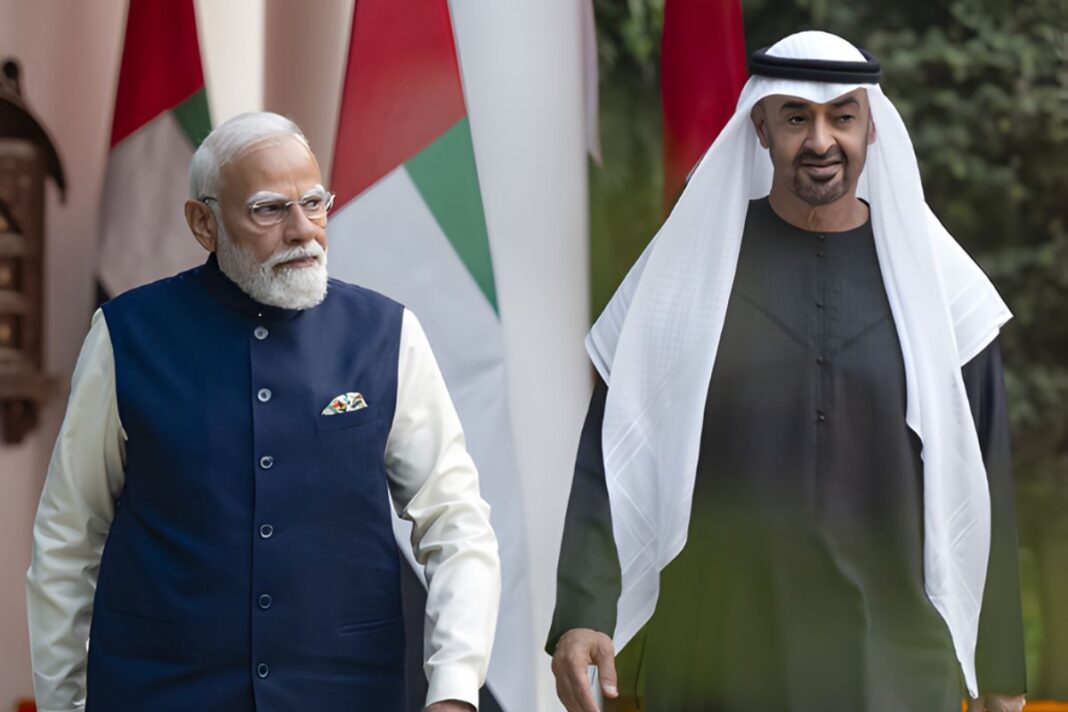
The visit was short but sweet. President of the United Arab Emirates Sheikh Mohammed Bin Zayed Al Nahyan spent barely three hours in the national capital New Delhi. But his brief visit, accompanied by a high-level delegation, led to a flurry of agreements marking the closeness of ties between the two nations. Coming at a time of geopolitical shift in the Middle East and growing global economic uncertainty, the visit underlines the evolution of India-UAE ties from transactional engagement to long-term strategic alignment.
From being received at the airport by Prime Minister Narendra Modi personally to being accompanied to the PM’s residence in his official car, the visit had all the optics of two close friends catching up with each other. The smiling picture of the two leaders seated on a wooden swing underlined the warm, personal friendship shared by the two leaders. This was the third visit by Sheikh Mohammed in four years since becoming UAE President.
The latest visit marks the maturing of defence ties between India and the UAE. The two sides signed a letter of intent to work towards a strategic defense partnership that includes joint defence production, counter-terrorism cooperation and training between the Special Forces of the two countries. This builds upon the recent high-level visits as well as joint exercises by the defence forces of the two nations.
Reflecting the high level of trust between the nations, talks are on to work out a regulatory framework for a digital embassy in each other’s territory. It is a new, interesting concept that seeks to create a safe harbour for digital data of national importance and strategic value with the aim of ensuring digital continuity and sovereignty in the face of cyberattacks, natural disasters, or geopolitical conflict.
It allows governments to maintain essential services even if physical access to crucial databases is cut off, by providing backups in a friendly country. Such a framework would also complement India’s growing reputation as a provider of trusted Digital Public Infrastructure (DPI) and the UAE’s ambition to emerge as a global hub for cybersecurity.
India and UAE are also looking at a joint initiative for developing space infrastructure that would include setting up new launch complexes, satellite fabrication facilities, joint missions, space academy, and training centers. These initiatives will have strategic implications for climate monitoring, disaster management and secure communications.
The UAE has always been a premier energy partner for India. During the latest visit, the two sides also signed a long-term agreement providing for the purchase of 0.5 million metric tons per annum of LNG by HPCL from ADNOC Gas over a period of 10 years starting from 2028. With this, the UAE is now the second largest supplier of LNG to India.
Buoyed by the Comprehensive Economic Partnership Agreement (CEPA), the India-UAE bilateral trade has crossed a hundred billion dollars, making UAE India’s third largest trading partner after China and US. With the US slapping steep tariffs on Indian goods, this visit provided India a chance to expand trade with other partners. Since the signing of CEPA in 2022, non-oil trade between India and the UAE has grown at a rapid pace, particularly in sectors such as gems and jewellery, pharmaceuticals, food processing, and logistics. The two leaders have now set a target to double the trade to 200 billion dollars by 2032.
UAE is home to about 4.5 million Indians today. The annual remittances made by the large Indian community there are one of the highest in the world. The Indian diaspora has emerged as a key pillar of the relationship, contributing across sectors from construction and healthcare to finance and technology. Steps such as the interlinking of national payment platforms, the launch of UPI in the UAE, and the integration of India’s RuPay card with UAE’s Jaywan card will play a further role in strengthening people-to-people ties.
Reflecting a deep interest in Indian culture, Abu Dhabi has decided to set up a state-of-the-art museum -House of India- that will reflect India’s ancient cultural heritage. Together with initiatives such as interfaith institutions and cultural landmarks, this underscores the UAE’s broader effort to institutionalise cultural pluralism and soft power engagement with India.
Yet beneath these tangible deliverables lies a quieter, less explicit dimension of strategic value: Muslim outreach. Without deploying the language of religious diplomacy, the India–UAE relationship has emerged as an important conduit through which New Delhi engages the Islamic world-both externally and domestically. New Delhi’s engagement is no longer mediated by regional rivalry but grounded in direct economic, strategic, and people-to-people links. Strong ties with the UAE enable Indian policymakers to argue that engagement with Muslim-majority countries is compatible with India’s national priorities.
By rooting its engagement with the UAE in concrete deliverables and sustained trust, India has crafted a form of Muslim outreach that does not rely on symbolism alone. In an era of fractured geopolitics and sharpened identity politics, the India- UAE relationship stands out as a reminder that quiet diplomacy- grounded in shared interests and people-to-people bonds- can often be the most enduring form of outreach.
Disclaimer: The views expressed in this article belong solely to the author and do not reflect the views or opinions of DNN24 or any affiliated organization.
Also Read: From Iron Will to Living Spirit: How Sardar Vallabhbhai Patel’s Dream Still Shapes Modern India
You can connect with DNN24 on Facebook, Twitter, and Instagram and subscribe to our YouTube channel.