

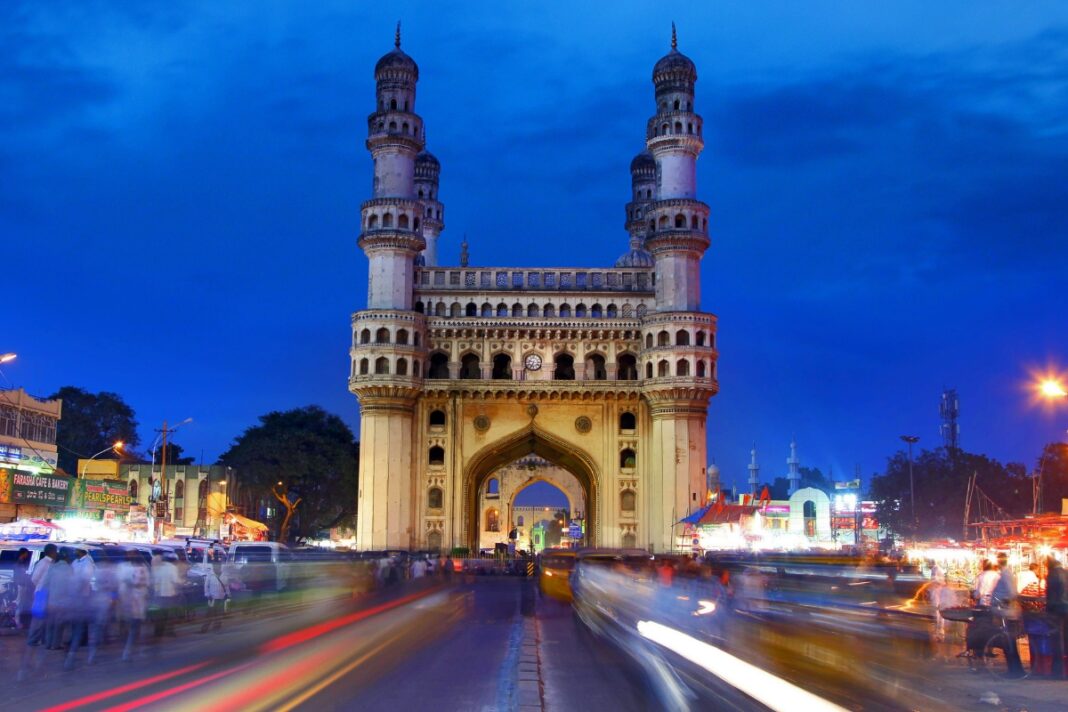

In 1591, a Sultan stood amid a half-finished structure east of Golconda Fort and recited a prayer in Dakhini Urdu. He asked God to fill his new city with people, as a river is filled with fish. Then his builders set to work. What rose from that ground was not only a mosque or a gateway. It was a blueprint, a declaration, and an act of faith pressed into granite and lime- The Charminar.
A Building Born From Catastrophe
Sultan Muhammad Quli Qutb Shah, the fifth ruler of the Qutb Shahi dynasty, did not choose this location by chance. The old capital at Golconda Fort had grown crowded, and a severe plague had ravaged the surrounding population. According to some accounts, the Sultan vowed to build a mosque if the epidemic passed. Other accounts say he chose the site because that was where he first saw his future wife, Bhagmati. Both versions may carry truth. Monuments that endure tend to gather meaning the way rivers gather silt.
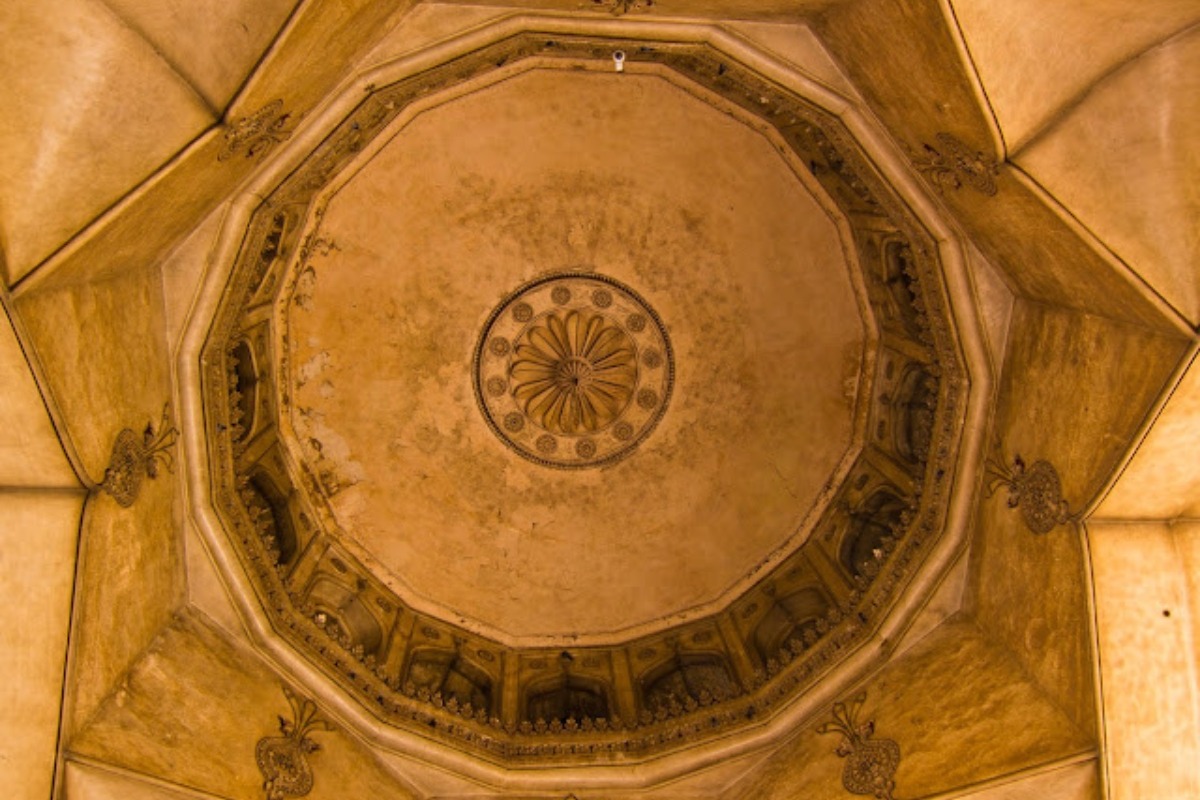
Construction began in 1589 under the supervision of Iranian architect Mir Momin Astarabadi. It was completed in two years at a cost of roughly nine lakh rupees, equivalent at the time to two lakh gold huns. The foundations were driven at least thirty feet into the earth. The total structure weighs approximately 14,000 tonnes. This was not a ceremonial gesture. It was a permanent claim on the landscape.
The Architecture Examined
The Charminar is a square structure, each side measuring twenty metres, built in the Indo-Islamic style that characterised the Qutb Shahi period. The term “Indo-Islamic” is commonly used but deserves closer scrutiny. At the Charminar, Islamic geometric planning and Persian decorative methods were applied to a building constructed by Indian craftsmen using local materials, specifically granite, limestone, and pulverised marble, bound together with lime mortar.
Four arches, each eleven metres wide, face the cardinal directions. Above them rise four minarets, each fifty-six metres tall, with fluted shafts, double balconies, and domed tops finished in petal-shaped ornament. The stucco floral work on the outer walls draws from Safavid Persian tradition. The balustrades and certain decorative motifs on the balconies reflect Indian building conventions. This combination was deliberate and characteristic of the Deccani courts of the 16th century, which simultaneously drew skilled workers and ideas from Persia, Central Asia, and the Indian interior.
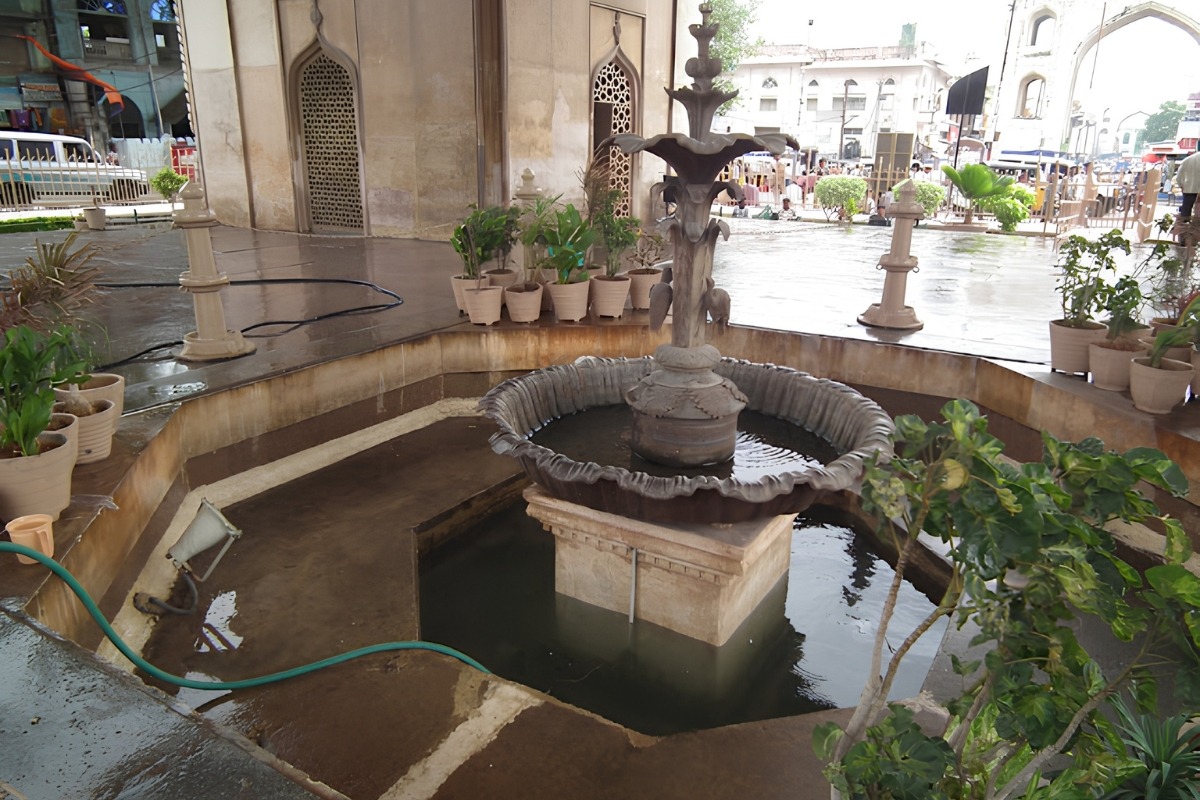
Inside, 149 steps wind upward to a mosque on the top floor with forty-five prayer spaces and a central fountain for ritual washing. In 1889, the Sixth Nizam, Mir Mahbub Ali Khan, installed clocks on the four arches. They remain there till date.
The building’s form also pays homage to the Shia taziya, the ornate temporary structures built during Muharram to honour Imam Hussain’s martyrdom at Karbala. Many scholars believe the four minarets represent Islam’s first four caliphs. This layering of meanings, Persian aesthetics, Indian craft traditions, Shia commemorative forms, and Sunni dynastic symbolism is what makes the Charminar genuinely unusual in its architecture.
How One Building Planned a City
What is less often discussed in the specialist literature is that the Charminar was not placed at the centre of Hyderabad when the city was built. The city was built around the Charminar because of its location. Mir Momin Astarabadi, who served as the Sultan’s prime minister and the project’s architect, positioned the structure at the intersection of the principal trade routes connecting Golconda Fort to the port at Machilipatnam on the eastern coast.
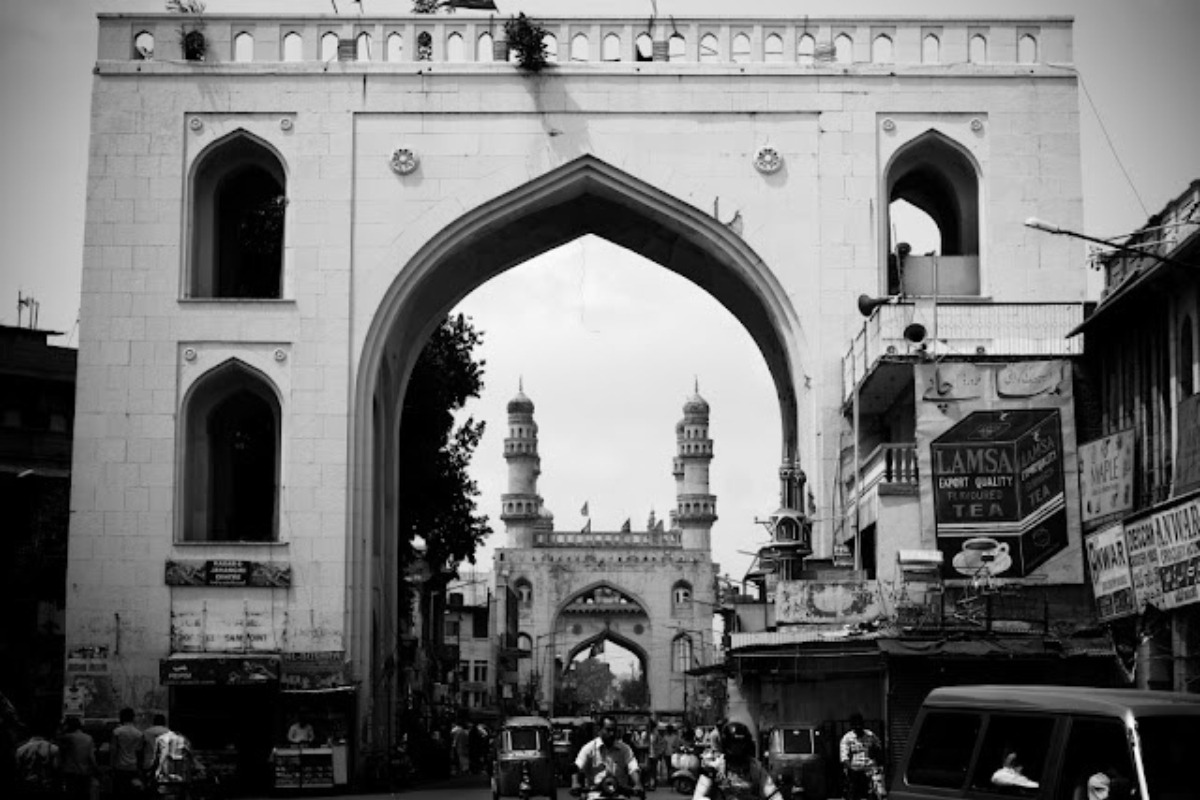
Four gateway arches called the Char Kaman were erected to mark the northern, southern, eastern, and western approaches. The city then grew outward from this fixed point in four quadrants, each developed for a distinct purpose. Markets, residential quarters, and mosques were distributed across these zones in a pattern that historian Mohammed Safiullah describes as making the Charminar “the epicentre of the new city.”
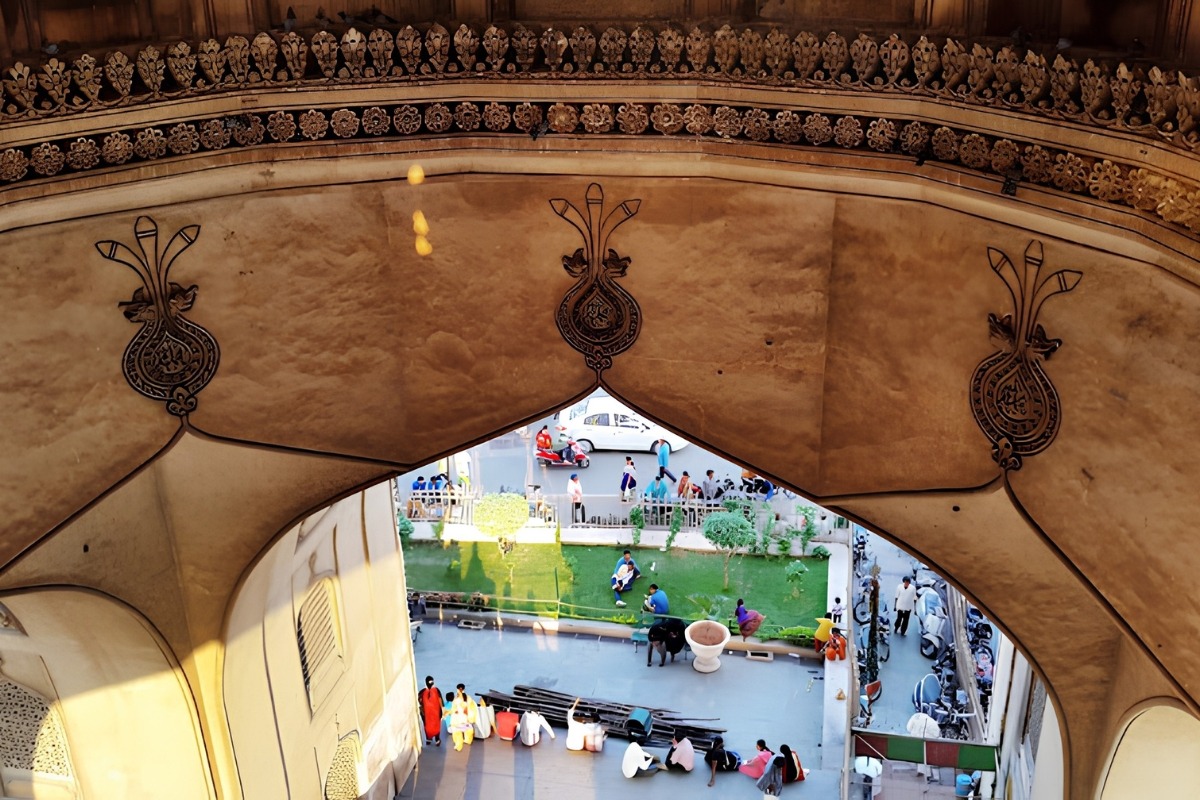
The bazaars that grew in the surrounding streets, among them Laad Bazaar, which has traded in bangles and pearls for well over three hundred years, were not organic additions. They were part of the original urban conception. The Charminar’s arches were designed to frame views of these commercial and residential streets, anchoring the building visually within the city’s life rather than setting it apart.
That urban logic has proved durable. The Charminar Pedestrianisation Project, which has been debated and partially implemented since the 1990s, works on the same premise: that the monument’s immediate surroundings must be managed as a coherent zone rather than a traffic corridor. The project establishes a pedestrian area within roughly 800 metres of the structure, redirects vehicles to widened ring roads, and attempts to relocate street vendors to designated spaces. Progress has been uneven. Full ring-road completion remains outstanding, and peak-hour congestion on the diverted routes continues. The underlying principle, however, that the Charminar functions as an urban core requiring coordinated planning rather than piecemeal repairs, was established on the day the Sultan’s builders drove the first foundation posts into the earth.
What the Records Say
The Archaeological Survey of India maintains the Charminar was built to mark the end of the plague and to serve as the physical and symbolic centre of Hyderabad. French traveller Jean de Thévenot, who visited in the 17th century, noted that local accounts connected the structure’s construction to the second Islamic millennium, 1000 AH, which fell in 1591 or 1592, depending on the calendar used. Persian texts from the period support this interpretation. Both purposes- plague memorial and millennial marker- are consistent with the Sultan’s known practice of embedding religious significance into civic buildings.
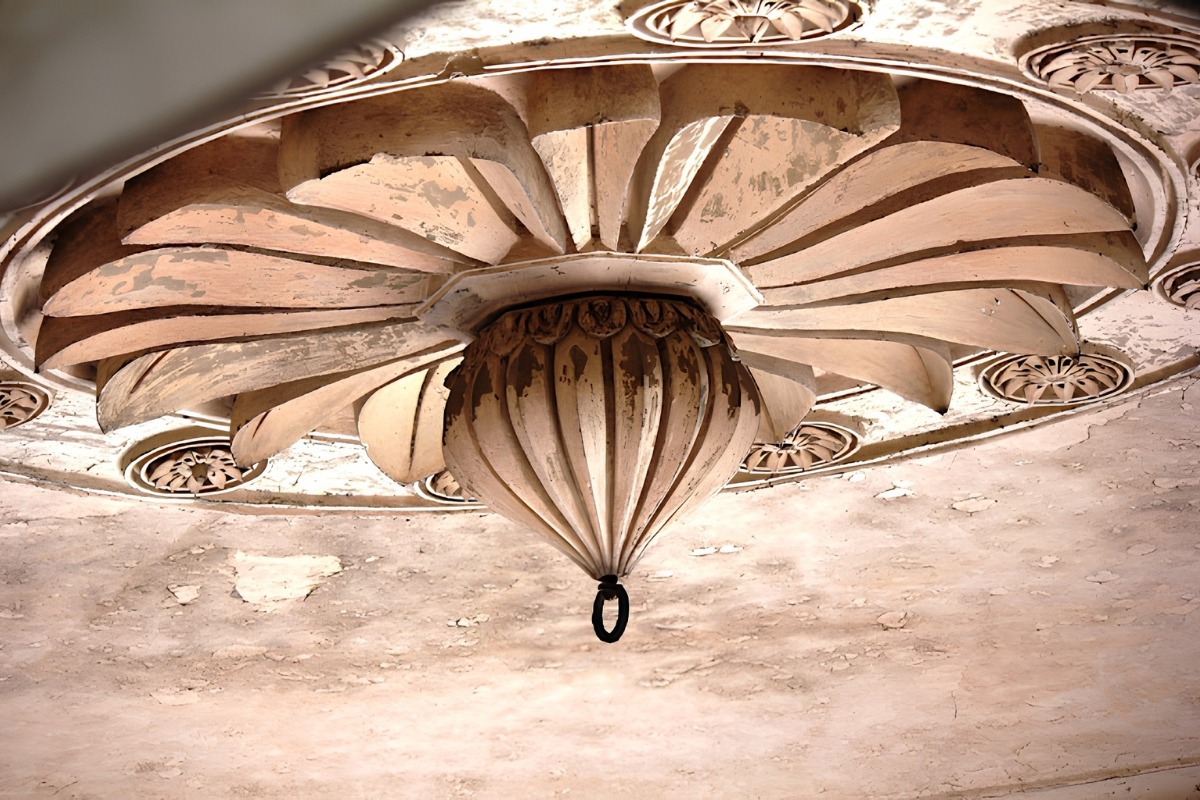
The Sultan’s own Dakhini Urdu poetry, portions of which survive, reflects a ruler who understood architecture as prayer given a form. That sensibility shaped how the building was received. Under Mughal rule, the Charminar was regarded by some as the equal of the Taj Mahal. The Nizams, who administered Hyderabad from the 18th century onward, funded repeated repairs, most notably in 1820. A lightning strike in 1670 damaged one of the minarets, which was repaired without altering its original form.
Why the Charminar Holds Its Ground
The Charminar appears on Telangana’s official emblem. The Charminar Express, a long-distance rail service, is named after the landmark. Replicas of the structure have been built in Karachi. It has been reproduced in chocolate. Sarojini Naidu wrote about its surrounding bazaars in verse that is still read. The adjacent Makkah Masjid, one of the largest mosques in India, makes the entire quarter a centre of religious observance, particularly during Eid.
A carved image of a cat’s head on one of the eastern arches is pointed out by local guides as a symbol of the building’s plague origins: cats were credited with controlling the rat population that spread disease. Whether the carving was intentional as a symbol or became one through later interpretation, nobody can say with certainty. The story persists because it fits. Buildings that last long enough become repositories for the stories a city needs to tell about itself.
The Sultan’s prayer at the foundation ceremony asked for abundance and for people. Four hundred years on, the streets around the Charminar remain among the most densely populated and commercially active in southern India. By that measure alone, the prayer was answered.
Also Read:Palace on Wheels: A Taste of the Royal Life
You can connect with DNN24 on Facebook, Twitter, and Instagram and subscribe to our YouTube channel.